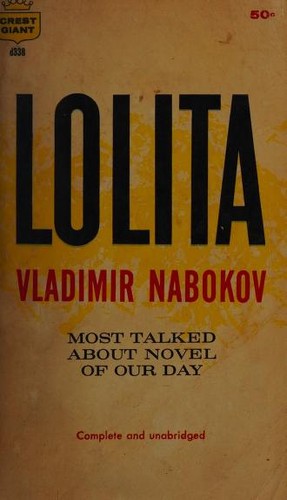
Lolita, light of my life, fire of my loins. My sin, my soul… You can always count on a murderer for a fancy prose style.
Nabokov had a lot of trouble getting anyone to publish a story about a grown man falling in love with a 12 year old. After multiple bans and scandals, Lolita caught fire in America, and is now considered perhaps his greatest work (altho you still cop some dodgy glances reading it on the train).
The great central tension is between Humbert Humbert the monster and HH the sensitive and sympathetic aesthete. How reliable is HH as a narrator? Is he deluding himself? Did he successfully hoodwink certain critics? Is he truly capable of love and redemption, or is everything staged for effect?
On the murder mystery: is HH really any better than his nemesis Clare Quilty? What’s the significance of trying to kill one’s shadow? Did we catch Quilty’s lurking presence throughout these pages? Does he even exist at all?
What’s the message of this story? On didactic vs aesthetic fiction, whether this book is meant to be moralising, Nabokov’s instructions to the reader, and an overall vibe check on how we feel about his tricks after reading both Pale Fire and Lolita.
life imitates art
Rich: Welcome aboard the Lolita Express, and thank you for choosing to fly with Do You Even Lit Air. This is your captain speaking, Captain Rich, and I’m joined on the flight deck today by my fabulous crew, Benny and Cam. Our destination today is Vladimir Nabokov’s 1955 novel Lolita. It’s a beautiful book, but it’s also a very disturbing book and quite a controversial book. We are expecting some turbulence today, so please fasten your seat belts, sit back and enjoy the flight.
Cam: I low-key got Lolita’d on the train, eh?
Rich: Oh no.
Cam: I know. Crazy, eh? Don’t read this book in public. Trigger warning. Yeah, we haven’t done trigger warnings for this episode.
Rich: What do you mean you got Lolita’d? Do you mean you got attracted to a pubescent girl?
Cam: No, Jesus Christ. Well, I did momentarily have a thought of, like, I’m reading the book on the train, which I was always a little nervous about anyway.
Benny: You raise your eyes and make eye contact with the girl across the aisle.
Cam: When I go into the office, there are a bunch of school kids who get on a few stops around me, and this girl next to me — I don’t know how old she would have been — she’s just like, “what are you reading? I just watched that movie.” I was like, oh god. So I take the headphones off and I was just like, oh, this is — and then she’s like, why are you reading this? And I was just like, I was just in a book club with friends, I was yeeting out of there.
Benny: It’s a book club with friends — that sounds even worse, dude.
Rich: Yeah, it’s a euphemism for a pedophile ring.
Benny: Yeah, me and the boys are reading Lolita.
Rich: We exchange interesting material amongst each other.
Cam: Just see our collection. Yeah, so I think it was fine, you know.
Benny: I yeeted out of there.
Cam: I was like, Jesus Christ, yeah.
Rich: She said she’d seen the movie.
Cam: I know. She’d been a little bit Lolita-like as well — she seemed like she was trying to be flirty, but I don’t know. I assume she was like 15 or something. So I was just, you know, looking across, you’ve got the old woman next to me, so we’re keeping this above level, right? Not sure if that one should make the podcast. It was a weird experience.
Benny: That would exactly happen to you, though, out of all of us.
Cam: Well, I’ve got the Humbert Humbert charm, I suppose. No, I think it was about the book.
Rich: Famously eloquent and charming.
Cam: I talk like a book. I think that’s what she said at one point. I talk like I’m from a novel.
Benny: You should have just rattled off the first line of the novel. “Light of my life, fire of my loins.”
Cam: Dolores in slacks. Yeah, no, I was immediately locked in. I was like, this could get inappropriate real quick. But you guys — Richard, you read the Kindle, right? This is the main reason to read on Kindle, reading Lolita. I mean, it has always been on my shelf.
Benny: Also, I mean, it’s such a famous book now, it doesn’t feel taboo in that sense.
Cam: Yeah, it’s a classic.
Benny: It would be weirder if not many people had heard of it or read it and then people are asking you what the book’s about and you have to explain it. But yeah, I’m not sure if it’s a red flag if someone has Lolita on their shelf.
the two faces of Humbert Humbert
Rich: So before we get too much further, we might as well get straight into the central tension of this book, which is, we’re reading the memoir or the confessional of one Humbert Humbert, who’s a professor of French literature. He’s extremely erudite, very witty, very charming, and also very self-aware and self-reflective. And he’s working in America where he encounters one Dolores Haze, aka Lolita, a 12-year-old nymphet who he grooms and then adopts as his quote-unquote daughter, and then essentially kidnaps and takes on a two-year road trip around America. The tension is evident right from the start that he’s basically a monster — he’s a rapist.
Cam: And a ripist.
Rich: Yeah, I mean, we can talk more about the moral ambiguity of it a bit later, but we can’t help but also feel some kind of sympathy and kinship for him, in the sense that he’s in many ways a brilliant person. He’s a very sensitive aesthete, and he gets quite a long way towards convincing us and himself that he has taken this relationship beyond the petty moral conventions of the day, into the realm of the lyrical and the transcendent and into the realm of very high-minded passion. You get that right from the outset — the very first lines, he essentially confesses to being a pedo, and then in the first two pages he cops to being a murderer, although we don’t know who he has murdered. So what did you fellas think about the book? How did that tension strike you? What was the emotional response is what I’m most curious about.
Benny: Yeah, I loved the book. I thought it was basically an intoxicating read. We had read one other Nabokov book before this, Pale Fire, and I kind of forgot how amazing his prose is. It’s so easy to just get sucked into it. But then what differentiates Lolita from something like Pale Fire is the fact that you’re in this moral morass the whole time. So his erudition and the sheer delight of his language on the page is playing with you, because you know that this character who’s narrating the book — while coming across as so delightful that you can’t help but cheer for him — is engaged in this monstrous behavior. And so you’re sort of wrestling with that from page one. Like Rich says, he admits right away what he is and what he’s doing. And right away, there is a part of you that can’t help but cheer for him.
And I mean, we should say so much so that many critics of the book make the case, after having gone through the entire book, that we shouldn’t judge him so harshly. So there is an interpretation of the book — and I’m sure we’ll get more into this — where Lolita has taken advantage of him in some sense. The narration, even though the details of the case are put there on the page for you, is so compelling that many people can’t help but take his side. He’s not, on the face of it, hiding anything from you. So that was also sort of my feeling as I was going through it. Now that I’ve gotten to the end I have a different read of it, but I still found it — yeah, I’ve read it twice.
Cam: You’ve read it twice, right? It does feel like a book that’s meant to be re-read.
Benny: Yeah, twice.
Rich: Big time, yeah.
Cam: I found it uncomfortable a lot of the time, in a key sense for obvious reasons, but I also had that feeling of being taken in by him at times. You’re sort of rooting for him, I suppose. Everyone says that in all their reviews, but that’s part of the genius of the book, because they kind of turn you into a groomer or at least supporting one, while being disgusted. And he’s likable. He’s funny, he’s smart, he’s clever. I’m not sure if I’m as big a fan of the quote fancy prose as Humbert says murderers are prone to do, which is kind of Nabokovian prose, as Benny — and maybe you, Rich — are.
Rich: Yeah, I loved it. I was like, oh, we’re reading a proper writer again. It felt like the first time in a while that we’ve read some actually fantastic writing.
Cam: I think part of it’s just a preference thing. And sometimes I feel, when you’re getting into the style versus substance thing — and that’s a false dichotomy as well — not to say that there’s no substance to this book, but you could imagine it gets to a place where it’s just pure style, which is perhaps defensible. And that’s a separate question of whether you like the style.
Rich: He’s also got a bit of an out, that it’s almost like not his style, it’s Humbert’s style, right? And that has to do with how we interpret him — it is almost like a little bit over the top.
Cam: Yeah, no, that’s definitely part of it. But it is interesting to think how much of Nabokov is coming in here, because he’s not Humbert Humbert, but we do know he’s obsessed with puns himself, and things like that. So he does potentially seep through. We know he’s anti-Freud, and Humbert’s anti-Freud. Things like that.
Benny: We should remind people that English was not — I mean, maybe it’s obvious in the name, but English was not Nabokov’s first language, and the fact that he has such facility with English genuinely blows my mind. We probably said the same thing with Pale Fire, but it’s shocking to me how good of a writer he is given that it’s not his native language.
Cam: It’s not quite — I think he grew up speaking English and had a native tutor as well. It wasn’t his first language, but I think Joseph Conrad —
Rich: He also wrote in Russian for the first half of his career and then switched to English. So it’s at least not his preferred writing language.
Cam: He’s trilingual, I think.
Benny: And he lived in Russia for, you know, 30 years or whatever.
Cam: Yeah, your point stands. But it’s not — I think, like, Conrad, author of Heart of Darkness, he’s Polish, he came and learned English later and then wrote in English, and it’s a bit clunkier. Your point still stands. He pulls off an erudite English gentleman as Humbert Humbert very convincingly, which is pretty astounding.
Rich: Well, I think we never learn where Humbert Humbert is from, except that he’s European, right? And people variously think that he might be some kind of a Jew.
Cam: He grew up in France.
Benny: I mean, he must speak French at least, right? Like, so either was born there.
Cam: He grew up in France for a moment, in the Riviera. I thought he was British and then moves to America. But yeah, like Vladimir Nabokov, he’s an immigrant, an adult immigrant to America. He’s not Russian, though.
Rich: So the clever thing that Nabokov does to set this up and create this tension is that he’s not out-and-out a serial-killer Halloween-style pedo. It’s more subtle than that, in that Lolita is already sexually active, and she allegedly — well, she has a crush on him to begin with, and then according to Humbert Humbert she comes on to him and actually consummates the crush. She’s the first one to make a move, when he has been trying to keep things, if not chaste exactly, then at least removed from her, so that he doesn’t sully her.
Cam: He’s got a moral sense — and not to say it’s the right moral sense — but he, as you say, is trying in some sense to protect her. And he’s unreliable, and he’s not necessarily doing that.
Rich: Well, at first he is; later on, absolutely not.
Cam: Yes, my point was his first moral sense is still bad, but in this warped way he is trying — if we are to believe him at the start, he is trying to preserve her somewhat. I mean, he’s not preserving her, and —
Rich: Well, yeah. It just makes it a better portrait than it would be if it was a cartoon villain. And so he is a rapist in the sense of statutory rape, and maybe in various other senses, but not necessarily in the most violent sense that people think of when you use that term.
Cam: Yeah, and one example: he originally — and this shows how planned it all is — he originally wants to use sleeping pills and do it while she’s sleeping, and his reason for doing that is to keep her not aware of it. Which, obviously, if you drug someone and have sex with them while they’re asleep, that’s obviously also rape. But there is a logic there as well — not to defend it, but that is a different thing than not caring about them being aware of it, right?
Rich: The way that the story unfolds is, we get pages and pages of purple prose about his beautiful nymphet, and how passionate he feels about her and how deeply in love he is with her, and then every now and again you just get this occasional sentence that’s like a punch in the gut that reminds you of what is actually happening and how sickening it is — which would be, you know, her sobs in the night, every night, every night the moment I feigned sleep. You’d just sort of periodically forgotten about the reality of it.
is HH an unreliable narrator?
So here’s where we can introduce whether or not he’s an unreliable narrator. I actually don’t think he is in this. I don’t think he tells lies, I think —
Cam: I don’t think he’s — hot take incoming — he’s completely reliable.
Rich: Humbert Humbert did nothing wrong. I mean, I guess it depends what you mean by reliable.
Cam: This is the apologia section. Whether he’s lying or self-deluded.
Rich: I don’t think he’s lying, because if he’s lying he wouldn’t speak so plainly about some of the horrific things. I think he’s just very selective about emphasizing what happens. So you get so much writing about his passionate trysts and the way that it makes him feel, and you get so little of the harsh reality of her sobbing in the night. That’s just a little aside. It’s not like a constant refrain, which you might think it would be if it was someone who truly loves and cares about someone, right? You just occasionally get reminded — or there’ll be a thing about how he has to pay her to do some kind of sexual act, and then as soon as the sexual act is over he steals the money back straight from her, or something like that. And you’re like, oh yeah, this guy is just kidnapping and extorting a child. It’s absolutely repellent. And you get this roller coaster of emotions that goes with that. I wasn’t disgusted the whole way through. The first bit was a bit icky feeling because it’s the most sensuous, I think.
Cam: Getting used to it.
Benny: Getting used to this. Just had to normalize it a bit and then I was fine.
Cam: Yeah, no, it gets more into it — in the second half, his bad acts, and it doesn’t shy away from them, really. The first half is him dealing with somewhat looking from afar. It starts getting into some really bad stuff as well. But I like the way you put it, though — you do kind of forget about it because of the writing style, because he’s charming. And then, yeah, there are these moments where you’re like, holy shit. If you just plainly describe what’s happening, it is kind of sickening. I don’t get angry too much, but thinking about this sort of shit…
Rich: Reading Nabokov on the train and shaking my head to make sure that people know I don’t agree with it.
Benny: Spitting on the book, throwing it out, stomping on it. You disgusting pervert.
Cam: Throwing it on the ground. Just sighing.
Benny: Well, maybe sighing is the wrong word, but —
Rich: Yeah, don’t make any groaning noises. Could be misinterpreted.
Cam: No groaning. But, okay, so is Humbert an unreliable narrator? This is a question of, is he lying to us versus is he deluded? He’s definitely — well, I think this is an open question of how aware he is of how bad he’s doing, because near the end of it, he seems like he is aware and potentially repentant, which has a question mark around it. I don’t think he’s lying about his feelings, his passionate feelings towards it. I think those are real. Now there’s this open question of, what are those? Is there love? Can you have love in principle? Does Humbert actually have love? Yeah, I don’t think he’s lying about that.
But there are hints, of course, that — he doesn’t actually talk around the details of the first sexual encounter. He leaves that out. He goes, we’ll leave that out, not for the audience. And I suppose that could be for two reasons. One, it’s private for him — sex is private for a lot of people. But two, he kind of knows that it was a bit worse than what he’s —
Rich: And three, that Nabokov wants to get this book published somewhere.
Cam: Yeah, the meta take. But there’s other moments — when Lolita’s in the hospital and the nurse doesn’t really trust him, and he’s acting like he’s not doing anything wrong. Other people are noticing something’s up. Lolita, of course, is crying. One of the most heartbreaking things was the closing of part one, where he hears her crying — she’s in the next room — she comes in, and he just goes, “she had nowhere else to go.” And that’s when it hits you. Like, Jesus, what a poor, poor girl. She’s lost her parents. She doesn’t have anyone else and is kind of trapped.
Benny: Yeah. Do we want to describe maybe what happened with her mom and stuff, in terms of just plot summary very briefly, just so people aren’t lost?
Rich: Yeah, I can do a quick summary. So Humbert arrives in this town and ends up boarding with Lolita and her mother Charlotte, and he falls for Lolita and starts dreaming up ways that he could potentially get rid of Charlotte to get her out of the scene, including one attempted murder which he averts at the last moment — luckily, because he would have been caught. And then later on, Charlotte finds his notebook where he’s been writing about all of the disgusting feelings that he’s been having, and she goes nuts, basically. She runs out into traffic and gets hit by a car and gets killed. So then Humbert Humbert, by this incredible stroke of luck, just sort of uplifts Dolores and manages to trick people into thinking that he is her true father, her biological father from a romp 10 or 12 years ago. And then before people can ask too many questions, he just takes her in the family car and goes on a road trip around rural America. Which is actually a good example of how little regard Humbert has for —
Cam: And the leaders at camp during this — she doesn’t see it happen. He calls up camp and says her mother’s sick, and goes and picks her up, and doesn’t tell her that her mother’s dead until after.
Rich: — anyone else’s feelings, or especially for Lolita’s feelings. Because her mother’s dead, and yes, she had a fractious relationship with her mother — they didn’t get on, as obviously kids of that age don’t always get along with their parents very well — but we get nothing about Lolita’s reaction to finding out that her mother is dead, or her grieving process or anything. It’s just assumed as if she’s fine, or she’s happy with it. There’s nothing.
Cam: Yeah, so Humbert’s a narcissist, right? Is, I think, probably one obvious reading.
Benny: Yeah, I actually want to make the case that he’s an unreliable narrator, both in a minor and in a major way later on when it gets to all the stuff around Claire Quilty and whatnot. But just in terms of being very selective with the information he gives the reader, and the gloss he puts on everything. So it seems kind of unbelievable that, like, the first time he has any sort of sexual encounter with Lolita, that she doesn’t notice. This is when they’re sitting on the couch and she’s sitting on his lap in some way, right, and he sort of — this is the first time they’re very close together — and he rearranges her in such a way that he can basically bring himself to orgasm in some unspecified way with her sitting there.
Cam: Yeah, she’s bouncing on his knees singing, and he’s relieving himself. And then he’s like, thank God she didn’t notice. But there are hints that she did notice.
Benny: He does say she jumped off right after that, basically.
Cam: And her hairs were sticking up or something. There was some physical thing.
Benny: Yeah. Then there’s being seduced by Lolita the first night when they’re alone in the hotel room after she’s back from camp, right? And he makes it like, she totally came on to me, I basically had no choice, she had learned how to have sex at camp with this older boy and now she wanted to try the same thing here. I find that somewhat hard to believe. And like you said, Cam, he’s leaving out the actual details there, where with other details he’s bringing them sharply into focus. So you have to ask yourself, why are those details being left out? Then there’s also Lolita’s language throughout the whole novel which — you know, it’s obviously written from his perspective, but she speaks like an adult. She’s incredibly eloquent. She’s very witty.
Cam: No, no, I don’t — partly, but there’s definitely some kid-speak in there, slang and stuff. There’s like, “what are you doing, kid?” I would have written them down.
Benny: I don’t know — when she reacts to situations, it’s obviously with a pun or some wit or something that I don’t associate with a 12-year-old girl, basically.
Cam: Sure. No, I think that’s probably true. But there are definitely pockets of teenage, like 50s teenage speak.
Benny: He comments on her obsession with some things, yeah.
Cam: Speaks like a Zoomer sometimes.
Benny: Yeah, I didn’t find that believable for a 12-year-old, and I think part of the play there is to make her seem more wily and, you know, sort of a seductress. He puts that image of her in the reader’s head — which, as I said earlier, lots of critics have bought that image of Lolita. So he sort of does that successfully. But let’s also remember he’s rewriting. This is first-person narration from his point of view, and he’s rewriting the story because his journal was burnt in a fire. So he admits that he’s rewriting this from memory, and he claims to have a photographic memory. But then he also claims, sometimes I can’t quite remember the order in which this happened, or I may have messed up some details here. So there’s a bit of inconsistency with respect to his narration, which I find a little suspect. So that’s my thesis: he’s putting a severe spin on this thing. But then I also, as we’ll get into later, I think he’s basically lying about major events later in the book.
Cam: The earlier spin as well was this question of how aware he is of this, or is he just in complete cognitive dissonance? I mean, with the whole idea of, did she seduce him, right? Which I think there was some critic in the 50s, 60s who kind of said that that’s the main frame. And of course everyone now is like, no way. My take is maybe they’re both partly true. This is not to blame Dolores at all — and I’m not even sure about it — but, in general, can a young person try and seduce an older person? That just feels obviously possible, that that sort of thing can happen, right?
Rich: He is a handsome guy. He looks like a movie star, who she has pinups of.
Cam: Yeah, and she probably crushes on him.
Rich: And he’s a sophisticated European gentleman, and it’s not inconceivable at all that she has a girlish crush on him. I think that’s normal for adolescent girls. But of course what’s not normal is the way a person in a position of power responds to those overtures.
Cam: Yeah, send notes to your teacher and stuff like that. So it doesn’t excuse — one, it doesn’t blame Dolores, and two, it doesn’t excuse Humbert, but there is probably some truth there, and some truth that it might make some men uncomfortable, like, this girl was flirty and stuff. It doesn’t make Humbert — yeah, my unreliable narration of my train journey.
Rich: It can even happen on the train sometimes.
Cam: So I think there is probably some truth there. And then he’s being unreliable in terms of — the problem is, he kind of comes across as helpless. He’s helplessly in love and he’s helplessly lusting for her, and that is a real condition of people. I mean at one point I think he says it’s a rate which felt a bit high —
Rich: He says what, sorry?
Cam: He says the rate of — I’m not sure if pedophilia is the right word, but, you know, people interested in nymphets.
Trying to distinguish between love and lust
Rich: Yeah, I want to talk about whether or not he actually loved her. Obviously he could be capable of love — just because you’re a pedophile doesn’t presumably mean that you can’t experience romantic love — but I think the textual evidence is that he’s not in love with her in the way that we would talk about love, and that he’s in lust with her, or that he is straightforwardly objectifying her. Because all of his descriptions are about her physical form, almost exclusively, or about the aesthetic of childhood and adolescence — certain imagery that he finds very erotic about a sock pulled up or riding a bicycle in a certain way or something like that. He waxes lyrical about all that stuff. But then whenever we get any glimpse of Lolita the young child or the young teenager, he mocks her and trivializes her. He thinks she’s a brat and her —
Cam: He finds her annoying sometimes.
Rich: — interests are trivial. He makes fun of the fact that she likes reading the gossip magazines.
Cam: Philistine.
Rich: She only reads the cartoon section of the newspaper. He makes fun of the slang that she uses. He finds her a gross child, basically. And how can you love — it doesn’t make sense to say that you love someone if all of the defining attributes that make them that person, you reject, and what you really care about is their surface attributes which they didn’t choose, like basically their age and their appearance and maybe their mannerisms. In this case, those are facets of a person that you can love. I think he’s in lust with her, not in love with her, at least at the beginning of the book. I’ve never been in love with a 12-year-old —
Cam: You’ve just never been in love, Rich. You don’t see it.
Rich: I mean, you have crushes, I guess. Crushes are pretty flimsy, right?
Benny: Not even when you were 12? Dude, you would have stunted love life. Come on.
Cam: Did you have an Annabel Lee?
Rich: They’re not based on deep understandings of the character of another person. They’re usually —
Cam: Well, it is another interesting question: can 12-year-olds be in love with each other? Because, you know, adults will be like, oh, come on, you’ll get over it. Humbert never got over it. Which, for a better context: he’s got these hang-ups about his 12-year-old love or crush, Annabel Lee — who is a reference to Edgar Allan Poe. Poe called Annabel Lee about his teenage love who died.
Benny: Yeah, just a total tangent about that: I think we’re supposed to take from the book that it’s because of that early love that he hasn’t gotten over this developmental stage basically, and he’s stuck being attracted to nymphets, when I think in fact pedophilia is genetic.
Rich: Really?
Benny: Mostly. Almost all of it. I don’t think it’s like a kink in the sense that you don’t just do.
Rich: But other paraphilias are to do with childhood exposure to things, right? It would be weird if pedophilia wasn’t at least partly due to some developmental hang-up, isn’t it? I don’t know.
Benny: Wait, are they?
Rich: I don’t know. I thought that you have a foot fetish because you had some erotic experience with a foot, or that imprinted upon your —
Cam: She just has nice feet.
Benny: I don’t view this as a fetish. I guess that was my point, right? Contrasting it to other fetishes seems to miss the mark. I think it’s a bit of a category error.
Cam: Anyway, regardless of whether it’s plausible or not, it is set up to be like, he’s got these hang-ups about Annabel Lee, and in some sense Dolores — i.e. Lolita — is finally this person who’s replaced Annabel Lee. He’s finally fallen in love again. Quote love. And later in the story, he’s even kind of blending them together, playing with the word name of Annabel Lee, Lolita. And just to invoke Edgar Allan Poe, who wrote that story — he married his teenage cousin. And there’s other literary figures who have done this in the past, going way back, and Humbert cites them. And that’s part of his defense, right? He’s like, well, this is like Dante’s love with — I forget who. And as anyone knows who studied history, this was far more common. In one sense, he defends it because of that — he goes, it’s unfair now that we have these rules. And in another sense, he’s just invoking literary allusions, or creating art. There’s this thing of, that seems to be one of his objectives for the end as well, making this story immortal or artistic, and making it seem less bad what he’s doing if he can turn it into art or something.
Rich: Yeah, he says that making art is not a secondary sexual characteristic — it’s the other way around, sex comes from the wellspring of art, or something like that. So he kind of inverts it, which is kind of what you’re saying, at least that’s his justification for it, and invoking all the child bride relationships throughout time to put himself in that tradition of great artists. But before we move on, I just want to finish my thought about why I don’t believe that he truly loves her, even if he thinks he does, which is that if you love someone, you care about their welfare, and you might have to do something that involves a sacrifice to your own pleasure or your own direction in life, or even your own life. If you love someone enough, you sacrifice your own interests for someone else, is almost definitionally what true love is, I think, because you’re willing to give and give and give for someone. And this story is marked by the opposite — he just takes and takes and takes from someone, and he doesn’t care about her interests at all.
Cam: Until the end, potentially. But, yeah.
Rich: Maybe until the end, but we’ll get there later. So he fools himself by buying her trinkets and candies and necklaces and magazines and so on. That’s his idea of giving her a good life, and taking her on this fun road trip where she can have an ice cream sundae whenever she wants. But in actual fact he’s doing terrible things to her and potentially doing massive damage to her psyche and robbing her of her childhood and her innocence. And he knows all of that, and I don’t believe that you can love someone and do that to someone. You could think that you love them, but I don’t think that’s consistent with it at all. It’s more consistent with his fetishization and objectification of a person as an object, I think — an object, a toy, that has an expiry date, and you use all this other language to dress it all up and make it fancy and make it sound nice for both the peers who are judging you and reading your memoir, and maybe for yourself to help resolve the dissonance and help make yourself feel better about your own actions.
Cam: Yeah, I think that’s right. And there is this question of, can a narcissist, a true narcissist, maybe ever find love, because they struggle to do what’s required?
Benny: Or maybe the converse is, everyone’s a narcissist until they find love. That’s the thing that makes you actually give up the selfish pursuits.
Cam: Well, it is interesting sometimes to think, what is love, right? This is famous — as we read Chekhov recently — about love. He just said it’s mysterious and can’t be defined and should trump reason. So, if we grant that Humbert is in love — this is when it seems to be a criticism of Chekhovian love, of love trumping everything else. Because, you know, Chekhov had this case where you’re in a relationship which has some goods and some bads, but you love them and it’s passionate, and don’t take the person who’s got the good job and who’s safe, don’t take the person you have passionate love with. But if it’s bad enough — what happens if that person’s beating you in abuse? Which, for Pelageya, most people say, well, okay, probably one, is that love? But two, if it is, you shouldn’t be with them. And certainly in this case, here, reason and rationality, if you hopefully have it, of that moral sense, should trump any feelings of love. But I do think Rich is right that it’s not love, and it’s kind of a delusion to convince himself it is. Well, yeah — certainly not in love.
Rich: Or even if it were, it’s unidirectional, right? She does not love him. She very quickly gets over her crush on him and openly hates and detests and resents him for almost all of the book, almost all of the time that he’s holding her in captivity. So there’s no way that you can call that love between two people.
Cam: But, okay — for the listeners as well, I mean, the reason you kind of think this could be a love story is just because of the way he talks about her, and I think Richard makes a good point where it’s not really her behavior or mind that he talks about, but he waxes lyrical about her in a way that, if it was non-quote-problematic, you know, it would be like, wow, this is an amazing love poem.
Benny: Until he doesn’t let her see other guys or take part in any plays.
Cam: Well, but yeah. I mean, it’s interesting, sorry, you go.
Benny: No, I’m just saying, you clearly wouldn’t do that with someone who was an adult, right? And so this is just part of Rich’s point that he’s not treating her as —
Cam: Well, I mean, people do aspects of that, possessiveness and jealousy. So he’s extremely possessive and jealous.
Benny: Which is unhealthy, though, right? That’s the point.
Rich: I don’t think you can love someone and think that they have an expiry date at age 14. That doesn’t make any sense, right? That is an object that you’re using for your gratification. That’s a fantasy that you’re inhabiting.
Cam: Yeah. I mean, morality aside, that is kind of a fascinating tension, which I imagine Nabokov was drawn to. Again, morality aside, it’s just like, yeah, what are some of the things that fall out of this sort of relationship? Him really, really worried about when she goes away to camp and when she comes back, will she still be in the right age range? The feeling that time is ticking down, in and of itself, is kind of this interesting tension.
Sympathy for the pedo
Rich: Yeah, I forgot to even think about that. If you’d never thought it — I’m guessing you guys have probably already had the thought that a pedophile who doesn’t act on their impulses is actually a very sympathetic creature, in that, by genetics or by environmental influence, they didn’t do anything to have this fucked-up sexuality which they can’t exercise. And it’s a pretty horrible, unfortunate state to be in. But I don’t think you get that reaction from this book, because it just skips straight past — because, you know, he does act upon it and he does exercise it. But maybe there are moments where you’re like, oh man, that is crazy. Even if you were to fall in love, it would be with someone who not only you can’t consummate your love with, but has a finite lifespan before you’re going to find them unappealing again, or whatever.
Cam: On your first point though, that is the classic thing you, as a rationalist, kind of think: oh, you’re okay, it’s not their fault. I’ve kind of gone 180 on that a little bit. Maybe it’s like virtue ethics. Or maybe my view is, it’s good to just kind of not sympathize with them too much, in a gut reaction sense. And maybe you can defend that with consequentialist grounds, because — I mean, we don’t have to get into this too much.
Rich: I don’t think there’s any danger of people sympathizing with pedos too much, like —
Cam: Well, there could be, if the cultural norms change enough. As a Schelling fence — just like, nah, that’s yuck, that’s disgusting, people should be ashamed of that. I think is a pretty strong Schelling fence. Anyway, let’s not get too distracted by that.
Rich: Yeah, no, that is right actually. Like throughout human history people have been sexually attracted to people who have developed secondary sexual characteristics, which happens at puberty, right? So today, we are conditioned to find it gross to be attracted to a 13-year-old or a 14-year-old or whatever.
Cam: And we probably develop earlier now as well, because of nutrition, right?
Rich: Biologically speaking, that’s not weird at all. And it is good that we maintain these social norms that say, oh, that’s yuck, and then it just causes you to immediately think that it is gross, and hopefully not act upon it. There’s actually a really good social norm to uphold, which is probably running counter to nature. So yeah, that is a good point. Maybe we should always actually express disgust or stigma, or whatever you want to call it — just assuming that we think that’s a good norm to maintain, which almost everyone does apart from like French intellectuals and that one moment in the 60s.
Cam: The famous ones, right? Like Foucault and stuff.
the questionable reality of Clare Quilty
Benny: Alright, so can I try and convince you guys that Claire Quilty does not exist?
Rich: Oh yeah, let’s go.
Cam: Okay, but first let’s describe old Uncle Trap. Are you a cue? Are you a Quilty?
Benny: Yeah, sure. So just leading up from where Rich left off, maybe I’ll just do a brief summary, unless Rich, you want to do it — I don’t want to trample on your territory.
Rich: No, no, go for it.
Benny: So Lolita and Humbert are driving around the country, and then they end up settling in this town called Beardsley. He wants to enroll her in school so she gets some sort of education, but it’s an odd school for a variety of reasons, and he has some funny conversations with some of the administrators there. But it ends up not working out and they leave again. Eventually Lolita gets sick and Humbert takes her into a hospital, and he leaves for the night. When he goes to pick her up in the morning, he finds out she’s not there, and it turns out she’s been discharged by her uncle. But Humbert knows she’s got no living family left, so who was this guy? It turns out it’s this fella named Claire Quilty, and she ran away willingly with him. And then we’re introduced to the whole saga that is Claire Quilty, and we realize that Quilty has been following them for most of the novel and has been in the background for most of the time, and they’ve even encountered him a few times before.
So, for instance, at the very beginning of the book, when Humbert is being introduced, Claire Quilty comes up in records of playwrights that the doctor who does the initial prologue to the book is enumerating. Quilty Clare is an American dramatist, born in Ocean City, educated at Columbia, has written some plays and stuff, including The Little Nymph, which was one of his plays. Quilty is also the name of the dentist who lived next door to Humbert and Charlotte when Charlotte was still alive. And he’s almost the dentist that Humbert got sent to.
Cam: That’s a different Quilty. So that’s Dr. Ivor Quilty.
Rich: It says uncle.
Benny: Yeah, that’s right.
Cam: It turns out to be his uncle. Yeah. But not called Claire Quilty.
Benny: Right. But Quilty keeps popping up at the Enchanted Hunters Hotel, which is — I believe the first hotel that Lolita and Humbert were at when they first have sex. Lolita spots a man sitting by himself that she thinks looks exactly like the dentist Quilty. And then we’re led to believe later that this was actually perhaps Claire Quilty. Then one of the plays that Lolita takes part in at this Beardsley school is also called The Enchanted Hunters, and the playwright was Claire Quilty. And so we realize — and there’s also some allusions in the rest of the book, like there’s certain cars following them at some point, and Lolita’s attention was distracted by some good-looking bearded man, stuff like that. I think we’re supposed to assume, after the fact, going back and rereading that, that that was Claire Quilty all along. So Quilty has been following them, and it turns out Lolita was in love with him and ran away. And Humbert is —
Rich: Wait, and you think he doesn’t exist?
Benny: Yeah, so I think we can build up to it, though. I think first maybe we should just give the details.
Rich: Okay.
Cam: So as Benny said, there’s these clues for the reader of who Quilty is, but you’re not really meant to notice it.
Rich: Well, did you guys notice? I noticed literally none of it.
Cam: Fuck no.
Benny: No.
Cam: I was confused about that.
Rich: I thought it was a cop who was following them, or, you know, yeah. And when she disappeared from the hospital, I had no idea who she’d gone with, put it that way, or where she’d gone. And I’ve read the book before.
Cam: So that’s an example of non-astute reading. On your second read.
Rich: I’ve read it so long ago. I’d read it like 10-plus years ago.
Cam: When you were 12.
Rich: Yeah. Really awakened something in me. For literature, for literature.
Cam: Just love the language. So we first get introduced to this mysterious man at the first hotel they stay at, the Enchanted Hunter, where they first have sex. He goes downstairs and there’s this mysterious man sitting in the shadows — that’s why Humbert doesn’t recognize him — and this man kind of seems like he knows. This reminds me, Nabokov did multi-syllabic rhyming. I was like, oh my god. So he gets down, and this mysterious man asks, “oh, how come you’re here with your daughter, who you’re here with?” And he’s like, my daughter. And he’s like, “you lie, she’s not.” And he’s like, what? He’s like, “July is hot.” And I immediately start trying to riff off rhymes of that. Michael Scott piping hot writer’s block. July it’s hot.
Rich: Let’s hear them. Oh, that’s pretty good.
Benny: That was pretty good.
Rich: Only the best, only the best rappers can do that. Remember, the careful listener will remember.
Cam: Nabokov and Eminem, not too many in between. So, you get this moment, there’s something up with this guy, this mysterious guy who seems to know. But was that in Humbert’s imagination? Was he mishearing that, and he’s getting nervous and he’s projecting? And then later on, he’s getting followed by this mysterious man, which he says looks like his uncle. Uncle Trap. Nominal determinism there. But there’s moments where you’re questioning, maybe Humbert is losing grip of reality. There’s a moment where he vomits because he sees what he thinks is Lolita showing off to what looks like Uncle Trap — because Uncle Trap keeps popping up. Humbert goes away for a bit and comes back, and Lolita’s talking to this mysterious man, and then she always denies it. But he vomits, and it says he looks at his vomit, it’s colored — it’s colors that he doesn’t remember eating. And he even questions it himself. You’re like, okay, is he imagining this stuff? He’s getting stalked by someone because he’s just so torn up inside by the evil he’s doing.
And there’s all these clues for Humbert around — he starts getting a bit obsessed for trying to find out who this is, and how Claire Quilty, i.e. Uncle Trap, is staying in hotels, and he’s changing cars, and he’s like following those clues, and he’s noticing the names he uses are literary allusions, and he’s like, only I could figure this out, right? Which feels a little bit —
Rich: Yeah, I thought he was going mad throughout all of this.
Cam: Impossible, yeah. And there’s this one obvious reading that Claire Quilty is his double, or his shadow. The first two times he meets Quilty is literally in shadows. Quilty wears the same robe as he does in the end, and he has these sick perversions that he does, and he loves literary erudition and puns and stuff. And that’s a common trope in fiction that’s probably been done a million times.
Rich: Well, that didn’t occur to me at all. But Benny, do you want to — yeah. How do you want to build up to it?
Benny: So I was going to say, I think perhaps one reason that the critics I mentioned earlier — who end up falling on the side of relative innocence for Humbert — one big reason they do that is because, I think, of Claire Quilty. We’re basically introduced to this character who is more successful than Humbert, equally as skilled and interesting, but is less repentant about his behavior. Humbert is not repentant with respect to his actions, but he does seem to — he acknowledges throughout the book that what he’s doing is wrong, right? And I think he’s trying to give off this sense that he does care about Lolita. You can either buy that or not. But I think by the end of the book — and we should also say, the book is sort of written as a court case, right? He’s always appealing to ladies and gentlemen of the jury. So the question is, do you find him guilty by the end of the book? And I think those that don’t are sort of persuaded by the fact that Claire Quilty — whose name, I’ll say, seems very close to “clearly guilty” — was the one who was actually guilty.
Cam: Nice catch.
Benny: This is the totally non-repentant —
Rich: Oh, now Benny’s doing the double Rame.
Cam: Slow that down. But really quickly, just in terms of: he’s talking to the jury. He’s trying to defend himself against murder. He’s not explicitly trying to defend himself. In the end, he even says, if I could do my sentence, I’d go away for 30 years for rape, but not for murder. The murder was just — which, you know, I imagine a lot of people, including me, think, yeah, like, killing — sorry, spoiler. Sorry, go back, go back.
Benny: Anyway — Claire Quilty, aka clearly guilty. And Lolita actually is in love with him; she runs away with him from the hospital willingly. And so I think you’re supposed to, in some sense, feel bad — or at least that’s what Humbert wants you to feel — feel bad for him by the end of this book, because this fucker stole Lolita away from him and is more successful in all these other ways, he’s a successful playwright, etc.
So we can either summarize the rest, so everyone’s on the same page, and then I can make the case that Claire Quilty doesn’t exist; or I can dive right into that case. It’s up to you guys. But maybe we should at least summarize the ending so that I don’t hit major spoilers.
Cam: Yeah, so as Benny said, Lolita disappears from the hospital, and we all sort of don’t know why. Humbert spends time trying to find her, and then also, maybe to try and move on, he ends up dating this older woman who’s still younger than him, and drinking alcohol — Rita —
Benny: Rita, I think.
Cam: Yeah, and still traveling the country. And then eventually he gets this letter from Lolita, years later, saying, “can you help with money? I’m married now.” And he tracks her down because of that, and he’s incensed, he’s angry, he thinks her new husband must be this person that stole her, Uncle Trap. But it turns out to be this quite simple guy. When they get there, she’s living a simple life, and he realizes it’s not Uncle Trap, i.e. Claire Quilty, and he sort of moves on from that.
But then he still wants to track down Claire Quilty, which he manages to do, because he suddenly has this moment of realization when he sees his dentist, who is Quilty’s uncle. And there’s this kind of cute moment in the book where I still got confused by it — he suddenly has this realization of who this person is, and he says, it’s the word “waterproof.” You’re potentially meant to go back and see, oh, this is when they were talking at the lake and someone mentioned waterproof. It’s when the Farlows — the neighbors, the friends — one of them mentioned some impropriety by the lake. I think she says “evil,” but, like, by Dr. — she doesn’t mention Quilty’s last name, but by his nephew.
Benny: Oh wow. Good catch.
Cam: I didn’t catch this, but I think it’s catchable in this kind of Nabokov chess game that he sets out. But yeah, he still doesn’t tell you, but that’s how he figures it out. And then he tracks down Quilty’s address and goes and confronts him with this gun that he’s been carrying around this whole time. And as the readers, we know he’s going to murder someone, right? It’s kind of an inversion of the detective story. It’s not a whodunit, but he’s trying to figure out who got done. And you kind of question earlier on — was it Mrs. Haze? Could it potentially be Lolita? He calls her Carmen at times, in that famous opera — she’s a victim. But then it’s finally Claire Quilty. He goes and confronts him, and it’s somewhat like a parody, almost, of this kind of big showdown of good versus evil. And there’s question marks of, is this truly good versus evil? And it just goes to shit. One, Quilty is just not even giving Humbert what he wants. He can’t really remember her, and he just doesn’t seem to care. And then they try and fight, dropping the gun, and they’re kind of weak, and it’s just a mess. And he doesn’t die originally, and eventually he kills him, but it’s all a little bit anticlimactic, which seems to be somewhat of a parody of these things, but also somewhat of a commentary. There was one line saying when he left he had Quilty’s blood all over him, or something like that — I can’t remember the exact phrasing — but he hasn’t removed all this, it’s still kind of with him. But he manages to kill him, and then he drives off. It is this kind of funny letdown. Well, Quilty letdown.
Benny: Yeah, so — unfortunately this thesis does not originate with me. There’s this fantastic essay called “The Questionable Reality of Claire Quilty” by Suzy Kassar, and I ran across this essay this morning because I was confused about Claire Quilty as a character and wanted to see if there were any hot takes out there. And indeed there were some hot takes. She presented this thesis and now I’m fully on board with it. I think it’s awesome, and I think she’s got some pretty rock-solid evidence. The evidence begins by looking at dates. These dates, I think, come from John Ray Jr.’s introduction to the whole situation. So the dates are as follows. Humbert dies in legal captivity on November 16th, 1952. He was arrested for the murder, supposedly, on September 25th, 1952. And supposedly received the letter from Lolita on September 22nd, 1952. Okay, so September 22nd, receives the letter from Lolita; arrested on September 25th; dies in legal captivity November 16th. First thing to focus on: there’s three days between receiving the letter and being arrested for the murder. I think this implies that he has no final encounter with Lolita, unless he went to see her absolutely immediately. There was just not enough time for any of this to happen. There was only three days, right?
Rich: But why wouldn’t there be enough time? Surely he just gets in his car and goes straight to where she lives.
Benny: Oh, the other thing was — sorry, he says he took 56 days to write Lolita, and there’s precisely 56 days between September 22nd and November 16th. So he had to start —
Cam: What day was that? 56th date — well, the date was November 16th?
Benny: November 16th when he dies. And he received the letter on September 22nd. So I think there’s basically not enough time for him to have this final encounter, well — I mean, he’s already sat down to write the book.
Cam: I actually did see this pop up. I saw your friend Brian Boyd, preeminent Nabokov scholar, wondered if those dates were mistypes by Nabokov, who’s apparently sloppy with dates — which seems very non-Nabokovian, right? But the argument against that is, when he translated it into Russian, they remained the same. I don’t know.
Rich: Yeah, I’m not there yet, I’m not there yet.
Benny: So the arguments are: if these dates are correct, Humbert began writing on the day he received Lolita’s letter and finished on the day he died, and he couldn’t have possibly gone to the final encounter with Lolita. He made up the entire visit with her for the sake of his writing, basically.
Rich: And the Claire Quilty death scene — he didn’t kill anyone, or —
Cam: He made it all up.
Benny: Yeah, he made it all up. And this would imply that he’s actually just in jail for his treatment of Lolita, basically, is the claim. But at least I think, if you take these dates seriously, you have to acknowledge then that this whole final repentance scene — because the whole point is, he repents after he visits Lolita and then is going to find Claire Quilty, right, this is when he has this big realization that he’s actually in love with her. He’s driving along these mountains and he realizes, oh, it’s like true love, I’m really in love with her. And this would imply that that actually didn’t take place, and that he’s saying all this to try and sway the people of the jury that he’s actually innocent. He’s trying to get himself off the hook by appealing now to true love. But I think, Rich, you made the case that this isn’t true love, and then I think this basically seals the case that he’s just making up the ending.
Cam: Well, just to flesh it out for the listeners as well — why he, why you could think maybe near the end he thinks he’s in true love, is — Benny’s saying this maybe didn’t happen, but in the book he goes to visit Lolita and she’s now 17 and she’s pregnant and she’s married, and Humbert just says, she’s no longer an infant but I realize I’m still in love with her, I want you to come away with me. She doesn’t want to, but then he says, that’s okay, I want to give you all my money, and he does, because he loves her, is why he says.
Rich: Yeah, he finally exhibits those traits that I said you need to exhibit to actually be in love, which is putting other people’s interests ahead of your own, and even being cuckolded in this case — or whatever you want to call it — being like, I hope you’re happy with your new man, and yeah, here’s my money, and I will very graciously not shoot you dead.
Cam: Yeah, that was the first moment I knew I was in love in my relationship, when we bought the cuckold chair for the bedroom. You know, just at the hotels — there’s always chairs in the corner.
Rich: Is that what that’s for?
Cam: It’s totally — well, I don’t know. It’s ruined. I heard that once and I just ruined the way I see the hotel chairs, because they’re always facing the bed.
Rich: Yeah, that’s so true.
Cam: They’re the cuck chairs.
Benny: Like a little lamp there, perfect.
Cam: Yeah, there’s a lamp and a cuck chair in every hotel.
Rich: The finer hotels have a little hole in the wardrobe that you can actually peek out through.
Cam: Yeah, or just the slits, right?
Benny: So, anyway, the point of this reading would be that he made up Claire Quilty as the person to try and take the onus off himself, and to convince the jury. I’m kind of convinced by that reading now, but if Brian Boyd is coming out against it, that makes me extremely nervous. Because who could stand up to Boyd and debate about Nabokov?
Rich: But I’m still a bit lost, because he’s claiming to the jury that he killed someone who doesn’t exist. So isn’t that just going to fall apart immediately? I mean, you could save it by saying he’s not talking to any jury, he’s just talking to the public at large, and he’s trying to launder his reputation. And also, when he dies — is it implied that he kills himself in a police holding cell or something, or —
Benny: So, we should also say, at the beginning of the book he writes “ladies and gentlemen of the jury” — from page one he’s already talking about the jury, but it doesn’t seem like he’s actually imprisoned yet at that point, judging by the dates again. So I think he’s writing it as a memoir that he intends to be read, and people are going to judge his moral character. Like, was this person guilty of any of these crimes that he committed in this book, right?
Rich: But he doesn’t intend for it to be read by actual jurors on any actual trial, right? He intends for it to be released after the death of Lolita and himself — which comes sooner than he might have expected — but he doesn’t want anyone in his lifetime to even read it. So it can’t be for an actual jury, right? It’s more metaphorical.
Benny: Right. So he’s making up this whole situation involving the death of this fictitious person, because this person sort of deserves it. This Claire person actually is the one who ruined Lolita’s life, not him, who actually had this revelatory moment and cared for her. And you guys don’t seem as impressed as I am, so, fuck.
Cam: I think this theory is a bit cute for me. But I’m just wondering, what are the implications of it, as well? Because I quite like Lolita’s ending. I mean —
Benny: The death?
Cam: Not the death — and death is just prevalent in this book, everyone dies.
Benny: Nabokov loves killing people off, dude.
Rich: But why does Lolita have to die? That’s what I don’t understand.
Cam: But just really quickly — I kind of like — because Lolita, as we’ve said, this is all from Humbert’s perspective, and he’s unreliable, and he’s narcissistic, and you never get — at one moment near the end, he’s like, oh wow, she has an inner mind, when she says this one thing. I think she even says, the problem with dying is you die alone, or something like that. And you’re like — there is this, as I was reading, I’d like, can we even see what it’s like for Dolores Haze? Like, is it possible? And I think, yeah, there are these moments where you realize what she’s going through. But near the end, she’s escaped — she’s escaped both evil men, and she’s just got this simple life, which is, you know, like living in a kind of trailer park sort of thing, not a literal trailer, but — and a very simple man, who’s close to her age, and a very simple life, but she’s kind of made it, and she’s somewhat escaped, hopefully moved on. And then she tragically dies. But if — the one implication of Benny’s reading is, we just don’t know what happens to her. I suppose you still get the letter and she’s still married, but you potentially lose that.
Rich: Yeah, well, we don’t know where she went from the hospital, but that ending is very self-serving, which is interesting, Benny — that does give it some nice weight. Because, yeah, he sees Lolita and even though she’s an ancient withered hag of 17 years old, he’s like, yeah, I actually still love her, and I do the gentlemanly thing. It definitely paints him in probably the best possible light, the best way that encounter could go. But then the encounter with Quilty, I don’t think paints him in a favorable light, insofar as, you know, he’s come to mete out this justice and to get satisfaction from Quilty, and Quilty does not give him a single ounce of satisfaction. He treats the whole thing as a joke and refuses to take Humbert seriously, shows no contrition, and just sort of really deflates Humbert’s intentions and leaves him with — what was meant to be this redemptive, glorious act, he steals all of the meaning out of it. He sucks the meaning out of it. So I would have thought that’s not how Humbert would have liked for it to go, and that’s not how Humbert would concoct it if it was concocted. So does your theory touch on that at all?
Benny: No, I don’t think it touches much on the style of the murder. I’d have to think harder about that.
Cam: Maybe it would just imply that Humbert’s more self-aware than we kind of thought, or less, you know — and he’s saying Quilty’s like his evil shadow, and he’s trying to kill it, but he struggled, and it was non-glorious, and he’s still got some of the evil in him, perhaps. Because that was kind of my reading of the ending, just taken at face value.
Rich: So if he kills his shadow and it’s not redemptive or transformative, what does that imply?
Cam: Well, I thought it was this kind of inversion of the — well, I’m not sure if it was an inversion, but, you know, there’s just that one line where he said, like, I still had Claire Quilty on me when I left. And as we know, Humbert is not just this good, noble person who’s dealing with his Mr. Hyde, who’s someone else. It’s in him as well. And yeah, Claire Quilty is worse —
Cam: — if it’s even worth making that comparison.
Quilty vs HH
Rich: He’s worse, and I think he’s better in one regard, which is that he doesn’t pretend about any of this. He doesn’t delude himself or others about what he is and what he’s doing, and he doesn’t try and excuse himself with all of this elaborate soliloquizing that Humbert insists upon. Quilty is just a rotten person, and he’s completely unrepentant about it. And also, it seems like Quilty just uses Lolita as a plaything — that he’s basically into all kinds of debauchery and this is just a passing fancy of his. And Humbert’s outraged because he considers Lolita to be his — his love for Lolita is actually passionate and sincere and so on, he’s not just using her. But I think Humbert’s wrong about that, and he is using her in exactly the way that Quilty is, but he just refuses to actually be brave enough to admit it and stop being pretentious about it.
Cam: I wouldn’t say exactly, because — I think what you’re saying is largely right, but I think Quilty wants her to do some — like, the reason she runs away from Quilty is because he wants her to do deranged orgy pornography with others, and she’s like, I don’t want to do that, and he’s like, you’ve got to do that if you stay at my ranch. And so she leaves. But Humbert — even he’s a bit disgusted by that. Like, why would you put someone like Lolita through that?
Rich: This is the same guy who pays her to give him fancy embraces, which is some kind of special sexual favors, presumably extra depraved things or whatever. I don’t think there’s any distinction there. And also, Quilty and Lolita seems to be a consensual thing, that she runs away to be with him. And I mean, to be clear, she also runs away with Humbert initially, somewhat — I don’t know, not obviously non-consensually.
Cam: Quote consensual. I’m sure she asked to kiss him, right. But I think her running away to Claire Quilty is kind of this interesting thing, because there’s this question — is this book somewhat apologizing for pedophilic relationships, or something, or is it not? And, you know, arguably the movies were a bit, but then, you know, people say, well no, Nabokov wasn’t, because you just have to be a close reader and realize Humbert’s a monster, and he sets it up at the start, the parody of the PhD person saying, you know, moralizing this book, we have to be very aware that it’s very problematic. And then you say, okay, well, we’re not actually saying Lolita was in love with Humbert, but then she runs away with Claire Quilty, right? And like, quote consensually. Perhaps she just wants to escape the evil Humbert. Benny’s theory might save this, but there is this kind of thing of saying — well, yeah, she said, she’s like, “Claire Quilty broke my heart, you just broke my life.” There is, like, a semblance of apology, perhaps, of this kind of relationship can somewhat exist, until, you know, Quilty goes overboard and makes her do stuff she doesn’t want to do at the ranch.
Benny: Do you know what Boyd’s thesis is? I didn’t actually read all his essays on Lolita, so I’m not sure. It’d be interesting to know there.
Cam: Summarizing it — I think he views it as anti, like, not endorsing these sort of relationships, and he’d say it’s a complete misreading if someone’s saying, oh well, this is just a taboo love story that is a tragedy that can’t exist.
Does Lolita have a moral? (death of the author redux)
Rich: Yeah, I think Nabokov’s point is that he’s not trying to say any — I don’t think this is a book about pedophilia, which is why I didn’t want to do a whole segment about the morals of pedophilia or whatever. I just think it’s a crazy thing to say, but —
Cam: I just, before you get to it — I love that take. It’s not about —
Rich: X is not about Y. This is my Hanson.
Cam: It’s about the Iraq war or something.
Rich: No, but that’s also the point. It’s not a symbolism for American decadence, or European corrupting American morals, or vice versa. I don’t think you’re meant to try and figure out what he really thinks about age-gap relationships or whatever. That’s not the point of this book at all. And so the introduction bit is just a little bit of a sleight of hand to —
Cam: I think it’s a Severeit, isn’t it? Because he gets annoyed where all these critics want to try and moralize things. And he parodies it somewhere at the start.
Rich: Well, we might as well say — I’m just going to say what Nabokov says, which is: “There are gentle souls who would pronounce Lolita meaningless because it does not teach them anything. I am neither a reader nor a writer of didactic fiction, and despite John Ray’s assertion, Lolita has no moral in tow. For me a work of fiction exists only insofar as it affords me what I shall bluntly call aesthetic bliss, that is, a sense of being somewhere, somehow, connected with other states of being where art (curiosity, tenderness, kindness, ecstasy) is the norm.” And yeah, obviously Nabokov doesn’t get to actually have the final word on what we’re allowed to think about his work, but even before reading his afterword I’d sort of come around to the same position. I think it would be really boring if it was meant to be pro- or anti-pedophilia propaganda, or something. I just don’t believe that that’s in any way what it’s meant to be about.
Cam: Yeah, but that’s the extreme. I think in one sense he’s wrong about it. There is morality in here. I don’t think it’s crazy or incoherent to say, yeah, this book implicitly endorses this relationship, or it doesn’t. I also, just on Nabokov’s view that it’s more about the aesthetic — and I’m now thinking, like, why he wrote that. It sets it up like a game, and it’s like this detective story, but he’s also just interested if you have a relationship like this, what are some things that fall out from that, in the storytelling sense rather than a moral sense.
Rich: Yeah, exactly. Which is interesting.
Cam: I kind of like him just having to be double-faced to everybody, yeah.
Rich: Having to conceal things, having to have all this kind of stuff, it makes for a fascinating psychological case study, and, yeah, as you say, everything that follows from that. But I don’t think — and there are moral implications, mostly about self-deception and the duality of man, the Humbert and the Humbert, right? One of whom is this giant kind and sensitive, thoughtful soul, and the other one is a total villain. And they can live in one person.
Benny: I mean, authors tend to dislike being just asked the question point blank about, like, what is the meaning of your work, or what is your work exactly about? So I don’t think, even if he’s claiming there’s no overt moral tones to this work, I don’t think we should be willing necessarily to take that on board, especially knowing that he was famously oblique when it came to interpreting Pale Fire, for instance.
Rich: Case, right? Where he’s actually — you can’t trust what he even tells us, because he’s deliberately leading us astray.
Benny: Exactly, exactly. He’s adding another layer of confusion to the whole thing. So I almost, for him, almost don’t care what he says about the work.
Cam: I feel a bit split on it. In one sense, it’s why I like Nabokov, and in another sense, it’s why I don’t like him. Because I kind of like the idea of, I’m going to be trying to be amoral, describe this sort of relationship and what are the implications to come out of that — and then the readers can take a moral stance on it. Because things being too didactic are often annoying, especially when it feels like someone’s lecturing you. There is this thing, maybe, where he’s just trying to make it into a game, or something — he’s in the early stage of metafiction, and they love chess in real life, and they like creating chess problems, you know, not an actual chess game, but little non-competitive problems to deal with. And puns. I like puns, and I like rhymes. But it feels like it’s this kind of that style-substance thing as well, like, if you do too much of that I don’t feel necessarily as nourished as something that has more weight behind it. Where, you know, the opposite would be Dostoevsky or something.
Rich: You feel like it’s just a game.
Cam: Yeah, like, which it isn’t, but, yeah, too much of that I kind of feel like is not great.
comparison to Pale Fire and Nabokov vibe check
Benny: Okay, I gotta run pretty soon. I’m wondering if we just want to do a quick comparison to Pale Fire. Which one did you like more?
Rich: Cam, you’re clipping a lot. Have you done something to your mic, or it’s like really loud — like maybe you moved it too close to your mouth or something? You got to get a new mic, man.
Cam: Yeah, okay, I’ll do that. But I didn’t move around, I don’t think. Damn, that’s annoying.
Benny: I think it’s fine. It’s back to where it was.
Cam: I’ll just try and sit down.
Rich: Yeah, it’s back to normal now. I think I like this more than Pale Fire.
Benny: I was going to give the same.
Rich: Is that what you’re going to say, or the opposite?
Benny: I feel like Cam is probably the opposite. I feel like my reasons are precisely —
Cam: No, I think I liked it more.
Benny: — the opposite of what Cam just said. Oh, interesting.
Rich: I think this is a very substantive book, and not a very game-like book, for Nabokov. And yeah, I’m not wildly interested in all the games and all the literary allusions. And also, a lot of multilingual quips that just went straight over my head — I can’t be bothered looking them all up and so on. But I just think it’s an incredibly sensitive, fascinating, beautifully written novel. I feel like I really got a lot out of it. Whereas Pale Fire — I didn’t like Kinbote. I didn’t like hanging out with him, and I found him quite boring, and he was a less interesting head to be stuck inside of compared to Humbert’s head.
Benny: He’s a fucking king, dude, come on. Giving the king short shrift.
Rich: Yeah, yeah, there’s a new king in town.
Benny: That’s interesting. I feel like I liked it — I also liked it more than Pale Fire — but for slightly different reasons. I felt like this also had some of the chess pieces and some of the mysteries and stuff that I enjoy, especially analyzing other people’s arguments about, and seeing what happened, what didn’t happen, how unreliable the narration is, did certain events take place, etc. So I do like that. But my criticism of Pale Fire at the time was that it was just all of that — it was all a game, and there wasn’t that much ethical substance, for instance. And I feel like here, there is that sort of substance. So it’s this beautiful combination of, as you said, stunning prose, ethically fraught territory that brings to bear substantial questions about the human condition, and then also has these game-like elements where you’re asking, did this really happen? Do these people exist, et cetera? And so it’s like the perfect combination of all of these things.
Rich: Nice. Cam?
Cam: Yeah, I mean, I don’t have too much to add.
Benny: It was aight.
Rich: Oh, you’re clipping again.
Cam: That was cool.
Cam: The games are fun. Oh, really? Maybe I’ll just not talk then.
Benny: Yeah, stop getting so excited, dude. Relax over there.
Cam: I think I didn’t love — I mean, I did love some passages. But yeah, the fancy prose style I’m less of a fan of. Although I’m looking at a passage now which is really great, which I kind of want to read now, but I might be a bit late for that.
Rich: Well, who’s got — my favorite line is, I wrote down a couple —
Cam: Yeah, let’s do some lines, yeah.
Rich: “I will create a brand new God and thank him with piercing cries if you give me that microscopic hope.” I love that so much.
Cam: Here’s one — I’ll read out one that I think does a good job of showing his unreliability, his metaphor and wordplay. So Humbert speaking: “So Humbert the Cubist schemed and dreamed, and the red sun of desire and decision (the two things that create a live world) rose higher and higher, while upon a succession of balconies a succession of libertines, sparkling glass in hand, toasted the bliss of past and future nights. Then, figuratively speaking, I shattered the glass, and boldly imagined (for I was drunk on those visions by then and underrated the gentleness of my nature) how eventually I might blackmail — no, that is too strong a word — mauvemail big Haze into letting me consort with little Haze by gently threatening the poor doting Big Dove with desertion if she tried to bar me from playing with my legal stepdaughter. In a word, before such an Amazing Offer, before such a vastness and variety of vistas, I was as helpless as Adam at the preview of early oriental history, miraged in his apple orchard.” So it’s just like — I know.
Rich: How can you not love that? How can you not lap that up?
Cam: No, no, I do. That’s why I wrote it down. Yeah, I’m going to start using “mauvemail” more.
Rich: Mauvemail, yeah.
Benny: Yeah. I wouldn’t hesitate to say his vocabulary is literally twice the size of mine, I’m sure. It’s incredible.
Cam: And that’s a big part of IQ, man. I was like, fuck, this guy.
Rich: My one very slight criticism of Nabokov, which is maybe similar to you, Cam, is that it all does feel a little bit silly at times and frivolous or something. He’s so — he knows he’s smart, and he’s showing off, and unrepentant about it. And he’s very different to David Foster Wallace, for instance, because he’s just a brilliant guy who knows he’s brilliant and is playing around. Maybe it does lack a little bit of weight and gravitas. Pale Fire especially, this one less so, but even this one — it’s kind of a romp really, isn’t it? And I wasn’t really moved that much by it. I think I would struggle to be deeply moved by a Nabokov book because he’s not that sincere. I can’t imagine him writing a deeply sincere book. It’s always going to be full of games and puns and playing and tricks and things that would detract from having a sort of a powerful, I don’t know, cathartic experience or something like that. Which is fine, it’s just the type of thing that he seems to write. But yeah, that would be my only thing. I didn’t really feel — did you guys feel attached to Lolita’s plight or anything, other than the disgust reaction? You don’t get too emotionally invested, right?
Cam: I think I had to take a step back, and then I would, just realizing what the situation was, and just realizing how tragic this is for someone to go through that. And, I suppose, how brave she is of escaping it.
Benny: Yeah, I think for me it was more the fact that you’re not feeling that plight at an emotional level on a page-by-page basis, only because of Humbert’s amazing ability to win you to his side using a lot of these linguistic tactics. And that is what I found incredible. What toyed with me as the reader was the bizarre psychological headspace that reading the book puts you into, and that’s what I found amazing. And, yeah, when you pull back from it you realize what’s actually going on, or, as Cam said earlier, every once in a while you get a sentence that reminds you of the horrifying nature of this relationship, and you’re like, holy shit. You’re jolted out of this reverie that his language games have put you in, basically. So that’s what I found intoxicating about it. Like, how is it possible he’s winning me over to his side?
Cam: And it can make you feel a bit guilty, right?
Benny: What is going on here? The power of being likable, I guess, is on full display here.
Cam: Yeah, no, it was good. I mean, I see why it’s a classic.
Benny: Yeah, nice. Next book.
Rich: Alright. What do we got next?
Cam: I think we talked around The Moviegoer, if we still want to do that. We’ve also mentioned McCarthy and Murakami. I’m pretty easy — any of those three.
Rich: I think we’re going to do The Moviegoer, right? Who’s it by? I can never remember the guy’s name. Percy something.
Cam: Is it like a one-hit wonder or something? Yeah, I’ve got that, so that suits me.
Benny: I think I do as well.
Rich: Okay, so next we’re doing The Moviegoer by Walker Percy. We can one-shot that, so let’s do that in two weeks from now. And if anyone has any comments on Lolita, or any of the other books we’ve talked about, you can write us at doyouevenlit@gmail.com — d-o-u-e-v-e-n-l-i-t, just the letter “u.” We’d love to hear from you. And until then, see you later.
Cam: Alright, good to see you guys.