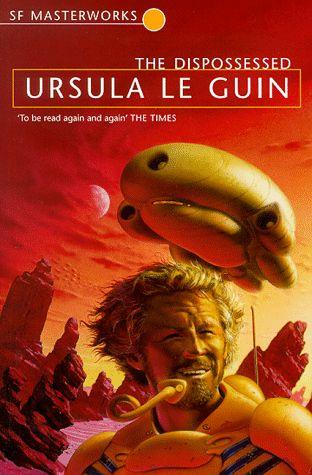
A brilliant physicist grows disenchanted with the stifling anarchist society of his home planet, defecting to a capitalist world in the hopes of finding true freedom…but what he finds only horrifies him.
Cam says Ursula K. Le Guin’s 1974 award-winning piece of sociological fiction is a leftist pamphlet. Benny and Rich call bs.
who’s right? let us examine the textual evidence.
On incentives: Are social sanctions powerful enough to get everyone to work voluntarily? Can an economy function without price signals and division of labour? How does crime and justice work with no police or courts? Do we have any existence proofs of flourishing anarchist societies?
On family life: Is having your children raised by other people as grotesque as it sounds? How about mere copulation without monogamy? Or living in communal dorms? The boys are much more sympathetic to the idea of ditching compulsory education, but wonder if unschooling etc is a luxury belief.
And the million-dollar question: from behind the veil of ignorance, would we rather be born on Anarres or Urras?
A fun wonky discussion of the central ideological clash. In part 2 we’ll try to talk more about the characters and the story.
Also: a humiliating question in the reader mailbag! bold of you to assume we actually read books outside of the podcast.
an ambiguous anarchist utopia
Cam: At one point the Urras scholars asked, why isn’t anyone stealing stuff? And the guy’s just like, well, we don’t have property rights so this can’t be stealing. And you’re kind of like, okay, well — what happens if someone just took, like, all the food? It’s like, you want to eat, right?
Benny: Just define the problem away.
Rich: Well, I actually object to Benny egoistically deciding how we’re going to do this conversation. And we didn’t even form a subcommittee on this. So I’m just going to talk about whatever I want. And you guys can shun me, you guys can put me on mute if you don’t like it.
Benny: We’re gonna lock you in a pseudo-prison and come back two days later and you’ll have shit your pants and smeared it all over the walls. Whoops.
Rich: Yeah.
Benny: Alright, kick this bad boy off maybe. So today we’re doing The Dispossessed by Ursula K. Le Guin, published in ‘74, old school, part of her epic Hainish cycle series. But this book is standalone — this is the only book in the series I think we’re going to read. The philosophy is kind of dripping all the way through this. You can tell the kinds of issues she in particular was thinking about, but also that culture was thinking about at that time in terms of utopia and capitalism and socialism, and those themes are just ripe throughout the book.
Benny: So before I give a little bit of background on the characters and the world, I’m actually curious, Rich — you tend to have an allergic reaction if you feel that the philosophy is too in your face in fiction novels. So I’m curious how you felt about this. Did you feel like it’s sort of appropriate and in the background enough that it makes it easier to swallow, or did you feel like it’s too upfront?
Rich: Yeah, good question. It’s not really in the background at all, it’s just front and center the whole way through. But it’s very well written, and it’s got good characterization and stuff, so it’s not the worst example of its kind. I’m excited to talk about the ideas. When we did Houellebecq I think I described it as: it’s so rare to hear a non-retarded critique of capitalism, and I think this is another book which is a very careful, well-considered, thoughtful, fully fleshed out alternative vision of a non-capitalistic, non-statist society. So it was fascinating to read about, aside from its literary merits. Yeah, it doesn’t bug me. I’m kind of hyped to talk about this stuff with you guys. Anarchy, baby.
Benny: Yeah, I think one key difference here is that the philosophy at least isn’t being endlessly vocalized by the characters. Like, it was in some other books — it’s there and it’s up front, but it’s up front in the narrative, in how the worlds are constructed. And so that’s immediate and that’s in your face, but it’s not as if you have characters acting as particular mouthpieces for obvious points. I think everyone’s slightly more nuanced than that.
Rich: There’s no Ayn Rand–style 40-page monologue moralizing speech in the middle of it. It’s a little more subtle than that.
Cam: I mean, I haven’t read Rand, but it pretty much is like a political pamphlet, I think, looking at her conception of a sort of socialist ambiguous utopia, as the subtitle goes. It’s funny, Rich — you’re hoping that we’ll get you over the line; I was hoping you’d get me over the line. Need some suffering for the brotherhood.
Rich: Oh, we need some communal brotherhood over here. So context for anyone listening: Cam’s been dragging his heels on this and we’re recording late because he couldn’t get through the assigned reading. So I figured you might not be loving it.
Cam: Yeah, it’s just kind of like a political tract — and we’ll get into the politics of it. I just don’t buy the world enough. I think it’s my problem.
Rich: Yeah, me neither.
Benny: Yeah, that’s a good critique.
Cam: And, yeah, it seems a little bit too sympathetic to communist anarchy. And then you read online and everyone’s like, no, it’s not, it’s ambiguous and it’s harsh on your side. And it is a bit like that, but —
Rich: But you say it’s a pamphlet — it’s not “this place is wonderful and the fountains are full of milk and honey.” It’s explicitly the opposite of that. The main character Shevek is trying to escape from this place, which has kind of ground him down and he thinks is holding him back. And then maybe at the end he’s going to go back or something, to be determined. But there’s a lot of detail about the grinding, almost near-subsistence-level lifestyle of these people, and drought and famines and people dying and unpleasant bureaucrats. So I don’t really think that’s right. We can try and figure out which side she’s on — I think she probably is trying to portray this as an interesting alternative, but it’s not in such a jarring way that she’s just pretending this is wonderful and all the problems are solved. If it was like that, I wouldn’t have been able to get anywhere near this deep into the book.
Cam: Yeah, you’re right, it’s not milk and honey. Part of the reason people like this is because it’s titled an ambiguous utopia and it’s showing flaws in both worlds. So I mean, for the listeners: we’ve essentially got two planets. Well, one’s like a moon of a planet, called Anarres — which sounds like anarchy — and Urras. A hundred to two hundred years ago some people moved to the moon Anarres and set up a kind of anarchist communist utopia with no private property.
Rich: Yeah, let’s get the term straight. It’s not communist or socialist because there’s no state. So it’s very explicitly anti-statist. There’s no government, so it’s anarchist.
Benny: Yeah, I think communist is the wrong term here.
Cam: There are forms of Marxist communism that want no state as well. So yeah — but the important thing is, well, there kind of is a quasi-state, but there’s no kind of official state.
Rich: We’re talking about a society with no government, no police, no prisons, no forced work, no forced education, no marriage, no church — and only social norms, basically.
Benny: No private property, importantly.
Rich: Oh, no private property, right, yeah.
Cam: And no milk and honey.
Rich: No milk and honey. Two servings of porridge per day on a good day.
Cam: Before we get into that, should we talk a little bit about how it starts, or should we get right into that?
Benny: Yeah, maybe let’s just set up the story slightly. So the protagonist of the story is this physicist named Shevek who comes from Anarres. He was one of the anarchists, and he decides for sort of unknown reasons at the beginning of the book to leave, to go visit Urras, which is the home planet. And this is a very controversial thing to do from both societies’ perspectives — they have basically cut off contact with one another except for trades that they’ll make because they both need certain resources from each other. But they haven’t actually sent anyone back and forth between them for probably a hundred years or something like that. And so the story basically kicks off with Shevek taking one of these transportation ships from Anarres to Urras.
Benny: Which — I think we should, for the sake of the listeners, continually say these names and continually remind them which planet is which, because even as a reader at the beginning it was like, there’s something cognitively difficult about tracking the terms, I found. I can never remember which planet is which.
Cam: Oh yeah, I couldn’t remember which is which until I clocked that Anarres is like anarchy. And then I was good.
Rich: Yeah, I wish I had that mnemonic. This is one of those books where you start reading it, or you look at the back cover, and you’re like, oh, we’re in sci-fi world now, because there’s going to be like the blogger blogs from planet blah blah blah.
Cam: And, uh, fucking names. I know — like his mom’s called like gulag or something. Well, not quite that on the nose, like Rulag.
Rich: Yeah, it’s very Eastern European flavored.
Cam: Yeah, I suppose you have to just do obscure alien-sounding names. But I do kind of hate sci-fi names.
Benny: Speaking of names, all the names on Anarres are auto-generated by a computer, and that’s how people identify themselves. So I guess this means that no one actually has the same name, because the computer can make sure there are no duplicates. But it also makes for these bizarre-sounding names.
Rich: And there’s no patrilineal inheritance or anything. You just have one name. Everyone’s like Madonna.
Cam: Like Beyoncé.
communal parenting, unschooling, and luxury beliefs
Benny: And you don’t really have parents as well. You’re raised by the community. It’s very much an experiment in — similar to, what were the Israeli —
Cam: The kibbutz. Yeah, they’re called children’s homes or something like that.
Benny: In the kibbutz, that’s what I’m looking for.
Cam: There’s probably a Hebrew name for it. But yeah, it reminded me of reading about that in even the pre-Israel state — a lot of the Zionist founders were also socialists, and they set up these kibbutzim where kids were totally separated from their family and raised in a community. Very much like how it’s set up on Anarres. And I think they did that in the twenties and thirties, and then it kind of died down in the sixties, seventies — just as Ursula Le Guin is writing this. And the general view, at least in the Israeli real-world cases, is that they moved away from it: a lot of people had attachment issues and psychological issues. There’s also just cultural changes in Israel at the time of the seventies, so that might be part of it, and immigration. I came across a writer from Israel talking about the kibbutzim. So her quote — Batya Gur — captures this sort of sentiment of the shift away from the children’s homes. She goes, quote: “I want to tuck my children in at night myself. And when they have a nightmare, I want them to come to bed, not to some intercom; not to make them go out at night in the dark looking for our room, stumbling over stones, thinking that every shadow is a monster, and in the end standing in front of a closed door, being dragged back to the children’s house.” So it captures the potential human instinct of preferring to be raised by your own parents and to raise your own kids, rather than just sort of trading them for anyone. I mean, I suppose it’s an open question for this book — it’s kind of a nature/nurture question that it’s posing — of can you stamp that out of people?
Benny: And we should say also, people don’t couple for life, unlike on Urras. So it’s sort of like people just choose to stay with each other for as short or long as they want to. Maybe they have kids, then the kids get sent to these communal children-raising little settlements. But people don’t really have long-term partners or anything. So this is — I mean, I guess I should have looked up sexual liberation movements and stuff, but I’m assuming this is smack dab in the middle of that, where people are romanticizing the idea of, you don’t need marriage, you just have all these short-term partners throughout your life and that will sustain you. You get together with someone for weeks or months or years and then ditch them as soon as it’s not working out.
Rich: And then you get reassigned to do toilet cleaning duty on the other side of the planet and you’re like, see you later, babe. See you in like a few years or never.
Benny: Yeah, exactly. And then — I think maybe it’s just worth dwelling on how childhood actually works in the society, because it’s one thing to just say it’s this anarchist semi-utopia, but the actual details of how all this stuff works is sort of bizarre. And I think this is a good critique that you guys raised earlier — that it’s just sort of unbelievable, in the sense that you need so much goodwill and trust and cooperation from everyone, and it just seems like you’d be constantly running into free-rider problems if you actually tried this in practice.
Cam: A paradise for parasites, one might say.
Rich: Yeah.
Benny: Do you want to talk a bit about how education actually works, and whether you thought this was a realistic picture for kids, of having no grades or anything?
Rich: Yeah, you guys will have to refresh my memory on exactly how it is, but it’s kind of like unschooling, right? You follow your interests in whatever directions they lead, and you try all kinds of different things, and there’s no grades, there’s no passing and failing, there’s no university. Teachers — or any person, because there aren’t even necessarily officially teachers — will volunteer to take a class, and people will sign up for it if they’re interested. Everything is determined by free association.
Rich: So this is actually one of the elements of the society that I really like, or am quite open to, because there’s something deeply rotten about our education and schooling system going all the way through. I’m talking about university in particular, but also — now that I’m coming up on the age where I have to start making decisions on what I’m going to do with my kids’ schooling, I’m becoming way more interested in unschooling and less worried about having arbitrary standards that a kid has to meet at this point, and at this point plus one, and this point plus two. Yeah. So this is probably the element of anarchist life that I’m most interested in and think has the most potential to actually possibly be good or beneficial.
Rich: But I’m also very unsure about that. Like maybe that just works well for certain types of people. A lot of the people who are unschooling advocates, or who are in the Taking Children Seriously / Sovereign Child type camp, are thoughtful well-off people who probably have good social circles, maybe have time enough to spend with their kids, hire good quality nannies, have interesting dinner-table conversations and all that kind of thing — which hopefully means that kids won’t just vegetate or never learn to read or anything like that. But yeah, I don’t know. What do you guys think about that? I’m sort of at the beginning of my learning journey with this. I’ve been reading The Sovereign Child, I’ve been thinking about Taking Children Seriously, reflecting on my own education and how I only came to rediscover learning for its own joy quite late in life, which is pretty sad. I’d love to be able to inculcate that from day one if possible, and not force a kid to do something to tick a certain box or get a certain grade for extrinsic reasons. It’s better if it comes intrinsically, I think.
Cam: So — to view it as normalized. That’s why I didn’t hate it. But also the main function of school is like a big daycare; it would totally destabilize society in that sense. So you’d really have to think — there probably would be an —
Rich: But people say “a big daycare” in a disparaging sense. It’s like, no, that’s super useful.
Cam: Yeah, we need a big daycare, right?
Rich: Trust me, I love daycare.
Cam: So you’d probably need that, at least double if you had a double-income society. So maybe you divorce the education standards, but then education also currently provides this great social value of signaling, sorting, verifying people. People with good grades have shown that they are hardworking, smart, willing to jump through hoops, maybe conformists, which businesses are interested in. So society would need to replace that as well — or it would replace that.
Rich: But doesn’t it do a terrible job of that? Because it takes like 18 years and vast amounts of money. We could just give everyone a test at age 18 or 20.
Cam: Yeah, no, I think that would be the IQ part.
Rich: And that would be that. Website, right?
Cam: That wouldn’t be the hardworking part, but you could find other ways. Or maybe it would be the hardworking part. It wouldn’t be this sort of conformist jump-through-hoops. But I agree, 10 to 20 years of your life is a very inefficient way of doing that.
Rich: Oh, I see — you’re saying the bit that it catches is that some companies want people to be willing to sit in sort of prison-camp-like environments doing boring rote things.
Cam: Yeah. And I suppose I’m thinking of university at that point — like a three- or four-year degree is a strong signal that you’re willing to do what you’re told and do the test, kind of like a lot of work environments. So you kind of want that signal as well. But I think school’s main function is probably daycare, plus perhaps this minimum mathematical and reading-comprehension level — which, you know, we’re sympathetic to: maybe we get that anyway, maybe that’s not true for everyone. So yeah, I think I have the same view as you, and for my kids I think pretty seriously about at least moving to that side of the spectrum.
Rich: Yeah, the bit that I don’t love at all about this society is the crushing of the individual spirit and will, which I think is totally counter to getting good outcomes in the world. And is one of the central big problems I have with this — it permeates the whole society.
Cam: Yeah.
soft coercion through social norms
Rich: Benny, do you want to talk a bit about that idea that they have, the sort of tall-poppy-syndrome type thing? We lock people in a closet if they get too uppity.
Benny: Yes. It just sounds like New Zealand on steroids, to be honest, from what you guys are describing. Yeah, so I mean, on one hand you could imagine not forcing kids to study any sort of curriculum is very liberating for their sense of curiosity and their intellectual development, and then you might encourage them to go and pursue whatever they happen to be interested in and good at. But that doesn’t actually seem to be what happens. Instead it seems to be sort of just coercive in another way, where you’re taught not to stand out. There is this term that they introduce called egoizing, which basically means to think great things of yourself or to expect that you’re better than anyone in any sort of way. And so it crushes any sort of individualism, I think, right out of you.
Benny: And you can see this in the main character, Shevek, who, especially when he was growing up, sort of realized he was very smart and mathematically gifted and was this brilliant physicist. He realized that in his classes he was understanding many things more quickly than his peers and even his professors and stuff. But he went through this period of turmoil where he wasn’t really sure if that was okay. And all he wanted to do for a while was just lock himself in a room and study and do physics, but he felt like that was inappropriate — and because they don’t really have private property, everyone sleeps in dorms and private rooms aren’t always available. It’s sort of a statement to take your own private room. He didn’t want to do that for a long time. But clearly, someone with his talents, it actually would have been better for society overall if he was just allowed to work on his physics and given his own space where he could work on it. Or maybe that’s just the Urrasti capitalist in me saying that.
Rich: Dude, imagine living in a dorm over the age of like 25.
Benny: Oh.
Rich: Like, come on. That is a nightmare. Remember the bunk bed at the dock hut that we stayed at?
Benny: Yeah, it’s exactly —
Rich: It’s honestly a hellish experience.
Benny: Those little kids screaming all night. Yeah, it does seem like they’re all getting laid more, though, than especially kids these days. So that’s one positive thing. What I find interesting from Le Guin — some of them, like the main characters, do, and that maybe is Le Guin speaking to how she’d feel about this sort of stuff. But it seems like a lot of people don’t, and they just ask each other very up front if they’d like to copulate, if you’re getting along with someone.
Cam: But they get sick of it, right? They find it too meaningless, and they get over it by the time they’re 20.
Rich: Yeah. My experience on the banana pancake backpacker trail, where you stay in dorms and you ask people if they’d like to copulate — no one owns anything.
Benny: That’s true. This is just the South Islands in Thailand, just on the moon, and with significantly worse weather.
Benny: So yeah, it’s oppressive in some way. I mean, I think one of the major themes Le Guin is getting at here is that, despite everyone ostensibly being free to do whatever they want, society ends up getting governed by certain norms anyway. So you might not have explicit laws that dictate what people have to do, but there are these cultural norms and expectations that dictate how you should behave, how you should relate to other people, what sort of jobs you should do. And this is, I guess, Cam, why I sort of disagree with you — it seems like a major theme that she’s saying. You can’t just easily set up these sort of utopic conditions in which you expect everyone to cooperate. Because even if you get yourself in a situation where individuals themselves are actually ready to sacrifice some of their time for the greater good, quote-unquote, they’re not actually looking to stab people in the back or make a bunch of money or whatever, they’re actually willing and wanting to be part of this anarchist utopia — you’re still in the situation where something is governing all these social relations. And whatever that is holds a lot of power over people, and ends up being just as oppressive — and I would argue more so than any sort of overt laws set up by a government or anything.
Cam: Yeah, more so is interesting. It’s certainly potentially as strong. Sometimes it feels like laws could be stronger, and sometimes the cultural norms —
Rich: I think she would probably say in capitalist society the coercion is of the form: you will do this work or you will starve to death. And here the coercion is of the form: if you don’t do this work, we will gossip about you and try to convince you otherwise and shun you, and so on. So I think she would argue — or an anarchist would argue — that it is a softer form of coercion. But I find it horrifying. I mean, obviously it’s hard because we’re so steeped in our own existence, but this is like the same amount of coercion in a different form, as you say, like you just have to be towing the line constantly, and everyone is constantly going to be monitoring whether you’re putting in enough effort and playing your part well and so on, in a way that is horrifying just in a different way.
Rich: And then of course the other thing that bugs me about this is that the simplified brutish version of capitalism where you will work or you will die is also not true in modern social democracies, where you have a state that collects tax revenue and has a social safety net, things like that. You’re actually not going to die if you don’t do your part, so you have kind of elements of this as well. If you’re sick or — I mean, obviously all these systems don’t work that well, but they still work enough that people’s lives are not actually in peril if they can’t get a job. Yeah, I think the social censure required for any of this stuff to work would have to be so strong that it stretches my ability to imagine. Because you mentioned freeloading before, Benny — in the society, if you want, you can go to the communal hall, eat your two meals a day; technically you could eat more if you wanted, no one would actually stop you. You can claim a luxurious single room. You can refuse all the work orders that get delivered to you. You can do all of that. You can also hoard belongings, even though there’s not meant to be any ownership — there’s one character who has a bunch of stuff that he’s purloined in his room.
Benny: Yeah, an old physicist.
Rich: So okay, I just want to say my big criticism of this book, because I think it goes through all these sectors. The idea here with the anarchists is that people are not inherently bad — the problems of society stem from poverty, alienation, and scarcity, artificial scarcity imposed by capitalism. And if you remove those stressors, then people will behave well, and they want to work, and they want to contribute, and so on. I just don’t think that’s true. I think the much simpler model of human behavior is: people respond to incentives, and those incentives include laws and sanctions as well as soft norms. If you remove all the actual hard laws around having to work to earn a wage and not commit crimes and so on, you need some incredible soft norms to replace them. I just don’t think it could happen.
Rich: I think people inevitably do the least that they can get away with without being completely shunned or getting beaten up. I want to talk about violence and crime and stuff as well, but maybe we get to that later. But the single underlying threat is that I think some people are just bad. Sociopaths exist. They will take advantage. People will get away with whatever they can within the framework of any given society. And it’s totally naive to think that one particular way of doing things will change the deep logic of human nature. Because not everyone responds that well to social norms. Not everyone is cowed into total submission by them. And also, from a game-theoretic point of view, over time you should expect more and more people who are resistant to those social norms, right? Like, what is it — the hawks and doves thing. The hawks should start to gain an advantage in a society like that.
Cam: Yeah, I agree.
Cam: I agree fully. I think Le Guin was reading a bunch of anarchist writers, leftist anarchist writers, that influenced this. So Goodman, who is like a New York Jewish writer in the 60s, and then Kropotkin, who’s a Russian, 1890s, very influential anarchist socialist writer. And the Russian thinker particularly just thinks that mutual aid is in our instinct. And if you took away property rights, like there would be no reason to be violent or to steal or to be selfish or to not pull your weight. Which I just don’t buy. I think it’s wrong, it’s false.
Cam: There’s even a point — speaking of political philosophy put into characters’ mouths — where Shevek goes to Urras, he meets these kind of four scholars, dressed in like university robes, which is quite a cool scene.
Cam: I wanted to quickly say something positive about the book that I liked. I think Le Guin in her other works as well often has this new world with a big difference or a couple of differences from our current world, and someone is observing this and being so surprised — including the reader — at finding all these things that you take for granted aren’t the case, and in this new world it is the case. Left Hand of Darkness famously does this and abolishes gender. So this one has a similar conceit, but it’s like, it’s our world — the character has gone to our world, and he comes from a place where none of this is normal. And he’s witnessing all this and it’s all surprising. Some of them are good things that he’s surprised by, like a shower — it’s like you have your own bathroom. But then he’s also surprised: there’s a servant who’s making his bed, and that’s not normal. And all these other things that we just take for granted. I did like that aspect.
Rich: Damn, that government salary’s paying alright.
Cam: Yeah, I know, that’s the funny thing. There’s kind of like a — what’s that — the Baumol’s cost disease, this sort of economic principle where things like servants and service industry stuff that aren’t that productive themselves are super expensive now. Like in the West you can’t have a servant; you go to some poorer place in the non-West, you can get servants and stuff. But you can’t have servants in the West.
Rich: Yeah, Indian families have domestic, even live-in servants is normal.
Cam: Yeah. Well, our buddy Arjun — he comes from a wealthy family in India. He finds it hard to get used to in the West, like no servants. Which is kind of funny. To the Le Guinian lens of just going there and everyone’s got a servant would be a surprising thing to see. Which, you know, was true in the West.
Rich: I had this experience when I went to Mumbai — we had a servant attached to our apartment and she came in every day and she made my bed every day, and cooked food for us, cleaned the house and stuff. It was really fucking weird. Like, coming from an egalitarian place like New Zealand, to have someone who is just so sort of servile. It’s like, I can make my own bed. It seemed very bizarre. And I never felt entirely okay with it, even though it was very useful and I’m sure mutually beneficial. I’m sure she was happy with the arrangement. But yeah, it would be a tiny glimpse of the culture shock that Shevek gets.
Cam: I think funnily enough, the richer society gets, the less you can have servants anymore, because the opportunity cost to be something else is well-paid. So you’d only be willing to — it’s like why a hairdresser and a massage — so you go to Thailand, well for other reasons perhaps, but you go to Thailand, you get a massage because it’s cheap. You go to India or Mexico, you get a haircut because it’s cheap. Anyway, I digress. I forgot where I was — I see my point around, I liked how Shevek’s kind of witnessing all this new stuff. But to go back to Rich’s point — let Benny jump in if he wants — around how unbelievable it is that everyone is just willing to do their part.
the free-rider problem and central planning
Benny: Yeah, so while we’re dealing with criticisms, that was also a major one of mine. Just not sort of dealing with the free-rider problem, or just skating over it. Then there was also — which is maybe excusable for a book written in 1974, I’m not sure — there’s just a total refusal to deal with the allocation of resources, namely prices especially. So how is all this food being furnished? We know that in societies that try and abolish prices, this is just disaster, because any centralized authority trying to make predictions about what people need is just going to be rough.
Benny: I guess maybe you get around this because people aren’t getting things for themselves — they’re not cooking for themselves. Everything is maybe just done by certain halls and they just have the same food all the time, and so maybe that eases the pressure. But still, it’s a society. They have to build new things, things presumably degrade. So they need to allocate resources — to clean certain things, to build new houses; their population is expanding or contracting. And we know now from modern-day econ that this is just extremely hard to do without prices. And I think we knew that at this point — but maybe we were still…
Cam: Well, Hayek class, I guess, is in the 40s, right?
Rich: I’m thinking Hayek already blew this thing wide open, right? So it’s kind of unforgivable.
Benny: He did, but not everyone bought it, right? There were tons of intellectuals in the West who were smitten with the USSR’s attempt to do centralized planning. That spell broke at some point, and I just can’t remember if that was after the 70s or before. There were a lot of communist apologists in the West who thought that centralized planning could work and Hayek was just wrong.
Cam: But funnily enough, this is not even centralized planning, right? Like a Soviet communist would probably at least get closer. But still, they don’t have the magic of the price system. So there’s still that “use of knowledge in society” critique, the Hayek critique. But yeah — just to have, you could think of a sci-fi utopia, you get a supercomputer that’s maybe good enough, even in our own society AI potentially could solve that problem. But with kind of no one running the show — even though they do have this institution called the PDC, right? The Production and Distribution Coordination, which kind of acts like a government. And it’s not really described too much in detail at first, but it’s kind of described as coordinating productive people, which is — I don’t know, is that everybody?
Benny: And it’s assigning jobs and stuff. But I think they get around calling this government because people circulate in and out every six months, I believe. So they have a fixed tenure time, and people basically volunteer for these roles at six months at a time. So there’s no way of people aggregating power over time, basically. And so they would object to the notion that they have politicians or that anyone’s trying to run things for much of their lives. So I think this is how they try and get around this notion of government. But of course, as Shevek points out, there’s still people with influence over these decisions, even if it’s just some sort of soft influence. The influence sort of seeps in whether it’s explicit or not.
Benny: And then, beyond just prices and allocation of resources, there’s also just a huge problem in allocation of talent, right? Shevek is obviously this brilliant physicist, as we were saying, but he spends most of his time just doing menial labor because that’s what he gets assigned to. And this is a huge cost for the society, where you have talented people, presumably in all these different areas, who can’t just work on that one thing as their job. Instead they’re getting allocated to doing random labor.
Cam: Yeah, but then sort of later on it kind of seems like he does get to be an exception almost. He goes to the academy and falls in love with learning and being isolated, and he feels guilty about it. He’s kind of torn because he’s been brainwashed his whole life to think you shouldn’t go and spend a bit of time in isolation. But he really enjoys it.
Benny: Shouldn’t egoize, bro.
Benny: Yeah, I was a bit confused about how that worked. So I guess they just recognized that he was talented and decided to send him over there or something.
Rich: But even that was pretty contingent, right? Like he could have just lived out his days rotating between planting trees out in the dust barrens and unclogging toilets and doing engineering. He wasn’t a shoo-in to get channeled into physics. It just things worked out that way, and then after a certain point they also stopped working out that way. So yeah, you have this society where you have no price signals, which is bad.
Rich: I think — their counter argument to this, because I was reading up on this particular brand of anarchism, which is called syndicalism, meaning that syndicates, like collectivized labor, is the distinguishing feature of this type of anarchism, as opposed to rejecting work altogether or wanting to totally deindustrialize or whatever.
Benny: Oh, this just clued me into the point — so there’s people like a lot of Deutschians are anarcho-capitalists, but these people would be anarcho-syndicalists. So this would be — I see what Cam was saying earlier now — this is sort of like the communist end of anarchism, versus you could have the capitalistic —
Cam: You don’t have to say communist, because this is like left anarchism versus right anarchism. The big thing for them is property rights — you have property rights, and like nothing else; don’t touch my property.
Rich: Yeah, this is the problem with anarchy, right? It includes like the David Friedmans of the world, and it includes like the full-on degrowthers of the world, and this — which is sort of somewhere in between — and various other factions. I guess we should just say that so people know what we’re talking about.
Rich: But yeah, their critique is something like: so we use price signals, you think, oh, that’s how you determine how to allocate resources in a society, and it’s nightmarish to try and do it otherwise. And their counter argument would be something like: no, that’s how you determine demand via purchasing power, not demand via actual genuine underlying need. So it’s good at getting consumer electronics into the hands of rich people or something, but it’s not good at allocating people what they need to actually survive and meet their needs. Or, for instance, it doesn’t prevent all of these social ills that we have in our societies — there shouldn’t be homeless people, there shouldn’t be starving people, and so on.
Rich: So they say, yeah, price signals are good at optimizing for a certain thing, but they’re not optimizing for the thing that we’re interested in. So I still think that’s sort of silly, only because there’s not a better way of doing it. If they could come up with like a galaxy-brain AGI allocation machine, then I’d be kind of more on board with it. But this society is not going that way. They’re not technological anarcho-syndicalists; they’re like a close-to-subsistence-level society who, as far as I can tell, are not interested in techno-optimism. So there’s nothing to hold onto there.
Cam: I was going to bring it up. I think it’s important to point out though that Anarres, the anarchy moon, is at subsistence level. And so in terms of allocation stuff, maybe they’re not concerned around that — it’s like they’re barely getting enough to survive. But I think it’s like this kind of barren land as well; there’s not a lot of resources there to live on.
Benny: Except for minerals, which they send to Urras.
Cam: Like, yeah, except for minerals. So Urras, the rich company, comes and buys it. So one time, yeah — one time they have property rights. That’s when they sell to the Urras.
Benny: But they get petroleum and certain manufactured goods from Urras, sort of implying that they do need people to actually supply them with things, right? Because they’re incapable of — it’s not even subsistence in the sense that they’re subsisting totally on their own. Like, they need external goods to actually survive.
capitalism as the root cause of all antisocial behaviour
Cam: But I was thinking, because I’m just thinking, this is the society we’re all not really buying — it would work — but I kind of think if it’s a small enough, homogeneous group of people that all kind of buy into this ideology, I can kind of imagine it going for a bit. But then I’m not sure if I have any protections against defectors. And as soon as you got bigger and non-homogeneous, with natural Schelling points in groups and out groups, I just don’t really buy it. And even without that, there’s these issues with how does it stop violence and how does it stop stealing? That’s the thing.
Cam: Like at one point the Urras scholars ask — they’re just really interested — like, why isn’t anyone stealing stuff? And the guy’s just like, well, we don’t have property rights, so this can’t be stealing. And you’re kind of like, okay, well — I know, it’s like, what the fuck.
Benny: Just define the problem away.
Cam: It’s like, okay, what happens if someone just took, like, all the food? It’s like, you want to fucking eat, right? What if someone took all the food? And then it doesn’t matter — if you can get a group together, or you’re strong enough, you can get all the stuff and dominate. And then they’re just kind of like, no one would — I think the implicit point, and maybe it was even explicit, is, no one would want to do that. Like, without property rights no one wants to do that. And then it’s like, well, okay, I don’t really buy that — quote, capitalism is the cause of that stuff. I buy more into this sort of Hobbesian human nature of wanting to compete over resources, wanting to compete over people, and wanting to deter others if you’re worried about them. There’s game-theoretic reasons why violence can erupt, and the solution is you get this Leviathan — this government that has a monopoly on violence, this kind of definition of government — to stop it.
Rich: Yes, scarcity is the state that causes these bad outcomes, right? And so they correctly identify that, but they believe that scarcity is like an artificial constraint imposed by capitalism, and that you can do away with it through this. But I have to believe — which of these societies is going to generate more scarcity? It’s a no-brainer for me that the anarchists are going to have more scarcity, and therefore it beggars belief that they won’t also have the associated competing for scarce resources and crime and theft and all that kind of stuff.
Rich: I just think none of this makes sense, because their founding grounding assumption is that you can get rid of scarcity, and that scarcity, poverty, alienation — those are the core drivers of antisocial behavior, crime, etc. I just don’t think that’s true. But even if it was true, they’re not getting rid of scarcity. The way that their economics is fucked, the way that their society runs, is through not having proper division of labor, not having price signals, and quashing the individual spirit that tends to lead to breakthrough growth technologies that actually improve everyone’s lot in life. By having none of those three strands, they’re trapped in this like little local optimum, which is maybe sustainable, but it’s not actually going to be a very good life.
Cam: Also, I’m not sure if the wealth inequality between Urras and Anarres is big enough. It kind of feels like USA versus Europe or something. Probably more so than that, but I just think if you really had this for like 170 years, it would be so vast, the difference.
Benny: Yeah. The US versus Malawi or something.
Cam: Yeah.
Rich: True. Yeah. That’s how it’s worked for us in our world, right? Capitalism has massively increased inequality, but it’s still dragged up the floor hugely compared to 100 years ago.
Cam: I mean, the other thing — when Shevek goes to Urras and what he notices is this different status. He notices, like, you have these scholars, and at first he really likes them, like, these are my people, we’re in physics. But then he notices some of them kind of look down on others. And then he notices, of course, the servant. He notices these hierarchical differences which he doesn’t have at all. And I thought, okay, that is important — when people care about that. We compare ourselves to the Joneses next door. But there was one line early on that kind of implied there was no status, that he wasn’t used to this. I imagine there would be heaps of status games on Anarres, but to be fair to Le Guin, I think she does show that that is the case as well, and it filters through in academia.
Cam: I did like the interactions with Sabul — is it, like, his teacher or mentor? Not much of a mentor.
Benny: Yeah, the elder physicist on Anarres.
Cam: Slovenly, fat guy with robes, lives in the library, who teaches — well, he doesn’t even teach him. He gets Shevek to learn Iotic, the language of Urras, and go away and come back. And he comes back, and then he steals all of Shevek’s ideas and plays them off as his own and sends them over to Urras — so these kind of breakthrough, I think, the simultaneity theory.
Benny: And not just steal Shevek’s ideas — I mean, I think this is actually important because it speaks to just the lack of innovation on Anarres. Sabul originally became a famous physicist on Anarres because he basically translated certain works from Urras. These were just common works on Urras, but they speak different languages, so he was able to translate the Urrasti work. And then people thought these were new ideas on Anarres, and so he got credit for them. And it’s only Shevek later on who realizes that these are all just originally Urrasti ideas, and Sabul actually hasn’t generated any novel ideas at all. And so there is just a total stultifying of progress and innovation on Anarres.
crime rate is zero if you don’t have any laws hehe
Rich: Should we talk about the crime and justice system, or lack thereof?
Cam: Yeah, I mean, does she address it apart from — I think there’s a question of, why is there no violence, and he says this kind of just isn’t. But did they address it more thoroughly than that?
Rich: Well, assuming it’s not that tautological thing where he’s like, no, there’s no murders because there’s no law against murder — I mean, people sometimes kill each other.
Benny: You don’t own your body, actually. You don’t own your body. Don’t egoize like that. If someone wants to kill you and take what’s inside you, that’s their right.
Cam: It’s funny that it’s quite a common thought though, like, you take away laws, there’s no crime. I’ve heard that made before, and it’s kind of like, we sure? There is a kernel of truth there with some crimes — they have this kind of societal-construct element to them.
Rich: Well, if they’re a genuinely victimless crime, then yeah.
Cam: Yeah. You can argue over whether particular laws and particular crimes are good or bad.
Rich: Did you guys catch what they do here? Because my memory is something like, if you sexually assaulted someone, it was something like, oh, you might want to check yourself voluntarily into a reform institute, unless the neighbors come around and beat you up or something like that. So some kind of mob-justice type thing — no policing, no formal courts, no prisons, but possibly some kind of retribution. There were some other instances of random violence that I remember. Right at the start, the crowd that is booing Shevek as he leaves for Urras throw a rock and kill someone, and there’s no repercussions for that.
Rich: So are you guys remembering this the same as me? There’s basically nothing formal, there’s just: if you do something then someone else might come and fuck you up. And then to me that’s also a very unstable dynamic that would definitely just spiral into protection rackets and mafiosos and vendettas and honor culture.
Cam: Yeah, no, I think that’s right.
Rich: Like, there’s a very good reason to have a monopoly on violence. But I don’t want to make that criticism if I’m forgetting that. I looked up how anarcho-syndicalists aim to solve this, and they apparently have self-organizing militias — no standing armies, but committees basically, and instant justice dispensed without courts or anything like that. I don’t exactly know what the mechanisms of it are. But it’s very small, very local, democratic, and then a lot of the punishments are less capital and more around shunning and exclusion — which also is mentioned in here, right? If you are a chronic freeloader you kind of get shunned, or people don’t want to associate with you.
Benny: Yeah, so I mean, let’s use Tirin as an example. So Tirin is Shevek’s brother who, as a young adult, writes a satirical play that was mocking certain Anarresti attitudes. And so people didn’t like it and it sort of shook them up a bit. And then what happened was he got posted to increasingly isolating work placements. He was actually maybe naturally good at something or thought he was, and he was supposed to get a placement to something that he would like, but that didn’t happen.
Benny: So I think there’s this soft form — or maybe not so soft — form of punishment where they can give you increasingly isolating work placements such that you’ll be on your own, you won’t know anyone, you have to go far outside the city and stuff. And so I think that’s basically what they did to him. And they just did this year after year, such that you either have the choice then to abandon your work assignment — but then you’ll sort of be shunned, I think, by society; people will look down on you. And then they have a term for people like this, who choose to just basically travel from one town to the next, because they get shunned most places they go, and they sort of just beg for food and whatnot. So I think ultimately punishment is grounded out in norms and attitudes. And if you do enough that’s wrong according to convention, then people will basically shun you. But there’s also these more explicit forms of punishment where they can just give you shitty work assignments and sort of make your life very miserable like that.
Rich: But that was all kind of non-explicit or non-legible, right? It was almost like they were gaslighting him about it. It wasn’t explicit, like: you have been a bad brother, therefore we’re giving you successive toilet duties in bumfuck nowhere. It was more like: even though you’re trained as a poet or a playwright, you keep getting these gigs that don’t reflect your specialties, and you don’t actually know why.
Benny: Yep.
Rich: And then there was some sad ending to his story, like he possibly killed himself, or placed into some kind of involuntary commitment center?
Benny: Yeah, I think this is getting a slightly beyond maybe the first part, but eventually when Shevek runs into him a couple years later, he had basically opted to go into some form of therapy, and they just basically destroyed his personality by therapizing his egoism, quote-unquote, out of him, and just totally de-individualized him, as it were. And so that’s just another reflection of — I think the fact that Le Guin is quite aware that she’s really not setting up a utopia here. She’s quite aware of a lot of the issues, if not all of them.
Cam: Yeah, I feel like I might need to explain my — oh, you go, Rich.
Rich: I was just going to say, it follows from this incredible importance of social norms — something I hadn’t thought of until you mentioned it, Benny — that if you do have subversive art that tries to subvert the norms, you have to destroy the artists. That’s actually just what you have to do for this type of society to flourish. So it’s just another corollary of how you structure the society, which to us is horrifying, but it makes sense that you have to do that. You have to destroy that guy, because he’s undermining the only thing that keeps your society continuing to work.
Cam: And it’s probably worth saying, that sort of thing happens in our society, probably maybe to a lesser extent. We have norms in our society and we have ways of maintaining it and shunning people outside of that.
Benny: But importantly we also have laws and rights and ways for people to go to court over things. And pursue wrongful allegation or wrongful termination by employers and things like this. So of course, if you become socially ostracized, that is a horrible experience, whether it’s personally with your friends around you or online, doxing or pile-ons or any of this stuff. But there is sort of a limit to how far this can go. There are backstops.
Rich: Yeah. And also, we have norms that hopefully run slightly in the other direction of encouraging the marketplace of ideas and trying not to cancel artists or other intellectuals who are trying to criticize some kind of power structure or satirize something. Obviously we could argue about whether or not those norms are eroding lately, which is sad. But generally speaking, we try to give people freedom of speech, not just in law, but in soft norms as well.
Cam: I feel like I need to explain my initial reaction around saying it was a pamphlet or she’s too sympathetic. I agree, there’s a lot in there where she’s pointing out, hey, this is not milk and honey. Human nature will come in sometimes, where you have Sabul stealing Shevek’s work, and you have this kind of quasi-government that’s kind of acting like government and has issues as well, and everybody’s poor. I even saw a Reddit thread of someone saying, what the hell, this is not a utopia. And everyone’s like, you missed the point of the book.
Cam: What I kind of meant was what we’ve really covered, where I think ultimately you miss some pretty important things, I think, about society and human nature and just how humans work. And that’s kind of what you have to do to make this work, or to not have it absolute chaos, absolutely destitute. But what I did like about it is — I think there’s this truth, that you have this rich, decadent society versus this kind of poor but spiritual society. I think there’s a truth aspect there. Shevek, when he arrives in Urras and he’s going into the shopping district — I think he calls it like Nightmare Street — one thing he’s shocked by is the artisans aren’t connected to the work. They didn’t make it; they’re just importing stuff and selling it. And I think there’s an aspect of truth there where there’s kind of a spiritual connection of what it means to be human. Funnily enough, I also think family and things like that are also part of that, which Anarres does away with all of that stuff. So you kind of have this soulless element there, as we talked about, where everyone’s sort of just copulating.
Benny: Yeah. As you were talking, this made me realize I hadn’t actually quite made the connection between egoization and anarchism, in the sense that I think I could have envisioned a society that was — or Le Guin writing about a potential society that was anarchic but still encouraged people to pursue their talents and what they were good at and to become extraordinary physicists and stuff. But now I’m realizing that maybe this is a huge tension because of what you were just saying, what Rich was saying earlier. If you encourage people to go off and do their own thing, this is sort of encouraging them to subvert certain norms of society and to change society in ways. And that’s incredibly dangerous. So you don’t want to encourage too much individualism, because you need people to conform to the norms. The norms are literally all you have. You don’t have this extra backstop of actual legal means of keeping people in line. The norms are all you have, so you need to keep people in line as much as possible. And that means discouraging innovation and people going off on their own to do things.
Benny: So anyway, this is possibly a very simplistic point. But I just finally put those two things together in my head.
has real syndicalist anarchism ever been tried?
Rich: So just before we finish up — it seems like all of our central arguments are: this couldn’t happen, this is not believable, and so it fails on that basis. So I want to look for some existence proofs of whether or not this has actually been tried and whether it has succeeded. The vibe I’ve got — the main one is Catalonia ‘36 to ‘39, which is during or just before the Spanish Civil War. And unfortunately, that all got horribly mixed up during the war, and it’s not a clear cut whether or not it worked. But it certainly worked for a while. They managed to collectivize the means of production. They managed to increase production of some things. A lot of the economy was running under anarchist control.
Rich: And then there’s a few other little scattered examples, which are all also on quite short timescales. And the things that they have in common seem to be that they’re really small, small to medium scale. And they are in societies where people know each other reasonably well. And there’s some kind of common enemy or something like that, like during wartime.
Cam: Yeah, I can imagine that’s the way it works.
Rich: Yeah, but it just doesn’t seem to — or at least based on our few case studies we have — it doesn’t seem to scale very well into a fully industrialized society where, A, you have external threats to your existence or you need external trading partners, and, B, where you just can’t possibly know all the people in your community; you start to get some of those other problems. Like hunter-gatherers is arguably even a case of this kind of thing, except they don’t even need the syndicates, they don’t even need the democratic committees and subcommittees and stuff, because they have such a small number of resources and relationships to allocate and organize, so they can just do it much more simply than this. But they do congregate on the same thing of — is it called a reverse dominance hierarchy or something like that? I don’t know if you guys have come across this, but basically if someone starts getting cocky and acting like an alpha male you shun them, make fun of them, or just totally ignore them. And ultimately anyone can just walk away from the band or the group as well.
Rich: So it’s a good organizing principle when there’s not that much to organize and when everyone knows one another, and seems like it doesn’t scale and would not be a good replacement for our current society — is kind of where I’m at with it. I don’t want to be too harshly critical, because A, we’re totally indoctrinated in the system that we live in, and B, like maybe true anarcho-syndicalism has never been tried, so.
Cam: But funny enough, as I’m saying it now when you’re talking about it — this could almost act like this kind of simulacra, you know what we’re talking about with Baudrillard earlier. I can imagine this book gets thought, like, when someone thinks, what would anarchy look like? We’ve got it — The Dispossessed. But it’s this kind of fake universe which I think is probably wrong in a lot of aspects of human nature, but it gets thought of as an example. But it’s not a utopia — look at The Dispossessed, there are aspects. Insofar as this is good fiction, hopefully they’ll be capturing that reality. I suppose where it falls apart is in the aspects where it’s not capturing reality.
Rich: Yeah, the argument from fictional evidence, right? It’s like, it doesn’t actually mean a damn thing. I appreciate all the work she’s put into it, though. It’s very thoughtful, and I’ve enjoyed the — what would you call it — world building or scenario building. She’s thought it all through. It’s just that we don’t know whether or not life would actually be the way that she depicts it. And my money is on no, it wouldn’t — it would be a lot worse.
Cam: Yeah. Given that your money would be that way, I think she probably hasn’t thought it through enough, or she hasn’t seen some flaws.
Benny: Also, we’re operating with more information now than she had, I think.
Rich: We’ve got more info, but for me it just hinges on the power of soft norms — or hard norms, I suppose you’d call it. It feels hard to believe that you could get this far just with social censure basically. But maybe you can, and I’ve just never lived in an environment like that. Maybe that’s possible. It sort of works for small bands or groups. We know there are some existence proofs. So I’m skeptical, but might be more of a failure of imagination on my part.
Cam: Yeah, I mean, you get me.
how good is le guin’s worldbuilding
Benny: Yeah, I want to try and defend the book on the grounds that it’s a hard subject to tackle, because we have very strong opinions going in about what sort of societies can actually work well, and which ones are actually realistically going to promote progress and stuff. But if we just want an author to set up a world and then try and live within the boundaries of that world and explore the consequences of that world as much as possible, I think she’s done quite a good job — better than a lot of the other authors we’ve discussed. Dick in particular, who sets up a crazy world and then doesn’t explore it, and doesn’t even arguably abide by his own logic. But insofar as she’s set up this dynamic, there’s these two different worlds — sure, ignoring that, could one have gotten to the scale that it’s at? Maybe not. But now that we have that premise, I think she does do a pretty good job of exploring what the consequences would be, how people’s behavior is shaped by these two cultures, how these two cultures interact with one another, the key differences between these two cultures. And I think she’s doing this with a lot more nuance than a lot of other writers trying to write about anarchist societies would have done.
Benny: In particular, I’m like Cam here, I’ve never actually read Rand. But my sense of Rand is that she’s way less nuanced. She sets up this world and she basically just uses it as a hammer to just spout off her philosophy. So there’s a role for —
Rich: Oh, 100%.
Benny: I’m just saying I don’t think she does a particularly good job of exploring the subtleties and the drawbacks and stuff of the kind of society she wants to see. And I don’t actually know that much about Le Guin’s ideology. I know a couple of the other books she’s written, and you can make some guesses based on stuff like The Ones Who Walk Away from Omelas and whatnot. But I purposely didn’t want to read about her biography too much for this, because I didn’t want too much of an insight into whether this book was supposed to be a specific promotion of a certain ideology, or whether just it was an exploration of certain ideas.
Benny: But again, what I look for in fiction is the willingness to set up a new world, whether it’s science fiction or our world and the differences are just like the types of characters and the psychologies you’re looking at — and then to play well within the boundaries of the world you’re setting up. And I think she’s done that pretty well. So I think I like the book overall.
Rich: No, I agree.
Cam: I think my problem is, you’re setting up this world and I think you’re just changing human nature to what it isn’t. People wouldn’t be violent and people wouldn’t want to be selfish and defect because there’s no property rights and laws. So you buy that premise — but that’s a pretty big thing to buy, and I think it’s not true. But, you know, in that world, okay, how would it look. But that’s why I kind of think it’s like the sort of — Baudrillard simulacra, simulacra.
Rich: I know what you’re getting at, Cam. The saving grace to me is that there are instances of bad behavior, lots of instances of bad behavior on Anarres, including hoarding, property rights, selfishness, violence. So she’s not trying to change human nature — she’s not magically saying human nature’s different. She’s saying, what if incentive structures were incredibly different. So what I don’t buy is whether that incentive structure would be strong enough to produce that outcome. But I don’t think she’s magically waving away human nature. There’s good people on both sides.
Cam: Well, not completely, but I feel like there’s something about the nuance. It’s like, this is nuance, both sides have issues. And it’s kind of like, well, that doesn’t mean you’ve captured the issues correctly.
Rich: Fucking capitalist scum profiteering pig.
Benny: She certainly does have a more malleable view of human nature than I think we probably do. And I think that’s probably a big sticking point. But I’m ready to sort of give her the benefit of the doubt on that for the purposes of fiction. And then once you’re beyond that, I sort of agree with Rich in that the threat of social ostracism is, I think, severe enough to keep a lot of people in line. And I’m not prepared to say that you absolutely couldn’t make some sort of shell of a society work with just that sort of social threat. I don’t know.
Rich: Yeah, like, we live at the end of history. There’s been all kinds of different social structures that are wildly different to our own. There still are today — hunter-gatherer life is wildly different to, and much more similar to this than how we live. So don’t get caught in the trap of thinking things have to be the way they are now at this moment in history, at this particular setup of society. This is the whole job of this — this is her job, is to break free of those constraints.
Cam: Yeah, I mean, hunter-gatherer tribes are like kind of small families, and the family unit — we do want to do stuff for the unit, and we extend that to the tribe as well, and we use metaphors like brotherhood and stuff to do that. But like, people think of their family differently to anyone else. I remember this Rage Against the Machine interview years ago with someone, kind of around this question of, would people just help each other out? Mutual aid. And the person said, well, we do it in a family, like we don’t need laws and stuff like that. Yeah, sure, but people think of their family members very differently.
Benny: There’s other reasons for that too.
Cam: I mean, why we think the kibbutzim-style children’s house is — why I’m not taking Rich’s daughter on for a couple years so he can go —
Rich: Yeah, and we still need laws for family, for wives that get beaten up and to protect children from getting abused. It doesn’t even necessarily work at the family level.
Cam: A question for you guys. So Le Guin herself is sympathetic to these anarchist ideas, but why she gets praise is because she’s not totally buying in, and she’s trying to point out there are these trade-offs. You’re a lot poorer, you lose a lot of freedoms, but maybe it’s better when we compare. Maybe Anarres is better than Urras. What do you think the book is saying? Do you think it’s kind of leaning either way? There’s trade-offs on each side, but which would you rather be, if you took the veil of ignorance?
Rich: Yeah, I think we’ll know by the end of the book. It would be pretty weird if she didn’t lean any way at all and it was just a pure what-if. And it wouldn’t be satisfying from a narrative point of view, so I think she’ll have to put a tilt in it. And I’m sure it will tilt towards — I mean, to be honest, I’ve read ahead, so I probably shouldn’t even talk about this, but —
Benny: Trying to pretend you don’t know what’s gonna happen.
Rich: The signs were there.
Benny: I’d be shocked if she didn’t lean a certain way.
Rich: But the Rawls question is interesting, because I had the same thought. I was like, from behind the veil of ignorance, which society would I want to be born into? And, you know, her thumb’s on the scale here, because Urras is portrayed as having a lot of problems. But I would much rather be born in a capitalist statist Francis Fukuyama society than I would be into an anarcho-syndicalist commune or kibbutz or whatever. That’s my answer, even if I ended up one of the —
Cam: Not shoveling shit once a week.
Benny: Although, we don’t actually quite know how Urras works also. We should be — maybe just for the listener — careful, that Urras is the home planet, but there are different societies on Urras. So Shevek shows up to A-Io, which is a capitalist society — you know, you can think of America or any sort of Western country right now. But then there’s also Thu, which is sort of another nation, and that’s like an authoritarian socialist state, which is sort of somewhere between the anarchist utopia of Anarres and the sort of capitalist society of A-Io.
Cam: And one of the characters is from there, right? Chifoilisk.
Benny: One of the other characters from there, when Shevek’s talking to him, he basically said, you guys are only semi-revolutionaries in the sense that you kind of got halfway there, like you rejected outright capitalism, but you actually haven’t become anarchist yet. And so you’re sort of stuck in this authoritarian socialist state.
Benny: So anyway, I just wanted to clarify that he’s on A-Io, and so there are other societies on Urras. And in fact, sort of about halfway through the book, which is where we are, there’s a revolt in one of these other societies. And so we’ll probably pick up next time talking about that revolt.
Rich: Next week, about his big trip to the big smoke.
Cam: Sounds good.
Benny: Yeah, we’ll probably hit a few more plot beats next week. I think we were mostly focused on the setting this time, and talking about anarchy versus capitalism, which is very fun and is obviously where the meat of the philosophy of the book actually lies. But next week, assuming we do part two —
Cam: I’m in the mines next week.
Rich: Dude, imagine coordinating a podcast schedule.
Rich: Well, a society with no podcasters actually sounds kind of good.
Cam: Yeah. Well, do you guys remember those Twitter threads where someone’s like, what would be your job in the future, like the Marxist utopia or something? “I think I’ll be making lattes,” and someone’s like, “I’ll be like a dad.” I remember one of them, one guy’s just like, “you’d be in the mines,” just commenting on it.
Rich: Mines, mines, mines.
Cam: Yeah.
Rich: Rice paddy.
reader mailbag: which new releases from living authors do we read immediately?
Rich: Cool. Alright. Do you guys want to do some listener mail? Do you have time, or should we just leave it there?
Benny: Let’s do it.
Rich: Alright. So we got some very good questions from Sonny. He’s asked quite a few, so we’ll just split it and do maybe just one or two today. His first question is: do any of you have living fiction authors or book series that you’re almost guaranteed to read if and when a new book is published?
Cam: No.
Rich: That’s an acceptable answer.
Benny: Nope.
Rich: That’s an acceptable answer. We’re an hour-forty in.
Benny: Yeah, so I have to admit I’m a big fantasy nerd, so the ones that actually come to mind for me are fantasy authors with ongoing big series, where if a new book comes out I’ll often reread the series. So like Brandon Sanderson has a couple live series — Stormlight Archive in particular, where for instance he actually just released the fifth book and I’m rereading the fourth book right now. Patrick Rothfuss has an ongoing series — unlikely that he’ll ever finish the third book, but I’m on the lookout for that. Game of Thrones, George R.R. Martin, obviously.
Rich: Oh, that’s the Name of the Wind guy, right?
Benny: Yeah, not George R.R. Martin, but Patrick Rothfuss’s Name of the Wind, yeah.
Rich: Yeah, I want to check that out.
Benny: It’s an amazing series, although it’s very frustrating because there’s two epic books and then you’re just left in the lurch with respect to the third one. And it’s been about 14 years, maybe 16 years, and no sign of him actually finishing it anytime soon.
Rich: How old is he?
Benny: Not that old. That’s what’s so frustrating. You’d think he’d have the energy to finish it. I think he’s maybe in his 50s.
Rich: Okay, well Lucy’s not going to die and leave you hanging, probably.
Benny: Yeah, sure. Robert Jordan did die, and then Brandon Sanderson had to come up and finish his series, which I was also keeping up with and read. So yeah, I don’t think there’s any —
Cam: I was worried you were going to list out like 10 fantasy authors. I’m fine. No one knows them.
Benny: I could keep going, but I would just embarrass myself too much. So I’ll put a plug there.
Rich: Cam?
Cam: Uh, well, the living caveat — I’m not sure, really.
Benny: He’s waiting for Dostoevsky to write his next.
Cam: Jesus Lazarus.
Rich: Get some posthumous release.
Cam: But yeah, if I was to tweak the question slightly to be: are there authors that I would want to read every word of? I mean, David Foster Wallace would be probably the closest. I haven’t actually read every word — I haven’t read The Pale King. But he’d probably be the —
Benny: That’s such a different question.
Cam: Yeah, but I don’t know. I suppose I’m not even sure if I read any living — I’m not sure if there’s a living author I’ve read anything by.
Rich: So the answer is no, right?
Benny: Oh, what about David Deutsch’s fantasy fiction book? I bet you if he wrote that, you guys would be lined up overnight at the bookstore.
Cam: Well, if you tweaked it as well, if it’s a non-fiction, there’d be people as well. But yeah, if someone like him released a fiction book, I would read it for sure.
Benny: For sure, yeah. Oh, Ted Chiang’s another one for me, actually, which is not necessarily fantasy. But if he released another series of short stories, I’d be all over that.
Cam: I wish I could answer in the affirmative there, but you guys make fun of me for not even having read all his current stories.
Rich: Bro, you don’t have to pretend to be something other than what you are. If you’re not a super-fan, then you’re not.
Benny: Yeah, we know you’re lining up for smut. What’s really going on here?
Rich: The latest dragon porn, volume three — those are the other ones that Benny didn’t want to say.
Benny: Yeah, exactly.
Cam: Sally Rooney, and who else, Rich?
Rich: No, I haven’t read Sally Rooney’s — I started her last one. I have read almost all of hers, but I started it and I reckon she’s fallen off. No, I don’t have any. I guess we mostly are reading non-contemporary stuff, and the authors that fell in that category for me are dead now. I guess like Terry Pratchett is my fudging answer, who I eagerly awaited every new book — although the last ones were a bit shit because he had Alzheimer’s and the quality was going downhill. But he’s dead now. So there’s no one. Yeah, there’s no one.
Cam: I mean, the other thing is — and this isn’t entirely true — but we’re all relatively new fiction-heavy readers. A lot of our diet has been non-fiction. So I can imagine some authors turning into this. Like I can imagine someone like Houellebecq, who we haven’t read much of at all, but he’s recently released a book, and that’s on my list, a new release on my list just because of who he is.
Rich: And you haven’t dived into the back catalog and started smashing through them, right?
Cam: Yeah, I think so. I mean, there’s also indicative of how hard it is to read, and how hard it is to read fiction. So that’s why David Foster Wallace has felt more true to me, because I keep rereading Infinite Jest.
Rich: And he does live on in your heart, in a sense. Now, I do kind of think that’s a fair answer in the spirit of the question — like, whose work are you really excited to keep grappling with?
Cam: But also, Houellebecq — like, a new release Houellebecq, I’m curious about it. I could imagine us doing, for instance — Rich, save me.
Benny: What did he just release?
Rich: Annihilation, I think.
Cam: Yeah, that might have been it.
Benny: That would be kind of fun. We could do a new Houellebecq. That would be kind of cool.
Rich: Hmm.
Cam: Yeah, you’re right, Annihilation.
Benny: Rich seems very excited by that prospect.
Rich: I’ve started it and I’m not super into it so far. I’m sure it’ll be good. I do own it, so that would be personally convenient for me. Yeah, you might be right though, Cam — like in a few years we might find out that, oh, I love Murakami or something, and start devouring.
Rich: I mean, honestly, I had this experience with Cormac McCarthy, but again, just in time for —
Cam: Yeah, that would be your answer as well, but he’s gone.
Benny: Yeah, that’s a good answer actually.
Rich: That would have been my answer, because I have read almost everything he’s written now, but it’s too late.
Rich: Cool. Alright. Let’s do the next one next week, huh?
Cam: Robin Hanson, he’s got one sci-fi book — next one coming out.
Rich: Russ Roberts.
Cam: Any fiction that comes out of George Mason University economics department, I’m straight there.
Rich: There’s got to be some — oh shit, I just thought of a bunch more answers actually. I should have thought about this in advance. Genre fiction, I’m on top of, actually. There’s these self-published authors, Quantum (Q-N-T-M) and Exurbia. This guy who wrote There Is No Antimemetics Division, which is one of my favorite self-published speculative sci-fi stories, that recently has become published by an actual publisher.
Benny: I’ve heard of that.
Rich: Yeah, I’ve read everything those guys write, and I will buy anything that they publish. I bet you there’s more like that too. I just got to think more about sci-fi and the Ted Chiangs of the world. There probably are a few, but not like literary fiction.
Rich: Write to us — doyouevenlit at gmail dot com. Just the letter U, not the word. And come join us next week for another anarchic episode of Do You Even Lit.
Cam: Thanks. See you guys.
Rich: Bye.