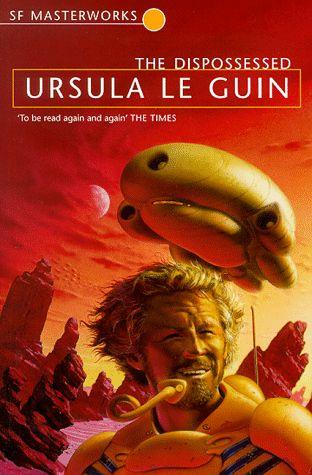
This week we wrap up our discussion of Ursula Le Guin’s 1974 classic The Dispossessed.
Simultaneity physics: just a MacGuffin, or deeper thematic significance? How is it different to a block universe? Does this count as hard sci-fi?
On the [redacted] scene: why would LeGuin include this? How are we supposed to feel about our hero Shevek? Why would capitalism make me do this??
Final thoughts on the book: was Shevek’s arc satisfying? Who would we recommend it to? Are we gonna read more LeGuin?
Ted Chiang story coming soon. Plus special guest episode!
Shevek’s arc or lack thereof
Benny: Okay, I’m kind of annoyed by the book to be honest. I think the first half was actually quite interesting, and I was actually more up on it than I think you guys were at the end of last episode. I think she sets up this cool dichotomy between these two planets, kind of explores how they both work. There’s some issues around how seriously she takes what life would look like in an anarcho-syndicalist society, and there are certain issues that she chooses, presumably, not to deal with because it would be extremely hard to do so — prices, etc.
That stuff aside, I thought the idea was quite cool. And then I found the end of the book basically to just fall flat. It basically just ends in this weird, ambiguous state where even Shevek, the protagonist, doesn’t really know what to do. Has he learned anything? Arguably not. Has his theories of physics changed anything? Arguably not. Are we as the reader in a better place to evaluate the pros and cons of both of these societies? Arguably not. Do I know what Le Guin’s philosophy is after this? Not really, because I think both of the societies come out looking kind of bad, but in kind of naive ways that you could have anticipated a priori.
So I just felt like it started out interesting and then just went out on a whimper. Just didn’t fulfill any of the interesting philosophical questions that she started posing in the first half. Agree or disagree?
Cam: I’m just imagining you reading it, and the first page is “what if… capitalism, what if… communism?” and you’re like — and then by the end they’re like, ‘not sure, they’re both flawed’, and you’re just devastated.
Benny: I want some straight answers, bro.
Cam: Um, yeah, I don’t know — Rich, do you want to — I think, I think I disagree, but you said a lot of — there’s a lot of “arguably” in there, there’s like five or six different —
Rich: Benny’s verbal tics are “arguably” and “in some sense”.
Benny: “In some sense” is bad. I wish you didn’t tell me. “Presumably”. “In some sense”.
Rich: It’s funny because it adds like no extra value to what you’re saying, but it sounds really smart.
Benny: It’s not in all the senses though, I just want to make that clear.
Cam: Yeah, not in every sense.
Rich: Yeah, there are some senses in which it doesn’t hold. It’s like, “I might be wrong, but…” — but I can’t think of why off the top of my head, so I’m gonna couch.
Benny: I get so annoyed by myself every time I listen to an episode and I say that. I want to throw myself against the wall.
Cam: It’s like your version of the wine-dark sea or something, you know — Homer always has the rosy-fingered dawn. Presumably you should — introduce you as Benny “in some sense” chug on the —
Rich: Yeah, that’s good. Benny “arguably” chug.
Rich: Yeah, I do, I do disagree, Benny. I think his arc works in that — so he leaves Anarres disenchanted with it and hopeful about checking out this new society, and then I think the second half of the book is mostly his process of becoming disenchanted with Urras and realizing that things were in fact better back at home, and coming home. So I think at least it is staking out some kind of a claim, where it’s like thesis-antithesis-synthesis, right? Because he comes home with critiques of Anarrestian society as well, and things that he thinks they should do differently — around allowing the individual to follow their interests in the service of the collective. He comes up with a justification for that, and he comes up with various other criticisms of Anarrestian society.
So yeah, I mean, I kind of agree that the ending doesn’t resolve anything, but it’s got a nice symmetry to it at least, and I think it works for his arc. The problem is that this book is some kind of almost an academic thought experiment or something, so it’s just hard to get the dramatic stakes high enough. At least that’s how it felt for me.
I think I saw it described as like a polemic, and that kind of seems right to me. Or like a sociological fiction — instead of sci-fi, like anthropology-fi or sociology-fi. It’s going to be about the ideas, and it’s going to be hard to get too invested, I think.
Benny: Yeah, you don’t get too invested with Shevek, right?
Rich: I didn’t. I was trying to read why people who love this book found it really moving and emotional. I didn’t have that experience myself.
I have a slight disagreement with the arc, in that I don’t think he goes to Urrasti — or Urras rather — I don’t think he goes to Urrasti society optimistic about the setup of their world. I think he goes and he’s always sort of critical, and even when he first shows up he’s skeptical of their ways. He wants to teach people that anarcho-syndicalism can work. He’s bamboozled by some of their norms. He feels immediate contempt for the fact that they have such a hierarchical society. So in other words, I didn’t read it as him being open to Urras as an alternative world. I read it as him reluctantly going because he had this opportunity to share his physics with people who might be interested, but he was actually skeptical of capitalism the whole time and sort of wanted to act as a covert agent to subvert their society.
Cam: I think he was naive of capitalism mainly. He was proud for the ideology of his hometown — he just kind of thinks that’s what life is. And then he gets there and sometimes he’s surprised, and like pleasantly surprised — he’s got his own toilet, and he meets these other physicists who are interested in what he’s interested in, and seemingly in a real sincere way compared to Sabul, his advisor back home.
But yeah, then he does get immediately disgusted with hierarchical stuff and property rights stuff and inequality. But I mean, you said nothing was resolved, Benny, but he ultimately chooses to go home, right? And he even says something like, “I don’t need anything from Urras. I understand why Odo and the original people 170 years ago came with nothing.” He came back with nothing. And he’s aware of something — he had to come back as well.
Rich: He was fleeing government suppression.
Cam: Yeah. He was thrown around — what would happen if he was killed in a revolution versus coming back.
Rich: But I think — so would you even argue he doesn’t even want to come back, potentially?
Benny: I think he’s just sort of buffeted by the winds of circumstance. That’s sort of how I read it. He’s part of this revolt, realizes he can either stay there and remain there as a figurehead and contribute to their society in some way that he doesn’t agree with, or he can go back home. And so of course, given that choice, he goes back home. But I don’t view him as particularly ecstatic about going back home. I don’t view him as having much development in terms of his thought over the course of the book. I guess that’s what I’m trying to argue. Really, like I don’t view him as having come to a conclusion that Urras is better for reasons A, B, and C, and so he’s going to go home triumphantly. He sort of goes back because he’s forced to, and he’s not even sure if he’s going to be accepted when he gets back. And yeah, it was just kind of underwhelmed by his development.
Cam: I wondered if Le Guin was saying, yeah, so there’s flaws with both, but ultimately the anarchist sort of quasi-communist society is better. And then I suddenly wondered — well, is he just content and wanting to go home because of like sort of status quo bias? Like because that’s where he’s from, and that’s why it’s preferable. And you could imagine the same person missing the luxuries of Urras and wanting to go back there.
Rich: I mean, that’s definitely a possible reading — that Le Guin was trying to explore in her mind fairly both of these societies, basically saying, yeah, this anarchist society has problems but ultimately we should turn towards something like that because it is better and more fair and more egalitarian.
Cam: That would be good, yeah.
Benny: Maybe I just don’t like that. Maybe I’m just letting my actual political philosophy color my reading at that point, because it seemed pretty clear to me that Anarres as a society was also a disaster. You know, this guy’s forced to be away from his family and his kid for four years while he does manual labor to save them all from a famine. That seems like not the sort of society I’d want to choose.
Rich: Yeah, she’s set it up so that they’re both really unpalatable, right? Because it’s not just a capitalist society, it’s one that guns down protesters in the streets from helicopters.
Cam: Which is something that would never happen in like the United States of America, right?
Rich: Yeah, right.
Cam: This is the direct line of capitalism — and gunning everybody down.
Benny: Yeah. So I suppose there is commentary around the state, right? It’s a state of society that has monopoly of power and can kill people, or can lock people up for making a Facebook post or something — whatever insert action that you think is ludicrous to be in trouble for.
Rich: Yeah, which is true. She’s like damning with faint praise, right? Saying that, oh, Anarres is the better country after all. It’s like, well, yeah, but only because this other country murders dissidents in the streets and is jingoistic and has this permanent suppressed underclass and so on. So okay, you know.
Cam: Yeah, I saw some commentary along those lines actually. Commentary around commentary — I didn’t see the source commentary, but someone saying that some people complain that, yeah, she sets it up and kind of has a — maybe not a best possible case but almost there — of the anarchist society, and then a kind of worst possible case, or at least almost there, for the capitalist society. And maybe the retort is, you know, she obviously points out a lot of flaws with the anarchist society.
Rich: Just coming back to his arc on Urras, Benny — I agree with you that he has contempt right from when he arrives. And you’re right, he’s not drawn there by the vision that it offers. But I think he does get a little bit enchanted with it, and his defenses do lower a little bit, when he starts hanging out with his colleague’s cousin, the fancy lady, and starts enjoying the society life a little bit. And that’s when he does have this peak in disgust, and you know, what would you call it — like a come-to-Jesus moment, right? Where he actually gets really drunk and then sexually assaults this lady, basically — and like premature ejaculates on her dress or something, which is one of the weirdest things in the whole book. And then wakes up the next morning and is literally purging all of Urras’s poisons out of his body. Like it’s not even really a metaphor, it’s just — yeah, that’s the moment when he realizes what he’s doing and how at odds it is with —
Cam: Just wake up — thinks of a good expression of covenant — wake up hungover full of vomit and like realizing you raped someone, just be like, “Okay, capitalism, it’s so bad.” This world is terrible, this world is terrible. Yeah, blames it on capitalism. Like, okay, dude.
Rich: It’s that bike meme — the guy putting the stick through the spokes of his own bike.
Rich: Yeah, that was great.
Talking about THAT scene
Benny: Yeah, what did you guys make of that scene, because that was kind of crazy, right? Like, it was fucking gross, and what was going on there?
Rich: Some kind of difference in sexual norms and sexual mores, or something?
Cam: Well, I did wonder, I had that thought — is she saying he’s used to no property rights sort of thing? But I was like, surely not — “no one owns your body”. Yeah, I don’t know, I was very confused by it, because other than that, you can make this argument like Shevek’s this hero that we don’t care about much and he’s not necessarily that flawed, and then you have this one instance of drunken-fueled sexual assault. Yeah, very confused by it.
Benny: Yeah, it was weird. I mean, it’s especially weird given that I think one semi-popular reading of this is that it’s sort of a feminist tract, right? And that it’s arguing for women’s sexual liberation — the liberation of always being the child bearer and stuff. So on Anarres, people — we talked about this last time — they just, you know, “do you want to copulate?” — they just sleep with each other for however long they want and then they go sleep with other people. And especially at the time she was writing, this was viewed as probably a good thing. There’s obviously pushback against that sort of lifestyle now in terms of what it does for families and stuff.
But you know, if you’re reading it as some sort of feminist tract, then to have one of the representatives of this anarchist society basically just take advantage of this woman and overpower her and assault her seems like a bizarre choice to make. And it’s hard for me to read this as Le Guin saying that women should have more sexual freedom in the way that sexual freedom is expressed on Anarres, right? So yeah, I was definitely confused by it. And if you define the feminist reading of this book as getting rid of sort of family structure — which has been the feminist line at some points throughout history — then this seems sort of anti-feminist.
Rich: Here’s an attempt to bend over backwards to make it make sense. Maybe her resistance and reluctance in that scene is not because she doesn’t desire him, it’s because there’s consequences for her, right? She’s talking about her husband, maybe she’s talking about getting pregnant or something. And those are structures of her society that are foreign to Shevek, so that he doesn’t even think of them. So she can’t allow it to happen, whereas on Anarres it would be like, yeah, you just copulate, and there’s nothing too much at stake because people are liberated from those kinds of considerations. That’s my best guess. And it just doesn’t even cross his mind, so maybe he thinks it’s some kind of a game or something, you know, I don’t know.
Cam: It reminds me of like when I was 10 or 11 or something. I remember reading some little snippet in some tabloid about Eva Longoria — do you remember her from Desperate Housewives?
Rich: Of course, yeah, the hottest of the Wisteria Lane ladies.
Cam: Yeah. And her husband was a basketballer, like a French-American basketballer — Parker. But I remember reading there’s some scandal, like he cheated on her or something with someone, and his response was something like, “Yeah, you know, it’s just a blowjob,” something like that, just so you know, whatever. Um, sorry.
Rich: Speaking of getting demonetized on YouTube — this doesn’t stand a chance.
Simultaneity theory unpacked
Benny: Okay, so yeah, one other thing that I’d like your takes on is whether his whole theory of physics — so the simultaneity theory that he’s working on — is this just a MacGuffin in the book, meaning something that’s sort of central to his motivation as a character but the audience doesn’t actually need to know anything about, or is it actually important? Is the fact that he’s working on this theory of physics that gets rid of sort of linear time structure, and I guess collapses maybe the notion of causation and time and stuff — it’s kind of unclear on the details there, we’re not really privy to that — so is the form of his theory of physics that he’s working on actually important? Or could the book have been written and the message be the same had he been working on any other theory of physics, like he’s just trying to overturn the dominant paradigm, basically?
Rich: No, this is important. This is maybe why you haven’t fully bought the book, I reckon, because there’s heaps of metaphorical stuff in here about the simultaneity idea specifically — of how it ties together past and present and future. And he has a lot of epiphanies around this and around Anarrestian society. But I haven’t been able to figure out what it means, and it seemed like maybe too vague that I couldn’t really get my teeth around it. I was going to ask you if there’s anything to the physics stuff in here, because out of the three of us you actually have the slightest chance of understanding it. But how is this different to just a 4D block universe? Is there some other thing going on here?
Benny: Yeah, I mean, so okay, one thing to say is that Einstein’s conception is not really a block universe, right? He ties space and time into being the same thing — space and time are one thing and they influence each other. My understanding of his theory though is that you still have this notion of, you can only affect things inside your light cone. The speed of light is sort of the ultimate speed limit of the universe, therefore you can only travel so fast, etc. One planet’s actions can only affect another planet’s actions, or there’s a necessary delay between how my actions affect your actions, and how fast therefore two planets can communicate with one another, etc. And I think he’s working on a theory of physics that basically collapses this distinction and says, you know, things in one place can affect simultaneously things in another place.
Rich: So it’s actually faster-than-light travel, or faster-than-light comms — and it’s saying that relativity is wrong?
Benny: Yeah. Because the rest of the book — or the rest of the series rather — I think actually does build on his theory and this technology to allow instant communication between different civilizations. I haven’t read any of the other books, but from some reviews I’ve read, that’s what’s going on. So I think they actually do leverage his theory later on in the series.
Rich: And so yeah, it’s a bit like Eric Weinstein wants to do the same thing. He’s a bit of a crackpot, but he’s also very dissatisfied with this notion that the speed of light is fixed and constraining, and he wants to do away with that because it does impose just how fast you can spread across the galaxy, for instance.
Cam: So why is everyone so impressed with Einstein in this book, and they think that his theories are really beautiful? Is it kind of the way that we would feel about Newton or something? Like he was partly right but he didn’t realize the deeper structure or something like that?
Benny: Okay, so one question is what is sequencing physics, because they set up this conflict between simultaneity theory and sequencing physics. I’m assuming sequencing physics is just Einstein’s.
Rich: Yeah, that’s what I took it as.
Benny: And I think they’re just impressed with him for the same reasons we’re impressed with him, because it did seem to shed light on how the universe works in some fundamental way. And then Shevek just thinks that’s wrong, and we’re not privy exactly to the details of how it’s wrong, but obviously Shevek wants to improve this in some way.
Cam: I mean, my reaction to your opening question, Benny, was like, yes, it was a total MacGuffin in this book, and it wasn’t really relevant for this book. It’s interesting to hear she went with it and actually used it — so it’s important in that sense, I think. A couple of ways that it had other impacts was — uh, like one was why he was disgusted with, or why he didn’t want to release it on Urras, because he was worried corporations would use it to make money, which disgusted him. So it had to be something that would have this breakthrough and practical implications, and this was like, I think it was like near-instant —
Rich: Space travel, right?
Cam: Yeah, it was instant communication, which would be amazing. Yeah, he’s like, no, no, no one can have it because people will make money. So I think it had to have that aspect to it. And there are real critiques there as well — there’s that everyone cites that famous polo example of the guy who like doesn’t paint it. So in that sense it was important what it was.
And in another sense, I just thought, I liked the satire of academia somewhat on both planets — but you know, his interactions with Sabul — so the fact he’s doing some form of breakthrough science I thought was important. But in terms of you actually applying this — I mean, that’s why when I said earlier, like it almost didn’t feel like a sci-fi. Yes, the anthropology-fi or something, or a philosophical thought experiment — it’s mainly just, what if two worlds with — I mean, you don’t even necessarily have to have two worlds, it could be on one world and you should have like a separate country. But it is quite nice having the moon, makes it a bit more believable, it’s more removed. But, I mean, they could just be conquered by Urras, so maybe it’s just as believable as if you had another country. Yeah, what do you think, Benny? Oh, unless Rich had more thoughts on that.
Rich: No, I’m just thinking it’s more clever than I originally thought, like now that I understand it’s meant to be faster-than-light comms and this is the whole project he’s been working towards — which I didn’t pick up initially. That’s important because his whole project is connecting everyone together simultaneously, dissolving boundaries and borders, and especially the siloing of information, which is this big problem that he has on both planets. So this is wanting information to be free — and free like against the laws of physics as we currently understand them, even. So I think they probably have a lot of problems with time dilation and stuff like that if they are an interstellar society, or just with however long they take for their ships to travel as well. This would actually be a hugely important technology.
And then if she’s planting the seed here for the rest of her series of how the ansible transforms the colonization of space, then I reckon that definitely counts as hard sci-fi — maybe even some of the hardest, in that there’s sort of real physics talk in here. And obviously we’re not going to get equations, but it was sort of reasonably convincing for someone like me who doesn’t know enough about any of this to be properly skeptical. Like, for a normal lay reader.
Cam: Yeah, in terms of being thematic, I think that’s a good point that he is — well, I just had to tie it into property rights and communication. Like I’m just thinking now, the internet has a kind of similar effect within a society that has the internet, or a world of this kind of instant communication. And that has a lot of impacts on property — it’s much harder to suppress the sharing of ideas. I mean, we’re seeing that right now with AI, right? It’s very easy to spread once you have these tools, and it’s hard to police. And yeah, so something like this technology would have impacts.
Rich: Yeah, because you couldn’t even create firewalls or blockages or anything, right? If it was truly true simultaneity, you sort of set the intention to put something out there and it’s out there at the same moment in time and space for everyone. That would be very different, even much better than the internet, because there’s ways that internet traffic can be blocked.
Cam: Yeah, so I suppose it is thematic. I mean, I think it’s mainly a plot — like an important plot device for Shevek’s motivations, conflicts later on. Anyone got anything else? Benny, do you, just to round out our overall thoughts?
Final thoughts on the book
Benny: Yeah, I’m curious — so like overall, would you recommend people read this, or was it unfulfilling?
Cam: Uh, do you want to take that first?
Benny: Yeah, Rich, what about you?
Rich: I don’t know. Did we talk about this last week already? I can’t remember.
Cam: Yeah, maybe.
Rich: Okay, I’m going to try and stay consistent. I don’t know, I’ve got a boring on-the-fence position, so it’s not interesting to talk about. It was interesting ideas. I stopped enjoying it after a certain point very much and was more reading it. I possibly would have do-not-finished it if it wasn’t for book club. But I weirdly also still want to — like, I want to read The Left Hand of Darkness now, actually. I don’t mind this kind of thing. And I want to read The Ones Who Walk Away From Omelas. We should do it for book club.
Cam: Have you not read that? That’s surprising.
Rich: I have, but we should read it and talk about it.
Cam: It’s an absolute slam dunk, right?
Rich: Yeah. I don’t know. So anyway, on the fence. I think I would recommend this maybe to someone who’s into constructed societies and sort of world building and stuff, because it’s a pretty rich example of it. But I don’t think I’ll ever read it again, put it that way.
Cam: I wonder if you’d recommend it to someone who’s into anarchism — they’re reading the philosophy and the politics, and it’s like, yeah, you’re like, read this.
Rich: I’ll recommend it to all my many anarcho-syndicalist friends. I kind of want to read more. This might hit harder once I know more history. I wish I’d read Homage to Catalonia or something like that to try and compare against real-life equivalents. I don’t know, I thought it generated good discussion last week. To be honest, I’m kind of bored, I don’t know if we even needed to do this second week, and I’m struggling to feign interest. So you guys go.
Cam: The book is boring.
Rich: It felt a bit like homework to talk about it again. Did it feel like that for you guys? Just — if you don’t do the homework, it doesn’t feel like —
Cam: Um, no, I didn’t do any, I’m just turning up, you know. I’m like looking at other tabs and stuff, it’s bad.
Benny: Just — that’s why I do the highlighting.
Cam: Highlight your notes, keep your hands busy, yeah.
Cam: Yeah, it’s funny, I didn’t actually have the same about today. I think — I’m not sure how much we’re adding, but yeah, I probably would be repeating myself, I think, for my overall take on it.
Like, politics aside, I think it kind of was — yeah, reads like a political tract, and it kind of lacks as a novel. Like you don’t really care about the character too much, and it’s mainly this thought experiment, which is, you know, it’s a useful thing to have. I think where it falls down for me is that it doesn’t really deal with what I think would happen, as we talked about last week, and it kind of loses track of reality and human nature a little bit. There’s kind of things like — you know, this is like everyone has the nuance to take, where it’s like, you know, she’s like, it’s not just this utopia, both societies are flawed. But it’s like, yeah, no, she obviously is sympathetic with anarchism, and she buys into this idea that just mutual aid is enough — you get a society, just everyone wants to help out and they’ll work and it’d be great. And I just don’t really buy that. I think it’s just kind of wrong to say even that it’s this balanced, nuanced take of both sides. It kind of is, but — hypothetically, if you’re not being fair to each side as well, and then it’s like both sides are equal, you’re not really doing both sides. And just because your overall take is that they’re even — well, not even even in her case — but you know, then you’re kind of getting into different political leanings and stuff. That’s kind of my overall take.
I mean, what I liked about it, and what I like about the criticism of Urras and implicitly capitalism or our society, is losing kind of touch of this kind of soullessness of it. Of, you know, “GDP go brr”, everyone says that this growth is right, and I buy into a lot of that, but there is kind of this emptiness to it of losing touch with the land or the people or whatever thing that is. I do kind of buy that critique. I think what’s kind of funny though, with this sort of thing, is like on Anarres, just with the whole copulation and the lack of family and stuff — it’s kind of like they’re complaining, like, yeah, with the monetary incentives and stuff you kind of lose connection to things that are important to the human condition. But then it’s like they don’t care about that — they don’t care about that for the family at all. And it’s kind of like, yeah, that would actually be fine, you just break down all those kind of norms and stuff, and like who cares, who cares if you don’t have your child around for like 10 years, and who cares if loveless sex is life. And I’m like, well, that also feels very empty to me as well, and then in the same sense “GDP go brr, all that matters” feels empty to me. So yeah. That’s my take.
Benny: Some good ideas, I think, just poorly executed. She didn’t flesh things out enough — or the consequences of her own ideas enough. So, good book, not great. I think I would unironically recommend it to any friend who was leaning into anarcho-syndicalism, though, because — yeah, it actually does — lots of the criticisms of Anarres would hit home, I think, right? She doesn’t take all the problems that you’d encounter in that society seriously, but she certainly takes a subset of them seriously.
Cam: And I gotta — I gotta bite on this fishhook you’ve dangled — “good ideas, poorly executed, doesn’t go into enough detail” — no fucking way, man. You wanted to go into like prices? How —
Rich: Yeah, same reaction. Price signals and stuff, bro? You’re just gonna get an economics textbook. This is pushing right to the edge of not just being an actual info dump disguised as a book. If you went any further — I’ve only ever seen Ayn Rand go further than this, and that’s not for the better.
Benny: No, I mean — her own ideas — fine to ignore certain economic aspects, that’s like whatever, I think it’s unrealistic but it’s fine. In terms of the character development and stuff, I just think there’s not enough there. Like the stuff I was saying earlier — we don’t see enough development from Shevek, we don’t actually see the results of these societies in any way. Just, forget the criticism from the outside, just in the world she sets up, the kind of issues she’s dealing with — I don’t think she does enough exploration. Nothing’s closed off, it’s ambiguous at the end, nothing gets tied up. All we get is some sort of confusion from Shevek at the end, which I just found unconvincing. So yeah, it’s more of that. So I stick to my guns. Good ideas, poorly executed. No way.
Cam: Yeah, I’m not sure if that — I mean, you mean — uh, yeah.
Benny: Okay, so this would be one where we’ve really gone against the consensus that this is a wonderful book and the best of her work and a real classic and so on. Yeah, it’s interesting.
Cam: Yeah, Rich can’t even stay awake for this.
Rich: It’s just — dude, I woke up at 4 a.m., I think it’s not helping.
Benny: Yeah, because it won like two awards. It won the Hugo Award and the Nebula Award. I think one’s like the writer’s award and one’s like the fan’s award.
Rich: Yeah, back when those awards meant something, it won them. And I think it’s continued to become more and more acclaimed as time goes on.
Cam: So yeah, it’s interesting, I view it as like a modern book almost — like, you know, and Left Hand of Darkness, this is the 70s book, but it feels — probably especially Left Hand of Darkness — it feels more relevant to the current culture, probably more so. And it’s extremely popular now. Okay, it’s not like an old book that’s like forgotten about and unpopular.
Rich: Yeah, and I still think we should put Left Hand of Darkness on our list — not anytime soon, but, like, because I’m sure it will be a good launching-off pad for, you know, whatever the gender-sexuality-world-building-imagination version of this one was, right?
Cam: Yeah, it got me thinking of just old books that are still popular now, and in some sense don’t feel like old books, they feel like kind of current books — and old books that are not popular now feel like old books.
Rich: All right, that wraps up another wonderful episode.
Benny: Another great episode of Do You Even Lit. Thank you for joining us.
Cam: See ya.
Rich: Bye.