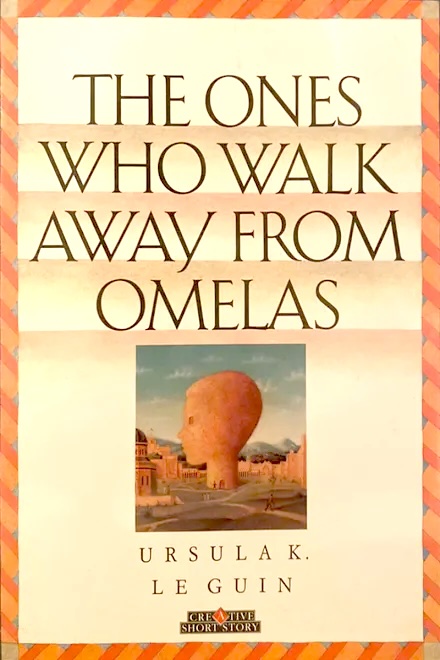
Ursula K. Le Guin’s 1973 story The Ones Who Walk Away from Omelas has been discussed to death, but the boys have finally cracked the ONE TRUE reading. Huddle in.
Rich remembered this being a glorified trolley problem that would allow us to settle the question of ‘who is the most utilitarian-brained of us all’ but it’s not! It’s about politics, and capitalism, and bold utopian leaps!
On the real-world parallels: does western prosperity actually depend on the suffering of the global south? Is there a difference between culpability and moral luck? Is there such thing as ethical consumption under capitalism?
Fighting the hypothetical: Benny has largely solved moral philosophy and finds the story less compelling the second time around. Also, Omelas is not very revealing as a thought experiment. We talk about how thought experiments fail, and compare with Nozick’s experience machine.
On those who walk away: morally serious dissenters, or virtue-signalling posers? Is Le Guin really so against incrementalism that she has set up the experiment so it’s impossible? We manage to find an optimistic reading lurking in there too.
Plus: Why can’t kids these days read good? We debate whether it’s a moral panic, if the use of LLMs helps or hinders, and how fucking stupid you’d have to be to try and start a literature podcast in a post-literate society.
This is a running podcast now
Cam: No, you can wear it on the way home.
Benny: Nah, yeah, for sure.
I think you could go to a restaurant after with it or something. I think that’s appropriate.
Rich: Nah.
Benny: With sub-1:30? Yeah, that’s fine.
Rich: It’s a participation trophy.
Benny: I guess it doesn’t say your time. It just says that you completed it or something.
Rich: No, they hand-etched everyone’s time onto it as they’re handing them out to all 3,000 finishers.
I reckon podium gets a medal. No one else should get anything.
Cam: No, no, no, I like you running in the middle at the marathon. Not for me — for everybody.
Rich: For everyone else.
Benny: Now, because it just increases the participation cost by that much more. I don’t want to pay for that, you know. You just lose it in a week.
Rich: Or you put it in a shoe box. What are you gonna do with it?
Benny: Yeah, exactly.
Cam: Whenever I’m trying to clear out the house I see some of like Ellen’s ones, I’m kind of wanting to throw them out, but I don’t. They’re in the cupboard.
Benny: Good move.
Rich: Yeah, incredible instincts, Cam. No, I’m just — I just wore this to troll you, Benny, to be honest.
Cam: You had us there, Rich.
Benny: Dude, I figured. I’m very impressed, dude. That’s an extremely good time. I think I’m screwed. I’m even doubting my targeted time at this point.
Cam: What is that, 1:30?
Benny: Nah, I was aiming for 1:35. We’ll see how that goes. I did a speed run today and got absolutely messed up. And in the middle of that I was like, I hate this. What am I doing? So we’ll see how that goes.
Rich: I’m just checking Strava. This will be really good podcast content.
Benny: I’m sure people love this.
Rich: I can’t see it. You’re going underground in case anyone copies your style.
Benny: Well, what do you guys do for indoor runs? Like, if I do my speed runs inside — it’s cold here today, so I just did it on a treadmill inside. I don’t — I never log those on Strava. I basically just do my outdoor recovery or long runs. So you do all your speed work and stuff outside?
Rich: I’ve only used a treadmill like three times in my whole life. So, yeah, I don’t know. I live in a — what do you call it — a temperate climate. It’s always fine for running.
Benny: Yeah. I’m more thinking of just dictating paces. Treadmills are very convenient because you know exactly how fast you’re supposed to be going. And then you can just set it to that. And if you’re doing minute work or X number of minutes at a certain pace, you’re hitting exactly that pace for exactly as long as you need to sort of thing.
Rich: Yeah, that’s true. I have a loop around a lake that I use, and I use it for every single workout. So I know how long it is, where the elevation is and how I might need to adjust my splits accordingly. But at least I’m still running around a lake. Like, it’s pretty.
Oh, you and I went around it I reckon, Benny — the one with the black swans. The famous black swan.
Benny: Oh yeah. Yeah, that’s true. Sometimes I forget what the example is now, because I’ve seen black swans and I’m like, is the example supposed to be all swans are white or all swans are black? Like, I don’t know.
Rich: Oh, this one’s a black, yeah.
Cam: Yeah, do we have white swans over in the antipodes?
Rich: I don’t think I’ve ever seen one, so therefore…
Cam: Do they exist? Yeah.
Benny: Out of philosophy, man. Just the examples make no sense for you.
Rich: Yeah, we live in upside-down world.
Cam: All right, yeah. With eggs — like, there’s white eggs and brown eggs. I’ve been asking some dumb questions recently. Does America have brown eggs?
Benny: Does America have brown eggs? That’s a crazy question. You think the entire country —
Cam: Yeah, well, in all the media you see white eggs.
Rich: Those weird sort of bleached-looking, unnatural-looking eggs.
Cam: Yeah, they have white eggs, right? And are those bleached or do they come like that? You know, I can probably Google these.
Rich: These are the big questions.
Benny: I don’t know.
Cam: Yeah, don’t worry, we’re going to get deeper.
Benny: I only show up with the requisite knowledge to talk about the book. Anything outside of that I’m not prepared for.
Rich: I’m not even willing to grant your premise that brown eggs exist until I see them with my own eyes.
Cam: I wonder what colour a swan’s egg is.
Benny: Bleached eggs is way outside of my wheelhouse, my god.
Rich: Do black swans lay white eggs?
Cam: To be honest, I’m so used to brown eggs, but if you’re really used to white ones, I imagine brown ones would feel a bit yuck, you know — even though I think they’re more natural.
Rich: No, the brown ones look way more natural, and they’ve got little speckles on them.
Benny: They look way better. Yeah, the speckles are where it’s at.
Cam: Would you break one egg for the perfect omelet? Not a bad trade-off.
Benny: That was good.
Rich: Well, it’s going to be a one-egg omelet though.
Cam: Yeah. The perfect one-egg omelet. A little bit of cheese, a little bit of capsicum — whatever. No, to be honest, if you don’t like capsicum, it doesn’t matter, whatever you want. If you hate capsicum, there’s no capsicum.
Benny: If you want some olives, throw in some olives. Add an olive or two.
Cam: Yeah, but I don’t like olives.
Rich: Okay, should we do some serious philosophical inquiry?
Cam: Speaking of —
Benny: Let’s hear why Rich is a virtue ethicist now. I know it’s going to come up.
Rich: Done the warm-up questions.
Cam: I’ve been a utilitarian my whole life, and then I read the story about the single —
Rich: This is funny, man. Okay, this already didn’t go how I thought it was going to go. So we’re reading this week The Ones Who Walk Away from Omelas, which is a very famous 1973 work by Ursula K. Le Guin, a giant of 20th-century science fiction.
Benny: Our second Le Guin.
Rich: Yeah, and that’s going to prove important. Anyway, I feel like I’m hung over.
Benny: This guy’s still messed up from the half.
Rich: I slept so badly, and I had two beers and I feel absolutely terrible today. But you guys will have to do the heavy lifting.
Anyway, so this is a story — it’s kind of in the Borgesian tradition. It’s not really a story. There’s not a plot. It’s a thought experiment.
Cam: Would you say a story?
Rich: It’s basically a thought experiment in moral philosophy dressed up in literary garb — or that’s what I remembered from when I read it ten years ago, thinking, oh, this is a glorified trolley problem. I chose this story because I’ve been feeling a bit of hesitation lately about whether consequentialism is the right form of ethics, and I’ve been flirting with virtue ethics. I thought, let’s talk about it, and let’s go back to one of the more canonical thought experiments. And then I realised it’s not really about that. It is about that on one level, but it’s more of a socio-political allegory or tract, which surprised me.
Impressions vs the first time we read the story
Rich: So I hadn’t read this in forever. Have you guys read this before? And how long ago was it?
Benny: Mine was probably similar to you, on the order of ten years. I mean, it struck me differently this time. I found myself just less taken with it overall. Probably partially because the territory of consequentialism and ethics and stuff seems a little less exciting to me than when I first got into it. I think I’ve resolved a lot of those uncertainties for myself, as opposed to when I was in my early 20s and you’re faced with a lot of these thought experiments, and you’re like, wow, you know, what sort of family of ethics am I going to buy? And you get all interested in the paradoxes, and you’re trying to be a good little effective altruist, and you’re wrestling with utilitarianism and consequentialism, et cetera. And it all seems very exciting. So yeah, for whatever reason, I found it less compelling than I did when I first read it. But again, I think that’s just partially because I’ve probably wrestled with these issues a lot.
Cam: You’ve solved that, self-loss, self-philosophy.
Rich: Oh, I can’t wait for you to just tell us the answer — the correct answer. Yeah, he’s done it, ladies and gentlemen.
Benny: Yeah, yeah. Don’t worry. I am the philosopher king of this podcast.
Cam: Man, it just requires one kid, and then yes, there’s sort of a great deal.
Benny: Yeah. The kid’s kind of ugly, too. So, I mean, what’s the — what about you, Cam? Have you read it before? Or is this the first time?
Cam: Yeah, same as you guys. I mean, one thing I thought was — not compelling is the wrong word, but I really like the name. Hey, Omelas — it’s a really great name. And I think apparently it’s like Salem backwards, but Salem with an O. And I think she just saw that on a sign or something.
Rich: Yeah, Salem, Oregon.
Cam: Okay, not Salem, Massachusetts. That’s where they walk to, maybe.
Rich: Holy shit, we’ve cracked the story.
Cam: But like, as a meme — just like, you know, everyone talks about the Omelas child and tries to think of funny quips about it or different variations. Yeah, I just think it’s sort of sticky. And I suppose more generally, the other — this one symbol of what happens in the main story is very sticky and strong and visually strong. It’s part of its success.
Rich: Yeah, it’s so visceral.
Cam: Yeah, yeah.
Synopsis: a utopian city with a dirty little secret
Rich: So we find ourselves in the city of Omelas, which is a beautiful seaside port city of unbelievable happiness and delight. The people are happy. There are no priests, there are no soldiers, there’s no king, and there are no slaves. And there’s no plot to speak of, except that today is the day of the summer festival, and there’s a really exciting atmosphere in the town. There’s young people who are getting ready to race on horses, and we’re just sort of taking a tour through the town to see the sights and sounds and see everyone enjoying themselves. And then Le Guin is throwing in a bit of world-building about how utopian this place is and how wonderful it is, before she pulls the rug out from underneath us. But she does it in an interesting way, where she says, instead of telling us exactly how Omelas is, she says, like, build your own utopia, really. If you don’t like this one, then tweak it as you see fit. If you like olives, we can do olives. If you like anchovies, we can do anchovies. Which I thought was an interesting twist on it. Anything you guys want to say before we get to the rug pull?
Cam: If you like having mass orgies and doing drugs every day with zero downsides —
Rich: Oh yeah.
Cam: — you can have that as well.
Rich: Yeah. And then we come to the twist of the story, and the philosophical problem that we’re confronted with, which is that all of the happiness of the city is contingent upon this dirty little secret, which is that there is one child locked up in a tiny little room beneath the city, and lives in abject misery, sitting in its own filth and shit in the darkness with just a tiny glimmer of sunlight. And it gets fed some kind of cornmeal or something like that, but it’s malnourished. It’s ten years old, but it looks like it’s six or something like that. And all the people are forbidden from showing this child any kindness, or even speaking to it, giving it a kind word, let alone cleaning it or giving it proper food or bathing it or anything like that.
So I’ll just read one passage.
The people at the door who visit never say anything, but the child, who has not always lived in the tool room and can remember sunlight and its mother’s voice, sometimes speaks. “I will be good,” it says. “Please let me out. I will be good.” They never answer. The child used to scream for help at night and cry a good deal, but now it only makes a kind of whining, eh-haa, eh-haa, and it speaks less and less often.
Yeah, I found that bit just as shocking and visceral as when I read it the first time. I think it is a really good way of sort of sheeting home the suffering. But then it’s from that point on that I sort of diverge from Le Guin’s intent with the story, I think. But did you guys want to say anything more about the suffering child, its portrayal, or anything that I’ve left out?
Benny: Yeah, we should maybe also just say that everyone in this town or city, what have you, knows that this child exists and is brought at some point during their childhood to see the child, I think.
Cam: It’s like this one school day of the era. It’s kind of like a school trip. You sort of — there’s some sort of hand-railing on the way there.
Benny: Yeah, exactly. Field trip to see the slave child in the basement. So I think they say between ages 8 and 12.
Rich: And it’s actually encouraged to throw rocks at it, unlike when you go to the zoo.
Cam: Yeah, start a food fight with —
Benny: And some people come back to see it multiple times, and some people don’t, but everyone knows that it’s there.
Cam: Did I say that — the guy that returns there? There’s some that walk away and there’s some that return like every month.
Benny: Yes. Now, I actually think I may have read an abridged version of the story. How long was the version that you guys read? Because the quote that you just read is not — I do not remember that being in that little short story that I read. When it actually talks about the child speaking —
Cam: There won’t be an imprint. This is, like, three pages.
Benny: Yeah, it’s like super short, right? It’s like four pages.
Cam: I have one thought about the child. It hit me that how visceral it was kind of depended on it being a child rather than an adult.
Rich: Yeah.
Cam: It’s way more emotionally impactful. If you just see like a wretched man or something — it’s almost, you can imagine it’s a Gollum or something. You’re sort of probably freaked out rather than feeling sympathy. I mean, you probably have sympathy, but you could imagine a type of old man that when you go and visit it, you’re kind of scared of it. And it’s a much more powerful emotional impact as a child. And then I was like, well, then does that imply that you sort of have to make it a kid? You know, every — I don’t know, I’m just wondering how long you’d have to change it. It’s probably like the same as the Humbert Humbert timescale. Like, it’s a sweet spot of like 9 to 13. Well, it’s probably younger actually. But like every five years you have to change it to make sure it’s a child.
Rich: Yeah, well, that’s not mentioned in here. Crucially, right, there’s nothing about how the child was selected or whose child it was. I thought there was, and then I was thinking we’d talk about, like, the veil of ignorance or something about whether you would accept the chance that it could be you or your child. But no, she just completely glosses over that. It’s just an eternal Platonic child that came from nowhere in particular.
Cam: Yeah, there’s a short story there, mate. Similarly, the consumer grows up. Yeah.
Rich: Yeah, anyway, just to stress, the causality of this world is — it’s not like this is some backwards ritual or weird religious conviction of making a sacrifice so that the harvest is good or something like that. The bizarro causality of the world is that these are the terms — they all understand that their happiness, the beauty of their city, the tenderness of their friendships, the health of their children, blah blah blah, depend wholly on this child’s abominable misery.
And so everyone goes to visit the child once they are of age, and some of them decide that they’re not okay with being complicit in this system, and they choose to walk away — the titular walkers-away. The place they go towards is a place even less imaginable to most of us in the city of happiness. I cannot describe it at all. It is possible that it does not exist, but they seem to know where they are going — the ones who walk away from Omelas.
Cam: Did you have that part in it, Benny? That was an important — yeah, important part of the story.
Benny: I did. So yeah, I found the eh-haa eh-haa in my version. I don’t know what I was talking about earlier.
Cam: A very important point that we left out — that it’s not just arbitrary. All the flourishing and happiness, as fantastical as it is, depends on this one child suffering in the basement.
Rich: Yeah.
Cam: Just imagine that field trip, you know. Someone asking, “how does this work?” Let me just — “shut up.” You’re like, “don’t ask.” Yeah, just like, “why is my TV being on, the car running, how does this work?” “Don’t question it.” But that changes, and everyone knows that, right? That’s part of the society’s knowledge. They know not only this child’s suffering, but that’s how everyone flourishes.
Rich: Yeah.
FIGHTING THE HYPOTHETICAL
Rich: Exactly. So I think we can take two runs at this. The first is the one where we try not to fight the hypothetical, and then the second, I’m going to fight the hypothetical.
Cam: Yeah, yeah. Don’t think it’s possible.
Benny: Yeah, I mean, I think — so I agree that for the purposes of this conversation, it could be interesting to just say, okay, suppose you’re in this hypothetical world, what then? But I do find the fight against the hypothetical to be a big reason of — it’s a big part of the reason that I didn’t like it that much the second time, or at least found it to be utterly uncompelling. I think, you know, it’s just like, this is not how the world works, and is so far removed for me from normal ethical considerations of actually just what to do next, that I found it just rather pointless, I’ve got to say. Maybe I just have less patience perhaps for these fantastical thought experiments than I did when I was younger. I think thought experiments are useful insofar as they help you shed light on aspects of the world, and I’m a little skeptical that this does that in any meaningful way. So anyway, I’ll just leave my complaints there for now. But it is hard to get behind it, I think, for that reason.
Cam: You guys ever seen that criticism where someone presents a philosophical thought experiment, and then someone’s like, “well, that’s not real.” And then some people are like, “oh, come on, it’s hypothetical. It’s not the point. We’re trying to constrain variables and think about it.” But then someone’s like, “no, no, it’s not reality, so it’s not worth —” it’s kind of like the breakfast man. And I always thought, yeah, that’s just stupid. But then sometimes I was like, well, I can imagine it being a little bit harmful if it is lacking reality but it’s superficially similar, and it could confuse your moral intuitions.
Rich: Yeah.
Benny: Yeah. I mean, I think a useful lens to have on this is just like thought experiments are like mathematical models, in that there’s better and worse versions of them, and they approximate reality to better and worse extents, right? And like, you just have to be careful if your thought experiments are reflecting reality in any useful way. They’re all trying to isolate certain variables, and just some do that more successfully than others. And I would just argue that this actually doesn’t do that very successfully. But the writing is nice, and it’s a compelling story on its own. But as an actual device for investigating ethics day to day, I didn’t find it very insightful.
Cam: All right, that said, let’s assume it’s true.
Benny: Yeah, yeah, sure.
Cam: What is — you know, thoughts?
Rich: Well, for me, without fighting it, I would stay in Omelas. But I think I can’t even talk about it without fighting, because I think that answer means nothing. The answer is meaningless. It tells you nothing about my own actual ethics, really. It’s not a deep revelation or insight.
Cam: Well, I think some people still would walk, right? Like, if — not just viewing this as a metaphor of certain aspects of society, but just as is — the injustice of a single child suffering is injustice.
Rich: Yeah. Actually, maybe let’s do it the other way around. Let’s fight the hypothetical first and then talk about that, because I think that leads more in the political, real-world comparison direction, which is — I now realise — much more interesting than the assumed glorified trolley problem element.
Cam: It just reminded me of the trolley problem. Just thinking now, is this literally a reverse trolley problem? Like, the trolley’s hitting the one, and the switch is 10,000, a million people. Is that kind of it? It is — if you were to let it.
Rich: Exactly.
Benny: Except it doesn’t kill them. It just runs over their leg over and over again.
Cam: Yeah, but walking away wouldn’t be flicking the switch — which actually is an interesting point even just in this hypothetical, right? The ones that walk away, they’re walking away, the child’s still suffering, right. And so you’re not gaining anything from this suffering — that’s the kind of implied reason why they do it. But there’s this other option. Like, even if you granted that this is something that’s not worth it in this contrived scenario, probably the better thing to do is let the guy escape.
Benny: I mean, yeah, I think the rhetorical answer to this whole thought experiment is just that the ones who are walking away are pussies, and they should stay and try and figure out how to free this child, or effect change in some way to change society for the better so that this doesn’t have to happen. But she doesn’t leave you that option, obviously. She doesn’t want you to have that option. It’s like this binary choice where you either leave or you stay.
Cam: Yeah, I mean, maybe that’s part of the thought experiment, right? You can’t break in — it’s just like concrete walls and stuff.
Benny: Yeah.
Rich: Yeah, I want to get there. I think this is like an anti-incrementalist parable that artificially and in a contrived way says incremental reform of the system isn’t possible. You have to go and take a grand utopian leap, even if you don’t know where it is you’re leaping to, and you don’t have well-formed plans about how you’re going to get there. And that is also a reading that I disagree with and don’t like, hence why the story has kind of left a bit of a taste in my mouth this time around.
The case against thought experiments: if magic was real, would you grant that magic was real?
Rich: But just to get back to the core problem — I think it’s worth talking more about how thought experiments fail. As you say, Benny. Just another way of putting it: something I’ve noticed with a lot of thought experiments I previously found compelling is that if you really condense them down to what they’re saying, it usually takes the form of something like: “if magic existed, then would you agree that magic exists?” And I’m like, yes, but —
Cam: Yeah, but I did eat breakfast. Kind of a good argument now I think about it.
Rich: Yeah. And if you think about some of the more famous ones — the one where I had this realisation was Nozick’s experience machine. Are you guys familiar with that?
Cam: Yeah, well, I think people know.
Benny: It’s worth saying for the audience, I think.
Rich: Okay. Well, I mean, it’s sort of imagine like a Matrix-like scenario — more people have probably seen The Matrix — where you live in a false simulation of a world, but you’re extremely happy, and all of your dreams come true. You get the Cypher Matrix experience of delicious steak and beautiful women. You will never know that you’re in the experience machine. You could stipulate that everyone else is in there too, et cetera. And I found it hard to disagree with that. Like, you know what, assuming some other things — like problems in the real world are being solved by someone — but there is no experience machine. It’s not probably possible to have one. And most importantly, you can never trust the guy who’s offering you to go in that experience machine. And in order to trust him fully that all of those conditions are met, you have to essentially just believe in magic and be like, okay, I leave no room for doubt about all of these claims you’re making. And that’s impossible to do. So the whole thing just falls apart. And in my mind it’s like saying, yeah, but magic exists here. And it’s like, okay, well, sure, then it’s tautologically true. If you’re telling me that I can believe with perfect infallible true knowledge something about the world, then okay, I will believe with perfect infallible true knowledge about the world. But that is never ever true in our world under any circumstances. So who cares? What’s it got to do with the decisions that we make in real life? And the same applies here.
Cam: Yeah, I think it mostly applies. If you assume that somehow you get this perfect side and flourishing for everybody, and there’s like one child — so the optimal number of children suffering is non-zero, and it’s one — it seems like a really good deal. Such a good return on investment that may —
Rich: Just imagining the sadist — and he’s like, “make it two children.”
Cam: Yeah, well, it’s just like — yeah, maybe you should build more basements. You know, it’s a good return on investment. But no, okay, so it’s like one child, and it’s saying — yeah, it’s kind of like it’s so impossible, but if that was the case, then yeah, sure, that’s an obvious deal. But I actually think a lot of people’s intuitions — I mean, maybe without thinking about it too much and arguing about it too much — would be, well, actually, no. You can still talk about the hypothetical on its own and perhaps disagree, because injustice, no matter how much good comes from it, and no matter how little the injustice is compared to it, is a deal-breaker.
Rich: So are you saying you would walk away while buying all of these premises, Cam?
Cam: No, no, no, no. I’m saying I think some people would. So it’s not — yeah.
Is walking away a moral act or empty posturing?
Rich: Right. And in other words, they wouldn’t be perfect consequentialists, because they would know that walking away is a sort of futile, empty action — because the child’s still locked up in the basement.
Cam: Yeah, yeah.
Rich: And if anything, if it causes them to suffer more, then they’re increasing the net suffering in the world. Although you could also argue —
Cam: If they suffer more — yeah, but in one way, they’ve alleviated their guilt, right? That’s sort of — I had one thought, it’s like the one pleasure that’s not allowed in this place is to be guilt-free of all this flourishing. It’s like, no, everyone’s ridden with this guilt and this knowledge, and so some people walk away from that.
Rich: But I don’t think they are. There’s this line about how guilt does not exist within the walls of Omelas, which I think is another way of saying — for those relatively rare people who do feel that, they remove themselves from the situation.
Cam: I was just imagining like — it’s impossible, you can’t be good. They’re just walking away, you know. So we’ve missed the whole — they just lost. Not guilty, just sort of whistling. I mean, they are described as sort of in the immediate aftermath, I think, most of them. So it’s like, it sounds like maybe you go back to society and you forget about it somewhat. But some people, as soon as they see it — I think a lot of them were kids, right, who walked away — but then also adults who returned and saw it and were reminded of it and then walked away. But it doesn’t sound like you suddenly walked away after five years.
Rich: Yeah. So the strict utilitarian calculus would be: does the guilt that you feel — the suffering caused by the guilt that you feel — outweigh the pleasure that you would derive from living in this wonderful perfect society? And then, for those who walk away, maybe they’d say they’re so torn up that they’re increasing net utility in the world by walking away, because they no longer feel guilt. But that’s weird, because the child’s still suffering. I would still feel guilt about the fact that I wasn’t able to help it, perhaps, for instance.
Cam: Yeah, it doesn’t alleviate it. And I also had the thought about the place they’re going, like walking off to the mountains. I’m wondering, would that be safe? And if it is safe, that’s potentially contingent on this child suffering as well. It’s not explicitly stated, but if the child’s not chained up, then all chaos breaks loose and potentially reaches the mountains as well. There’s this assumption that you’re away from it, but potentially you’re somewhat less flourishing, but still — okay, life is dependent on this as well.
Benny: Do you guys agree that the tone of the story is that one should want to be the kind of person who walks away from Omelas?
Cam: Open for either way. But yeah, I think so. I think you’re meant to admire the people that walk away as being brave and sacrificial in the face of injustice.
Benny: Yeah, I agree. And does that track with anything we know about Le Guin? Do we know that she had been outspoken against utilitarianism or consequentialism in any of her other writings or at any other point in her life?
Cam: I think she’s more outspoken in terms of the maybe that second part of the discussion that we might have around an unjust society being built on suffering.
Le Guin’s true motive: socio-political critique or glorified trolley problem
Rich: Yeah. That’s why this story went so differently for me this time around — with the context of having read The Dispossessed in my back pocket. And that’s why I believe that this is not really about utilitarianism. That’s not really what she’s interested in. So yes, she wants to encourage people to walk away on some level, or it’s implied that that is a good thing to do. But it’s not like a virtue ethics versus utilitarianism frame where you should do the right thing regardless of the consequences. The passage that I found very illuminating was where she was talking about how it’s really hard to envision a world without suffering. So the first thing she does is lay out this wonderful utopia, right? And then she says something like, “do you believe me? You don’t, because we need to put some kind of a sting in the tail to make it more believable” or something. And that’s when she introduces the child. And there’s a quote that says:
The trouble is that we have a bad habit, encouraged by pedants and sophisticates, of considering happiness as something rather stupid. Only pain is intellectual, only evil interesting. This is the treason of the artist: the refusal to admit the banality of evil and the terrible boredom of pain.
So she wants us to be brave enough to envision a world without suffering at all. It’s a story in favour of genuine utopian visions, I think. And so the reason why the ones who walk away from Omelas are praiseworthy is that they’re going off into the blue yonder to try and find some other system which isn’t built on the coercion and suffering of any human individual. They don’t tear down the society, because she stipulated that that’s not possible. But they are actively looking for a better way of doing things — like blue-sky thinking, or whatever you want to call it. And what we do know about her biographically is that she is very interested in anarchist, leftist forms of political organisation, right? That’s what we learned in The Dispossessed. And this is why I kind of don’t like the story on rereading, because I think I disagree with her method of making the world better on the deepest possible lesson level. And then I’m rereading this story as kind of like a very sneaky rhetorical device to encourage people in this direction, which in my mind is the wrong direction. But I’ll just stop there to let you guys sort of react to that reading of it.
Is Omelas actually an anarchist utopia?
Benny: It’s interesting because, as you said, she has these anarchist leanings. And she actually depicts Omelas as basically an anarchist utopia. She says there’s no kings, there’s no police, there doesn’t seem to be any form of government. It just seems to be self-organised and perfect. And so it’s intriguing that she chose it to be that sort of society, and it still had her sort of ideal society built upon suffering, and then had people leave it — as opposed to it being some sort of hyper-capitalist world that presumably she wouldn’t have liked. And maybe her point is broader than that. It’s just that whenever there is suffering, we should be looking for alternative ways to live or alternative forms of government or something like that. But it is interesting that Omelas itself is basically an anarchist haven.
Cam: Yeah, I didn’t think about that. I wondered if it’s almost like a floor, because I think you’re meant to kind of read this as the metaphor of current society, or, you know, pick your country — Western civilisation, perhaps. But yeah, you’re right, she does actually make it this kind of anarchist utopia. And maybe that — but the purpose of that seemed to be like, that pulls you in. It’s just like, no, no, just trust me, choose your own adventure, it’s great, you’d really like this.
Rich: Yeah, I just want to push back on the anarchist thing actually, because she doesn’t say that or even really hint at that. She very deliberately describes all the outcomes and says nothing about the actual political-social structure. So you could —
Cam: Well, she just said no kings.
Rich: But imagine — I mean, we don’t have a king either. There’s —
Cam: Yeah, okay, you kind of read it as no leaders. But like, maybe — yeah, maybe we’re reading too much into that “no kings” comment. But there’s no police, potentially as well. It’s, you know —
Benny: I don’t know, Rich, I kind of disagree with you. So she said:
They did not use swords or keep slaves. They were not barbarians. I do not know the rules and laws of their society, but I suspect that they were singularly few. As they did without monarchy and slavery, so they also got on without the stock exchange, the advertisement, the secret police, and the bomb.
Cam: The stock exchange — what’s that done?
Benny: Right, yeah, there’s no stock exchange, right? So that’s a very —
Rich: I mean, anarchists and no bombs? Come on.
Cam: Yeah, you had me. You had me as well. Yeah, this doesn’t sound like a utopia. This is not what they told me.
Rich: Yeah, okay, well, that’s interesting. So you think that undermines it a bit, that she’s accidentally — I say accidentally — sort of given a flavour of anarchism to the society that she wants us to reject in favour of some other even better society? But I have to give her props for making the strongest possible case for her claim, which is that no matter how good you make your society, and even if it’s almost perfect in all the ways that I like — such as there being no advertising, no stock exchange, and other sort of leftist ideals — any suffering at all, if the prosperity of the many is built upon the suffering of the few, no matter how few and no matter how many, then we can do better than that. So at least she’s gone for almost the hardest possible sell there, I suppose, right? All the purest possible principle in favour of — against compromise and in favour of total utopia. Like, true utopianism.
Benny: Yeah, there’s also a sympathetic take here, which is that she was deliberately wrestling with some of her own doubts regarding something like anarchy, right? She might have been involved in like early-stage experiments there and realised — I mean, there’s some people who aren’t happy under this system, and what are we going to do about that? Are we just going to forge ahead regardless with our revolution? Or are we going to take that suffering seriously?
Cam: But then the solution is go to the mountains, right? Which is kind of —
Benny: Well, which is to leave behind perhaps the project that she is sympathetic to, maybe.
Cam: Yeah, that might be.
Rich: The key thing is not just the leaving that everyone focuses on — I think it’s the going somewhere else, or the looking, the searching, the questing. That’s what I didn’t appreciate last time I read this book. And that’s what I think the real point is — that it’s not just walking away from this, it’s trying to do something different, even though you haven’t actually sketched out a viable alternative. Like, you don’t know what the alternative is, but you’re going to just try anyway. And on one level, I kind of like that, I guess, because it’s in favour of experimentation and looking and being creative and problem-solving. But knowing what we know about her political beliefs — and this pattern throughout history has been kind of like this utopian leap has an absolutely horrible track record in history, where you say, “let’s wipe away market economies,” or “let’s wipe away liberal democracy,” or whatever it is. And, “I have a general idea of what’s going to come later, we’ll figure out the fine details as we go. Like, don’t you have any ambition? Don’t be such a petty accountant. You’re going to have big vision here.” It goes fucking horribly, like the Bolsheviks, the USSR, Khmer Rouge. Like, this idea that reform is a failure of imagination or a compromised position means that you’re not a morally serious person, right? I don’t know. I’m not a political historian, but my intuition is that that line of thinking is really bad and harmful versus more reformist, incrementalist lines of thinking. But I could be totally wrong about that too.
Benny: I mean, I mostly agree with you, but in the spirit of defending her, she’s deliberately positing that these people who leave don’t try, as you said, to tear down the existing society, and instead they leave and try and do something new on their own, or perhaps with other people that they find along the way. I think what has happened historically is that people have some utopian ideal in mind, and then they try and instigate a revolution in a stable society.
Cam: Free the child and society collapses.
Benny: Yeah, exactly.
Rich: Yeah, right, right.
Benny: And that’s what often leads to terror and pain and suffering — is trying to tear down an existing society and erect something new. But she’s deliberately saying, okay, maybe if you’re unsatisfied with the status quo, maybe the solution isn’t actually to try and tear down the status quo. It’s to just express discontent with it and then to leave and try and do something new. And I actually do — that is more of the incrementalist move, right? It’s to say, okay, I don’t actually know how to solve these current problems necessarily, so I’m going to go off. I’m not going to try and tear down this existing system because it’s sort of the best we have at the moment. I’m going to leave and try and seek something new because you’re optimistic, and you believe something new and better does in fact exist. So there actually is, like, a very optimistic slash incrementalist reading of the people who walk away, which actually didn’t occur to me as I was reading the story.
Cam: It’s funny, like, I may have said this last week, but one of my thoughts was the sort of critique that the people that walk away — actually, you know, the suffering is still happening, it’s not better, and there’s this virtue-signalling element to it, and actually freeing the child would be — if you grant the frame that it’s wrong, then that would be the right thing to do. But if you don’t think that’s the right thing to do, and actually freeing the child and collapsing society would be bad, then actually the virtue-signalling is good, actually. Part of my thought — it’s better just to walk away and leave this flourishing utopia, even if it’s not for you, and ruining that would be worse. So part of me thinks like, oh, you know, virtue-signalling, something like that — kind of cringe and kind of annoys you. You’re not actually doing anything to change. But insofar as doing those actions would be bad, then actually it might be a good thing.
Rich: Totally, yeah. The surface-level critique of the story of the people who walk away is that they are like posers, basically, right? Where they want to feel like martyrs or feel like a sense of moral superiority despite having no impact on the actual world that they claim to care about. But — okay, so very good point. You’re right that if this could be more radical, it could be, like, blow up the whole system, rescue the child. That would be the hardcore leftist take on it, I suppose. So I now realise that what I’m really feeling bad about is how she’s stacked the deck by making reform of Omelas impossible. That’s what bothers me — that she’s just ruled that out from the very get-go and forced us to accept this frame. It’s the disanalogy between Omelas society and the real world that’s what bothers me, that this thought experiment still sort of means nothing. Because the true solution would look something much more of the form of, like, in the real world, not only is this not the case where suffering magically is causally connected to prosperity for a place, it’s almost the inverse of that. It’s usually the inverse of that. And we’re sort of zigzagging our way towards getting more and more of the inverse of that.
Cam: Why I think that’s one of our cruxes and our ideological premises in the background here — that we just don’t grant the idea that flourishing of this kind is reliant on arbitrary suffering. Causally, we just don’t think — if anything, that’s kind of maybe a blood libel. But, I don’t know, to steel-man it, it’s sort of thinking like, well, okay, perhaps — yeah, well, okay, yeah, to steel-man it: what’s actually happening, I think, in our society is — well, I mean, you can talk about injustices certainly in the past, and even currently. But generally we don’t live in an equal society. You have winners and losers, you have downtrodden and poor — and we have wars and stuff, but not even to talk about that. Just —
Benny: This guy’s been reading too much Houellebecq, dude. Oh, man.
Rich: Yeah, we’ve got incels.
Benny: We got the ugly incels.
Cam: Who’ve got incels? What about the incels? Okay, now the other — and the child’s an incel, by the way.
Benny: What about the incel?
Rich: Hey, orgies for all — actually, when she said, “and by the way, there could be orgies if you want,” I was like, you know what, I’ll stay. I’ll stay.
Cam: Yeah, yeah, yeah. I know you, man. You’re out walking away, you’re sort of at the border, and someone’s like, “yeah, yeah, I plan to leave, I plan to leave in like, you know —”
Benny: Yeah, that’s the real question. How quickly do you leave? Do you start packing your bags? Like, do you leave that night, or like a week, or —
Cam: Three years.
Benny: I’ll leave eventually.
Cam: Yeah, yeah. It’s kind of like confession, right? As long as you do it before you die.
Rich: Just walk to the gates of the town, have a little look out, and then come back in.
Just one step at a time. You could build up to it.
Cam: Imagine, yeah, almost like Isabella running after — I think it was Columbus, who was threatening to cross the border when Spain weren’t gonna give him money to travel. He’s like, “I’ll go to France.” And there’s this apocryphal story, I think, where he’s sort of at the border, and someone’s running, “no, no, no, we changed our mind.” But I’m just imagining the wretch, right, at the end, and someone’s going, “no, no, no — wretch, wretch, there’s orgies.” There’s a — turns around. Yeah, maybe. Maybe I’ll stay.
Rich: Or Queequeg when he decides not to die because he finds out that GTA 5 just came out.
Cam: Yeah, yeah. I forgot to do something.
Benny: I feel much better now.
Cam: I always just imagine him springing up — like, in my canon, he just springs up. I can’t remember what he actually does.
Rich: There’s so much to live for.
Cam: Yeah. But like, we kind of don’t think the world works like that ultimately. But there are unequal distributions, and there is suffering. And then that’s a big political question of like, how much does the rest of society help towards those people? And — can you enjoy your flight, can we now enjoy our flourishing and our success and our world knowing there’s some people doing badly and doing quite badly, right? Is that a moral stance that’s okay to take?
Is there such thing as ethical consumption under capitalism?
Rich: Can we clean up the question a bit to say: do you guys grant that part of our good lives comes from people in the global poor, and so on, who are making the raw commodities that go into all of our consumer goods? And basically that our happiness is dependent on suffering of other people to some extent? Because I think that is probably true.
Benny: I am skeptical of this narrative that any sort of mass manufacturing in third-world countries, or I guess Global South or whatever the correct name is for these countries now —
Rich: I was going to say the Global South and then I was like, wait a second, I’m in the Global South.
Cam: No, you’re in a temperate class.
Benny: Yeah, exactly. That’s a — I can imagine that’s like a funny skit for someone whose English is their second language, and instead of saying Global South, they just say “the globe — the southern hemisphere” or something. They’re just talking about how the southern hemisphere needs to get its act together.
Rich: What is the politically correct term? Like, people experiencing low Gini coefficients or something?
Benny: I think it’s — yeah, people — that’s funny. Yeah, I think it is Global South, but I don’t know. I haven’t been keeping up.
But yeah, I am distrustful of this narrative. I mean, okay, let me say — I’m sure it is true to some extent, but we also have fairly good evidence that people opt into these jobs. So it’s better than the status quo. So it’s easy to look at a Nike manufacturing plant in like Zimbabwe and say, “well, okay, they’re paying them low wages and that’s no good.” But then you have to ask, okay, if the factory is not there, or given a choice between working in the factory and not working in the factory, the majority of people choose to work in the factory because it’s a better life than the status quo. And so you have to contend with that fact as well. And that’s not to say there shouldn’t be legislation around hours worked or wages paid, et cetera. But I think this general narrative that manufacturing in the Global South is just the Global North taking advantage of free labour in the Global South — I think that’s largely false.
Cam: Yeah, but what you’re saying now — there’s even a Paul Krugman essay, an economics essay in the 90s, saying that this is a real preference. This is what people prefer, and it’s that they’re actually better off. But then there’s the Marxist critique of saying, well, they don’t have any other option. So it’s like, either die or do that. So yeah, they’re better off, dying, but it’s still not good enough, right? Whether or not it’s unjust — but there’s still a second part where some of our flourishing is dependent on cow-fish and everything. Let’s say that you just raise the minimum wage for them. I’m sympathetic to you that you don’t necessarily need to, but let’s say you do, and then they make them better off. I think it’s true that things would be a little less efficient. We might not notice it — I don’t know. Well, then the argument is, if we don’t notice it, then maybe we should do it. But we’d probably flourish slightly less. I think it somewhat is dependent in that sense. And it’s certainly dependent, I think, on just like, in egalitarianism, unequal societies. If you really wanted everyone to be fully equal — and if that’s not the case, suffering in that sense — we would have a very different society.
Benny: Yeah, okay, I agree. I mean, let me strengthen the thought experiment and just say, the fact that there are poorer countries, and the fact that we’re exporting a lot of our labour to those poorer countries, regardless of whether it’s actually good compared to the status quo for people in those poorer countries — that in some sense is us piggybacking on their suffering, because even though their life working in the factory may be better than, again, the status quo, it’s probably not better than ours. Or they at least don’t have as much opportunity as us and stuff. So we are benefiting from the fact that there’s unequal wealth distribution between America and Africa.
Cam: Yeah, like you could rearrange society so they’re better off and we’re worse off, and everyone’s worse off — and that’s kind of what’s going on in the story a little bit. Yeah, but it’s wrong to think it’s just like us having someone in the basement.
Benny: Right, exactly. And also, this just ignores the evolution of progress. And I think this is what Rich was getting at, which is annoying — which is that, you know, we typically solve problems by starting with the status quo. We identify problems, and we slowly work to resolve them. And sometimes we’re successful and sometimes we’re not. But we start at the place where we’re at. It’s usually, and for good reason, typically counterproductive to just throw out whatever you have and try and start from scratch, because, you know, now you’re back at ground zero, basically. And you’re probably going to end up running into the same problems that we’ve developed solutions to now as you start scaling solutions up. So in terms of how society works, there’s a lot of knowledge that we have, and we’re just increasing that knowledge over time to solve our problems in better and better ways and to create more and more positive-sum outcomes.
Cam: First, you know, slightly more comfortable chains. You know, there may be some milk with the wheat. You know, it’s just like, eventually we’ll figure it out.
Rich: Those scary mops in the corner.
Cam: Yeah, the fucking mops. That’s right, great point. Yeah, what’s going on with that?
Rich: No, but listen — yeah, but this is again why there’s one interpretation of it where it’s optimistic, like you were saying, Benny, but it’s actually totally hostile to optimism, because it rules out the possibility of any of that happening. That’s the move. It’s not an optimistic take on how we make improvements to our societies. It’s exactly wrong about it.
Benny: I’ve changed — yeah, yeah, I agree.
Moral luck vs. culpability (EA is good akshully)
Rich: Another way of dividing it up could be like culpability versus moral luck. Where culpability would be: people in the Global South who make our shoes have a bad life, and that’s our fault. Versus: people in the Global South make our shoes and have a bad life compared to us, and it’s not our fault. It’s just we were born in this body and they were born in that body, and everyone is responding to their local incentives and everyone is making the best choice available to them. And I think I’m more in the second camp. But I still feel bad about that, and I still want to take whatever steps we can take to level things out and to sort of share in the good fortunes in a way that is sustainable and incremental and so on. Hence why I’m — if anything, now more than ever — a big fan of effective altruism, and trying to figure out how to pull the levers on global health and development, and I give my money directly to some poor guy in Africa and stuff like that. Because I don’t feel that it’s my fault, but I do feel like — I feel quite sad about just the fact that there are minimum-wage workers in New Zealand, a prosperous country with social safety nets, and that some grandma has to stack the supermarket shelves or something like that for her whole life, and maybe struggles to buy a house and whatever, and I don’t have to struggle with that kind of thing. And it’s at least partly just due to — or maybe entirely due to — my good luck. And I feel bad about that. I don’t feel like it’s my fault, but I do feel bad about that. And I don’t know, it doesn’t stop me from enjoying all the summer festivals and all the orgies that I go to and stuff like that. But I think it’s a good, healthy way to feel about things.
Cam: Yeah, no, you’re right. But like, don’t pull the rug on society. But it does suck — it sucks for some.
Rich: Yeah, I don’t want to dismantle capitalist liberal society. But I do want to —
Benny: Just because you’re a pussy.
Cam: I am.
Rich: Maybe that’s the other thing — is like, I’m so end-of-history-pilled. What could be better than liberal capitalist society? And we examined the anarcho-syndicalism at length and decided that that wasn’t it for us. But honestly, maybe I just lack imagination.
Cam: I think — okay, so —
Rich: No, and I think I was just thinking — like, when Marxism was big, I reckon I would have been really excited about it. And I reckon you would have had to be a bit soulless not to be excited about it, even, especially as a person with an intellectual life. I reckon, with the benefit of hindsight, it seems quite silly to me, but I’m almost certain I would have been swept up in it and a big proponent of it, in large part because of this big utopian thinking. And it wouldn’t have been clear to me the reasons that it would fail.
Cam: Yeah, I think you’re quite right. It’s quite common to see intellectuals who are now critiques of communist thinking — often you read their early life and stuff, and their background is usually communism as well. They had a phase. This is quite common.
Rich: Yeah, we might be unusual in just not having had that phase, because I read Ayn Rand before I knew anything about Marxism.
Cam: Yeah, it’s probably a generational thing.
Rich: Yeah.
Cam: One other thought I had around the story, and one other reading, was — there’s, I think, a Girardian (I don’t know why I said that so weird) — René Girard — there’s a Girardian reading to it of just like the scapegoat mechanism. I thought, this is quite a useful symbol of the scapegoat. And, you know, as we said, like, of course, it was kind of hard to believe, but just this idea of a lot of peace and reconciliation depending on finding the scapegoat. And like finding the one child, and then I found it interesting that the stipulation in there that you’re not allowed to show any comfort to this child — that’s an important part of it, right? These days now we see kind of Baudrillardian-type scapegoats, like online, where one person gets piled on or cancelled or something. And a big part of the rules are: you’re not allowed to show any niceties at all. So this single person is just unfairly getting it all, for it to work. So, just as a symbol of that — I mean, I’m not sure how much I buy Girardian scapegoat theories, but it did seem to fit with that as well.
Rich: Yeah, I think the Girardian stuff is — it’s like a different mechanism for the scapegoat, where you’re trying to diffuse all of the collective resentment about inequality or about whatever the social problems of the day are, and you take it all out on this one victim. But in this story, that’s not really how it is. It’s not like they hate the kid. It’s just this weird mechanical system that they have. It doesn’t sort of symbolise anything in particular.
Benny: Yeah, it is interesting that there’s none of that. Though you can imagine a twist on this story in which society over time becomes sort of poisoned by hatred for the kid as a post-hoc rationalisation for why they’re keeping this kid chained up in the basement.
Rich: Did it say that some people were cruel to the kid? Like, they kicked the kid or yelled at it or something?
Cam: There was — yeah, your mind wandering — what would I do if I visited? I don’t know. I can’t remember.
But yeah, I mean, not only the mechanism’s hard to believe, but it’s also just hard to believe this cognitive dissonance. But I suppose, you know, cognitive dissonance exists. But being able to be okay with this level of cruelty — but yeah, I suppose you just justify it, because that’s the only way everything works.
Benny: I have sort of a meta question for you guys, which is that presumably she wrote this for a reason. She had a thought in mind, she had a message that she was trying to explore herself or that maybe she was trying to get across. And I’m curious why you think she chose to write this as a little fictional parable, as opposed to either just writing a political essay in which she made the point she wanted to make, or wrote a book which would really have to flesh out the details of this world — which is part of the reason I’ve really come to respect fiction writers, to be honest, because it’s a giant extended thought experiment. You have to take your own thought experiment very seriously and flesh out the consequences, et cetera, et cetera. Whereas here, she doesn’t have to. She just writes this little five-pager. It doesn’t have to make it realistic. And so in that case, for a thought experiment that’s so fantastical like this, I’m wondering why she didn’t just write a little political pamphlet saying, “I’m fed up with the system for so-and-so reasons, and we should do such-and-such a thing.”
Rich: She did make a book.
Cam: Well, my guess is this would have been far more successful and influential and accessible. You know, you don’t have to be an activist to enjoy it.
Benny: Well, I don’t know, because everyone can read their own message into this, right? Like, even us — we’re having a hard time deciding, oh yeah, there’s this optimistic part of it. We’re sure they don’t tear down the existing society, they try and do something new. There’s also this pessimistic side of it, thinking you can’t change the existing society, right? It is confusing. And then there’s just the straightforward deontology versus consequentialist reading. But my point is, it’s actually not — and it’s not actionable, because, like we’ve been saying, it’s so fantastical, it’s divorced from any details of how the real world works. And so, like, what was she trying to do here?
Cam: I don’t know. I think — maybe you’ve been a little bit autistic about it. Like, anyone can read the story, and it really stays with them, and there’s this ethical dilemma at the end. I suppose maybe that’s part of its success — you get this ethical dilemma and people argue about it.
Benny: Yeah, I agree it’s a very — it’s become an extremely influential story. And if your goal was to just write a very influential short story, then she accomplished her goal. But my sense is that that was not her goal. My sense is — and we know this a bit from her other writings — we know she was very politically engaged, and she had ideas she wanted to explore. She had a way she wanted things to be.
Cam: I think it’s partly a goal. I think she wants to make art and make stories.
Benny: Sure.
Cam: It’s probably the —
The stickiness of the Omelas story
Rich: I think she succeeded on every level. Versus writing the pamphlet, which no one would ever have read, and she would not be a household name. And because she cloaks it in just enough ambiguity for it to not come across as an outright political tract — so much so that when I read this when I was in my 20s, I didn’t realise that it was primarily a socio-political allegory for there being no such thing as ethical consumption under capitalism, kind of thing. So I think she absolutely pulled it off, and all the readings point in the same direction. Like, she stopped short of saying “blow up the whole thing.” Okay. But other than that, the readings point in the same direction of: we need to envision a society in which the happiness of people is not built upon the suffering of the downtrodden, and sheeting home this very visceral feeling that at present, in our society, in the real world, our lives are built on the suffering of other people. And it works not just for leftists — it works for people across the spectrum, I think. So I think it works really well, even though ultimately I kind of disagree with it and I feel it to be a sneaky rhetorical kind of trick in the way that she’s set up the thought experiment. So fair play to her for having such impactful messaging. This has got to be her most famous work, right? And it’s just — it’s not even a story. There’s no plot.
Cam: I do wonder if it’s the most famous work. It probably is. I think there’s some selection effects going from internet nerds, like, love it.
Rich: Well, maybe I should say the one that most people have read, which is because it’s much shorter and more accessible. But I mean, also, think about the context here. She wrote The Dispossessed — or she published The Dispossessed two years after this. So she is struggling with this whole problem at this point in time. And again, to her great credit, she tries to build out the world. She tries to build out other visions of how the world could be. And if anyone’s interested in us grappling with that, then go and listen to our Dispossessed book club episodes, where I think Cam was sort of the least impressed, but I — you know, reject it, but still think it was an interesting effort. Like, in a worthy effort of trying to imagine something other than what we have.
Cam: And Benny prefers the pamphlet.
Benny: Yeah, I actually re-listened to those episodes a couple weeks ago, because I had a friend who was reading the book and I wanted to refresh my mind. Good little episodes.
Rich: Where did you come down on that? I can’t quite remember.
Benny: I sort of started more in your position, in that I was impressed at the effort, or at least I wanted to give her the benefit of the doubt. Yeah, basically in the first episode I thought she did an okay job of setting up this world and then playing within the boundaries of the world. But then I think Cam persuaded me by the second episode that it wasn’t actually as good of an effort as she perhaps could have made, and there were too many glaring, unrealistic elements for me to be able to take it seriously for a whole 300 pages.
Rich: Hmm, yeah.
Cam: That was the rocks, Rich — in The Dispossessed, they threw the rocks at the spaceship. I think that’s what you are. Sorry, I’m just being stupid. I don’t think there’s any rocks in this story.
Rich: We’ll never know. It’s far too long to re-read.
Maybe there’ll be an abridged version one day.
Cam: Or you could do the abridged version.
Rich: Segue: listen to mail this week.
Benny: Oh, let’s do it.
Eric T’s listener mail: can kids still read good?
Rich: It’s really big — it’s so long. It made the clanging noise when it landed in the email — in the mailbox. So we’ve been sitting on this for a while. We tried to tackle it, but it was too big. It’s from Eric T, a very thoughtful email. It’s really good, but we’re just going to focus on a little bit of it today, and then another little bit of it next time, perhaps. Thank you so much for your thoughts, though, Eric. We have all read the full email.
So mostly what Eric’s responding to is our episode on C.P. Snow’s The Two Cultures. We were talking about the sort of mutual ignorance between science and technology types and humanities intellectuals, where there’s not much interdisciplinarity between them, and they tend to be sort of woefully ignorant of quite basic foundational things in the other field. Anyway, Eric has very good context on this because he is — is he a professor, or he works at a university? Anyway, he’s got 18 years of experience across six universities. So, most learned listener, I reckon. So he says, in this day and age, he thinks there’s more mutual admiration if anything, but he points to a bigger problem, which is people cannot fucking read books anymore. So forget about humanities types not knowing the second law of thermodynamics, or STEM types not having read Shakespeare. He just wants his students to be able to read books, full stop. Okay, here’s the excerpt:
However, we do spend a lot of our worry time on wishing people would read more. It’s not limited to the tech bros or STEM students, though reading was supplanted long before it was supplanted by the internet and then social media. We find ourselves having to do a lot of remedial instruction, picking shorter books to ensure students actually read them — parentheses, even English majors — trying to find workarounds for various forms of technology-enabled cheating, and lowering expectations for critical reading and analysis and discussions, both in class and in papers.
So that just jumped out to me as a fascinating and depressing insight that I’ve seen other people talking about too. So, Benny, I thought —
Cam: You can’t relate, of course.
Rich: No, no, I mean — well, I don’t teach kids. I don’t know. Like, this is the tale as old as time.
Cam: But you’re right. You’re right.
Rich: Like, I’ve heard other educators — teachers and university professors — saying kids these days are genuinely going backwards. Like, yeah, things are actually bad.
Cam: Brain-fried.
Rich: But I wanted to ask you, Benny, because I know you’ve sort of looked into the Jonathan Haidt-style arguments as to whether the device anxiety is just the latest in a series of moral panics, or whether — I’m curious, do you put any stock in these kinds of anecdotes from people like Eric? Where did you land on that?
Benny: Yeah, so the Jonathan Haidt stuff I view as somewhat tangential to the question of whether kids are reading less. There, I was more just interested in the claims that social media is resulting in more depression and self-harm and things like that. The claim that kids are reading much less — yeah, I really don’t know where I come down on this. I mean, okay, on one hand, it just seems superficially very plausible, given that there’s lots to do online. We have our devices with us all the time, and we know kids spend a lot of time on social media. And so it seems like, okay, well, there’s only so many hours in the day. So you have to find time to read, and if you’re on your phone all the time, then you’re not going to find time to read.
And there have been people like Eric, but then there’s also been some essays in Persuasion and Quillette, et cetera, of professors basically complaining that the kids they’re trying to teach are essentially pre-literate. They don’t stand a chance of getting through an essay, let alone a 300-page book. And they basically have to teach college students as if they were junior high school students. I genuinely don’t know what to make of those claims. I mean, on one hand, that is the cultural cachet of the moment.
Cam: That’s true, bro.
Benny: That’s the general narrative. And so I’m not surprised people are writing essays about it. And I think it’s easy to overestimate how poor or rotten the current generation is and sort of forget about the problems with your own generation or previous generations. I think that’s a bias we’re all susceptible to. On the other hand, you know, a bunch of anecdotal evidence at some point you have to start taking seriously, right? If you have a mountain of teachers saying our kids can’t read anymore, then there’s only so long you can close your eyes to that and pretend it’s not happening. So I just don’t know. I mean, how many books do we think the average kid read 20 years ago? Like, you know, are your parents fluent in Dostoevsky and Nabokov? Probably not. My parents haven’t read any of those. Most of the books we’ve read, my parents haven’t read, even when they were our age. My sense is that’s probably true for most adults — not to just throw shade at my parents specifically.
Rich: Dude, your parents are dumb as fuck, man.
Benny: You know, I think we’re liable to try and hearken back to this age where we think of everyone as just reading the newspapers and books and being super well-read and literate and fluent. And I think that age just never really existed. And, you know, speaking of anecdotal evidence, just go talk to some kids on college campuses. They’re bright. They’re with it. Most of them are very social. They’re not hidden in their mom’s basements just jerking off all the time.
Cam: All right, so Benny’s maths PhD students are fine. Ignore the data.
Rich: Selection effects.
Benny: Sure, selection effects. But like, no, just go talk to undergrads. And sure, you can scream selection effects all you want, but then you also have to contend with the fact that, like — well, everyone’s at college, though, right? So you could say selection effects, but —
Rich: Selection effects.
Cam: The point is, that’s no longer a selection effect the way we’d want it.
Rich: No, no, no, you’re right.
Benny: I mean, so many kids go to college now that it’s like, okay, well, now you have to explain that.
Cam: But that’s part of it.
Rich: So you need a fixed thing. Like, what did they teach in the curriculum for 10-year-old kids ten years ago? Let’s say they used to do, I don’t know, The Great Gatsby when you’re 13 or something, and now kids find that they can’t read something so monumental, and they have to read an excerpt of it or whatever. I would accept that as evidence — if you could get rid of selection effects and sort of compare like with like across time.
Benny: Yeah, but okay, so — I agree that’s pretty good. But you also have the problem where we also just, I think, take it easier on kids now. I think it would have been more acceptable for teachers like 30 to 40 years ago to just say, “here’s all the reading you have to do for this week —”
Cam: Should lock them in the basement —
Benny: “I don’t give a fuck if you — I don’t care what else you have to do. You have to read this or you’re going to fail the class.”
Rich: With the mops.
Benny: And like now we have these crazy policies where —
Cam: Yeah, that’s part of it. That means they can’t read. Part of that is, they can’t read now.
Benny: Maybe. Or maybe it’s the other way around. Maybe they can’t read because you don’t expect them to read.
Cam: I think you’re trying to sneak in like, “no, no, everyone’s all good. Everyone can read.”
Benny: Like, if you’re not allowed to fail students —
Cam: Yeah, but either way, they can’t read. That’s part of it.
Rich: But your thesis is the collapse of expectations rather than the technology supplanting or interfering with reading-skill development.
Benny: Well, I’m saying part of the evidence people use to claim that people can’t read is asking teachers like, “oh, are you giving your students the same amount of work as you did 30 years ago?” And sure, that’s like sort of a good point, except that expectations of teachers have changed a lot, right? We take it much easier on kids now, and we give everyone A-pluses. And so —
Cam: So actually, everyone does read Dostoevsky, we’re just not giving it out as readings. Yeah, that’s what our evidence shows.
Benny: Yeah, this is all to say, I don’t know. And I think it’s hard to control for. And yeah, I don’t really know what the gold standard of evidence is here, because anecdotes tend to fail.
Rich: You just said anecdotes aren’t that useful, so let me give you another anecdote.
Benny: Yeah, nice. Lay it on me.
Cam: I’m someone who can’t read — my friend.
Rich: So our friends came to visit from Canada. I think this is just kind of funny in a revealing way. They have a seven-year-old kid, and he can’t read, and they’re just starting to think, what’s going on here, why can’t he read? And they went into the school. His mom found out that they do a lot of device time, and they’re basically just googling stuff and browsing the web. And she was like, well, they must be able to write and read in order to do that, at least. And it was like, no, they use the microphone audio dictation button, and they just dictate their search queries into their laptop. And this is what passes for education — they’re just speaking into their laptop to look at pictures of Pokémon or whatever it is that they’re doing. This is what they do in school. And she’s like, “I’m fucking homeschooling my kids. This is bullshit.”
Yes, bite that bullet, baby.
Cam: Well, there’s another aspect as well. Like, yeah, kids can’t read, but is that bad? Like, you know, do you need to read? Can you manage now with just talking into it and stuff?
Benny: I mean, I think that taking-children-seriously people do bite that bullet, and they’re like, yeah, you don’t have to learn algebra until you actually need it.
Cam: Yeah, yeah, it doesn’t matter. My kid can’t read.
Benny: Yeah.
Rich: This is why I’m really curious to see whether you and Vaden — or I guess the taking-children-seriously people — what evidence you would need to see, if anything, before you change your mind about saying this is fine, basically. Let people follow their own interests, as it were, and acquire skills or not, as it suits them. Because it’s super relevant to me as a parent, right? I’m so philosophically attracted to taking children seriously, and sort of empirically so concerned about actually following the precepts to their fullest extent.
Cam: My kid cannot read the simple paragraph.
Benny: Skeptical, yeah.
Rich: Anyway —
Benny: Yeah, I think — I mean, honestly, I think we’re similar. I’ve actually come around to a lot of their advice, and I think a lot of it is really good advice. The places where I get stuck is just that I don’t think — I think brain plasticity is probably real. I think there are better and worse times to learn, say, languages or math. And that goes for both learning and health effects and stuff. You know, like, I think a kid eating all sugar for a year when they’re young is probably not good and probably going to have some lasting impacts.
Rich: Yeah.
Cam: Yeah, I think it’s true that this thing where kids and students can’t read — by the way, Benny, I think it is a phenomenon. There’s like evidence coming in, and I think it’s probably different reasons. Like, I don’t know, sure, if you guys saw — there’s like a decent Kelsey Piper essay around — I think Mississippi had these like interventions on reading pedagogy and literacy, and it’s been really effective.
Benny: Yeah, phonics versus whole word stuff. Yeah.
Cam: And like for whatever reason, lots of places in the world don’t do that. I don’t know if it’s ideological reasons or institutional rot and paralysis that can’t be fixed, but I think that’s part of it. I think there are selection effects — like even though we’re just yelling at — that is part of the argument in the other way, was like, you know, when you read these old books, university students like grad students reading so much — you know, holy shit. But it used to be like 5% of people that went to uni, right? So you’re dealing with — at some point in time, and now uni is kind of the new high school, when grad school is kind of the new uni, etc, PhD —
Benny: Yeah. Yeah, that’s a good point. That would be a selection effect that works in the skeptical direction, right?
Cam: So if you looked at the top 5% at uni, then perhaps it’s not that bad. And that’s kind of what you’re comparing.
Benny: It’s the same. Yeah, exactly.
Cam: However, the more interesting — yeah, look at primary schools.
Rich: That’s why you need 12-year-olds or something, right? Because everyone goes to primary school, and they have done for at least the last few decades. So there’s no selection effect there, or at least you should be able to more or less control for that in a way that you can’t for universities.
Benny: Yep.
Cam: But did you guys ever see those things? Sometimes they go viral online. It shows literally the passage that people can’t read. And you’re like, wow. Sometimes it’s like, how can no one understand? Like, it’s real.
Rich: I don’t see that because I’m not online. I’m busy reading.
Cam: Yeah, fair enough.
Benny: And still not understanding.
Cam: I don’t read books.
On the stupidity of starting a lit podcast in a post-literate age
Rich: Do you guys think it’s funny that we started a podcast in like a negative-growth niche? Like something that is going to become perhaps completely extinct within our lifetime. We’re doing the opposite of what you should do to try and exploit a new and growing sector.
Cam: Yeah, exactly. We found our niche audience. We need a pivot.
Rich: Like the last remnants of people who read books, and especially hard books.
Benny: I don’t know. I mean, there might be a revival of the humanities because of AI being so good at math and coding and whatnot, and these technical subjects. There might be renewed interest in poetry and books and plays and drama.
Cam: I’m just still really bad at writing.
Good literature.
Rich: What’s the mechanism there, Benny?
Benny: Well, there’s like a lot of — or there was a lot of — status associated with techie jobs, right? Like parents would always encourage their kids to be doctors, go into STEM, go into math, especially learn to code. But now it seems that a lot of those jobs can be automated. Not all parts of them, but many parts of them. So like these coding agents are amazing. Lots of people are getting excellent medical advice from LLMs. That’s not to say you don’t need any doctors, but it may serve to reduce the status associated, say, with being a doctor, or just reduce the number of doctors overall. And if we know things about humans, it’s that they status-seek and they like to set up status hierarchies. And so if a lot of those jobs slash tasks are being automated, then maybe some of that status shifts towards things that LLMs aren’t as good at, which yeah, includes writing — humans discussing books, sort of thing.
Cam: All the smart people go into the classics again.
Benny: Yeah, I mean, it could be. I mean, they are just remarkably bad writers still. Like, they’re just —
Rich: Or, yeah, in general, as we get more economic surplus, we get more people going into somewhat less useful things, like the arts and humanities, right? That’s probably a trend over time.
Benny: Yeah, yeah. So we’ll see. I mean, because it’s been the other way for a long time, right? Like humanities departments have been slowly dying. But yeah, it might be a resurgence.
Cam: You get less —
Rich: Oh, okay. I see what you’re saying. Yeah, in the academy. Yeah.
Benny: For sure, yeah.
Rich: But there must be way more hobbyist writers and playwrights and movie-makers and music-makers and artists of all kinds, even if the growth trend doesn’t look as good within universities.
Cam: Yeah, even with the reading as well, like, I was wondering if it’s maybe they just have a higher variance now, and the average is down but potentially the most voracious readers ever exist now. Like, maybe not, because they would go against this whole — which I feel myself, it’s just so hard to read for like an hour. That would go against that. But then also, what counts as reading? Because somewhat — in the whole thing of, “yeah, we don’t read so much, but it doesn’t matter” — part of that is true. Like, especially for non-fiction, I will just use an AI to assist with that reading, instead of reading a history book or something like that. And that is way more efficient.
Rich: But you’re reading the output of the AI.
Benny: And he needs to filter that through a second AI. What the hell is this AI talking about?
Cam: But — okay, I’ll be vulnerable for a minute. Like, sometimes I get a bit insecure about this idea. You read a hard text, and it’s, you find it really difficult to fucking understand, and then you feed it into an AI, or you just discuss it with an AI, and it helps you, like, it guides you, like a teacher. And I’m sure there’s some people that rely on that less, like, including potentially you guys, and I don’t know — like, in terms of assessing literacy, not everybody, but most people eventually get there if you can hold their hand enough to, you know, spell things out. And do you really call that literate? Like, in one sense, a high-calibre version of literacy is, like, you deal with a difficult text and understand it and be able to talk intelligently about it. And I would imagine people are less good at that now.
Yeah.
Rich: Yeah, I think so. It’s a muscle that gets stronger. But let me be vulnerable for a moment. I don’t know if I mentioned this to you guys, but I talk to Claude about our book club books now, almost always before we have our meeting. And the way that I do it is — it’s not like I don’t get The Ones Who Walk Away from Omelas, what does it mean? I come in with my initial thoughts, quotes that I like, talking points, and I just sort of do a preliminary talking-them-through with Claude a little bit. And it helps me sharpen up my critiques, or finds a slightly better example, or corrects me if I’m not quite understanding something. And then I come to book club with more carefully formed ideas that aren’t from Claude exactly, but that Claude has helped me with, and helped me understand certain things. And yeah, I think that’s like the best of all worlds, hopefully. Like, I don’t think I’m outsourcing my thinking to Claude. And in general, my experience with LLMs is that when faced with a blank page, they’re not very useful. The more context you can give them, and the better you are at framing your prompts and your follow-up questions and so on, the more you get out of them. And the less you know about something, the more useless they are, because you’re just going to — it’s pretty much like reading a better Wikipedia, which is still cool. But it’s very much a two-way interaction.
Benny: Yeah, I mean, I think that’s right. I think that’s great. I think they’re the ultimate sort of dialectical tool, where you can say, like, here’s what I’m thinking, what are your counter-arguments? And sometimes it gives you good things, and sometimes it gives you trash, which tends to be when I kind of know, like, okay, maybe this argument has some legs of mine, right? Or, like, often I’ll do this with writing — with essays, I’ll be like, okay, like, here’s a draft of an essay. What don’t you like about this? Or what is a critic going to say? And then it’ll — because the thing is, it’ll always say something. It’ll never say like, “oh, I actually can’t think of any counter-arguments. I think this is really good.” Like, always gives you something. And then you can kind of judge, like, okay, how strong is this essay based on the quality of these pushbacks? And like, sometimes the pushbacks aren’t great, and you’re like, yeah, I’m comfortable with it. Or sometimes it points out something glaring, and you’re like, oh shit. And then you engage in conversation with it. Okay, like, that’s an interesting point. And then you start wrestling with it. And yeah, I think those are great uses of it, I think.
Rich: Yeah.
Anyway, my point being, you guys are fired. I’m just doing the book club with Claude from now on.
Cam: Well, yeah, I didn’t want to mention that — you know, some of your insights, a bit familiar.
Rich: That’s a genuinely sharp observation.
Benny: Oh man, it’s still so cringe. Yeah, yikes.
Rich: Yeah, I just got the latest Claude, and they cannot solve these verbal tests apparently, or they don’t care about it. Anyway, we’d better wrap up. That went way longer than I thought it would.
Benny: Cam, you got the next book? Or short story?
Cam: Yeah, I think we’re doing another short story, just because of time constraints and stuff. So next week we’re going to be doing Raymond Carver’s Cathedral. I’m not sure if you guys have read it, but he’s quite well known — mid-to-late 20th-century American writer for his short stories especially. So Cathedral is just one of the most famous ones.
Benny: Awesome. I’ve never even heard of it, to be honest. I’m excited.
Rich: Cool.
Cam: Hopefully I’ll pick the wrong one.
Rich: Nice. All right, see you guys in a week. Thank you, Eric, for your big email. We’ll address another bit of it next time. But our mailbox is running a little bit light now, so please write into us — whatever book suggestions, something we’ve said on an episode (you can go back to old things as well, it’s fun to revisit some of the past works). Our email address is douevenlit@gmail.com — that’s d-o-u, just the letter U, evenlit@gmail.com. We’d love to hear from you. And yeah, if you want to read along, we’ll see you next week.
Cam: See you guys, good to see you.
Rich: Bye-bye.
Cam: Goodbye.
Mic drop.
Benny: Dramatic pause.
Rich: I’m so tired I can’t even think. Like, “oh yeah, goodbye.” Yeah, right, yeah.
Benny: He’s like, what is the synonym for “farewell” that I’m supposed to use here?