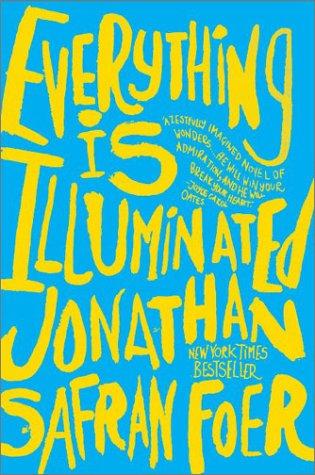
we have very premium episode for you this week. welcoming special guest Nicole (@elocinationn), one of the great up-and-coming poasters of our time.
We revisit one of her younger self’s favourite books, Jonathan Safran Foer’s ambitious 2002 novel Everything is Illuminated.
On being disconnected from history: can you be traumatised by losing connection with your past? how reliable is our conception of history anyway? can the stories we tell ourselves be ‘truer than true’? do we care about our own family genealogies? what are the challenges of trying to write about the Holocaust as a third-generation survivor?
Foer’s incredible ambition: How derivative is this book? does it really matter? Who are Foer’s postmodernist forebears, and what did he do differently? Should more young authors try to swing for the fences like this?
Plus we stumble upon the inspiration for borat, find out who invented the gloryhole, and MORE.
intro and why we chose the book
Nicole: Wait, has it stopped recording?
Rich: Yeah, we’re recording.
Benny: Yeah, but we cut all this stuff. Don’t worry, there’s lots of behind-the-scenes editing.
Rich: Yeah, anyway — what was your exact address?
Nicole: P. Sherman, 42 Wallaby Way, Sydney.
Rich: Nicole, we’ll cut out stuff. If you say a boo-boo or anything, we can cut it out, by the way.
Cam: Thank you.
Nicole: Awesome.
Benny: Unless you insult Cam. That stays in.
Rich: Yeah, that’s guaranteed.
Benny: Fiat.
Rich: That’s cash money.
Nicole: Or any comments about having sex with animals?
Rich: It has to be dog specifically.
Nicole: Well, there is a dog who’s slightly sexualised in this book.
Cam: I thought we said something on mic previously for a second.
Benny: Oh, that is true.
Nicole: Doesn’t he start humping Jonathan in the back of the car or something?
Cam: The bitch — yeah, the bitch likes Jonathan, but Jonathan doesn’t like Sammy Davis Jr. Jr.
Benny: Don’t they invent the 69 or something? Or at least she tries the 69 on him, right?
Rich: Yeah, one of their claims to fame is inventing the 69.
Cam: Oh, I got confused. The dog invented it, is what he said.
Benny: I think so.
Rich: So, alright, welcome to Do You Even Lit, everybody. We’ve got a very special episode today. I’m joined by Cam and Benny, as per usual, and we’ve also got our very first guest. Welcome to the pod, Nicole. How are you doing?
Nicole: I’m good, thanks for having me, guys.
Rich: Of course. Very happy to have you here. How would you describe yourself? I was going to say Hegelian e-girl — I don’t actually know what that means. Is that accurate at all?
Nicole: I was briefly part of a group chat called the Hegelian Eagles. I’m now part of one called — and I don’t know how to pronounce this, but you know the Bene Gesserit, from Dune, the witches?
Rich: The Dune witch? Yeah.
Nicole: So I’ve now evolved into a kind of witch. How would I describe myself…
Rich: A eugenics witch? Don’t they do eugenics?
Nicole: Yeah, look, I haven’t actually read Dune. I’ve watched one film, but I got added to the Google chat and had to Google what the name meant, and then I understood.
Rich: That’s in keeping, right? Because no one’s read Hegel, I assume.
Nicole: I mean, I’ve attempted to read it. I can’t say I’ve understood it — he’s a pretty bad writer. Have you read the Phenomenology? It’s terrible.
Benny: People have looked at each page of Hegel — I think that’s about as far as we can go.
Nicole: I remember I took this class at university called Intro to Political Ideas, and I remember distinctly the tutor saying — using Hegel as an example — not all good thinkers are good writers, and then looking into that book. So yeah, to answer seriously, I would describe myself as kind of an intellectual dabbler, which is not very flattering, but I read a lot quite broadly. I’m excited to be part of this book club — humorous literature is kind of rare, so yeah.
Cam: On your reading, Nicole — I wanted to ask you a question. All of us, to a slightly different extent, come from a bigger nonfiction diet, and now we’re sort of moving into fiction, and you’re a voracious fiction reader. I wanted you to say a few words about what it means for you to read fiction, and your reading habits.
Nicole: Oh, you know, I feel like I actually read them pretty equally — or I read more non-fiction now. I probably read more fiction six, seven years ago. But I was having this conversation recently with another guy who was telling me he never reads any fiction, and he’s like, “What’s the benefit?” And I think it is the psychology of it — a good writer is really good at exposing the inside of the mind and building characters that tell you a lot about yourself and reality. I think that’s something you don’t get as much in nonfiction. So that’s part of what I like about fiction — how I can maybe tag characters to people in reality. And then also just the beauty of the writing and the focus on prose and making things sound nice, which I think is not as core a focus in nonfiction. Would you agree at all?
Cam: That’s why you stop reading Hegel and you move to Nabokov.
Rich: Yeah, everything seems easy after Hegel, I guess. That’s the benefit — the Nabokov is like a walk in the park.
Cam: Yeah, I actually find them both — and I know you’re being rhetorical.
Benny: You find every book we read hard, dude.
Nicole: No, I found this hard. Like, even when I was reading your notes, I’m like, “Oh, there’s parts of this that have gone over my head,” and I had to go back and review. So I think my attention span for fiction has reduced — I miss things now, whereas I used to pay more attention.
Rich: This is a tough book, I think.
Cam: Yeah, I was very confused at the start of this book, orientating myself. It took about 30, 40 pages.
Rich: We should say what it is, by the way, before we go on. We’re reading Everything is Illuminated…
Cam: We should illuminate.
Rich: Yes — Everything is Illuminated by Jonathan Safran Foer, 2002 or thereabouts.
Cam: Illuminate our audience.
Rich: And Nicole, you picked this one — you’ve read it before, so you’ve actually got the advantage on us. What was your reading experience like this time? Apart from — well, you still found it confusing.
Nicole: Yes. I read this in 2015, and what I remember about it was that it was the only book that made me both laugh and cry, which was quite distinct to me — I’m not a very emotional person. But then when I reread it this time, I realised I’d forgotten most of it. So kind of makes me question my opinions on books that I read like eight, ten years ago. But yeah, I picked it mostly because it was very good at generating emotions, which I thought was interesting. There wasn’t honestly a much deeper reason. I guess I haven’t really met many people who’d read it before, so yeah.
Cam: Yeah, that’s interesting. I mean, it seemed like it was a massive book in the early 2000s, just from reading online — this guy who is in his mid-20s, I think…
Benny: Yeah, early 20s.
Cam: Very young, yeah, early 20s. Like, just finished uni and went overseas and then wrote this book, and it became this sort of cultural phenomenon. Which is an interesting thing to think about — when picking books to read, I’m thinking of recent books popping out and being big things, and then sort of 20 years later this is probably less well heard of.
Alex as the proto-Borat
Nicole: Well, actually, it reminded me of something. Another reason that I probably liked it at the time was — I think Borat is the film that I remember the most, or find really funny. I think the character of Alex, the way he speaks, could almost sound like Borat. Would you see that?
Rich: True. Wait — which came first? Is this a ripoff of Borat?
Nicole: I think this came first.
Cam: Borat was probably ‘07, ‘08.
Benny: No, this came first, yeah.
Rich: Oh yeah, so this is the original.
Nicole: Yeah. If it was a cultural phenomenon, like you said, Cam, maybe Sacha Baron Cohen was inspired by it.
Cam: Or maybe just inspired by my wife.
Benny: Now I can’t help but hear Guileless in Borat’s accent.
Rich: Whenever we read quotes from Alex, you have to do the Borat voice.
Benny: No.
Cam: Well, were you guys reading it in an accent? Alex’s voice?
Rich: No, my inner reader doesn’t have an accent, I don’t think.
Nicole: Yeah, mine — is yours?
Cam: It adds a lot to the reading experience.
Rich: Yeah. And what does yours sound like, Cam?
Cam: Well, I’m not very good at accents, but yeah, it’s kind of like this sort of fake Russian accent. You know, like — what are some examples? He says, “My English not so premium,” or “I was…” I think it took me a minute to realise what was going on. I mean, I suppose context for the listeners — I could give a really quick gloss of one of the conceits of this novel. So, Everything is Illuminated is this book written by Jonathan Safran Foer, as Rich mentioned. And it’s about a character called Jonathan Safran Foer, i.e. himself, who’s an American Jew travelling to Ukraine in order to find a woman who he thinks is called Augustine, who supposedly saved his grandfather during World War II. And Jonathan’s joined by Alex, who’s a Ukrainian translator whose English is not so first-rate, not so premium. And they’re both joined by Alex’s grandfather, and their dog, who’s called Sammy Davis Jr. Jr., famously after Sammy Davis Jr. from the Rat Pack, actor in the ’50s, ’60s. So when we’re talking about accents — we’re talking about Alex. He’s written with broken English, and not just broken English, like — he’ll get grammar and syntax wrong, but he also seems to be speaking with a thesaurus sometimes, right? He’ll use rare words or less common words. His probably favourite word, as an example, is he calls something “premium” rather than good or awesome or great. And he’ll say he wants to “manufacture disease” or “manufacture happiness” — he’ll use slightly polysyllabic, less common words a lot of the time, which I don’t think is how non-English speakers go. I think it’s like a thing in this book, to add flavour.
Nicole: Oh no, I think it actually is, though. I’m trying to think of an example, but sometimes, yeah, foreign language speakers use a real weird word, which they’ve clearly just learnt from a dictionary, and it’s correct but is kind of weird. Actually, in school there was a girl who used to say “seldom” a lot, which in school when we were teenagers was not common. And she was a Chinese exchange student. I was like, OK.
Rich: She learned English from Jane Austen novels or something.
Nicole: Maybe. Sorry.
Rich: I think you’d get a sprinkle of this kind of thing, right — of people using the wrong vocabulary word. But he doesn’t make other mistakes that you’d expect of an ESL speaker. The conjugation is pretty much all correct, and the word order and things like that. So it was pretty jarring to begin with, because I was like, “What the fuck? This doesn’t sound like anything real.” And then later on I realised that Jonathan Safran Foer literally gave him a thesaurus to try and improve his writing skills, because he says, “I fatigued the thesaurus you presented me.” So yeah, we should say also that Alex’s half of the book, which is interleaved with the novel that the Jonathan character is writing, is all letters that he’s writing to Jonathan Safran Foer, so it’s just his voice throughout. So half the book you’re just reading this incredibly jumbled, thesaurus-mangled speech from Alex, and it takes a while to figure out what the heck is going on.
Cam: Speaking of Borat, it kind of reminded me a bit of Bronze Age Pervert, actually, who also does this kind of fake Eastern European accent and writing. He similarly uses erudite words occasionally.
Nicole: It’s literally like Borat — like, “I’ll go to America to make cultural learnings for Kazakhstan.” I don’t think it’s totally wrong, but it’s just weird.
Rich: Actually, you know what? Isn’t there a bit where he says his grandfather is “retarded,” meaning retired? That’s an exact joke in Borat, where Borat’s at the dinner party and the guy’s like, “I’m retired,” and he’s like, “Oh, you’re retarded? At home we will put you in a cage,” or something.
Nicole: I remember that.
Cam: I mean, I mentioned Sacha Baron Cohen — he could well have read this book. I’m not sure how influenced… yeah, I think it’s a big Jewish American book.
Nicole: Probably. He is Jewish.
Rich: I reckon he probably has. Big Jewish book.
Cam: Yeah, well, Sacha Baron Cohen is British, but yeah — massive Jewish book.
Nicole: Yeah, the other kind of connection is the Trachimbrod, or the magical story — that feels very magical realism, right? Like Brod, and the way she’s born in a river, it’s giving Gabriel García Márquez, or also Isabel Allende. But I find it kind of weird that I don’t like that part of the story, because I think at least when you’re reading magical realism, you know — it’s slightly jarring because it was originally written in Spanish. Whereas this is — it just seems like the language is bad, you know?
Rich: On the Trachimbrod section, or the Alex section?
Nicole: It’s the — this is the part that Jonathan’s writing, right? The story of Brod. Yeah. Which gives — do you see how it kind of feels like a bit of a magical story? Like it’s not fully real, what she’s like.
Cam: Yeah, definitely.
Rich: Yeah, big time. I think we’re actually reading 100 Years of Solitude after this, and I’ve started it and it’s eerie, actually — it’s definitely the same vibe. So I’m guessing that this is inspired by that, or if not directly by it then by the movement in general.
Nicole: Yeah. Have you guys read any other magical realism? You like it?
Rich: No, I historically haven’t liked it, but I haven’t tried very hard.
Rich: So I’m going to try hard for Gabriel García. And I’m really liking it so far, so things are looking good.
Nicole: Yeah, the opening line is good. What is it like — “I remember the day my father took me to discover ice,” is that it? Of 100 Years of Solitude? Yeah, that’s a good one.
Rich: Yeah, yeah, it’s heaps of fun. I mean, I liked the Trachimbrod storyline as well, but just staying on Alex for a second — I’m curious to do rounds of who found Alex’s voice endearing versus annoying, because I think that could definitely determine whether or not you like the novel as a whole. And for me, it started out more confused than anything else, because it’s kind of a hostile start to a book to have to decipher that, and then to get plunged into a bizarre magical realism storyline from an old Jewish village. But once I got about 50 pages in, Alex’s character develops quite quickly and I really came to like him, and I didn’t mind the language. And I found it also very funny quite often — some of the word substitutions. Like the one that got me was he signs off his letters with “guilelessly.” And you have to do — it’s kind of like mini problem-solving where he uses a word, and every time you have to try and think what he meant to say. So “guilelessly” is like, “oh, yours sincerely.” You have to work backwards to figure out what he was actually trying to say. And it’s often funny, and often just like a fun little problem to reverse-engineer his language. So I was on board with it, and I loved Alex’s character. But yeah, Benny, how’d you go with that storyline?
Benny: Yeah, I thought it was totally endearing, almost from page one. For one, it was hysterical — I agree with Nicole, the book had me nearly laughing out loud at points. And I loved Alex’s mannerisms and his writing. I disagree with you, Rich, that a normal person wouldn’t use English in this way. I think the way to think about this is, just someone who understands the grammatical structure of English — you know, perhaps they learned it through school or something, but then is just limited in their vocabulary. And so it was learning vocabulary basically via a thesaurus and doesn’t have the cultural context to know what words are actually appropriate where, right? And I think that is basically Alex’s version of English in a nutshell, and accounts for his weird idiosyncrasies. I also think it’s very impressive for Jonathan Safran Foer to have written this from Alex’s perspective. The book is following the protagonist of Jonathan Safran Foer, which is a reflection of the author — but we never actually get anything directly from his perspective. So almost a third of the book is Alex sending these letters back to Jonathan in his broken English. Then sort of the other third of the book is Alex describing their journey through Ukraine, but again from Alex’s perspective and again in this sort of broken English. And then the rest of it is this history of Trachimbrod and Jonathan’s grandparents and great-grandparents in this magical realist style. So oddly, even though Alex is sort of the main protagonist throughout the novel, nothing is actually from Jonathan’s perspective. And the fact that two-thirds of the book are written from Alex’s perspective requires that Jonathan the author is so in Alex’s head — and it’s an impressive skill to have the command of English such that you can represent how someone else would misrepresent English. So I was pretty impressed with his skill as an author to be able to do this for two-thirds of the book, basically.
Cam: To write like Borat for like 200 pages.
Benny: Yeah, and keep it consistent. I think that would have been quite challenging. Maybe it was suspiciously easy.
Rich: Yeah. Nicole, annoying or endearing?
Nicole: I liked the character. I found it very funny. Mostly I think it’s because of the connection to Borat, which I also find very funny.
Cam: Were you confused when you first read the book? I’m sort of thinking for that first 50 pages.
Nicole: So you guys all seem to have said that you were confused at the start, whereas I felt it was fine at the start, and I mostly got confused in like the last third. But maybe it was because I read it over too long and was reading multiple things and zoned out, so at the end I was like, not sure what was happening. So yeah, I think it’s just because it’s really funny at the start — like, the scene of them in the car and the dog, it’s just the farting dog and it’s like childhood humour. I was laughing so much.
Rich: What was that quote that you put in the group chat? Read that out.
Nicole: It was, in quotes: “‘Your train ride appeased you?’ I asked. ‘Oh, God,’ he said, ‘26 hours, fucking unbelievable.’ This girl, unbelievable. Must be very majestic, I thought.” I really should have read it in two voices, but you know what I mean.
Rich: Yeah, there’s so many good lines like that. Cam, you haven’t weighed in yet — Alex’s voice.
Cam: Yeah, no, I liked him. I think the main thing I was struggling with was that, in conjunction with the flipping between storylines and sort of trying to orientate myself, and then potentially getting annoyed at this broken English because I was annoyed at not yet orientating myself as well. But once I was over that, it was fun. I liked it. And yeah, sort of started reading it with an Eastern European accent — a failed, I mean, talking of Baudrillard from previously, it was sort of a failed imitation of a fake English, broken English imitation.
Nicole: So do you always do that? When you’re reading, you have a different accent for different characters?
Cam: Well, sometimes I mix it up. Do you guys have a reading voice in your head most of the time, or some of the time, or you don’t?
Nicole: I don’t think so. No, I don’t think so.
Cam: Yeah, I think a proportion of people don’t — I think it’s like, you know, 20–30% don’t.
Nicole: Wait, wait — don’t have a reading voice, or?
Cam: Yeah, sorry, an inner monologue when you read.
Benny: Like, do you have an inner monologue when you read?
Nicole: Oh, yeah, yeah, I do. But it’s my voice. Like, I don’t have a voice for different characters.
Cam: OK. Some people don’t. Just me, then. Well, sometimes it will be the author’s voice as well, if I know what the author sounds like. Often it’s hard to shake the author’s voice when I read. I read this a little bit out loud to my partner and started doing the voice and then couldn’t shake that. I might mix my voice — I’ve definitely done that in the past. Sometimes I’ll try and throw an accent.
Benny: Cam’s that guy reading in public who doesn’t know he’s actually reading out loud — he’s just sitting on the train reading the book aloud, thinking he’s being all quiet.
Cam: You’re saying it’s like a type of guy?
Nicole: Wait, Benny, I’ve never seen this.
Cam: It’s not “guys reading in public.”
Rich: This is how you got in trouble with the leader.
Nicole: There is the type of guy — or person — who plays their music out loud on public transport, and they seem to not realise that nobody else is enjoying this, or wants to listen to him speaking.
Cam: I know that — that infuriates me. But I was on the —
Rich: Death penalty. Death penalty.
Cam: Yeah, I know, straight to the death. I was on the tram the other day and I look over and again I’m like, this fucking guy is watching sport. And then I’m like — it was my team that I follow in the Premier League, and I was on the way to work, and it was a really important game. And I was just like, ugh. And I went and sat next to him, and I was just watching it over his thing. And then I looked complicit, right? It looked like I was just part of it as well. But I was like, OK, this is my one exception — I’ll watch loud Liverpool thing. Sorry, I’m not sure if I asked — yeah, I liked Alex. I think Alex turns out to be potentially the protagonist, right? You root for him and he evolves, and it’s really from his perspective most of the book.
Nicole: Yeah, like stuff’s illuminated for him as opposed to for Jonathan, I feel.
Rich: Yeah, Jonathan’s like this weird shadow character who we only get through Alex’s pen, but we never really — I never felt like I knew who Jonathan was, or felt any connection to him at all.
Nicole: He seems like an asshole, but then when you actually think about the circumstances that he’s been put in — like, he’s paid for this trip and then he’s arrived and he’s in this car that drives like, what, 60 kilometres an hour on the freeway, and he can’t get any food, and there’s a dog racing and farting next to him.
Rich: Getting 69-ed by a dog.
Nicole: And he went all like, “Wow, he’s so annoying.” It’s weird how they make you kind of empathise with the grandpa and Alex, even though they’re in the wrong.
Benny: Alex and the grandpa won’t let him eat and stuff. Like, send him to bed and then wake up early and eat breakfast themselves, and then inexplicably not wake him up, and then eventually wake him up after they’ve eaten and then tell him, “We gotta go, we don’t have time to eat,” which was a bizarre detail that I didn’t fully understand, but there we go.
Nicole: Yeah. And they call him “the hero,” like kind of tongue in cheek. Like, you know, if someone called you “Miss Princess” when you’re younger, or something — as in, you’re difficult. Like, he’s the hero.
Cam: Oh, was that tongue in cheek?
Nicole: Well, I mean, I assume it was kind of meant to be part of what we’re saying, where he’s depicted as being difficult.
Cam: I missed that. I thought he was being sincere.
Rich: It’s the author writing his own character in a self-deprecating way, right? Because there’s lots of jokes at his expense, and him being a spoiled Jew and stuff like that, where he’s lampooning himself, which I really enjoyed. I would love to meet Jonathan Safran Foer — I think he would be a super funny and cool guy. As little as we got to know him through his author-insert character, him as an author I admire a lot. It’s crazy. This is a crazy book to write. It’s so ambitious. Imagine being 21 and writing this book. And he pretty much pulled it off, I think. Not to get too ahead of myself, but — yeah. Let’s talk about the Trachimbrod storyline.
Playing at happy families with Brod and Yankel
Rich: I’m just going to give a quick overview of it for people listening, to get a reminder. So this is the parallel magical realism storyline, which is Jonathan Safran Foer’s book-within-the-book that he is writing. It’s based on historical events, but quite loosely. It’s a village called Trachimbrod, and it’s just charting generations of Jonathan’s ancestors and the sort of mythology around them in this town. Starting with, I guess you’d call her the town founder or the central character — called Brod, which is this baby who miraculously pops up in the river after someone crashes their cart into the river. And it’s never entirely clear where she came from or how she survived, or what happened to her presumed father who was driving the cart. And she gets adopted out to a character called Yankel, who is a disgraced money lender, an elderly money lender. There’s a lottery in town, and apparently it’s hot property to adopt a baby — everyone wants in on it. And Yankel wins the lottery and adopts her. And it’s this very sweet storyline which I really liked, between this precocious little girl and this old protective man who’s feeding her curiosity and buying her lots of books and intellectually sparring with her as she grows up. Yeah — there’s a couple of things I want to talk about, but before we get to them, did you guys have anything that you want to say about the Brod–Yankel storyline?
Nicole: I think this was one of the things that felt really — when I said that the book evokes emotion well. So Yankel was the one whose first wife, she left him, right? With the note, like, “I did it for myself.” And that — do you remember that scene? It was actually quite emotional.
Rich: And the note keeps popping up — like, he doesn’t throw it in the bin, but everywhere he turns, the note is — it’s folded within the pages of the book that he happens to be reading, or it’s pinned on the wall above his bed, and it just keeps following him.
Nicole: Yeah, you feel really bad for him. You’re like, oh, he’s quite touched. He really loved her, and she just left.
Rich: Yeah, you get the sense he’s had a tough life, partly through his own mistakes but partly through circumstance. And then this is kind of a redemptive arc for him when, at age 80, he becomes the adoptive father of this little girl. And then they grow to love each other. But the way that they talk about love is fascinating in here. So I just want to read the quote to you guys so you can react to it. It’s on page 83. For instance, when she falls over, he will scrape his knees and be like, “Oh, I fell over too, so you don’t need to feel bad.” Or they’ll pretend to pee their pants or something so that the other one doesn’t feel embarrassed about making a mistake. And then it says, “And when she said, ‘Father, I love you,’ she was neither naive nor dishonest, but the opposite. She was wise and truthful enough to lie. They reciprocated the great and saving lie — that our love for things is greater than our love for our love for things — willfully playing the parts they wrote for themselves, willfully creating and believing fictions necessary for life.”
Rich: What he’s saying is that they love kind of the abstraction of love, or the story that they’ve created around their relationship with one another, more than they actually, base layer reality, love one another — kind of coming back to your Baudrillard thing, Cam. Does that strike you guys as true, either for Brod and Yankel, or just in general about love? It’s kind of like, people want to play the part of being in love more than they actually want to be in love, or something like that. I think it can be true in some circumstances, but it’s a bit surprising here, and I don’t know why it’s meant to be inspirational, exactly. Seems a bit sad, actually.
Cam: In terms of unpacking the performative nature of expressing your love for your loved ones.
Benny: Why do you think it’s supposed to be inspirational, Rich?
Rich: I don’t know if it’s supposed to be inspirational, but it’s described as a great and noble lie. “She was wise and truthful enough to lie. The great and saving lie.”
Cam: So she’s not his biological daughter, right? And does she know that at this point?
Rich: No, she doesn’t know that. So we’re talking about a 12-year-old girl who sort of says “I love you” to her presumed dad, but is more saying that because it’s sort of the kind of thing that one ought to say to one’s father, and knowing that that is what he would want to hear, but without necessarily feeling some great connection to him. I thought it was a bit jarring, especially because I thought there was a really good connection between these two characters because they’re both misfits and share a lot of common interests. And I really love their relationship — it’s one of the two deep relationships that I like in this book. But Brod is also presented as someone who’s not capable of feeling love. She’s got an interesting psychology, right?
Nicole: Yeah, is she like a sociopath?
Rich: I don’t know, or a depressive or something?
Nicole: She can perform the emotions, but she knows what she’s supposed to do but doesn’t feel them. It’s kind of weird.
Benny: We’ll get into this more later, I guess, with Brod and the Kolker, but I think we’re supposed to think that sort of at the end of that relationship, when they’re watching each other through the peephole, through their doors, I think we’re supposed to infer that that was sort of a real love — like maybe the first time she was experiencing real love in her life. But you’re right that other than that, most of her relationships are superficial — that’s the wrong word, but maybe manufactured or something, right? Like, she doesn’t feel much for other people in the town, but they all sort of adore her, and yet they don’t know her. So in that sense, their adoration of her is a little bit fake and superficial, and they’re sort of maybe just holding her up as some sort of idol that they don’t really know. And then even when she marries the Kolker later, he’s beating her at one point, and she just pretends to go on keeping loving him. So there’s some superficiality there. And it’s like all of her relationships, except for maybe at the very end, have this weird play-acting quality to them.
Cam: I was just going to say, Richard’s quote kind of reminded me of that — it foreshadows her relationship with the Kolker, which Benny will describe in a minute, but where she also has this kind of, via her actions at least, you know, cares for him, but also sort of explicitly isn’t really in love with him, doesn’t have strong feelings towards him, has a kind of performance. Which, I don’t know, maybe the author is trying to say is kind of equivalent, or is as good, or is a separate thing.
Nicole: There’s an interesting quote here, which I think is from Alex in one of his letters to Jonathan, when he’s reading over that — he’s like, when Brod asks Yankel why he thinks about her mum even though it hurts, and he says he does not know why — that is a momentous query. Why do we do that? Why are the painful things always electromagnets? But then it’s also interesting why she asks the question — kind of makes the point of, why are you thinking about something that, because it’s not voluntary, right?
Rich: Yeah, so she’s causing him pain and asking the question.
Nicole: Well, she doesn’t know the pain. She’s asking him, why would you do something that makes you feel pain? And so it kind of adds to the story of her — like, she’s just performing, so I don’t know.
Traumatic impact of being disconnected from history
Benny: So are we supposed to infer something about the disconnect — you know, like the disconnection between her and her past is what’s causing her some inability to feel what she’s supposed to be feeling? Like, she’s disconnected from her past in the same way that maybe the hero is, and this is why he’s going on this journey to find out about his past, in the same way that the actual author of the book feels disconnected from his past and is trying to go on this journey and write this book to feel connected. Is there something here where, I don’t know, it sounds very trite when set out — like if you sort of don’t know where you come from, or you don’t know your history, there’s some way in which you’re bound to just not be fully connected with the world.
Cam: I think that’s a good catch. I think that’s what the author was probably — now I think about it, it’s almost like this metaphor. Because I think Jonathan Safran Foer the author travelled to Ukraine as a 22-year-old to try and find history of his family, and found nothing, and it was kind of this emptiness. So what do you do with that emptiness? And there probably is — he probably had this performative connection to the place, or to the history, even to the Holocaust, which is in slight tension to how he maybe directly feels around it. And yeah, I think Brod is definitely somewhat allegorically getting at that.
Rich: Yeah, that’s a good point. And I think further evidence is that the very first line in the book is about the cart of Trachim that may or may not have overturned and may or may not have pinned him to the bottom of the Brod. And like, it’s sort of enshrined in a plaque that stands on the spot — the fundamental uncertainty of the events of the past and what may or may not have happened, and how frustrating that could be. So yeah, maybe Brod is that personified, because she is maybe or maybe not the daughter of the guy who went into the river, and she’s been assigned a father literally by lottery. It’s so arbitrary. I was thinking it wouldn’t matter so much because she doesn’t know about that, and because we’re all assigned our parents arbitrarily, but with a more metaphorical lens it makes a lot more sense.
Nicole: And then also, if that is the kind of symbolism, her obsession with sadness makes sense, because it is kind of like the sadness of not knowing your origins. Like you said, Jonathan went to Ukraine, didn’t find anything in the story — I mean, not to spoil it, but kind of, it’s like, doesn’t find anything, and that feels sad. Like, you’re looking for closure but you don’t get it. And then her character is this very weird, hard to understand, but the only identifiable emotion is sadness.
Rich: Yeah, she details, like, 120 kinds of sadness or something like that.
Nicole: And I was like, is this like 13 Reasons Why or something?
Benny: Oh yeah, there’s some wild ones in there. Sadness of the Anus was my favourite one, I think.
Cam: I relate to that one.
Rich: Cam? Sadness is an understatement.
Cam: But so, on being disconnected to your past and stuff and that impacting you — like, I don’t really relate to that, to be honest. I mean, I’ve done a little bit of family genealogy, family history recently, which has kind of been fun. I mean, the way I thought about — I almost approach it like I approach most things I learn about: I just kind of want to learn it all exhaustively to gain the knowledge. But I know a lot of people feel about it quite differently. And yeah, if you can’t piece it all together — I mean, if it was more immediate, like, “Who’s my real dad?” — I can imagine that having a huge impact. But like, your great-grandfather — whereabouts in Scotland was he? Even myself, I’ve just found out that my great-grandmother either had an affair or was adopted. I think Dad’s a little bit in denial around those options, but it doesn’t really impact me too much. I don’t relate to the traumatic impacts, potentially, of being disconnected from your past. Which I’m sure people would just say is the kind of the soulless West or something, I don’t know.
Nicole: No, I don’t really either. I mean, it’s not that emotional for me. I think as far back as it goes — like, the unknown part is maybe similar, Cam. My grandma’s mother was an orphan, so on that side it’s like the end, you know, nobody knows. And I did the genealogy, and it just kind of seems like she was from that part of Greece anyway. So it’s not like she was literally just a poor kid who got adopted by someone else, parents died young in times. So no, I don’t relate. But maybe it’s slightly different if it was connected to some war where a large percentage of your ethnic community or something was wiped out — I can see why it feels slightly different.
Rich: Yeah, I heard a good take on this around this being somewhat of a — not uniquely, but particularly — Jewish phenomenon in the context of the Holocaust. In the history of fiction around the Holocaust, you have the first-generation accounts written from the point of view of people who actually experienced it firsthand, which, you know, it’s very obvious that there would be a lot to explore there. And then you have second-generation accounts, which is people whose parents were Holocaust survivors. And that’s usually written about themes around hidden family secrets, and Mom and Dad not wanting to talk about what happened, and also the habits that they brought over into the new world, assuming that we’re talking about American Jews here — the things that are still keeping them tied to that past. And then you have third-generation authors like Jonathan, which is where it gets tricky, because you don’t only not have firsthand experience, you also don’t even have secondhand experience of being raised by parents who were Holocaust survivors. And so you’re sort of scrabbling around to find what your connection is with it. And, almost one of my points that I don’t love about this book is that I don’t really know if there is anything in particular of interest there, but he’s written a book about how there’s nothing of particular interest there, which is like a very meta, nice way to do it. It’s probably about the only way you could handle it. I think he’s handled it well. He went on that trip, like you said, Cam, to Ukraine, looked around for a few days, found nothing — how do you make a story out of that? He made a story out of that, and it’s an interesting story. It’s maybe not quite as narratively satisfying as if he were closer to the action. And I wonder if some of the Holocaust scenes in here are maybe a little bit gratuitous, or somewhat cheapened by him not really being connected to that — like borrowed shock value or something. But we can talk about that later. But yeah, the sense of connection and longing there — maybe it is more connected to a big historical event like that. That feels so much more important to know, whereas I have no idea who my grandparents even… and I don’t care at all. Like some farmer or something, some guy from Scotland or England, I really couldn’t care less. Maybe I would if they were involved in an atrocity on one side or another.
Benny: Yeah, I mean, you also might care if you found out something about them. Like, I take part of this — part of the point is that, you know, if you look at Alex as a character, he basically didn’t know about his past, and then as he finds out about it and starts to grapple with it, he becomes — maybe not happier is the right word, but you get a sense that he’s better off. He can actually now deal with the world as it is and can be more agentically engaged with it somehow. And so it’s almost the lesson here might just be that knowing is better than not knowing in some way. And so you might feel differently if you found out that, I don’t know, your grandparents were part of some atrocity or something. That might reform your self-image in some way.
Rich: Yeah, but that’s the point, right? Alex has got a direct connection. His granddad was alive during World War II and his plot is directly relevant to this book. Also, Alex’s father — the partial illumination that Alex receives directly informs his decision about what to do with his father, and why his father ended up the way he is. So it’s not impersonal at all. It directly bears on how he should be in the world and what he should do about his life and his mom and his little brother and all this kind of thing. So that works fine, that works well for him. They’re situated right in the action there. It wouldn’t work for me because I’m too far removed from anything.
Benny: Yeah, maybe — I don’t know, it depends what kind of secrets came out, I guess.
Rich: What are you trying to say about my granddad, dude? What do you know?
Benny: The notorious Meadows man.
Rich: My granddad actually was in World War II on the good guy’s side. So fuck you.
Cam: Yeah, no, I’m just thinking about — I imagine it would have an impact, right? You find out your granddad or great-grandfather or great-grandma was a bad person, and just ramp up the badness, and it would make you feel a bit funny.
Nicole: Actually, you’ve kind of triggered something — a memory for me that I hadn’t thought about — around the disconnected storyline. Because mine is more recent. So my mum died when I was 17.
Lista and Alex’s granddad: survivor guilt
Nicole: And I feel it was just before I was old enough to start having proper adult conversations with her. My mum stayed at home and my dad was mostly working, so he doesn’t really remember much about my childhood. And there are all these questions and things that I want to ask, and I don’t have anybody to ask. There are things that I ask him and I can see that my dad just has no idea, and that is quite frustrating. I wouldn’t know if it’s sadness, but it’s just like a frustration — like, I need to know these things and I will never know. So yeah, maybe that does feel kind of familiar.
Rich: Irritate or torment you? Or have you made your peace with it, or is it just always lurking?
Nicole: No, it irritates me more with time, because there are more questions that I have, and the box of unanswered things keeps filling. My grandma sometimes tells me stories and you can see that she’d concealed certain elements from me when I was a child because they weren’t favourable. But then she tells me the full story and I’m annoyed that she told me now, because there’s things that I want to ask my mom about that I can’t. Yeah, quite a few of those.
Rich: Yeah. Actually, now that I think about it, I do feel it’s important to try and do like — what do you call them — oral genealogies or something. I want to do that with my parents because I know that there’s a lot of stuff that they haven’t told me, and that will just go with them to the grave. And family secrets that have just come out that I had no idea about, like things I’ve learned about my dad’s childhood and his mother which have massively changed my view on who he is as a person and how he ended up the way he is. And which I just had no idea about until quite recently, when he started letting little hints slip about it. And it’d be fascinating to pull on those threads. And there is a limited window because my dad’s like 70-something, and you know, that will go to the grave with him. Yeah, I should get on top of that, start asking questions repeatedly, like that scene with — oh, maybe we’ll talk about it later, but the scene where Alex is asking Augustine: “Do you recognise the people in this photo?” Oh my gosh, that’s so powerful.
Cam: I think it’s worth talking about now.
Rich: OK. So coming back to the Jonathan–Alex–granddad quest. Jonathan’s arrived with this photo of this young woman called Augustine, who he thinks helped his grandfather escape from the Nazis. They’re just driving around in rural Ukraine, around where they think that he’s from, just asking all of the people, “Do you recognise the people in this photograph?” And they’re just driving around and around for hours, getting absolutely nowhere. They find this one woman of the right sort of age category, just sitting on the stoop of some old broken-down house, and Alex goes up to her and is like, “Do you recognise the people in this photo?” And she says no. And then for some reason, he just keeps pressing her. He notices something in her manner, or in her bearing, and he asks her again, and he gets a slightly different kind of “no.” And then he asks her again, and it’s this quite painful scene. Like, I only realised afterwards, I think it’s meant to mirror perhaps when the Nazis are asking you to reveal a Jew or to turn over your neighbour or something, and your defence mechanism is to say, “No, no, no, I don’t know who that is, I don’t know who they are,” over and over. And then it just breaks down the barriers and eventually she says, like, “I’ve been waiting for you for so long.” And in fact, she does know Jonathan’s grandfather and invites him in, and sort of shows all of these — what would you call them? Like keepsakes, all of these little objects that she’s recovered from the ruins of Trachimbrod, which no longer exists at all. It’s just her. She’s all that’s left. And then she recounts this horrible story of what happened when the Nazis came through. But she is not Augustine — she’s another woman. We never find out who Augustine is, which again is obviously meant to be the frustration of never really finding out the full truth. But we get enough of the story.
Nicole: Do you have a guess who she is? Have you guys guessed who she is in the story?
Rich: Who Augustine is?
Nicole: Yeah. Or, like, they call her Lista, right?
Rich: Yeah, I think Lista is a different person because she’s mentioned in other parts of the book. So I think she really isn’t Augustine. She really is just a different person.
Nicole: Yeah, but I have a kind of guess, actually, of who she might be. She claims that she moved into her sister’s house — who was the one whose baby got shot, right? But then, does the sister exist? I wonder if she’s the one who had her baby shot, and then she’s just really traumatised, and that’s why she’s the last one.
Benny: Oh, I hadn’t even put those things together.
Rich: Yeah, I think you’re right.
Nicole: The only one who escaped in the lineup was the pregnant one.
Cam: Yeah, that makes sense.
Rich: That’s right, yeah.
Benny: Right. Oh man, that was a brutal scene. Oh my god.
Nicole: Because who is the sister? Like, there wasn’t two who survived, there was only one.
Rich: Yeah, she tells what happens to every member of the family, except herself, which is presumably the sister. So the scene there, which is the most horrible scene in the whole book, is — the Nazis make Lista’s father spit on the Torah, or they’ll kill their family members. And he refuses, and they kill his wife, they kill his other children, and then they kill the sister’s baby but don’t kill her directly. And then finally they say, like, “Spit on the Torah, or else we won’t kill you, so you’ll have to live on with the suffering.” And that’s when he spits on the Torah.
Benny: And then we find out he wasn’t religious, right? Yeah, wasn’t that the kicker? I actually forget who was telling the story, but they say he actually wasn’t a religious person.
Rich: I missed that. Lista is telling the story, or at least it’s her story. Yeah, but I think you’re right, Nicole. I think that is her, because otherwise it doesn’t make any sense. She’s the one who lost her baby and lost her entire family, and is basically the sole survivor of the town. She’s got boxes of people’s teeth and little toys and knick-knacks and photographs and stuff that she’s scavenged from all around the ruins of the town. And then she’s just stayed there while everything else has moved on for 50, 60 years. She’s all that’s left. And she’s like the rememberer, the one who remembers things in this town which had a deep history of remembering things and writing things down and passing on stories and histories. The townsfolk were kind of obsessed with that. And it’s sort of ironic, or extra dark, that they just get totally expunged. There’s nothing left except this one woman and her very patchwork collection of little memories.
Nicole: Yeah. And that was the scene where I cried. Remember I said this is the book that made me laugh and cry — that was, yeah, it was very sad. When they’re like pointing everyone out and then the way they described how they got shot.
Rich: I thought that was where you laughed.
Benny: I thought it would have either been that or the scene with Grandfather and Herschel. That was also a rough one.
Nicole: Well, wait — I’m thinking of this scene. This is the scene because then they like, Herschel is one of them and then he goes into the synagogue, right? But they also, the pregnant woman, they shoot her and she runs away. Is this the same scene in my head, or not?
Benny: Yeah, does this all happen in the same scene? I’m kind of forgetting, to be honest.
Nicole: I think it is. Like, they don’t shoot everyone — some of them they burn in the synagogue.
Rich: I think Grandad tells the story a little bit later. He’s from one village over or something like that. It’s around the same time period, so they all know each other. I’m not sure if it’s the exact same. Maybe it is.
Cam: Everything is not illuminated. We are.
Benny: No, no, but I think it had to be the same — because they find the grandfather’s picture in Lista’s stuff, right? They’re going over her pictures in the restaurant, and they see a picture of the grandfather.
Rich: But isn’t he potentially a Kolker? Isn’t he from Kolk, the next town over?
Benny: But why would she have all those pictures? I thought these were pictures of stuff she’s…
Rich: Yeah, but those two villages often interact, and the Kolkers come for the river festival and stuff like that. That’s my memory, but I definitely might be wrong about that.
Cam: Wait, so isn’t the big reveal that Alex’s grandfather had a Jewish friend who he betrayed, right? OK, but that’s the main thing. So this whole time — I mean, it’s been building up like, Alex is kind of learning from Jonathan Safran Foer the character of what happened to the Jews in Ukraine, like especially Ukraine didn’t treat them that well as well. And he’s kind of in conflict with that. And he kind of realises, “Wait, my granddad was around during this time, and what does that mean?” And the granddad’s a big grump, right? You sort of don’t know why he’s like — Jonathan kind of annoys him and he’s kind of in denial about these things.
Rich: And he’s antisemitic, right? Like, low-level antisemitic.
Cam: Yeah, he calls him “the Jew.” That would be one thing. Yeah, it seems to be antisemitic and just kind of cantankerous curmudgeon as well. And the big reveal is, this photo that they’re trying to recognise people from — it turns out that one of them looks like Alex, which when you first learn that… you know, everyone’s got the same name in this book, like, there’s three different Jonathan Safran Foers.
Nicole: Which is the 100 Years of Solitude thing as well.
Cam: Oh, OK, spoiler, shut up, shut up. My connection with these books is, like, Jonathan Safran Foer is a disconnected connection with his history, trying to piece things together. So someone looks like Alex, and it’s a little bit confusing at first, but it turns out that’s the grandfather, who looks like Alex. And he had this Jewish friend who, it turns out, he betrayed the family because the Nazis said, essentially, “We’ll kill you or your family unless you hand over a Jew.” And so Alex’s grandfather handed over his Jewish friend.
Rich: His best friend, and borderline thruple-type situation, right?
Cam: Yes, yeah, yeah.
Rich: His wife’s boyfriend.
Cam: Yeah. He’s not even Jewish, right?
Benny: Puts a slightly different spin on it when you say it like that. Wait a second…
Cam: But yeah, so Alex suddenly sort of has to deal with learning about what that means in family. Which is — it’s kind of funny, I was just thinking now, when we’re talking about what would happen if we heard about things around our ancestors — there’s an irony where, if your ancestor was the perpetrator or something, that’s almost harder to deal with. For us I was like, “Oh man, like, granddad, great-granddad was evil,” rather than like he was the victim — that would have its own impacts. Especially around what you feel around today of, like, could that happen again? It would have some impacts on your own psyche as well, if you deserved it, if you felt inferior. But yeah, if your ancestors were perpetrators, that’s kind of a hard thing to deal with.
Nicole: Yeah, it’s like the internet meme of, like, finding out that your ancestors were blondes in Argentina or something — what does that mean? Like, because they fled Nazi Germany, they were Nazis? Well, in Brazil they have a weird Jewish town — oh, Jewish German town — where they think a lot of the Nazis fled.
Cam: Yeah, like a German name in South America.
Nicole: And people finding out that they have some weird connection to this is like, “Oh, OK, they were Nazis.” Yeah, like, if you find out that about someone you don’t like —
Rich: There’s the white nationalists who are devastated when they find out that they have a little bit of Jewish blood or African ancestry or something like that. But would be, well — I was going to say they’d be thrilled if they found out their great-granddad was —
Rich: — a Nazi from Argentina or whatever.
Cam: Well, there’s a joke — Argentinians are very white, like, in South American terms. But when you actually see the ancestry test, there is more admixture than you’d kind of expect. But Argentinians view themselves as very European, as South Americans go. I’ve seen this joke: don’t ask a woman her age, a man his income, or an Argentinian what their ancestry results are. For the opposite reasons of the German.
Rich: It’s mostly an Italian influence, I think.
Cam: Italian, Spanish, yeah. And it’s much lower native and African admixture than the other South American countries, but I think that joke is that it’s not quite zero, like most Argentinians kind of think.
Nicole: Yeah, I’m actually like one percent Sudanese.
Cam: You’re part Sudanese?
Nicole: Yeah, I’m like one percent — I’m joking. I have a lot of — no, it was a joke.
Cam: It doesn’t matter, right?
Nicole: I did it, and it’s all West African and that stuff, of course. I think everybody probably has some percentage. I mean, black man walked out of Africa.
Rich: Go back far enough.
Cam: Yeah, I’m not sure about that, about everyone, but it might be getting distracted. Cam, you got a few percent of something.
Cam: Yeah, I’m like those white scholarship recipients for the indigenous scholarships, Nicole, that you may have seen in your time in Australia. I didn’t actually do it.
Rich: Except that you didn’t get a scholarship.
Cam: I didn’t get a fucking scholarship. I didn’t get the grades. No, I found out later. But bringing it back to the theme — I didn’t feel too different about myself when I found out that my history was different. So where were we in the book? Alex finds out bad stuff about his grandparents.
Rich: We didn’t say what happened to granddad. So you better finish that off.
Cam: I was going to handball that one to Benny.
Benny: Sure. His grandfather reveals all this to Alex in a letter, I believe — correct me if I’m wrong. And then kills himself. And then Alex finds him in a bathtub, having slit his wrists, I believe. Finds him in a pool of blood.
Nicole: I don’t get why he killed himself, but, like, it’s weirdly sad. He’s like satisfied about it. He’s like, “This is my closure, so now I’m going to kill myself.”
Rich: Yeah, it’s like what he wanted, right? I also don’t quite understand — in the context of what was happening in that scene where he gave up Herschel, he almost had no choice. Because what was happening was, the Nazis would say “point out a Jew or you’re dead,” and then the guy next to him said, “There’s no more Jews here, that’s all of them, I swear to God.” And then they shot him dead. So if Alex Senior hadn’t given up anyone, he would have just died, and they still would have kept going. I mean, obviously it would still be really hard to live with yourself, but it’s a bit different to proactively pointing out a Jew. Yeah, it would still be hard to live with. He has a wife and children.
Benny: You can’t really self-sacrifice in this moment, because you have a family, and they would assume that then all your kids are also Jews if you say that you’re a Jew. So you’re in trouble.
Rich: The other little wrinkle, which I didn’t catch until I was reading something about the book, is that in that story where he’s talking about his best mateship with Herschel, he is called Eli, which is a Jewish name. So another possible wrinkle is that Alex’s whole family are actually Jewish and they have rewritten history such that they’re not, so that they don’t have to feel that pain of having betrayed their own people. Or it’s just a nickname that Herschel’s given him or something like that. Not illuminated, but interesting to think about.
Brod and the Kolker’s violent love
Benny: Yeah, that is a good catch. Nice. OK, so should we bring it back to Brod and the Kolker briefly? Which — I guess we’re going slightly out of order here, but this is returning to the historical timeline, the magical realist setting. So Brod has this either touching or horrifying relationship with Yankel, as you prefer to see it. And sort of everyone in the town is obsessed with her, as we’ve said. And one day she’s out late and someone follows her home and rapes her. And afterwards she returns home to find that Yankel has died — he’s sort of curled up on the floor. He’s extremely old, so it’s a natural death, I think. And someone’s looking at her through the window, and it’s the Kolker. His name’s also Safran, or Shalom depending on how he feels that day. And then he basically refuses to leave, and she asks him to take revenge on the person who killed her — sorry, raped her. And he does that. They find her rapist the next morning, I think hanging from a bridge or something like that.
Cam: Is that Sofiowka, the place name?
Benny: Yes — Sofiowka, right, which is also the name of the town, I guess. So this, I guess, is the name of the town after it was Trachimbrod. I’m realising I’m confused as I’m talking about it.
Cam: Oh, the same town. Yeah.
Rich: They had a lottery to decide the name of the town, and Sofiowka, who’s the village idiot, was in charge of the ballot box, so he rigged it to name it after himself. And then everyone hated him so much that they were like, “We’re not calling it that.” They even called the town like Not-Sofiowka for a while. And then eventually they gave it another name, Trachimbrod, after the Trachim who went into the Brod.
Cam: It was funny also how it talked about that, because that was the official name, because that was a lottery for the official in the first one. And then no one wanted to call it that, so then they needed to decide on, like, what are we going to call it unofficially? Because everyone voted for their own stuff.
Rich: They got one vote each, for every single name — like every single person wanted it called something different.
Cam: And then they randomly assigned someone else, Yankel, I think, to name it after Brod.
Benny: Hilarious. So Kolker and Brod get married. The Kolker works in a factory, and one day a blade comes flying off a machine and gets lodged in his head. It’s perfectly perpendicular to the earth, and somehow magically he survives this, but it does change his personality, and he becomes at times extremely abusive towards her. She stays with him, constantly saying, “This is my lot in life, and I’ll overcome this — no one beats me like he does, and him beating me just represents his love for me,” things like this. But eventually it gets so bad, and in his more clear moments he realises how bad this setup is for her. So they start sleeping in different rooms, and they interact only through a small peephole in the wall between their adjacent rooms.
Cam: Have you tried that one yet, Benny? The peephole.
Nicole: Including how they have sex.
Benny: So yeah, ironically, I guess like I was saying earlier, this actually results in some of their more intimate — maybe not physically intimate, but emotionally intimate — moments. And then eventually the Kolker does die, and Brod has his body bronzed and turned into a statue that they put in the town square. And people start associating the statue with luck — they rub it and lick it at times to give themselves good luck. And because the blade is still lodged in his head and it’s so perfectly perpendicular, they also tell time by it, so the statue comes to be called the Dial.
Rich: And this is all revealed backwards, right? Where there’s been a lot of talk about the Dial and worshipping at it, and then we get the story of the Kolker turning into the Dial. I really enjoyed that little twist, and I didn’t see it coming. The same with what the Kolker had to do to win the hand of Brod in marriage — we only find out about that later in the story, which is a nice little reveal.
Benny: Yeah, that’s true. I’m definitely linearising things — it’s a little more chaotic as you read it. I don’t really know what to make of this relationship, to be honest, beyond maybe some of the stuff we said before about — she, you know, this love seems fake in some way. It seems very clear from the reader’s perspective that she should leave him after he’s becoming abusive. It’s a bit unclear whether she ever loved him at all. He would often say “I love you” and she wouldn’t reciprocate. There were certain things she seemed to love about him, but whether she loved him wholeheartedly is sort of an open question. And the fact that their relationship sort of becomes the most intimate when they’re actually physically separated — I’m also not really sure what to make about that. Maybe something about, like, imagination and the role that imagination plays in structuring your life and filling the gaps in your life, something like that. This is really me grasping for handholds. But yeah, that’s about all I got.
Nicole: I think I liked the starting part where it was quite sweet between Brod and Yankel, and then later on I’m like, “What is — I didn’t get what the point of it was,” but I was very entertained. Like, I’m guessing the blade went in this way — that’s what they meant, right? Like, sliced the corpus callosum — isn’t it like an actual lobotomy, kind of? That’s what they would do, right? And then he had like a personality change. I was more just scientifically interested. I found the story kind of weird; I just kind of skimmed.
Benny: Yeah, I guess they would just separate his hemispheres, right? I guess that’s how he survived. I was just going to say, good catch to relate it to Phineas Gage in the notes here. That didn’t even occur to me, but it’s an extremely good analogy. Not even analogy, I mean — Phineas Gage happened before this, right? So I’m assuming Jonathan Safran Foer knew about Phineas Gage and probably modelled this after that incident, in part.
Nicole: Because it was like the personality change — that was the typical example of the guy who had the freak accident and somehow survived. And it was the same, I believe — like, where he would be sometimes nice but then randomly change to being really aggressive, and people, it really disoriented people. And there’s a quote in the book — you keep talking, and I’ll try and find it. That perfectly encapsulates…
Rich: Who’s Phineas Gage?
Nicole: You know that guy who — was it like, he had a spear go through his eye or something, and then his brain, and then he survived?
Benny: He was a railroad worker, and he had one of the railroad spikes driven through his head in some way. Wasn’t a very good worker, apparently. And anyway, miraculously he survived, and this changed his personality. He retained all his memories and everything, but his family sort of reported him becoming much more, yeah, grumpy, quick to anger, and abusive afterwards. So extremely similar to the Kolker.
Nicole: Yeah, this is the quote. It’s like: “Weep not, my love, weep not, my love. Your heart is close to me, you fucking bitch, ungrateful cunt. Your heart is close to me. Oh, do not fear, I’m nearer than near. Your heart is close to me. I’ll gouge out your eyes and pound in your fucking head, you fucking bitch, whore. Your heart is close to me.” Like, the personality, and if you separate the two hemispheres of the brain, isn’t that kind of what they think you’re going to get — like a split personality? I’m not sure.
Cam: Yeah, I think Phineas Gage, Rich — a lot of pop psych books use him as a classic example. And I mean, I think Benny’s talked in the past — I don’t want to devolve into a free will discussion, but it has impacts on what you think about free will, of these external events happening, impacting your personality and values.
Rich: So this isn’t pure fantasy — he could plausibly survive having a saw blade stuck through and powered through his skull?
Cam: One more millimetre, no way. But yeah, just sort of right.
Cam: Nick — sorry, this reminded me. I think Benny and I, when we were driving around, were listening to this podcast with Steven Pinker on. They chose a book to read, and one of them was Jonathan Livingston Seagull — someone else chose that, and he read it, Pinker didn’t really like it, and they asked him what he thought about it. He said, “I didn’t want to be mean, but he didn’t like it.” And then he just said he liked the aerodynamics in it — like he liked reading about the aerodynamics of the seagull. But this is like the ’70s pop culture book of being independent and being yourself and stuff.
Rich: Damning with faint praise.
Nicole: I still can’t bring myself to read it when it’s like an 800-page book about a whale.
Rich: I’m going to force you guys to do this one of these days. We got to do it.
Nicole: Many people have said it’s worth it. I really should. But it’s got a 3.6 on Goodreads, so I’m sus.
Rich: A 3.7.
Cam: 3.46.
Rich: That’s our white whale.
Cam: Yeah, Moby Dick is our Moby Dick. So I mean, back to the Kolker, there’s got to be some sort of allegory there. I wanted a clock, a good one. But I didn’t quite get there.
Rich: So no one’s got anything for this, apart from this family invented the 69 and the glory hole. So that’s pretty cool, I guess.
Nicole: I don’t know, but there does seem to be these kind of mirrored relationships in the story. I’m not sure if it’s exactly the same, but it’s like Brod has this abusive husband who she needs to get away from, and like Alex has the abusive dad. And then I also wonder if the friendship between the grandpa and Herschel is like similar to Alex and Jonathan. There’s all these kind of mirrored relationships, but I don’t know what the significance of it is, and if that’s actually correct. But yeah, I couldn’t figure out the point of this Brod and Kolker stuff.
Cam: I mean, in the context of the sort of theme of generational reflections on the Holocaust, especially, I was wondering if I had some sort of geopolitical or historical allegory of this person who’s strong and becomes abusive, and then you’re still kind of caring for him. I thought there’s potentially something there, but I couldn’t quite crack exactly what.
Nicole: It’s a common story. Like, my grandma’s sister — her husband was so abusive that she had to be in the hospital multiple times, and used to bash her up. But then when he got old he got Parkinson’s and slowly died, and she nursed him to his dying day. And I’m like, why would she do that? Like, the second he becomes incapacitated you’d be like, “OK, let him suffer.” But no, they just seem to like…
Cam: Get him back. Just fuck with him.
Rich: The dynamic in here is worse than that. It’s not even like putting up with it because you love other facets of this person. It’s like she likes the beatings, or — maybe something to do with her catalogue of sadnesses, she’s finding ways to make it into an aesthetic experience or something. That’s all I’ve got. She finds something of interest there. It’s not like she takes the good with the bad — the bad is part of the appeal somehow. And maybe just coming from violence, like, their marriage is built on two horrible violent acts. And the way her personality or her psychology works — it’s just so alien to me, but it must make sense to her.
Nicole: She’s just like, “Hit me, I’m trying to feel something.”
Rich: Yeah, I need a 131st type of sadness.
Nicole: So weird. Does it make any sense?
Cam: So that allegory maybe of wanting to always be seen as victims, perhaps. No, I’m going nowhere.
Rich: Wait, where are you going with this, Cam?
Cam: Yeah, I mean, have we talked enough about Kolker and the Brod?
Rich: The Brod.
Cam: Yeah, sorry — what, the Brod? How do you say it, is it Brod or Brod?
Rich: I don’t know, but “the Brod” is funny.
Benny: I just think it was the “the” that really does it. The Brod.
Rich: Oh, unless you got something else, let’s do Jonathan’s grandfather, because we haven’t talked about him yet.
Cam: Yes — I mean, the third storyline, right? Well, third main one. Yeah, because Benny, when you said the historical storyline and when you’re talking about the mythological — I thought you were talking about Jonathan’s grandfather’s storyline.
Benny: Well, I would wrap this in with that, to be honest. I view those as similar.
Rich: And there’s some mythologising going on here too, right? Like, come on. There’s no way he got that many girls, man. He can’t be that good in bed.
Nicole: Oh wait, this is the one who has the little arm, but they find it sexually attractive. Is this the one?
Rich: Yeah, just totally a normal real thing.
Cam: Yeah, which is funny that we — well, we read Brief Interviews with Hideous Men by Wallace, and there’s all these different hideous men, and one of them is this guy uses his withered arm to sleep with women, and he calls it “the asset” because they always sympathise with it. And he’s that guy. When he put it… I was like, oh man, we got another guy with the asset.
Rich: I forgot about that.
Benny: I mean, I think DFW must have been inspired by this, to be honest. Oh no, wait — I mean, I guess this was after. This must have been inspired by that, right?
Nicole: It was around the same time.
Rich: Roughly contemporaneous. Maybe Brief Interviews is first, though.
Cam: Brief Interviews first, I think. Foer — I mean, speaking of that, Foer was sort of influenced by a lot of stuff. And he kind of took things, and maybe it’s less original than we thought.
Benny: Oh yeah. I mean, the historical storyline is, like, definitely got some postmodern elements and whatnot.
Jonathan’s granddad finally achieves release
Rich: Big time. Let’s get into that, but let’s just go through Safran, Jonathan’s granddad. Who wants to give the overview? Nicole?
Nicole: Nah, I feel like I don’t really totally remember this one as well. I don’t really think I was —
Cam: I thought you’d read this two and a half times.
Rich: So he’s got the dead little arm. I don’t remember it very well either.
Benny: I don’t think it’s little, Rich. It’s just a dead arm.
Cam: This is the worst part of the book, to be honest.
Nicole: I think it was, like, not flattering to Jonathan. Like, he didn’t realise that he was so promiscuous and wasn’t actually a good guy, and stuff, right?
Cam: Well, there’s a confusing thing — I suppose a question, maybe, to spark things — is, you get Jonathan’s description of his grandfather, who’s super promiscuous, like, starting young. He loses his virginity, he’s like a 10-year-old.
Rich: Does he potentially get groomed by older women? Is that another reading of it?
Cam: Potentially got groomed by older women, yep. There’s that. My uncle’s a bit like this — he’s got stories, he’s a small-town working-class guy, worked on a chicken farm, like, potentially groomed by the farm’s wife, you know, lost his virginity when he’s an 11-year-old. Anyway, it reminded me of that. Almost — I feel like it can’t quite work, you know, like, as living your own…
Benny: As an asset.
Rich: Well, his famously works. He’s got a dead arm and he’s permanently — he can get hard and stay hard forever, and he never comes. That’s his — that’s the secret to being a good lover, apparently.
Cam: Sounds like hell.
Benny: That’s definitely magical realism.
Rich: So he starts sleeping with all of the widows — older women who are in need.
Benny: But he’s sent by the town. It’s not as if he seeks out the widows, right? Exactly.
Rich: He’s sent to look after them and do, like, what would you call it? Meals on wheels equivalent or something like that. And he’s a damn snack.
Nicole: Wheels on wheels with a happy ending.
Cam: To be honest, I didn’t love this part. I thought, “What’s the point of it?” It kind of felt like he was just trying to be funny, and it wasn’t super funny, but it wasn’t the funniest thing either. Just felt a little bit…
Nicole: This is what I felt with this whole book in general — is that I think I read it when I was younger and I hadn’t read as much literature, and so I thought it was good and enjoyed it. And then I read it again, like, 10 years later, and I’m like, it’s not that good. Now it’s just OK. A lot of parts don’t make sense. It’s just kind of like filler. I’m like, why is this here?
Cam: Well, it feels a bit unedited. Like, it’s almost like, you know, this 23-year-old — people were pretty impressed with it and just let him write the whole thing. And I do wonder how it holds up. You know, people who really enjoyed it in 2003, 2004, and then reading it now.
Rich: But let’s generously assume that the author wasn’t just shitting out random crap. Like, I’m sure he had intentions for this character and why he is the way he is, and what this all means, right?
Cam: OK, go on. What’s Mr — I can’t get one for Grandad Everhard.
Rich: Permahard.
Nicole: So then it was one of — was it like the last woman that he slept with that ended up being Jonathan’s grandma? Like, who, what was the story there?
Rich: Well, one of the women he sleeps with is Lista, because he sleeps with not only old women but with virgins, who I think we’re meant to think are like femcels, basically. Like maybe a plainer woman, or, I don’t know, like socially awkward woman or something like that. So yeah, he beds lots of virgins and lots of widows, and it’s kind of like an act of service. It’s not like he’s a crazy playboy. Because — I mean, also the other thing that just beggars belief is, like, having sex and never coming does not sound fun to me. Like, you can’t come — am I crazy? That’s not my idea of a good time.
Cam: No, no, definitely.
Rich: I’ve only got so much generosity of spirit. I want to get my nut too, come on.
Cam: So I remember my question, actually. So I think Jonathan was writing this about his grandfather, but his grandfather, I think, didn’t talk about this part of his life. And maybe I was getting confused, but there’s this kind of historic truth versus what happened, then going on as well. And there’s sexuality links also to do with Alex himself, who, when we first met Alex, he’s like, “I’m a smooth operator. You know, I get all these girls. I have much carnal success with the ladies.”
Cam: And then that’s all kind of a lie, right? That he eventually comes clean to as well. So there’s kind of the sex like there.
Nicole: But Jonathan’s grandfather really was, seemingly, a womaniser. But Alex isn’t. But is it meaningful? Or just, that’s just two examples of, you know…
Cam: Yeah, sorry — I was wondering if it was true about the grandfather as well, and how we knew about that. And then I was just questioning how we kind of know about any of this stuff. Because Jonathan’s just writing this mythical history.
Nicole: Oh, maybe. Yeah, like, why would someone with a little arm be a womaniser? It’s not true, it doesn’t sound true either, right? It’s just very confusing. Maybe it’s better to be…
Cam: I mean, I didn’t love these sections, to be honest.
Rich: We’re going to get to the climactic scene, literally — which must be important as well.
Cam: There’s no climax.
Nicole: Oh, it actually comes.
Rich: No, there is finally — the resolution of the biggest case of blue balls in history. The grand-grandfather. When Granddad marries his new wife, they’re consummating their marriage as the bombs start falling, and he finally is able to orgasm. At first I thought it was something to do with the bombing, which doesn’t make any sense, but actually — I went back and looked at the section — it’s because he’s falling in love with his baby, his as-yet-unborn baby that is being — the egg being fertilised in that moment, and falling in love with again, like, the idea of being in love or something like that. And that’s what finally lets him be able to achieve physical release. There’s this recurring image throughout this book of when you have sex, there’s like light emanating from your bodies that can be seen. You could zoom out like a satellite map of the earth and you could see where people are boning, and you could see the intensity of it.
Nicole: Oh yeah, that was a really nice quote from this. Keep going.
Rich: Yeah, see if you can dig it up. So when it finally happens, it’s like this huge — you know, everything is illuminated — this huge outpouring of light. And I feel like that is meant to be — that climax literally is meant to be the thing that gives importance to this whole storyline. And sadly, again, I just don’t quite know what it means, except that he finally is able to find love, right? Because he’s just been absolutely churning through all these women, and he has this gypsy girl who he really likes but who he doesn’t end up staying with. And then this is a big important point of character development, that something changes in him deeply.
Cam: Yeah, is it like maybe Jonathan the author’s realisation that the performance is the thing, perhaps? Like, he can’t find this genuine connection to his history and stuff, and he realises this performative love can replace that, and that’s important. I don’t know.
Nicole: There is some sort of biblical theme throughout the book which I haven’t fully figured out, but it’s something to do with Genesis and Revelations, right? Because there’s revelation spoken about, and it’s towards the end. And then also, you know, the apocalyptic narrative, and it’s like, the end, and there’s many at the ends, and I think there’s a chapter that’s called The End of the World or something. So it feels — something that I don’t fully understand. But this quote is about the making love and light, which is actually a really nice quote: “From space, astronauts can see people making love as a tiny speck of light. Not light exactly, but a glow that could be mistaken for light. A coital radiance that takes generations to pour like honey through the darkness to the astronauts’ eyes.” That was nice. But you’re right that, yeah, because at the end, it’s like the Book of Revelations — oh, I just lost it. I feel like there is some deeper biblical reference in this book, but even when I was Googling, it doesn’t seem like the book got enough coverage for someone to really deeply analyse it.
Rich: That’s our job.
Benny: What do we know about the grandfather’s past? Because I was trying to ask myself, what would be different about the book if he didn’t engage in all these sexual exploits? And it seems like maybe a theme here is that he’s not fully connected to the people that he’s supposedly engaging with — in the same way that Brod is not fully connected with the people who supposedly adore her, or even with her husband, etc. And then Brod has this aspect of her personality where she doesn’t know where she came from, doesn’t know her origins. And what do we know about Safran the grandfather’s origins? Does he know his parents and stuff, right, or no? We’re all doing OG research right now.
Cam: Everyone’s reading. I don’t know what the fuck you’re talking about, Benny.
Benny: This is like that moment in English class where the teacher’s asking a question and no one’s done the reading, and everyone’s just looking at their book. OK, this is all great content.
Truth of fact, truth of feeling redux
Cam: All right. So I’ll pose a question. I think one of the themes of this book seems to be the bridge or the difference between truth and facts versus fiction and feeling, which funnily enough — everyone’s still reading. Which is connected to the last thing we wrote — I mean, we literally just read what was that? Truth of fact, truth of feeling. No, what was it called? The Truth of Fact, the Truth of Feeling by Ted Chiang. And the question — can something that’s fictional and blurs facts be true? Can it be even more true in a sense, even with lies? Is this kind of a meaningful thing to talk about and think about?
Nicole: Well, the book is fiction.
Cam: So, yeah, the book itself is fictional, and everyone’s lying in the book. Yankel’s lying about his history. The grandfather’s lying. But then you get this question — and even there’s this kind of metafictional element where Alex is talking to Jonathan. He’s like, “Should I fix the English spelling?” Jonathan the character keeps recommending to remove the dog as a character, because he doesn’t like the dog for somewhat good reasons — he doesn’t have a good relationship with his dog. And so there’s this thing going, like, is Alex being authentic to what happened? And then Alex even asks Jonathan at points, “If we’re going to lie about what happened, can’t we be positive about family members and stuff like that? Why be negative?” But this question of not recounting facts correctly — I mean, another example, David Foster Wallace and Jonathan Franzen disagreed about this, because David Foster Wallace writes a lot of quote “nonfiction,” which probably more people have read than his fiction. He’s got all these essays, and some of them is investigative journalism, where, you know, Wallace is this probably slightly exaggerated character of Wallace in these different situations where he goes to a state fair or he goes on this cruise and points out the non-funness of some of that. But I think Wallace makes a bunch of shit up, and there is this question of: is that legit, is that OK? And then, the other question is, is this kind of true? Because there’s something around — I’m thinking of Wallace’s picture now of the state fair or the cruise itself — like, it seemingly captures an account of what that feels like, exaggerated for comedic effects sometimes.
Rich: The platonic cruise ship.
Cam: Yeah, like that. And even metaphorically — this always reminds me, there’s Bosch paintings, if you know Hieronymus Bosch’s Garden of Earthly Delights. Like, oh, there you go, everything’s illuminated, all the three stories coming together at once. But it has this feeling of capturing America at these — like the state fair, of everyone stuffing their face, animal-like, and farting, and falling over and causing — and some of this stuff didn’t literally happen, but in one sense, it’s maybe more true than… if you’re capturing a feeling. And maybe not, because — I mean, going back to potentially, you can sign people up to that, like, “This is actually what happened,” if you’re not… Yeah, anyway, sorry, I’ll stop pontificating.
Nicole: I think you’re onto something.
Rich: Well, how’d you do that, Nicole?
Nicole: I just stopped interrupting. I think you’re onto something, Cam, actually, as you were speaking. As you were speaking, I think I kind of got what you mean. I think it’s actually playing on the idea that history is subjective and it’s always kind of biased by the storyteller, right? And so you’re right when Alex and Jonathan quibble about whether they should change the story, and then you notice that parts of this story are weird and not believable. And it is, I think, supposed to be unreliable, and then maybe reflects on the fact that it is about tracing your history, and then they can’t really trace it, or in the way that they want to. And then in general, that’s all that we have about human history. Like, we don’t really have any truths — we just have people’s accounts, and they obviously have filtered it or moulded it to their own subjective reality and interpretation.
Cam: Yeah, I heard this quote of, like, you know, it’s hard to get reality at the moment — everyone’s lying about reality at the moment. Like, imagine how hard it is to get history. I mean, it was funny because I agree with you that history seems to always have this narrative to it, at least, and this myth — I mean, to one of the themes of this book, this myth-making element to it. It’s also — I mean, there are facts and falsehoods, right? There is legitimate empirical methods of undefining what’s true or not, so it’s not completely subjective to us either.
Nicole: So much of when you read history books — beyond the “this person died, was born on this day” — beyond those things, they have… like, I read a biography of da Vinci, and I must have, like, I’m thinking, who — how did you write 800 pages on this? Like, who knows what da Vinci was like, you know what I mean? So much of it is kind of just filled in by the historian.
Cam: Yeah, I mean, good history writers fill in stuff that could plausibly happen to kind of add narrative entertainment and understanding.
Rich: But there’s the Trachimbrods of the world as well, which just disappear almost without a trace, right? And think how many of those there must be throughout history. In fact, that must be the default, basically, even in highly literary cultures with writing and stuff like that — we still lose most of it. So I’m reading Safran Foer is saying — I’m not sure where he lands on truthfulness, like narrativising history in order to tell a useful story versus telling the most honest story you possibly can. So I’d be interested if you guys have a thought on that, but I think he definitely is valorising the importance of telling stories and remembering and mythologising, and attempting to have any kind of history at all, because things are so easily forgotten and so easily destroyed and then can be reinvented from whole cloth in ways that you might not intend or that might not be accurate. So, yeah, I don’t know where he stands on that question of whether or not you should narrativise or tell it plain. His entire book is an exercise in making up cute details. Like, none of this stuff actually happened. His trip to Ukraine, he didn’t meet a guy like this. Like, I read about it — this is not based on real events.
Cam: Oh, there’s no Alex.
Rich: There’s no Alex. There’s no Sammy Davis Jr.
Cam: Alas.
Rich: Yeah, I mean, that’s the job of an author. It’s not that surprising — you’re not meant to document exactly the exact boring details of real life.
Benny: I would have thought there was at least an Alex, though, to be honest. I’m kind of surprised by that.
How original is this book? Mapping influences and forebears
Rich: There’s a translator, but he wasn’t an Alex, put it that way. Yeah, I mean, maybe this gets us to the other thing that I think we should talk about, which is that this is like a pastiche of other people’s work in a large way. So Alex apparently is based on, maybe, a Philip Roth character — it’s a strong allusion to another character. But before we go there — Benny, I think you got to bounce, so do you want to hit us with your overall takes on the book, or anything else that you want to say?
Benny: Yeah, I can probably try and stick around for like 15 more minutes, push it close, but just for…
Cam: Same, same probably.
Rich: All right, cool. Let’s get into it then. Yeah, so I’ll just say my thing on this book, which is that I’m really impressed by Jonathan Safran Foer. I think he tried to do something really difficult, technically difficult, and dealing with big, consequential subject matter. He did it when he was 21, fresh out of college, and it worked, and it was crazy successful. And I think it works really well. But kind of like what you were saying earlier, Nicole, I think the degree to which this blows your mind is based upon what you’ve read previously. So this book is repeating all of the post-modernist tricks from the ’60s and ’70s, and from Gabriel García Márquez as well — the magical realism stuff, it’s borrowing tricks from Pynchon, and from Roth, and from — I think even Toni Morrison or something. There’s various bits and pieces that you could imagine a writing student who’s reading all the stuff just saying, “I’ll have a bit of this and a bit of that and a bit of that.”
Nicole: Maybe like A Clockwork Orange as well, with the weird English.
Rich: Yeah. But if you are a new reader, or just haven’t read very much, like me, it works great.
Nicole: I don’t think that’s true, but yes.
Rich: Well, like, I haven’t read much Pynchon, I haven’t read Gabriel García Márquez, and so it works. But it still doesn’t work quite as well as it would have. I have read Don DeLillo, I have read some Pynchon, I’ve read David Foster Wallace, which is the biggest curse of all, as I’ve talked about, because the order in which you read things matters.
Rich: And when you read the guy who did it best first, in my opinion, everything else feels like a pale imitation, even though the antecedent is the other way around — he’s copying from Pynchon and DeLillo. And so I have this problem with this book, where I’m like, it’s a good, ambitious book. I liked it, I enjoyed it, but it didn’t blow my mind. But if I’d read it when I was 21, I think it would have been my first experience with metafiction and with the author-insert character and the book-within-the-book and all of these clever formal tricks which he uses, and he nails them, I think. But it doesn’t come across as super original if you’ve encountered them before. So that’s where I’m at.
Cam: Yeah. Roth, one of Roth’s ’90s books was Operation Shylock, where, also, he’s an author-insert character as well, and meets his doppelgänger.
Nicole: I haven’t read Roth.
Rich: Yeah, we should read him at some point.
Cam: Yeah, so do you think at the time this came out, everyone was like, “Oh, this is quite derivative of all these”? I mean, even kind of recent authors. So if you’re thinking of some of Roth’s work in the ’90s and Wallace — or is that more like 10 years later, everyone’s like, “OK, maybe this is a bit less original than we thought”?
Rich: I don’t know. You’d have to look at the reviews from the time. But I think it happens in generations. So if you think about the ’60s and ’70s as the boom of postmodernism — Wallace is actually right at the tail end of it, right? And then if you are born in the 90s, like us, or 80s, 90s, noughties, it’s like, well, you haven’t really been exposed to those authors, probably. So I don’t have any problem with him reinventing or re-employing some of these tricks. Why not? They’re great tricks and they’re fun. But yeah, everyone said it’s like a brilliantly original book, right? That’s what all the blurbs on the cover say, and it’s like, kind of, but also it’s a little bit of a pastiche maybe.
Nicole: Yeah, you mean like a patchwork of lots of different styles type thing. I don’t think I’ve ever used the word “pastiche.” What does it mean?
Cam: That’s an Alex word.
Rich: I hope I’m using it right.
Cam: It’s a great pastiche.
Rich: It’s a very premium web.
Cam: We have the postmodern authors from the ’60s and Borat and a lot of different influences on Safran Foer.
Nicole: Yeah. I think it was quite amazing for a 21-year-old to have written this, and also to have read enough to have been able to synthesise all those different styles. But then, yeah, obviously when you read it as a bit older and having read a lot more, you realise that he didn’t fully pull it off. Like, he did well for his age. And I think this is a really interesting thing in literature — that often their best works are much later, because writing is one of those things that just continues to accumulate, I think. You get better and better with time.
Cam: I’m wondering about that premise.
Nicole: You don’t think so?
Cam: Well, I mean, certainly not, like, early kind of finding-your-voice stuff. I’m just wondering even if most people’s magnum opus comes later. Because I also feel like there’s this trope — someone writes a great work, might not be the first, but maybe the second or third, and then they can never quite live up to that work. And there’s also, especially with non-fiction writers — often they start off with this big thing of, like, Scott Alexander, who we all read. But, you know, prime Alexander, like, you know, 2012, 2013, 2014, and there seems to be this feeling, it’s just not quite as good. There’s this one quip around, “I had 30 years for my first book, and then I have one year for my second, or two years to write my second book.”
Rich: It happens to musical artists as well. The debut album is often really good, and then they really struggle with the sophomore album, because that was all their material that they’d been working on.
Nicole: Not Radiohead.
Rich: Yeah, not Radiohead.
Nicole: All the good ones get better with time. Like Nabokov as well — his best work was his latest stuff. Like, I feel like the real amazing artists kind of mature with time, and the kind of one-hit wonders are the ones who get good on the first. I don’t know, maybe this is a generalisation. I’ve got like two examples in my head.
Benny: Yeah, like the Beatles. The Beatles are a good example of this. They just got better, I would argue, over time.
Rich: But it probably shows the depth of your ideas if you’re a writer, right? It’s like, you didn’t have one good idea — because everyone’s probably got one good idea — you have, like, Nabokov is a genius probably because he can just keep having good ideas over and over again, and he can improve his craft. So I’m sure that Foer could improve on both of those axes, but I haven’t read — I don’t know what his other books are like.
Nicole: Yeah, I’d be interested.
Cam: I’m just thinking — there’s also potentially a selection effect of, you know, if your great work is early, it’s hard to match it, regardless of your level of skill. And like, if your work’s more good, your early work’s more good, then you can have great work later. So great early works, sort of by definition, is harder to — I’m not sure if Nabokov’s early work is just considered as good as his later work, and he just consistently hit it. But I think it’s also true: the depth and breadth of ideas to keep going and to reinvent themselves. I imagine Safran Foer was dealing with the shadow of this book his whole life. I actually first came across him — he wrote a non-fiction book, Eating Animals. I remember my stepdad gave me that when I was reading about Peter Singer and all that.
Nicole: Well, what was Pride and Prejudice in Jane Austen’s, like, which book of those?
Rich: Benny, I want to hear your take before you go.
Benny: Yeah, I mean, I’m going back and forth. On one hand, I agree. He’s trying to combine a bunch of different styles, and I can’t help but agree with the critique that he feels like he didn’t quite pull it off. And I think you can see that by us really struggling to connect some of these storylines together. Like, how much different would the book have been if he dropped most of the grandfather’s storyline — not Alex’s grandfather, but his grandfather, right? And there’s no doubt that there’s some funny laugh-out-loud moments in there, but as the meat of the novel, were some of those elements really important? I think I just have to swallow that critique, and I basically agree with it. On the other hand, the book got me to think more deeply about ancestry and historical origin and stuff than I really had before. And even at this convo, I’m quite ready, now, next time I go home to visit my parents, I’m quite ready to bring out a laptop and sit my parents down and ask them to start running through their life story. Because I want to know these details, and I feel that in my bones a little more than I think I did before reading this book. And so, insofar as it got me to some sort of emotional place of thinking that understanding your origins is important, then it did a good job. And I kind of feel his pain a little bit — of this kid goes to Ukraine thinking he’s going to find out the secret of his family heritage and just finds nothing. He, like, shows up, maybe he walked around with a tour guide for a couple of days and toured some empty fields where his great-great-great-great-grandmother once walked around, perhaps. And, you know, I think kudos to him that he turned this into something that was at least somewhere near a bestseller. So I don’t know, yeah, I’m having a bit of trouble deciding where I land on it. It’s cool that he was very bold about it and really went out on a limb, especially as you guys were saying, as this young man who tried to do something very audacious. So I don’t know — you’re hearing me struggle with it in real time.
Rich: We need more bold authors, bold novels.
Benny: Maybe. But also, as I said, I started, I was thinking, do I want more people to try and write like this, where they’re doing a pastiche, as Nicole said? I don’t know if I do. I don’t know if I want more books like this, to be honest. I think this is, of this very specific genre, I think this is roughly as good as it gets. If you put it in the hands of DFW, then yeah, it’s going to be a bit better.
Nicole: Have you read If on a Winter’s Night a Traveller by Calvino?
Benny: No, I have not.
Nicole: It’s a similar — I found it, it’s supposed to be a brilliant book. I think I’ve got a reread, because I didn’t get what was going on. It was like a skipping between many storylines and back and forward and so confusing.
Benny: Yeah. I don’t want this to become a genre where people are trying to write characters that speak in broken English, and they’re doing this constant shifting between magical realism and more historical accounts and letter writing. I don’t trust many authors to even attempt this, let alone pull it off. And I think he, like, he almost pulled it off, which is very impressive. And I don’t want this to become a rote style that early authors try and mimic or something. I think it would just be horrible to be flooded with bad books that are trying to do something similar. So, like, I’m not even sure I want to say we want more bold authors in this exact sense.
Rich: Yeah, but “bold” in the way I mean it doesn’t mean copy exactly this. That’s the opposite of what I mean. I mean, try and do something that plays with the form. Not plays with the form in this exact way, but just go all out. Big subject matter, big formal structure emphasis.
Nicole: My favourite writers tend to be ones who have a kind of — they do something quite crazily, quite well. Like, you know, Nabokov is like this. He does kind of mix a lot of styles, and he breaks out into different languages, and he’s very poetic. He has such a unique — so when people can do it right, it’s definitely amazing. And I don’t know any modern authors who do it really well. I don’t really read any. I can’t think of any.
Rich: Yeah. Compare this with the minutiae of the autofiction trend of writing about the coffee that you had this morning. I think he’s done it, like — I don’t want to say cynically, but quite intentionally as well, which seems to be maybe the mark of a great author, that they are trying to do great things. Like, we talked about this with McCarthy, where he’s self-mythologising in the book and sort of memeing himself into the literary canon. And this guy’s doing it too. The balls on this guy, to do this book in this way with this subject matter, fearlessly and, without being too shy, I guess. Like, I applaud it, and I want more of it. And I don’t penalise him for not doing something completely blindingly original at age 21 or whatever.
Rich: I also want to say quickly, in some ways I think he succeeds with the metafiction stuff better than his forebears do. Well, I haven’t read that much of them, but the little that I’ve read of DeLillo and Pynchon, I actually haven’t really loved, because usually all of these tricks are so playful, and drawing attention to the text itself inevitably takes away the weight,
Rich: the weight, any emotional resonance that it might have. So you end up with quite flat characters, and you don’t particularly feel strongly for them. You’re unlikely to feel strong emotion — you’re more just, like, the ironic detachment and amusement. That’s certainly how Don DeLillo felt for me. And I think Jonathan Safran Foer actually threads that needle really nicely, where he does the cute author insert and the text commenting on the text and these kinds of things, but he still has emotional resonance. Like, I didn’t cry, but I definitely felt — that definitely was uncomfortable, and emotional reading at times, and very funny. So it’s hard to do that with these kinds of forms.
Nicole: Agree with that.
Cam: Would you rate more?
Nicole: I kind of want to see his evolution, but also I’ve got so much that I want to read that probably it’s not going to happen for a while. I mean, I’ve got hopefully a long life ahead of me, so at some point.
Rich: You need a palate cleanser between a book like this, right? You need to read something very different stylistically so it doesn’t become — yeah.
Benny: Thank god we’re reading 100 Years of Solitude right after this. Great choice, Rich.
Nicole: That’s like, it’s another focus-orienting one.
Rich: Yeah, well, it would be good to do the compare and contrast at least.
Nicole: Yeah, I’m keen to listen to you guys’ analysis. I haven’t read that.
Final thoughts
Benny: All right, any final takes?
Rich: Everything illuminated?
Nicole: I like it more having spoken to you guys about it. I feel it’s nice, actually. I realise I’ve never properly done a book club, which is weird. But I never really, I don’t really want to read what other people want to read. So sometimes I’ve joined book clubs and then been like, “Oh, I don’t want to read this book,” so I just don’t. I gave you guys the book. So, but it’s made me understand it more.
Cam: I don’t know, I don’t know what you’re talking about with that feeling. I — I just quickly mentioned, I didn’t love this book, to be honest. But you guys have somewhat won me around a little bit. But — felt a little bit overly stylised, and it was funny at times, I didn’t find it super funny. But you guys have won me around a bit talking about this as well. I think I see a lot of the good in it.
Rich: It’s interesting that you love Wallace but you don’t love this, because it’s very similar.
Cam: I know, I was wondering about that.
Nicole: Really? I find them very different. I think Wallace is so cold and ironic, and it’s more of the amusing, whereas this is more like — there are funny jokes, but it’s not meant to be detached in that way, I feel. And I feel less modern, like, you know, DFW would make a good shitposter, don’t you think? I’m not sure that this guy would. Put it that way.
Rich: This is an earnest book, like a sincere book, and that’s why it’s unusual within the postmodern tradition.
Cam: I think he was influenced by this kind of new sincerity — Wallace’s new sincerity thesis. Yeah, I was wondering that. Why? Because I do see the similarities. Maybe I just felt a little bit derivative, along with other authors’ influence on Foer. Maybe just less good. I don’t know. Maybe too Jewish, I don’t know.
Rich: There’s a lot of Jewish in-jokes in here. I got kind of tapped into it because I watched A Serious Man at the same time, on Benny’s recommendation. I felt like I was having a little Jewish humour week, and I enjoyed it a lot. I still maintain I’m spiritually Jewish.
Cam: I do like Jewish fiction. I mean, I like Woody Allen movies. I think I would like Roth. Yeah, so — I don’t quite know what differs between Wallace and Foer. I think I felt it was kind of a less good version of it would be why. I didn’t want to dive deep into this book and get every little connection and nerd out in that sense that I would with something like Infinite Jest.
Rich: Why not? Do you think they might not connect up? That he might be just flying by the seat of his pants?
Cam: Well, I think, yeah, it felt like less payoff. Sometimes it was like, “Yeah, this seems just a bit silly.” But I mean, that’s also true of stuff in Wallace. It’s just, yeah, this is in there because it’s funny.
Rich: See, I had the sense that if you reread this, you could pull on a ton of strings and make a ton of connections, because there’s all those references in the Book of Remembrances, and there’s lots of foreshadowing that you wouldn’t pick up on until you do a reread. I think it could be quite a rich book, but I also haven’t gone through and pulled those threads, so maybe some of them don’t connect.
Cam: Yeah, I’m least convinced that’s true, or at least the payoff would be worth it. Like, sure, you kind of see the Easter eggs connecting up, and maybe the payoff’s not worth it. But maybe one needs to reread it with that in mind.
Rich: Cool. Reread in 10 years to make 20 years for Nicole. Thanks for coming, Nicole. That was great. And let’s get you back on again, if you do — like, especially another book that you feel like people aren’t talking about that you would like to talk about. That would be great. And yeah, it should be hopefully within our wheelhouse.
Nicole: Thank you so much for having me on. I really enjoyed it.
Rich: Cool. Alright. Bye, everybody. If you want to write in and give us feedback, our email address is doyouevenlit@gmail.com — DOU, just the letter U, not the word U. And yeah, we’re doing Gabriel García Márquez’s 100 Years of Solitude next, so if you want to read along with us, pick that up and we’ll see you next week. Bye.