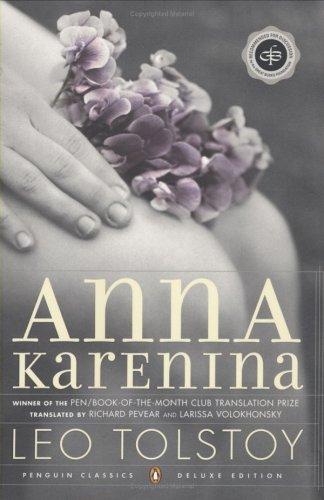
Benny decided it was time for the boys to read Leo Tolstoy’s 800 page whopper Anna Karenina. Today we discuss parts 1 and 2 of the novel.
Rich immediately fell in love with all the characters. He wants be Levin, be with Anna, and be… something with that majestic horse Frou Frou.
On the famous opening line: Are happy families alike? Are any of Tolstoy’s families happy? Rich argues the line is actually about statistical mechanics.
On Stepan and Dolly: We meet our first unhappy family. Are they meant to be nodes who connect everyone else? Will they stick in there and make the marriage work?
On Levin: Rich identifies with Levin, warts and all. Is this Tolstoy’s mary-sue character? How did he fumble the bag so hard with Kitty? Speaking of, why can’t Benny bowl without the gutters up?
On Anna: Rich falls in love with Anna almost as quick as a Tolstoy character. Her elegance, intelligence, and her black dress. He loves her even more than Levin but Frou-Frou the horse gives her a run for her money. How does Tolstoy write such likeable characters? Is Anna’s burgeoning relationship with Vronsky love? What to think of her cucked bureaucrat husband Alexei Karenin, who’s obsessed with propriety? On fiery passion vs duty.
AI rates our podcasting skills
Rich: Welcome to Do You Even Lit.
Cam: Welcome back. Should we talk about — wait, is it Sonny or is it Sunny?
Rich: Sunny like Sunny Jim. Were you guys surprised by your scores?
Cam: We did a session on one of our podcast episodes around word count, interruptions, unique words, and we all had a guess who was who. And it turns out Benny doesn’t speak as much, and I don’t speak uniquely. So like Alex from Everything is Illuminated, I’m going to be speaking with a thesaurus today to get my word count up.
Rich: How good was the pseudo-psychoanalysing profiles as well? For me, I was described as the marathoner — “risk of steamrolling others, may benefit from conscious turn-handling”.
Cam: My advice was that articulation clarity could improve. Quickest to speak, but not very articulate. Keeps the flow going. Afraid of awkward pauses.
Rich: Benny was called the pensive minimalist — speaks least in absolute terms but with the richest lexical diversity and calm pacing.
So it’s not bad, right? It’s pretty accurate.
Benny: Yeah, I’m gonna put this on my CV. The pensive minimalist.
Rich: Dude, you should have called your Substack that, seriously.
Benny: Then I could get away with only posting once every two months.
Cam: Road to Sharia was just yelling out to you too much, you couldn’t ignore it.
Benny: I couldn’t ignore it. Once it was in my head, it was like a meme, I couldn’t get out of this.
Rich: Wait, it’s not called the Road to Sharia, is it?
Cam: Well, no, but it might as well be. It’s so badly named, it might as well be, mate. This is for, um — keep Britain for the British.
Rich: Oh, man. What is it? Is Sharia the place? I mean, I don’t even know where that place is.
Benny: It’s in the Odyssey, right? Dude, you didn’t Anki this shit, come on. Come on, dude, you’ve changed.
Yeah, no, it’s Steps to Phaeacia. I went with Phaeacia instead of Sharia because Rich said it sounded like some form of irritable bowel syndrome.
Rich: It’s like — was it, you’re losing your hair slowly, or your hair is falling out?
Benny: I had that when I was younger, actually. My hair was falling out.
Cam: Damn. Were you nervously picking it?
Benny: I was, I would. And I would pull out chunks. It was crazy. I had like a massive bald spot in the back of my head.
Rich: It’s looking lush now, man.
Cam: Yeah, it was great.
Rich: He got a good guy in Turkey.
Benny: I went to — yeah, exactly. Paid the Turks a visit.
Cam: That’s where Phaeacia is.
Benny: Yeah, that’s what gave me the name.
Rich: Alright, should we dive in? Any more nonsense administration that we need to cover before we talk about this book?
Benny: I know. This book is awesome. This book was made for us.
Cam: Just quickly — Sonny, that analysis was completely wrong. It didn’t capture me at all, by the way.
Benny: It’s AI, just hallucinating stuff.
Rich: Yeah, LLMs clearly not on the path to AGI.
Benny: Yeah, exactly. Cam’s going to be speaking very slowly with very extravagant words today.
Rich: What does that mean? Guilelessly.
Cam: Alright, so the boys today are tackling parts one and two of Anna Karenina. So this takes us up to page roughly 250 out of the 800 pages. There are eight parts in total, so this is just the first two parts. I don’t know about you guys, I’m really liking the reading experience. I feel like this was a book that was sort of made for us, because there’s a lot going on sociologically and there’s a little bit of romance thrown in.
Rich: I’m in love.
Benny: We’re some feely fellas.
Rich: Yeah, I’m in love with at least three of the characters in this book. I got my own little love triangle going on. Maybe four if you count Frou-Frou.
Cam: And you fall in love as quickly as a Tolstoy character.
Rich: Yeah, page five.
Opening line: are all happy families alike?
Cam: Yeah, okay, so let’s just dive in. The very first line is a famous first line in literature, obviously. It reads: “Happy families are all alike; every unhappy family is unhappy in its own way.” Bang it. We agree or disagree from that line? Do you agree, Rich? Do you think that’s actually true?
Rich: Um, I want to take it in a different direction that’s not about families. But — I think it’s like — you say, you go first.
Benny: Well, I think obviously it’s not literally true. I think it’ll be interesting if Tolstoy’s happy families differ or not. I mean, we haven’t really had an instance of a happy family yet, we’ve had two or three unhappy ones. It’s an arresting line. There’s a running joke in philosophy departments that the opening line has been quoted so much by philosophers that you can question how much philosophers’ knowledge of Tolstoy extends beyond it, because everyone just references that opening line.
Rich: Yeah. I remember Peter Thiel’s book starts with this line. Everyone knows this line, it’s so good. I think it captures something — even if it’s not literally true, it captures a deep, important regularity about all of life, which is that there’s many more ways for things to be disordered and fucked up than there are for them to be working and functioning the way that they’re meant to. This is like the central insight of statistical mechanics, and entropy, and things like that. It’s crazy — I actually looked this up, Boltzmann is a contemporary of Tolstoy, but there’s no way Tolstoy would have known about statistical mechanics or entropy. But it’s a very neat observation.
I don’t know if you guys remember, but we talked about this when we were arguing about whether IQ is normally distributed or whether the right tail is truncated. So like, there’s a long left — there’s all kinds of ways that you can degrade performance of someone’s brain, but there’s not the equivalent number of ways that you can improve performance of someone’s brain. There’s just a way that a system can be functioning, and then there’s so many — whenever you introduce noise or perturbations or whatever, they’re almost always going to be detrimental, they’re very rarely going to improve it. That’s the central insight, and it’s across so many different fields, like epistemology as well. It’s relevant to our little niche interests of what makes a theory good or bad — there’s so many more ways for it to be wrong than for it to be right. So yeah, anyway, I love it. It’s an absolute banger, iconic opening line, and it has this very deep wisdom which is relevant to any kind of system, whether or not it’s true of families.
Cam: It’s almost like the base case or the status quo for Tolstoy is perhaps this happy family that there’s kind of nothing wrong with, and perhaps we don’t scrutinise very critically or very closely. Of course they’ll have slight differences, but nothing to focus on too much. But as Rich said, the entropy insight — there’s just so many different ways for that to go wrong, and those are often the interesting ones, and you can take the story. I mean, we’ve done two parts and we’ve already got three or four different quote-unquote unhappy relationships or families so far.
Rich: So you’re saying one of us writes our pop psych book or pop statistics book about the second law of thermodynamics — this entropy — and we can start it with that, we can put this as the opening line at the top of the chapter. Totally. Peter Thiel’s book really starts with this line — well, he actually inverts it. He quotes the line and then says in business it’s the opposite, where he says every successful business needs to be a monopoly of one and completely unlike other businesses. But even then you could invert his inversion and say the common factor of all successful business — that’s okay, that’s a stretch, but yeah.
Benny: I mean, I think this is probably true from the perspective of an outsider looking onto a family. It seems like if there’s a happy family, they all seem similar and that they’ve all sort of worked out their kinks. From the outside, it seems like they’ve all just sorted themselves out and they’re sort of boring in their happiness. Whereas if you have a family that’s constantly fighting, they’re always fighting about something else. There’s someone else’s cause to ruckus or whatever. And so from the outside, there’s much more variance going on if you’re dealing with an unhappy family. But I think it’s not true from inside the family’s perspective, in the sense that people are all different, and working out a relationship with one person looks differently than working out a relationship with someone else. There’s going to be different issues in the relationship that you’re going to have to solve, different sorts of problems.
Cam: I mean, it’s also just not true comparing families with other families. I’m interested whether we’re going to get happy families or not in this book, and whether they follow a certain archetype that maybe is a Tolstoyan archetype. It seems to me that maybe Tolstoy is more interested in the emphasis on how things can go wrong, or even more deeply put, like on evil versus good. The book’s probably more going to be about unhappy families. I mean, it starts with an unhappy family right from the get-go, and that’s going to be the focus. And yeah, maybe good is the status quo and the entropy causes us to push away from it.
Benny: Okay, so let’s just dive in to part one. Maybe just as very brief background—
Rich: Are we not going to the second line now? I thought we were doing line by line. This is a close reading group.
Benny: We’re just going to not pronounce the three names every time.
Cam: How many pages is this book? A thousand pages?
Rich: I actually don’t know because I’ve got a Kindle.
Benny: 850. But it’s like a thousand chapters, unfortunately. So there’s like 300 chapters in part one. So we can’t go line by line, we’re an unserious book club.
Rich: Don’t give Cam the idea of doing a line-by-line book club, because we’ll be doing that for Infinite Jest for sure.
Cam: That is settled, yeah. We’ll really live up to the title.
Benny history snippet: freeing the serfs
Benny: So yeah, maybe just worth saying that it’s set in roughly, I think, 1870s Russia.
Cam: It’s set in Russia, yeah.
Rich: Yeah, I took a speed-reading course on Tolstoy. It’s about Russia.
Benny: It’s about some families in Russia. And I guess this is — still Tsarist Russia, I think, but the serfs have been liberated but there’s still big inequality in society. So the serfs are now sort of what are called muzhiks, I think, which are basically just peasants that do work and get paid, but they don’t get paid very much and they don’t get paid enough to rise through society. So society’s still very much stratified between the aristocracy and the muzhiks.
Cam: Tolstoy himself has to like release his serfs round about now, I think. And he’s kind of in conflict about it because he’s this aris- arist… rich guy in the countryside.
Rich: You went for aristocratic — changed it! This is why your lexical score is so low. It’s for the like — like Tolstoy and Levin: I see these peasants as my equals, unlike his brother who sees them abstractly as a class. I see them as my people, I’m like one of them. But yeah, I think he was kind of in tension — like he lived down in this manor and had all these peasants, probably didn’t feel that great about them, and then had to release them.
The general idea is that the freeing of the serfs didn’t go all that well for the serfs, right? Like actually in some cases they were better off under serfdom, just in that their incomes were not really enough to live on for working the land pretty often. So it was like a step in the right direction, but they didn’t do it in a way that — they didn’t fully make them whole.
Stepan and Dolly
Alright, so the book kicks off with Stepan and Dolly. Cam, you want to walk us through the beginning?
Cam: Yeah, sure. So it opens up, as Benny said, with Stepan — also known by his nickname Steve — from the Oblonsky family. And he has his wife Dolly, and she’s one of the Shcherbatsky sisters, which will meet some of the other characters. Right from the get-go it opens out that Stepan’s had an affair with his governess, and Dolly’s super upset, threatening to leave him. She even calls him, quote, the terrible word, a stranger. But she’s in conflict — she doesn’t know whether to leave him or not. And Stepan himself, I don’t know, he has an interesting take on it all. He doesn’t feel super guilty about his actions; he’s more focused on the fact he got caught. He keeps thinking about his reaction when he was confronted — he had this weird smile. So he doesn’t seem all too guilty about it. But he’s quite a likeable guy as well. Like his sister Anna, everyone likes him. He treats people equally, apparently. He reads the liberal newspaper because it suits his lifestyle. So it starts right from the get-go.
I did wonder why — I mean, Tolstoy must have intentionally started with these guys. I did wonder about posing that question of why we thought Tolstoy started with Stepan and Dolly.
Rich: I like that Stepan is the kind of guy that just loves to have opinions, but gets them totally uncritically from all the newspapers he reads. And this was pretty insightful, I think, by Tolstoy to notice that this is a kind of person who really likes to be up on the news and well read and conversant in the issues of the day, but is totally predictable when it comes to their politics. And whatever they think about issue X was talked about in newspaper Y yesterday in exactly the same language. And so just not actually critically thinking at all, but just likes to be the kind of person who can show off that they know about what’s going on. Which is definitely a kind of person — maybe arguably the default.
Benny: Yeah, apart from us bold freethinkers.
Rich: Yeah, yeah, bold independent truth-seekers. Let me read the quote, because the way that he puts it is so nice. He says: “He only changed his views when the majority changed them, or, more strictly speaking, he did not change them, but they imperceptibly changed of themselves within him.” Which I think is like a really nice way — I mean, it immediately makes you think of all of the modern waves. We’ve talked about this before, like, social reality is in a certain equilibrium and everyone is just in that equilibrium, and then it sort of shifts and everyone rushes for the exit and quickly moves into the new equilibrium, pretends that they always were. But I don’t think it’s a conscious, deliberate or dishonest thing — it’s just the way that humans are as social animals that live in the social reality. You don’t figure everything out from first principles, you just sort of roughly mirror what everyone else is doing unconsciously. But yeah, I enjoyed that little passage too.
Cam: Also just needs another character who just imperceptibly goes the other way, so when everyone changes their mind, changes to the opposite.
Rich: Yeah, I’m a reflexive contrarian, which means I’m like retarded in the exact opposite direction, but just have less friends. Yeah, just find myself arguing with people a lot more often.
Cam: Yeah, reflexive in a way that just makes you more socially unpopular. The worst.
Benny: So can I just ask a clarifying question before we go on — did Stepan actually bang the governess, or was it just like — something in this whole book is that the sex is kind of hidden if it is taking place. Did he just write her a bold letter, or, you know, he sent her a sext? Ye olden dick pic. I don’t know, because we’re thrown in the aftermath of them thinking back even to the confrontation and the conversation about it. It sounded like it kind of had been ongoing. I don’t know how intimate it got, and yeah, Tolstoy certainly later on stays away from — not really smart, I was — you know, I still feel the book just feels like it’s building up to this.
Rich: Could be 18th-century smut, but you know, better not look too closely on the sexual details. Just 800 pages of edging. It’s cruel.
Cam: Okay, and then Stepan is excited that his sister Anna is going to come to town, because he anticipates that his sister can help relieve some of the tension and maybe help get his wife back on his good side. And so that’s why he wants his sister to come to town. And that introduces us to Anna.
Yeah, just quickly — I’ll answer one of my questions around why Tolstoy started with these guys. I think it somewhat fits the theme, right? So we get this opening line that we’ve talked about — “unhappy families are all different” — and then we straight off have this affair. But it doesn’t start off with Anna Karenina, what the book’s named after. It doesn’t start off with Levin, who the book maybe could have been named after — probably wouldn’t have sold quite as well. It starts off with Stepan and Dolly. One of the reasons, as well as the thematic reasons, I think they’re just a central part connected to all these other characters, right? So Stepan’s the Oblonskys, and he’s married to Dolly, and so she’s part of these Shcherbatsky sisters. So we get Kitty and Natalie and Prince and Princess, the mother and father. And then Stepan is brothers with Anna Karenina, who’s married to Alexei, who Stepan knows — that’s how he got his job, and he’s friendly with and he appreciates. And then Stepan’s old childhood friend is this country bumpkin Levin, who’s crushing on the Shcherbatskys. So these two are kind of people that connect everyone. So we can kind of start with them and veer off into these different storylines with everybody else. It also allowed Tolstoy to do that.
Rich: Yeah, that seems right. I think it also gives you a bit of an outsider’s perspective on Anna and stuff. Like, he can introduce some of Anna’s qualities to you as the reader without trying to do it immediately from actually discussing her.
Benny: And I suppose contrasts Anna with Dolly as well, and yeah.
Cam: True. Alright, yeah — Rich, do you want to talk a bit about the introduction of Anna and Mr Vronsky?
Meeting the famous Anna Karenina
Rich: Yeah. So she comes down from Petersburg on the train — wait, to Petersburg? From Petersburg to Moscow. From Petersburg to Moscow. And she’s in a carriage with this old lady who’s bending her ear, who turns out to be the mother of Vronsky — Count Vronsky — who is one of our central figures in our love triangle, or love quadrangle. And when the train comes in at the station, Vronsky comes aboard to meet his mother and notices this woman who, interestingly, I think he describes as not even sort of arrestingly beautiful, but kind of just interesting-looking and compelling. And there’s sort of a flash of tension between them. And Anna realises that this is the son who the older lady has been rabbiting on about the whole way down on the train. It’s a fairly brief interaction, but there’s a spark of chemistry there.
And just to give some more context: Anna is a married woman. She’s got an eight-year-old child. She is not a single lady. Vronsky is — he is sort of a foppish, he’s in the army, but he’s basically like an aristocrat who capers around and goes to dances and theatre productions and says ironic witty things to his ironic witty friends.
Cam: But seems generally liked, I would say. Right? Like, seems sociable, seems like people like him.
Benny: And a bit of a ladies’ man, right?
Cam: He’s very well-spoken. Everyone gets along well with him.
Rich: And I think I started falling for Anna’s character almost immediately as well. You might think it’s strange that people fall for one another in this book so quickly, but I actually didn’t have that experience when I was reading the book, because something about the way that he writes these characters is so endearing. Like, I loved Stepan’s character immediately, even though he’s introduced as a philandering, somewhat shallow, glib person. But I just found him very endearing and warm. And then the same thing happened with Anna — less so with Vronsky, but we can talk about him more later.
Benny: Alexei had me straight away, as soon as I read about his ears and his reading habits.
Cam: I mean, honestly, I don’t think it’s too unrealistic. You meet someone, there often is a spark of intrigue right away, right? And you may or may not follow up on it, or it may or may not fade as you get to know them more. But that does often happen, right? Like, you meet a cute girl —
Benny: Don’t always call it love though, right?
Cam: No, no, but you develop a crush. There’s obviously some initial chemistry. But I don’t think he called it love originally either. That’s kind of my point, right? It took a little bit longer of them seeing each other at various events and balls and stuff before I think it actually culminates in something like love. So I mean, I don’t know — developing a crush on someone from seeing them in the train station seems pretty realistic.
Benny: Yeah, it just sparks it. There’s more to come. So let’s get to the ball, right?
Rich: I guess, yeah, one other thing though — do you guys think — so they’re at the train, and it turns out that I guess as the train was coming to a stop, it ran over a worker or something. And then everyone’s panicking, they run to the front to see what happened, find out this worker’s been run over. His wife is around, who’s now widowed, and Vronsky gives her like 200 roubles or something, and sort of does it ostensibly without the knowledge of everyone else in the party, but they kind of find out anyway. And I’m still unsure what to make of this scene.
Cam: Anna says it’s a bad omen as well.
Rich: What — that the guy got run over, or that Vronsky gave —
Cam: The guy got run over. She felt not good about it, and I think literally said it’s a bad omen.
Rich: So do you think it just foreshadows future tragedy in the book? Like, maybe it’s too early to say what that event meant, or maybe it meant nothing, but I’m a bit confused about what was going on there.
Benny: I took it as Vronsky like capitalising on this tragedy to try and raise his esteem in the eyes of Anna and others. Like, even though he didn’t do it totally overtly, I think he probably would have known. I mean, don’t make me mention the word signalling.
Rich: Every book is about preference cascades and signalling.
Cam: Yeah, no, it’s just like that thing when you’re on the bus and there’s, you know, a hot girl next to you, and you’re like, some old woman comes across and you stand up for her. Let me get your bag.
Rich: In front of Anna Karenina, let me get your bag. Just praying the whole bus ride — please, there’s something bad happening that I can—
Cam: But yeah, definitely the bad omen is foreshadowing something. Some way a family is going to get unhappy probably, would be my guess.
Rich: Yeah, that’s right.
Benny: In a different way to another family being unhappy.
Cam: Okay, so now let’s introduce some of the characters that get us confused about or get involved in some of the funky love situations that we’ve got going on throughout this book. So Dolly, who is Stepan’s wife — we mentioned earlier — has a sister Kitty. Kitty is 18 at the beginning of the novel, and is, I guess, at that ripe age where you’re looking to get married, of course.
Rich: A day over 19 would be too much.
Cam: So she’s looking to get married any day now.
Rich: Wouldn’t be interested in you anymore. And the older sisters, yeah, exactly. Well, this was something that confused me, like, you guys — but remember when we get introduced to Stepan, and one of the reasons he gives for having his affair with the governess is he describes his wife Dolly in pretty unflattering terms, where he says, like, oh, now she’s old and she’s hit the wall — but not in so many words, but he’s saying that she’s kind of not very physically attractive. And then when I found out that her sister Kitty was 18 and was this beautiful maiden, I was like, what the hell? I was imagining them as being like 40 or something. So like, the Russian woman hit the wall at age 23, or Stepan — I don’t know, I was a bit confused by that.
Cam: This was before Turkish hair transplants and facelifts.
Rich: That’s true, that’s true.
Cam: They all had alopecia.
Benny: Levin, Stepan’s mate, crushes on all the sisters, right? He was into Dolly back in the day, and then Dolly rejected him or went for someone else. And then he was into Natalia, or Natalie, who isn’t mentioned — oh wait, was he? He’s kind of moving on to each sister.
Rich: I keep getting older, and the Oblonsky sisters stay the same age.
Benny: Alright, alright, alright. And this is a big deal because this is like the last one.
Cam: This is like the last — yeah, no wonder he’s so upset. I know, he’s gonna be in deep despair if she doesn’t choose. Okay, yeah, so we have these three sisters, the Shcherbatsky sisters: Kitty youngest, Dolly oldest. What’s the middle one’s name? No, it doesn’t matter. Natalie, I think she’s — not important, I don’t think, or at least not yet.
Rich: She’s a happy family.
Benny: She’s a happy family.
Levin crushing on the Shcherbatskys
Cam: So Constantine Levin, he’s 32 — so, you know, Cam’s age, I think. So he’s, yeah, I guess has been in love with all these girls but is now seriously in love with Kitty and wants to propose to her. He has a plan to propose to her. And Kitty’s father likes Levin enough and wants her to say yes, but Kitty’s mother is not a huge fan of Levin and wants Kitty to hold on for someone better, I guess, with more aristocratic ranking.
Rich: Kitty’s mom’s like — Rich, just been taken in by Count Vronsky, you know, taken him by his channel. Oh, that’s all you said, you love, man.
Cam: And so Kitty, it sounds like she’s known Levin for a long time and she does sort of love him in some ways, or is at least very fond of him, but her heart is sort of set on marrying Vronsky, who we’ve already been introduced to. And her mother likes this match a lot more.
Rich: So, you know, all these families are just throwing balls all the time, because that’s what aristocrats do, I guess. They have no work to do, so they just throw parties constantly. And Levin basically shows up to this party that the Shcherbatskys are throwing early, gets Kitty on her own, proposes, just throws himself out there. And she just shuts him down kind of ruthlessly. She tries to be as nice as possible about it, but he’s heartbroken. Vronsky shows up in the middle of this encounter — basically Kitty has shut him down, Vronsky then walks in the door, Levin’s heartbroken and just wants to leave. And then Kitty basically can’t help but be nice and flirtatious with Vronsky because he’s such a charming guy, right in front of Levin. And Levin just wants to blow his brains out. And so I really felt bad for Levin here — this was brutal. Just sitting around politely making small talk with everyone, and you just had your deepest hopes dashed. Oh man, you just want to go home and crawl into bed, watch Netflix.
And he can’t help but somewhat respecting Vronsky — he kind of sees the positive aspects everyone else sees there, but he also kind of hates this motherfucker.
Benny: Yeah, exactly. And he acts exactly like — it’s written, the section is written perfectly, and I can understand why people like Tolstoy’s writing and also think that he’s a good sociologist. Because the dynamics of everything that happens are pretty realistic. Like, he has his backup, he’s extremely annoyed, he’s extremely short, but then this doesn’t come across as him being intriguingly defiant or anything to the people around him. He just comes off as sort of daft, and like he’s just grumpy, and an asshole — which is exactly how it would go in real life.
Cam: It’s like that name and the guy in the corner and everyone else is just dancing. Who’s that?
Benny: Yeah, yeah, exactly. He’s just — yeah, he just proposed, he’s on the back foot, and he’s just defensive the whole time. And yeah, we with the god’s-eye view understand and sympathise, but for everyone else, he probably comes across as a bit cold or a bit of a jerk.
Cam: And he’s generally shy and easily embarrassed. I think he comes in as this country guy, and I think Stepan makes a joke about his clothes or something — “oh, you’re wearing a European suit coming in,” and he suddenly blushes. And that always comes over him, and he’s always second-guessing what he says. He’ll say something to Kitty — I think they go ice skating early on as well, and it’s going quite well, they sort of have their own little spark, and I think she brushes or touches his arm, and he goes, “I like it when you lean on me,” or something like that. She kind of, like — he just blitzes.
Benny: He blitzes it, yeah. And he’s like, yeah, I shouldn’t have said that.
Rich: Yeah, yeah, that’s exactly what it’s like. It’s like, no, just don’t react like that. Saying it’s fine, be cool, be cool. “I like it when you touch me.”
Cam: And he’s a baller skater, right? As well, he almost kind of gets her back, he’s like doing twirls and stuff.
Rich: So something we should say here is that we made it seem as if Kitty just rejected him out of hand, but no, I think they legit were on track to be a couple. I think it had been bumpy, but things were moving in that direction. This was not like a crazy move on his part. And then Vronsky was the new element that just upset the apple cart. But I think absent Vronsky, I reckon Levin would have been in with the grin.
Benny: And even with Vronsky — Levin, when he proposes, she rejects him, but it’s even written like she is filled with warmth and light when she feels sort of loved by him. And then ultimately, you know, he’s got her mother on one shoulder and her father on the other shoulder. So her mother really wants her to go with Vronsky, with the father’s line being “I see through Vronsky.”
Cam: Yeah, I don’t know if they were on track, but certainly it wouldn’t have been totally unexpected. Stepan realises sort of that this is probably why Levin’s coming into town in the first place, to propose to her. He doesn’t seem totally caught off guard by it. He’s sort of awkwardly in this position where he does know about Vronsky as well, so he’s not sure quite what to say. But yeah, I agree. Levin seems like one of the natural choices.
Benny: Stepan gives them a 50-50 each, right? He’s kind of the neutral observer.
Cam: I mean, I don’t know if that’s what he actually thinks, but that’s how he puts it. Could go either way.
Benny: Yeah. He’s basically like, shoot your shot, bro.
Rich: Yeah, he’s like, get in there. Do it. Throw a party tonight, show up early, ask her. Even when she’s — he’s rejected, right? He’s still kind of like, keep shooting your shot, man.
Benny: He’s really optimistic.
Rich: I really like Levin, I gotta say. I don’t know how we’re supposed to feel as the reader towards him exactly, but I can’t help really liking him. I kind of like that he’s socially awkward, but he feels quite earnest. He feels like a little alienated from modern society. He lives in the countryside, and I think there is a bit of a rural-urban split dynamic that Tolstoy is creating here. He can’t quite understand why everyone loves living in the city, and then the people that live in the city sort of look down on him a bit for being a country bumpkin — although “bumpkin“‘s the wrong word, because he’s got a massive — he’s an aristocrat, many servants and horses and stuff. But he definitely views life a little differently from the rest of them, and seems a bit more preoccupied with life’s bigger questions — trying to figure out how to live, how to live well, what it means to live a good life, the ethics of treating his servants certain ways and how he should own land and stuff. And then when he gets shut down by Kitty, he sort of resolves to just go back and live a very simple life, and actually get rid of a lot of his possessions.
Benny: Touch grass.
Rich: Yeah, yeah, exactly. Touch grass. So yeah, this is all just background. Levin — I’m really liking.
Cam: When he comes into the city, he even notices, like, I think some other one of Stepan’s friends has long nails or something. It sort of gives him the creeps — which, I think, just probably gives could give you the creeps anyway. But he kind of thinks, well, this person’s not using his hands for work. How can you have long nails as this aristocrat rather than needing it for work? And he’s somewhat disgusted by it.
Rich: So, yeah, that’s definitely setting that up. And for context, like, Tolstoy himself lived out in the country, and he was a rich aristocrat, but he — I think Levin is probably partly based on him.
Benny: I think so. I mean, I don’t know Tolstoy’s biography too closely, but I know near the end of his life he started getting really into, you know, this sort of — I think part of Levin’s philosophy of being in touch with your work and manual labour. I think Tolstoy became a bit of a Georgist, by the way, near the end of it as well.
Rich: Yeah. Once he lost all his serfs, maybe.
Rich: So did this outdoorsman, this countryside scene charm you, Cam, in particular? Because, like, you know — I know that you generally don’t like this kind of thing, but I love this section where he’s roaming around his farm, thinking about crop rotation and talking to his various handlers and his peasants, and riding through the forest and just living that bucolic rural existence. Even though it’s somewhat lonely and isolating — he just has, like, one of his servants as his main companion — but I loved it. I thought it was a beautiful passage, and it gave me nostalgia for living in the country. Shooting, going out shooting with the birds and the dogs, and riding horses. It’s very romantic, I think.
Cam: Yeah, yeah, sure. I imagine these sections are a bit polarising amongst readers in terms of — I think I’m more drawn to the drama of the Anna Karenina arc, where it’s kind of cinematic and just drama every second. And then it’s an interesting juxtaposition, then you go to Levin — he’s kind of moping out in the country about his lost love and his relationship to work. But he just buries himself in work, right? He’s a very practical man, and that’s his form of moping. It’s not that he just shuts himself up, he sort of really actively gets out on the farm and tries to give it his absolute best, and also thinks harder about how he can — what next steps he could take to make his peasants’ lives better and things like that. So yeah.
Benny: These sections, Tolstoy is sneaking a bit of, perhaps a bit more didactic than the Anna Karenina sections, and sneaks a bit more philosophy into it. So Levin’s having discussions with his brother — and his half-brother, actually. So his half-brother, Koznyshev or something, he is a philosopher and he has all these abstract ideas. And I think it gets a bit contrasted with Levin’s kind of more practical side of things. So my understanding of Levin — to contrast with his half-brother, who I think is very positive towards the peasants, you know, for the greater good. And for these zemstvos or whatever, these council estates, which I think have been recently—
Cam: I was half-expecting Benny to give us a table of ranks and the 30s and the zemstvo.
Benny: We have these city council things that have been formed by Alexander II as well as freeing the serfs. But Levin seems to be — his philosophy is more about what gives you happiness. Like, work for him gives him happiness, and that’s why he goes and does it. And he doesn’t like the zemstvos, the councils, I think partly because he doesn’t enjoy them. He also says they’re corrupt and stuff.
Rich: Yeah, he’s a very sort of high-minded critical person. He’s critical of everyone — the institutions, the people, the councils, and of himself as well. And I think this is why I love Levin in maybe a narcissistic way, because he reminds me of myself the most by far in this book. Because he’s, you know, he’s a serious man, and he’s quite earnest and critical in a way that I think makes it hard for him to get on with people sometimes, or he feels like a fish out of water. And you can imagine he could be quite hard to get on with sometimes — he won’t necessarily easily go along with what everyone else is doing, and maybe he’s not the best company. Like, you can see him being grumpy. He’s grumpy when he’s hanging out with Stepan quite often, and he has to be sort of left alone to come out of his funk. But yeah, I love him, and I relate to him really strongly, so I’m pretty invested in his arc at this point.
Anna and Vronsky
Cam: Okay, let’s go back to Vronsky though. Let’s go back to this ball. So Kitty has refused the hand of our dear Levin, and so she’s endeared towards him in some way, but her heart is much more set — seems like genuinely sort of excited about marrying Vronsky. And from her perspective, this all seems in place now. She’s, you know, she expects Vronsky to now basically court her and marry her. She’s so excited that she goes, “Anna, you should come to the ball. Come to the ball, I’m so excited about this ball.”
Rich: Oh, I missed it — did she — she was the reason that Anna was there?
Cam: Yeah, well, like everyone, she loves Anna. Like everyone’s taken in by Anna. You know, as Rich said, he was taken in by page one, and Kitty is just in love with Anna as well. She’s so amazing. All the kids love her, like, she just has an energy that she exudes I think that people are very drawn to.
Yeah, but she convinces her to come to the ball. So they throw this ball — I guess this ball is later in the week after the earlier ball where Levin proposed to her, right? This must be a separate event, I’m assuming. And so anyway, yeah, whatever happens basically, you get Vronsky, Kitty and Anna all at this ball, and Vronsky basically just cold-shoulders Kitty the whole time. Maybe dances one or two songs with her, but the main sort of, I guess, romantic dance is between couples — the mazurka.
Benny: There we go.
Cam: Yeah, I’m imagining is like the sexiest dance you can get in old-fashioned and fusty ballroom dancing. So maybe they like touch each other’s waist or something.
Rich: No, I think it’s like an upbeat Polish dance.
Benny: Yeah, yeah, finish the night on like doing the can-can or something.
Cam: Yeah, you know — and so Kitty is hoping that Vronsky is going to ask her to dance the mazurka. She’s not hoping, she’s like she just assumes that’s what’s gonna happen.
Benny: Yeah, and she rejects all the other suitors of asking her, because she’s like, well, no, because obviously it’s going to be with Vronsky.
Cam: Yeah, that’s a good detail. So all these other men are asking her to dance, she keeps saying no. And then meanwhile, Vronsky is just totally taken in by Anna, and you can see them get more and more interested in each other over the course of the ball. And then he asks her to dance, and they dance together. And at this point there’s nothing technically socially inappropriate going on, but this basically is heartbreaking for Kitty.
Benny: And Kitty can see it as well. I think she can see it in their eyes. She knows.
Cam: Other people notice too, that this is — it’s all technically within the bounds of normal behaviour, but it’s like, you can — yeah, it’s a slight, very slight transgression perhaps, and enough so that it’s very publicly marking out that there is some kind of connection between these two.
Benny: Yeah, between this married woman and this guy who’s supposedly courting another girl.
Rich: Which is true, like — you can see that in people, right? So in a work context or a friend group or something, people just hanging out lots, opposite sex, often, and sometimes you can see the chemistry growing and people notice that. Like, you know, the way the body language is interacting with each other and the way they’re looking at each other — people kind of get this vibe often that, you know, they haven’t done anything, everyone’s, you know, we’re just going bowling, there’s this all as a group, but you can kind of see, it’s like, yeah, the way they’re talking to each—
Cam: Oh man, I went on a date recently, bowling, and I was so bad at it. It was so bad. I’m sure I gave her the ick right then and there.
Rich: I’ve been bowling in like a decade, man, like, I couldn’t —
Benny: Oh my god, bowling’s hard to be good. Guys, I need that little machine that you like just set the ball on top.
Rich: Yeah, yeah, get the angle right.
Cam: Halfway through I was like, it killed me now.
Rich: Was she good at bowling?
Cam: She wasn’t that good, it was fine. We get it laughing about that stuff, but who knows what she was thinking. I’m always stuck in this conflict of wanting to choose a lighter ball, but like you don’t want to choose the same weight—
Benny: That’s the girl, we need the heavy ball.
Rich: What size of your hand — I think you should go down.
Cam: Yeah, surely this won’t fit.
Rich: Oh boy. Um, yeah, so this basically breaks Kitty’s heart, and she actually gets ill because of this. She falls ill, and then her family basically has to go on vacation to Germany, because that’s the only thing that doctors can think of, I guess, to do with her. This seems to be the common medical cure of the age — you have to go take the waters in foreign lands or something, which basically just means go on holiday.
Benny: Yeah, go to a spa. I know, I got so confused in that section because I just thought they were on holiday, right? It’s like German spa. And then I realised, like, everybody’s ill at this spa. You know, everyone’s sick, and I was like, okay then, that’s why he’s there.
Cam: And are we meant to think she’s sick because she’s heartbroken, potentially?
Benny: Yeah, yeah. Or was there a sort of a mention of — I don’t know, actually. Tuberculosis, I wasn’t sure if it was as well.
Rich: Definitely it’s connected anyway. And again, this is like a common thing amongst aristocratic classes of this time and of other societies and throughout history — especially amongst women, that we’ve mentioned before, like neurasthenia and things like that, where you have this very strong psychosomatic illness basically. But Kitty is devastated.
Cam: I think we just have to infer from this, kind of like work backwards to figure out what the social norms of the day are, and to figure out, oh, this is actually really scandalous and upsetting. And in fact, the text does say: “Vronsky didn’t know that his behaviour in relation to Kitty had a definite character — that is, courting young girls with no intention of marriage — and that such courting is one of the evil actions common amongst brilliant young men, such as he was.” So actually we do get a textual, like, straight-up condemnation of what he’s doing.
Rich: Which also is funny, because this is a point that I continue to think is underrated today. In my, you know, growing boomer conservatism, I get mad about men dating young women indefinitely without any intentions towards them. I think it’s actually quite a cruel thing to do.
Benny: He’s kind of the main player, right, in town. And I always imagine there’s some famous guy, you know — you can get with any girl he wants, right, and he’s not really serious about her. He’s sort of, yeah, as you say, it’s definitely a type of guy that still exists, that enjoys their company, like, genuinely, but is ultimately non-serious.
Cam: There was another interesting little thing in Kitty’s reaction that I think you touched on earlier before, Rich — how when Levin was proposing to her, she was filled with joy and she loved that even though she wasn’t going to accept the offer. I think she really loves the idea of being in love. And then there’s another quote I saw where she said, “For me to live with him now would be torture, just because I love my past love for him.” Which again is like a really nice little keen psychological insight into how people work, especially maybe a young woman of that class where you’re kind of fetishising the love itself.
Rich: It reminds me of the Baudrillard stuff, where the love has become the sign instead of the real thing, and the sign is now more powerful than the original referent — or it’s more desirable than the original referent. It’s a classic mistake that people make that I think Kitty is perhaps making. But it’s also hard to avoid when it’s been hyped up so much to be this thing. And of course, everyone wants to be in love, right? It’s very understandable, it’s a natural motive.
Cam: Yeah. And we should say, it seems apparent that Kitty very quickly regrets her decision. I think she realises that she’s sort of made this mistake, and that she’s cast aside this guy who did indeed love her, and she could have had this happy life with him. And she put all her eggs in Vronsky’s basket and now he’s totally forgotten her. She’s still in denial about it as well, because I think she sees Levin’s brother or something out on that resort as well, and she has kind of an angry, disgust reaction when she sees a member of the Levin family because she’s still feeling shit about it all.
Rich: Which is unfair to our Levin, right? Because his brother does seem like a slightly odious character.
Cam: Yeah. Okay, so that’s sort of the end of the Moscow line. And then Anna had come in from Moscow — Vronsky also had come in from Petersburg, St Petersburg, sorry, to Moscow. And then they all sort of go back after this ball’s over. And that’s when we actually meet Anna’s wife. So now we’re in part two — and his husband, or sorry, Anna’s husband.
Benny: Yeah, that would be a twist. You find out Benny’s been reading the fan fiction.
Cam: Anna’s definitely bisexual coded.
Benny: Yeah, it’s projecting your love on her.
Cam: Yeah. We get to meet her husband Alexei Alexandrovich Karenin — Karenin, I guess you’d say. And he is like this very dry, sardonic bureaucrat who always speaks to Anna a little bit condescendingly and disparagingly, and is like obsessed with his position within the court — you know, with winning the favour of bureaucrats who have a slightly higher station than him, and how he’s perceived and all this kind of thing. His legacy and his — yeah, his social position, I would say.
Alexei Karenin in denial
Rich: And he has this quite fairly cold relationship with his wife, which is evident right away, even before she starts properly falling out of love with him and cheating on him. But basically immediately Vronsky follows Anna back up to Petersburg, and they just start seeing each other at every opportunity, hanging out at every opportunity, and it just becomes really obvious to everyone what’s going on. But Alexei Alexandrovich is just totally in denial about it. So they have one conversation about it where he says, “Don’t embarrass me, basically. Whatever you’re doing — maybe I’m wrong, and it’s not improper, but it has the appearance of being something improper, so make sure that it doesn’t have that appearance.” He’s not giving her the blessing, but he’s definitely turning a blind eye to being cucked, like a hundred percent. So really interesting. I wouldn’t have expected it to go that way necessarily, but it’s because — I don’t know, I’d be interested if you guys have a view on this, but I think he’s just such a career man. And his goals are so removed from domesticity and love and things like that that he just can’t let himself even feel the feelings that he ought to be feeling. Because I even think there’s a hint in here that if he’d been more onto it and had been able to connect better with Anna, he could have possibly reconciled their relationship. They have a child together, she does see good attributes in him, she does still have moments of affection for him. It’s not totally doomed. But he, well, they both play a role, but he makes it so in particular by just freezing her out and not questioning what’s going wrong, not trying to figure it out. And just sort of — it’s like too painful for him, or he’s too distracted. I don’t know, what do you guys think?
Benny: Yeah, I mean, I thought she got the ick from him pretty quickly when she met — but those pointed, those sticky-out ears, I’m imagining like Shrek ears, you know.
Cam: Yeah, it’s the first thing she noticed when she got back. And you just imagine Vronsky must be this young dashing military officer, right? Alexei’s probably older. But yeah, he’s in deep denial about it because he’s really concerned around his status and how people perceive him. He explicitly says that — they keep talking about impropriety is the word that the translator uses. But he also just doesn’t want to think about what the possibility could be — which implies, well, he does actually care about it more so than just impropriety. I think he just doesn’t want to deal with the possibility of it. And he’s got all these mechanisms — he buries himself in work, or whenever he starts to meet her as well, because it sounds like every summer or winter or whatever, she stays at the second house, and he visits her a week, but he wants someone else to be there as well, so that will avoid awkward conversations. Or he wants to avoid people who will talk about her — I think one of his other friends, Count Lydia or something, is saying how improper it all is, and so he stops hanging out with her — that’s one of his mechanisms to just not deal with it.
Benny: Yeah, when people ask, like, how’s your wife, he gets offended and tries to change the subject, even something that could be and probably is totally innocuous. He’s that shielded off, that he prefers to just avoid it altogether.
Rich: And he also gets alienated from his son, which is really sad, because he’s got an eight-year-old son who’s already on uncertain terms with — and then he sees the son as like an extension of the mother somehow, and doesn’t know how to treat him, and becomes quite aloof and ironically detached with the son as well. And this little son is so confused, because he doesn’t know who this Vronsky guy is. He’s like, who is this man who keeps coming to see my mother? And he can pick up on the vibe that people think something’s weird, but no one ever is saying anything out loud about it. And it’s all just within the bounds of plausible deniability. There’s never an open, direct transgression or acknowledgement, it’s just like hiding in plain sight.
Yeah, it feels like the ultimate mode of motivated reasoning, where he’s just like — my sense is, he kind of realises he’s pushed her away with his actions, and he sort of expected her to be dutiful, because that’s how he views relationships. It’s just like two people doing their duty to one another. Well, love is sort of outside the realm of his thought. And I think he sort of realises this, but just then doesn’t even let his mind go there. I forget the actual phrase Tolstoy uses, but he’s got a couple nice instances of, like, you know, his mind started to wander in the direction of feeling guilty or wondering how this had happened or wondering what he should do about it. And then somehow he just closes down his thoughts and starts focusing on work and, like, doesn’t even let himself go there, basically. Which, yeah, I thought was interesting. I mean, the term “motivated reasoning” wouldn’t have existed when Tolstoy was writing, so that is another keen insight that he had into people’s psyches.
And another interesting bit here was — he sort of says to himself at one point: “I had always wondered how other men would find themselves in this position. How would they let this happen to them, such that their wives would be cheating on them? And now it’s happening to me.” And I can imagine that — I mean, none of us would have had this experience — but I can imagine that would be the reaction when, you’ve been married for, you know, 10 plus years, and all of a sudden you’re in these deep marital troubles. I can imagine you just feel like, how did this happen? How did things go this far? And there would be this temptation to just tell yourself, like, okay, this isn’t happening. Or, like, if I just act like it’s not happening, it won’t be happening. So my sense is this is probably a pretty realistic reaction in some way, given his personality. But yeah, I couldn’t totally tell because these are foreign waters for, you know, an unmarried fellow like me. But I’ll tell you in 10 years.
Cam: Yeah, exactly. You’re the Count Vronsky, you’ve been here.
Benny: One thing you said earlier is that Alexei is a man of duty, and I think that is one of the tensions or contrasts maybe that Tolstoy is setting up — of this deep love, emotions, feelings, sort of fiery feelings versus this kind of duty to marriage. And perhaps needing both, not being able to have one without the other, is a thing to think about. It is interesting to think how their marriage would have been before Vronsky came along — if it was one of Tolstoy’s unhappy families already, or perhaps that they were fine and it was working. It’s weird that Anna is just so amazing — she seems like the catch of the two cities. And Alexei is, you know, he’s obviously smart and kind and respected, but he does seem boring. It is an odd match somewhat.
Cam: We should also just emphasise maybe for the listener — we sort of skipped over it, but like, once they come back to St Petersburg, there’s this informal relationship that develops between Anna and Vronsky where they spend a bunch of time together, both in private but also in public. Like, Rich, you were saying earlier, in balls and social settings, they’ll have conversations in the corner. And at this point it does start getting very noticeable. People are realising, like, why are they spending so much time together? And her husband, Alexei, will show up to these parties, and then they’ll basically ignore him to keep talking to each other.
Benny: Yeah, I found that scene so awkward.
Cam: I know, it was horrible but so well written. And everyone’s just noticing, and he doesn’t notice. Right, so everyone’s just there and everyone’s just gossiping — it’s what they do. And yeah, they’re off in the corner talking, and everyone just starts gossiping about them, and Alexei’s totally oblivious. But then Alexei realises when they get home that other people are noticing, and that’s kind of what he’s initially concerned — that’s the step too far for him.
Benny: Yeah, yeah, he kind of wants to nip that in the bud. But I like how Tolstoy set up around these different social cliques, right? I think he described there’s like two or three different types. There was kind of the boring, you know, less flashy, less good-looking group. I think he even mentioned that Anna initially preferred hanging out with them. But then there’s these young flashy types — Betsy is this main character, is Vronsky’s cousin — and suddenly Anna wants to always hang out with this group, because Vronsky’s good. But just, you know, that dynamic when there’s just someone you want to see and you’re going to all these events.
Cam: Yeah. And when people ask you about it, you kind of have this plausible deniability reason. But it’s just obviously all the time.
Where’s all the sex?
Rich: So again, did you guys clock that they were actually boning? Because when we get to the revelation that Anna is pregnant and the implication that it’s Vronsky’s, I was so surprised that I was trying to like reread the text to see if I was confused. Because I thought they were just sort of carrying on this improper but non-consummated relationship. I didn’t even realise that we were meant to infer that they were in fact having sex. So I kind of got really whiplashed by that. Did you guys see that coming?
Cam: I was the same way. I didn’t see it coming at all. And in fact, even when I read that she was pregnant, I wasn’t sure as the reader what was happening. I wasn’t sure if it was definitely Vronsky’s, or if she was just pregnant from Alexei again, and now this is going to cause big problems because she’s having another kid with this man she doesn’t love. And I think — I’m pretty sure now we’re supposed to infer as the reader that it is Vronsky’s, that they’ve been sleeping together, and she’s now pregnant with Vronsky’s child. But that took me a while to piece together. I was like, what the fuck’s going on here? So yeah, I was totally caught off guard by that.
Benny: I think there’s one section that kind of implies it. I don’t have it on hand, but it ends with them, and then it kind of, it’s almost like dot, dot, dot. And then it goes to the next session.
Cam: Yeah, yeah, kind of like a fade-to-black implied one. Yeah.
Cam: So maybe let’s just wrap up their storyline here. So Vronsky is racing in a horse race with his favourite horse named Frou-Frou.
Rich: Frou-Frou.
Benny: Frou-Frou.
Cam: Okay. Gladiator is the other horse he’s racing against. And he visits Anna right beforehand. Anna tells him she’s pregnant, he encourages her, I think, to leave Alexei at that point, right? He sort of says, like, “I love you, and we should be together, fuck this guy.” And she’s much more torn than him, mostly because of her kid — which is, again, another very realistic concern. She doesn’t want her kid to hate her, basically. And so he — they leave, they promise to that evening presumably to do some more boning, which we now realise is what’s happening. And Vronsky goes for the race, and breaks his horse’s back. Like everyone’s falling off their horse, right, in this race? So it’s crazy.
Benny: Yeah, these horses, these races seem nuts. So I don’t know how long the course is, but it seems like there’s 17 horses, they’re jumping through, you know, over all these hurdles and stuff. And the whole crowd’s like gasping every time someone crashes, and then crashes. And then Anna’s like, oh my god, she’s not looking at anybody else.
Rich: Yeah. This race scene is incredible, by the way. It’s my favourite scene in the book so far. It’s like a thriller, the way that it’s told — the way that both the lead-up to it, where Vronsky’s really nervous and he’s going to visit the hustler and getting tips, and then the race itself, like the blow-by-blow account of him versus his rival and each obstacle as it comes up, and the — you know, how much is at stake, because apparently, yeah, really dangerous jumps to be doing, jumping over barriers which have a ditch on the other side, and the horse will just break its legs and die if it catches it wrong. And it was a wonderful scene. And then devastating when he’s riding — he’s finally pulled ahead and he’s at the finish line, he’s going to make it, and he starts really thrashing Frou-Frou on, whereas before he’d listened to his handler’s advice to sort of let her go at her own pace. And he bounces in the saddle in a weird way and comes down in a funny way, and breaks the spine of his beautiful, beautiful Frou-Frou. And so it’s really sad. Tolstoy made me love this horse within the space of the scene — this character of a fucking horse that arises and falls. I was so upset by it. And I was cheering for Vronsky, I don’t know about you guys, but I was totally on his side. I wanted him to win. I was getting nervous reading it, like, oh no, is something gonna go wrong?
Cam: Well, we’ve been humanising Vronsky throughout these last chapters, where before, like, you probably — I mean, I sort of was a bit hostile towards him, I guess, because Levin’s my main boy and I feel sorry for Kitty. But the more time you spend with him, you see that this time he’s not being a cad. You know, like, he loves Anna, and this is a lasting thing, and he’s crazy about her. And there’s something very sympathetic and romantic about that. And he is in a terrible bind because he’s in love with a married woman.
Benny: But the reason that the race is so good for me is that, like — he ruins this beautiful female young creature by his ego and greed and so on. And it’s just like a very direct parallel to — I wasn’t sure either Kitty or Anna or maybe both — that he’s just destroyed this innocent beautiful creature through his own desire. And he’s fine, he’s back up.
Cam: Yeah, don’t worry about it. He wishes that he got injured, but he just walks away.
Rich: He walks away, and they shoot the horse dead. I just read one little line: “He stood staggering alone on the muddy motionless ground, and Frou-Frou lay gasping before him, bending her head back and gazing at him with her exquisite eyes. ‘Ah,’ groaned Vronsky, clutching at his head. ‘Ah, what have I done?’ he cried. ‘The race lost, and my fault — shameful, unpardonable. And the poor darling ruined mare. What have I done?’” He feels shame, which is the correct emotion to feel in the context of this race, the animal’s death. He doesn’t feel the same shame for Kitty, and it’s unclear whether he feels it for Anna. But this is the parallel, right? Like, he’s —
Benny: Yeah, yeah, yeah. Anyway, I love that scene, I love that scene so much.
Cam: During the race scene as well, in the crowd, I was feeling bad for Alexei as well. I love the way Tolstoy set it up. This is a moment where Alexei kind of puts his foot down in kind of an indirect way, I suppose, where he kind of realises what’s going on. He’s saying, “No, no, I think you should come with me.” But even before they go there, it’s just the way they’re dealing with it — everything’s just through indirect. None of it’s common knowledge, but it’s kind of shared knowledge that people know what’s going on, and it’s all kind of euphemistic. He comes to see her and he goes, “Well, why don’t we go together?” And she’s like, “Well, I want to go with Betsy.” He’s pushing back at that but always in this indirect way. And same for when they’re in the crowd and she’s watching him, and he says, “Are you okay?” when he kind of knows why.
Rich: Yeah, there’s plausible deniability until the end, right, where he’s saying to himself, “Oh, it’s a thrilling race and lots of people are being injured, and it’s not unusual that she should be gasping and shocked when Vronsky gets thrown off of his horse.” Like, he’s trying to justify it to himself right up until — yeah. And Anna, to be clear here, is in shock up in the stands. She’s crying openly in the stands watching Vronsky through the opera glasses, and is refusing to go home with Alexei. Yeah, it’s just couldn’t be more obvious.
Benny: Yeah, but just that dynamic of how hard it can be sometimes to say something explicitly, and people being passive-aggressive about things, and like, everyone knows the kind of subtext for why you’re annoyed, and you’re coming through annoyed, but it’s still just so hard to call the person out, and for the other person to say, I know what this is about as well, and call it out. Which eventually does — and she comes clean and says, “I love him.”
Cam: Yeah. So we should just spell that out. Like, eventually Alexei’s telling her that, you know, “We should go home now, you should come with me,” this is after Vronsky has crashed, and she’s refusing. And finally the third or fourth time he basically puts his foot down and makes her go with him. So they leave, and then in the carriage ride on the way back, she basically just tells him that, yeah, “I’m in love with Vronsky. I hate you. I don’t love you, I love him.” And it’s pretty intense, something like that.
Benny: It’s an intense — yeah, no, she says, “I hate you,” yeah.
Rich: And Alexei, I mean, to his credit, you know, he remains calm. “I hear you.” I don’t think it is to his credit though, I think this is his whole pathology. That when his wife says, “I love another man and I hate you,” he can’t even summon up any passion. Or at least he has to control it, because he’s so obsessed with propriety. And instead he just stares into the mid-distance for five minutes or something and then says with a slightly trembling voice, “You know, right, let’s just keep up appearances until we can — you know, make this — our affairs, sort this out properly,” and so on. It’s like, I don’t know, I don’t even know if that’s admirable. I mean, I guess it kind of is, in the moment it’s more admirable than like hitting her, or something, right? Like, you can imagine a lot of guys in that scenario do something less than kosher. But I agree, I mean, you’d think if you at all loved this person, you’d fight for her. This is the moment.
Cam: Yeah, like, you gotta — I mean, you’ve already, you know, many moments have passed where you could have done that, but this is the final moment where you can possibly, you know, at least try and get your foot in the door a bit.
Benny: Well, I think it’s also just a bit tragic, right? Like, it’s sort of outside of his control. This is sort of his personality. He’s this type of guy described well by Tolstoy, and he doesn’t really know how to keep her. But he feels strongly about the duty, I suppose. You can contrast it to — I’m just now thinking about Dolly and Stepan’s relationship — she finds out and she’s tormented by it, but I mean, she confronts him early on. She’s also in this decision of, do I leave him and leave the family, or do I stay with him and kind of forgive him, which is ultimately what she’s done so far. And she’s uneasy about it. She talks around, she constantly is a little bit nervous or anxious when he goes out and stuff, but ultimately she wants to stick with the family and stay together husband and wife. And Alexei seems to be making a similar decision, I suppose. He kind of knows it’s happening, but he wants to sort of make it work and stick with it. He’s tormented by it. He’s not just okay with it. He’s not in the hotel chair in the corner, but he — yeah, he wants to make it work.
Rich: Um, hold on. I didn’t read that as wanting to make it work. I read it as, “We’re getting divorced, but let’s just keep up a good face in public until we can sort out our affairs.” I don’t think he’s trying to save the relationship.
Benny: No, I think he knows it’s over.
Cam: Yeah. And that’s the whole contrast with Vronsky. It’s just not the type of guy to be impassioned about things, and that’s like a big turn off. Imagine Vronsky in this same scenario, you know. Like, he would fight, or he would be wearing his heart on his sleeve the whole time. So it’s just like, yeah, it sums up his character. And how they’ve gotten so cold and isolated from each other that he can’t even get mad in the moment that he finds out he has in fact been cucked. Although I guess he also sort of knew it, he knew it on some level all along. So he just can no longer compartmentalise.
Rich: It was such a good pressure release valve. Like, this dancing around that you were talking about, Cam, where everyone is just perfectly skirting around saying the thing that they all know — it’s very artful, but it also could wear on you after a while. And it was quite a relief for Anna to just say, “I love Vronsky, I hate you,” and just sort of let’s just put it out there, let’s just see what happens from here, rather than just continuing to artfully dance around it indefinitely. So I’m excited about where things go from here.
Tolstoy’s writing
Cam: Yeah, that’s a good point. I think Tolstoy really does a good job of not prolonging certain elements of the novel, right? You could imagine another writer gets sort of too infatuated with the world they built, and just wants to linger in some of this uncertainty and social awkwardness and stuff. And arguably Dostoevsky had some of those elements where you get so much mental anguish on — who’s the main character in Crime and Punishment? — Raskolnikov’s head, right, like arguably you spend too long there. And I haven’t gotten that sense from Tolstoy at all yet in this book. He keeps the plot moving, things happen sort of right on time, there’s been no parts where I’ve been like, okay, this is getting really dry. Like, I get, I understand what’s going on in this scene, I understand the social dynamics. Let’s move on. He’s moving things apace.
Rich: Next time I’m reading the gardening sections with Levin, I’ll think of you guys.
Cam: Yeah, being in bliss.
Rich: That — can’t go. This is an easy read, right? Not easy-easy, but by comparison to other stuff that we read, this one’s really moving along. You can read it without — I don’t know, I’m really enjoying it and not finding it like a struggle at all, put it that way.
Benny: I mean, I suppose it’s why people say he’s a great writer, right? Because it’s so old and it moves along well. It’s interesting that — because I think we’re all reading the Pevear and Volokhonsky translation, which I struggled with with Dostoevsky. And now I’m sort of wondering why. When I read commentary around them as translators, I think they try to capture the style of the writer, and keep it, for better or worse. They don’t sort of clean it up if there’s translation issues into English. And I just thought their version was so clunky and I preferred more modern translations. And this is fairly modern, it’s the 1990s, but it reads perfectly fine in this Tolstoy. And I just wondered maybe that’s just because Tolstoy was kind of an easier writer to read, which I think fits my understanding of them.
Cam: Yeah, I think that says way more about the writers and about the translators. Yeah.
Rich: Alright, well, come join us for next time. I think we’ll probably do parts three through five, but that’s a bit up in the air depending on scheduling and stuff, and what happens in the book, right? Like, who knows how much stuff there’ll be to talk about, but totally — it’s a good start. Alright, until next time, fellas. See you next week.