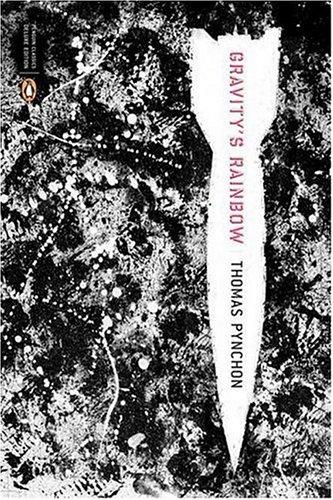
Yeah fuck this book. After much blood, sweat, tears, and other unspeakable bodily excretions, we’ve had enough.
This is our first ever DNF after 50+ titles, so we thought we should do a postmortem of what went wrong.
Did we not try hard enough? Is Pynchon basically an asshole? Do we have a problem with postmodernism as a tradition? Or the maximalist writing style? How is that we (mostly) love David Foster Wallace, who copied so much of his schtick from Pynchon, but not the master himself?
And several other theories for why this book ultimately defeated us.
Theory 1: We chose the wrong Pynchon
Rich: The war is over. It’s VE day in New Zealand over here.
Cam: This is — it’s Christmas and the war is over, we have stopped reading Gravity’s Rainbow at about 350 to 450 pages, and we’re happy about it.
Rich: We have to defend our honour to the listeners, because the last thing they heard was us being confused at the 100-page mark, and now we’re saying that we quit. But we kept going — you don’t know what we went through, you don’t know what it was like.
Benny: You don’t know how many recordings there are that are buried and will never see the light of day, of us trying to sort out exactly what on earth is happening.
Rich: It’s like a bad breakup, you know, when you’re like, oh, but should we, and you sleep with them again, and you know what you need to do but you’re too much of a coward to just call it quits and do what’s good for your own health and sanity. So I’m actually — I’m proud of us. I still have mixed feelings, but I’m proud.
Benny: That’s a bad metaphor though, because it’s not like typically you go back with someone because the sex is at least good, you know. But in this case there was nothing redeeming about it. I was lost and confused the whole time.
Cam: No, there was — there was a snippet.
Rich: Octopus Slothrop up in the French Riviera — it had its romantic moments.
Benny: The octopus? Great scene.
Rich: But yeah, we’ve — this is our fourth meeting on this book. We’ve been talking in the group chat, we spent god knows how many hours actually trying to read it, so we’ve given it a good god’s honest try I reckon. And then today we thought, rather than just like publishing one episode and never mentioning it again, we’d just say what the hell happened here. Like, to be clear, we’ve read 50 books or something, and this is the first time that we’ve DNF’d. Individual people might have not finished a certain book sometimes, but we never as a book club were like, nah, we’re bailing out. So: postmortem time. What happened? Why didn’t we get Pynchon? And I thought it would be a good time to also zoom out a bit and talk about postmodernism as a literary movement, just because we’ve been reading around it for quite a while and we’ve actually got a few books under our belts. But Gravity’s Rainbow is like the crown jewel of the postmodernist tradition, so I kind of want to just get a better sense of what the hell this particular project is about, which features we enjoy, which features we’ve been struggling with, what’s Pynchon-specific, what’s sort of to do with this broader movement.
Cam: Yeah, and Gravity’s Rainbow is also the crown jewel — well, usually — of Thomas Pynchon himself. Maybe not often recommended as the starting point, but yeah, dude has his masterpiece.
Rich: Yeah, so we’re going to explore a few theories as to what went wrong. I’m curious to know what your guys’ theories are. One that I’m going to personally get out of the way right up front is the theory that it’s just this book and we would have done great with another Pynchon book. Because I don’t know if I’ve mentioned to you guys, but I’m 0 for 3 on Pynchon books. So this is — and also like weirdly similar — I’ve bailed around the halfway mark on The Crying of Lot 49 and Inherent Vice.
Cam: I didn’t know that.
Benny: Oh, wow.
Rich: So I’ve really, really tried, I think, and just have not. I just don’t like what he’s doing, I think. And the objections to those other books is the same that I have here. So you guys will have to answer this question for yourselves one day, but for me, I have falsified that particular hypothesis.
Cam: I don’t want to do that meme of just like, just one more Pynchon, bro, just trust me. But I think novel V. is often recommended as a good starting point, so you could try one more just to make sure at some point.
Rich: This — I reckon if you ever wanted to have a hope of liking this, perversely the best thing to do would literally be, like you’ve been saying Cam, to start again from the start and do the reread, which is maybe how it’s designed to be read. And that’s just so dispiriting to think — oh, if you want to have a hope at unlocking what this book is all about, guess what you’ve got to do? Just start again. Like, is reading V. really going to help you with Gravity’s Rainbow, bro? I don’t know.
Cam: Well yeah, I suppose it would if you became a Pynchon fan. And there are quite a lot of — I mean, even Pynchon stans now and then, you just feel like it’s kind of worth it to get to the end and to understand it all and to talk about it and to reread it.
Rich: So you’re saying you’re still open to the theory that we just chose the wrong book and we might love other Pynchon stuff — and by we I mean you guys.
Cam: I’m even open to the theory that we could even love this book if we got to the end of it and reread it.
Rich: No, I don’t want to hear that talk. I don’t want to hear any of that backsliding.
Benny: Like, to what extent do you guys think it was a matter of effort? Assume you had nothing else going on in your lives, and you dedicated eight hours a day to sitting down with pen and paper and this book and tracking the characters, tracking the references, trying to decipher each sentence — do you think it would have been a more enjoyable experience?
Cam: I don’t reckon it would have been more enjoyable. I mean, we put in quite a bit of effort. We’re doing a book club about it, reading outside materials.
Rich: It’s like what you’ve been saying Benny at times, that there’s layers to reading a book, and the best books are very re-readable because you can keep reading them on different layers. So the surface layer is just you enjoy the plot and the characters and the writing style and the surface attributes, and then you get some thematic resonance if you think about it or do some close reading, and then maybe you get like deep allusions or some allegory or something, and you can keep finding new ways to attack it. But if it’s missing that first surface layer, I’m just not going to get to those other ones. So to answer your question — I could have unlocked more if I did that, but it would just be boring-ass homework. It would be like studying the bible or whatever. Sure I could have done that, but I don’t want to do that, and I didn’t enjoy my limited attempts at doing that, because you’re meant to get rewarded with these little bits of insight of like, oh, that’s why that thing, and this character means this, and I didn’t get anywhere close to that.
Theory 2: We are too dumb for this book
Which brings me to another theory, which is the most parsimonious — are we just too dumb for this book? Did we just get intellectually outclassed? I’m genuinely asking that as a genuine question, because Pynchon is definitely very smart. We can’t write this off as like a Sayd writing deepities or something — I mean, maybe we could argue about that, but he’s clearly super intelligent. And it made me feel really dumb. So Benny, what do you reckon?
Benny: Yeah, so I was wondering the same thing. I don’t think I have an answer, to be honest, but I’ll just echo what you said of feeling totally overwhelmed by this. It really brought my ego crashing down. We’ve read all these books at the book club. I thought we had at least some amount of literary sophistication under our belt. Clearly there were times where we’re not in lockstep with the literary community — I’m sure there’s lots of times where we’re just totally missing something, not appreciating what’s in a book or the surrounding context of a book. But with this one, I just felt so outclassed, I felt like a moron every time I would open the book. And it just made me realise that I think I just don’t have a good theory of literature, in the sense of: if the culture is telling you that this book is amazing and you can’t even get past two pages without wanting to toss the book across the room because you can’t figure out whose character’s head you’re inside right now — then it does feel like it’s on you, and that you’re sort of missing something, and that it feels sort of cheap to say, well, the author isn’t bringing me along with them, or there’s not enough surface level detail here for me to follow along, et cetera, et cetera.
So yeah, I mean, we could just be morons, and I don’t really know what to do with that. Like, I just feel a little worse about myself. And again, just genuinely —
Rich: I don’t think we’re morons. We’re definitely not dumb, we’re definitely capable of reading hard books. It’s more just, like, is this tailored at some kind of literary elite or intellectual elite that we are not ready to join the ranks of, either by innate talent or by experience and familiarity?
Benny: Like, are we just not good enough readers to have actually tackled this the first time?
Rich: Yeah, I want to slightly include skill issue as well as raw brain power.
Cam: I mean, okay — maybe skill issue, but I think there’s obviously more of a patience, conscientiousness, trust, and like masochism thing more than an intelligence thing. And, you know, there’s certainly a threshold to difficult works. I remember reading that the real guy that Don Gately in Infinite Jest was based on — I think Big Craig was his name — but he can’t get through Infinite Jest because he just doesn’t understand it, it’s like too hard for him. And just imagine that this is celebrated work, it’s like literally the hero is based on you, and then you can’t even crack 50 pages because you’re so confused by it. And so of course. And there’s like a bit of truth to — I don’t know, like Pynchon is maybe — DeLillo is the high school version of Pynchon, or not in terms of being lesser work but in terms of being easier to understand and stuff.
But I mean, I don’t think that’s the reason. I had this thought, I wondered this, like this element of like Stockholm syndrome for Pynchon and potentially other authors, where when you read them you’re kind of forced to admit, like, it wasn’t an immense waste of time and effort, so there’s — you know, so I wonder how true that is for a lot of people. But it’s like, I know that feeling, you kind of feel dumb, but it’s not like — obviously, there’s no people that read this the first time and it makes perfect sense to them. You know, it’s designed to be confusing.
Benny: That’s an open question for me though, that’s what I don’t know. It’s like, surely, surely not — surely those people don’t exist. I mean, they might exist though.
Theory 3: Gravity’s Rainbow is for literary masochists
Cam: Yeah, it’s designed to be confusing, and you’re meant to be disoriented, and then you’re meant to put in a lot of work to understand it all. And we kind of understand the first half of the book — I think we could talk to a big Pynchon fan about it and we wouldn’t totally embarrass ourselves. Of course we haven’t gotten all the connections, and I think you have to read this probably three or four times to truly understand it all. So I think it’s mainly this putting-in-the-work thing. I think that was Richard’s potential third theory, of like, is it massive masochism?
Rich: Yeah, so this is — at first what I was going to say as a joke, but now I think might possibly be true, is that we were joking around in the infamous shit-eating scene. Maybe I’ll splice the audio in here from one of our dead meetings so that people know what we’re talking about.
[The scene is described in] incredibly graphic detail — I’ve never seen anything like it. So it starts off with like whipping his withered old buttocks and so on, and maybe kissing her boots and stuff, like which is I guess vanilla by BDSM standards. And then we get to the piss-drinking and I was like, oh man, that was crazy. And then I could not believe what happened next.
Benny: I know.
Rich: Complete with the observation as he’s, by the way, just being made to chew and swallow all of her shit — the observation that in his mind he’s like, oh, this reminds me of a black man’s penis. That’s like even more to burn. Like, dude, you’re already eating shit, there’s no need to bring like a race kink into it, leave something else, you know?
We were kidding around and saying, oh, this is clearly a metaphor for the experience of what it’s like to read this book. It’s like there’s this sort of sadomasochistic element of it, of you’re being force-fed, and you want to be controlled and dominated. And usually you say, oh, this is clearly just for masochists, and it’s meant to be a dismissive insult — but what if there is the literary equivalent of sexual masochists out there, and they actually get off on big walls of impenetrable prose and massive run-on sentences and books that require you to work and work and work for the smallest possible rewards? Doesn’t that sound very similar to going to see a dominatrix who makes you lick her boots and do all kinds of unspeakable vile acts, and then provides you with some tiny pathetic release at the very end, or possibly not at all? Like, this book is sort of edging you. And maybe there’s a real type of reader who goes in for this kind of thing, who loves the pain and loves the struggle, you know, as good things unto themselves, and is willing to like — eat shit, enjoys eating shit in a literary sense. Am I crazy?
Cam: I think there’s probably a small element to that. Because even this book, there is at the end almost like — kind of what you said, this is sort of a little payoff that everyone’s like, what, are you kidding me? And I could even imagine myself, an element to me, kind of liking that. Like, I can’t believe Pynchon wrote like a thousand pages — it’s like, with a bit of a fuck you, right, at the end. And it’s like, well, kind of props to him, you can kind of see the humour in that. And then there’s other layers to it, and it’s not just that, it’s not completely meaningless. I think if that was all there was, it wouldn’t quite have the stature that it does.
Rich: But do you think readers like that could exist? I’m not such a reader, but maybe such a reader could exist, who doesn’t just not mind an indifferent or hostile author, but enjoys an indifferent or hostile author.
Benny: I don’t know. It’s hard for me to imagine liking the actual reading experience of that. I can imagine a book like that still becoming — so this isn’t to say Gravity’s Rainbow is this kind of book — but I could see a book like that becoming popular for those reasons, because that sort of reading experience has a certain social signalling element to it in the wider culture, where people who say that they like that sort of thing seem high status because it seems like they’re grokking things that other people aren’t grokking. Or it seems cooler and more difficult to read walls of text that barely make any sense than it does to read something like White Noise where you can actually parse each sentence. So I could see it being true at sort of a cultural level.
Rich: Yeah. So in the same way that the optimal amount of kink-shaming is non-zero, we need to start kink-shaming more. I think we need to start shaming people for lionising massive unreadable tomes, and try and switch the status dynamics back the other way and say, you like Pynchon, you fucking disgusting little freak. Keep that to yourself.
Benny: You freak. I mean, I would agree, if it’s correct that Pynchon and Gravity’s [Rainbow] in particular is actually a book like this, where it is just impenetrable walls of text, and there isn’t that big of a payoff, and there’s no necessarily rhyme or reason why it’s so impenetrable. But that’s what’s unclear to me. Like, I’m realising I’m not good enough reader to understand — is he doing this for a reason? Is there something in here that you’re getting as the reader by the end of this book that you couldn’t have got if he had written this any other way? I think that’s the true test. You know, take Pale Fire or something — there’s a very specific reason for each sentence in there, or for the structure of the book, that by changing the structure, you’re really changing the message that’s delivered to the reader. And so it is, I think, with most great books.
And that’s really the big open question about Gravity’s Rainbow for me. Like, is it difficult for the sake of being difficult? Because then it’s really hard for me to respect him, or for at least that to be a reason to respect him. Or is it just like, actually there is a lot going on? Like, I think we can all maybe say with Infinite Jest there’s a reason it reads like it does, and it’s important it reads like it does. Maybe it’s a bit gratuitous at times, but in general, you know, there’s a method to the madness. But I just don’t know if that’s the case with Gravity’s Rainbow, and I don’t know how I’ll ever know, because I can’t read it myself and figure it out.
Rich: Well, there’s one way for you to find out. Read the book again.
Cam: Well, I think — you guys, I think self-deprecation is a little bit overstated. Like, I think you guys know we don’t think this is a meaningless book, we just think it’s kind of not worth it. Like, we know some of the themes around this book and I don’t hate —
Rich: Name three.
Cam: — this.
Rich: Name three.
Cam: Erections. But yeah. Well I mean, the themes I kind of like —
Rich: The themes that I got as far as was my little bullet points.
Cam: Name three books.
Rich: Just my little bullet points. That was like racial politics, question mark. Sexual —
Benny: Yeah, exactly. Like, backwards causality, who knows.
Rich: — psychosexual. Yeah. Question mark. Yeah. That’s not a theme. That’s just like, I’m vaguely aware that there’s something there probably.
Cam: All right, maybe you guys are too dumb for this book, but —
Benny: It’s not to say it’s meaningless, just to be clear. I didn’t say it’s meaningless. The question is, did he have to structure it as he did to get across what he wanted to get across? You can write a non-meaningless book that’s still too complicated, given the message it wants to deliver. And that’s the open question with this, I think.
Theory 4: Postmodernist disorientation spiral
Rich: Yeah. Maybe it would be helpful to zoom out here from Gravity’s Rainbow itself and just talk about the dominant features of postmodernism itself as a literary movement. And one of them is this — not exactly incomprehensibility, but like deliberate disorientation, and denying the reader a clearly wrapped-up story, denying you an ending, and rejecting this idea that there is a ground truth and that there is some big grand narrative that you can figure out. That’s the whole point of postmodernism, is very deliberate incoherence. And so, yeah, I guess to zoom out a bit, like how do you guys feel about that as a vision? Because it seems to me to describe some aspects of reality well, but in other ways to be just needlessly annoying. And yeah, again, like edging is kind of what I think — or like deliberately frustrating, or something like that, to sort of hint at things and inject little bits of meaning here and there, but to ultimately sort of throw it all back in your face and say, the joke’s on you, reader, there is no truth here, there is no moral, there is no ending.
Cam: I mean, I’m sympathetic to Wallace’s take on it a bit, where the original motive with postmodernism in literature was to kind of deconstruct that we’re kind of reading these stories — and it’s a story at the end of the day, breaking the fourth wall — and the story is trying to do things to us, and we’re kind of noticing that. And then his critique on postmodernism is, well, maybe some lesser works are also trying to do this entertainment themselves, or like a show-off, kind of signalling element, where, yes, you’re kind of pointing out that the person dived into the pool and that symbolises going to dive into adulthood, and you’re telling the reader that — but like that there itself is also this kind of being clever and showing off to the reader.
And like, if there’s no thing to nourish or benefit the reader, then it can be a bit hollow at the end of the day. And yes, it’s very clever — I mean, you can often appreciate these things in terms of how smart and complex they are. And I suppose as well, I’m not sure — like with Gravity’s Rainbow, I think it probably does have stuff there. I mean, it’s still got thematic stuff there that I think will sit with me. To be specific, like around things like paranoia and conspiracy, and like justified paranoia. And this kind of parapolitics or something, where, you know, that’s been fictionalised — but yeah, this conspiracy of three-letter organisations or big companies kind of controlling things and having their own motives and not really caring about sovereign citizens necessarily. And yeah, I think it captures that kind of worldview quite well.
Rich: Yeah, I agree. I think this is the best use case of this strategy of deliberate incoherence — is with very complex systems where you’re a tiny little moving part in this very high-dimensional dynamic system, and traditionally humans try to model it and it’s a bad idea, you get overconfident if you think that you can map all the moving parts and how it works. And some kind of nihilism, like epistemic nihilism or something, is actually sort of appropriate, or at least paranoia is sort of justified. And so I like that about this book to some degree. But if you apply it too widely, then you’re just going to get conspiratorial or nihilistic about — you can imagine kind of like a dumb person reading this book and coming away thinking, you know, governments can never be trusted about anything, and just sort of broadly being accepting of any sort of conspiracy theory. But not that many systems are actually like this.
Benny: Yeah. Yeah, I’m similar to you guys, I think. I enjoy it. I mean, I thought White Noise is great, Infinite Jest is great, insofar as Kafka is sometimes described as verging on postmodernism, I think it’s great. I think I tweeted once that postmodernism is a terrible philosophy but a pretty good literary movement, because it’s good to pierce the veil every once in a while. Like, it’s good to remind yourself that you don’t actually just see reality clearly all the time, and that a lot of the narration coming out of modernism is too simplistic and it’s easy to fool yourself. You know, postmodernism as a philosophy is a bit weird, but it’s on to something.
So it takes the claim that reality is socially constructed, and it takes that claim way too far. There’s a lot of shades of postmodernism, but the most intense corners of postmodernism would deny the existence of objective reality. Okay, clearly we’ve gone a fig too far at that point. But the basic insight that your world is shaded by your ideas is true in a very fundamental way. And this also comes straight out of like even Popperian and Deutschian type of philosophy stuff, right? Like the stuff we’re very sympathetic to is that you’re not seeing the world clearly — that doesn’t even make sense to like just perceive the world as it is. And postmodernism, both as a philosophy and a literary movement, are getting at that truth.
Now, as a philosophy, it then goes way too far and says, well, okay, if you’re not seeing it as true, then how are you seeing it? Okay, it’s all power dynamics and all this stuff. And it sort of eats its own tail. But postmodern literature sits at this cool little intersection where you can play with those ideas of people not seeing the world clearly, you as the reader not perceiving exactly what’s going on clearly. And I think those are fun, very interesting ideas to play with on the page.
One place I just get confused often with a book like White Noise, say, is the extent to which it’s adopting the view that there actually is no fundamental reality at bottom and that you can just keep going with this narrativisation of life and reality. And ultimately I disagree with that view. But I can sort of never tell in these books, like how far they’re taking that — like, are they trying to make it the claim at the end of the day that everything is just fundamentally socially constructed and that’s it, there’s nothing deeper going on? So that’s where I get off the boat sometimes. But it still makes for interesting books.
Rich: Yeah, I think that’s right. That’s a better version of what I was clumsily trying to say. It’s like a small dose of it is fine, but you can easily overdose and get carried away, and once you start denying the existence of any ground reality or thinking that everything is a conspiracy, then maybe postmodernism has sort of been net unhelpful for you as a thinker or as a person. And especially when it is used in the academic fields and so on, it’s very clearly a self-negating pointless exercise. But yeah, fun little sandbox to play in for sure.
Cam: Fiction is probably also quite a useful vehicle for it, because you can write a book about like the lizard people controlling the world or something, and you can interpret that as a metaphor or whatever, and pull whatever truth and insight is in the book. But you know, if you’re just this guy talking about the lizard people, you’re obviously nuts. So I just wonder, kind of, books touching on these themes — long novels — will be more sort of long-lasting in that sense.
Yeah, I mean, I also think postmodernism as an era is maybe even right in a lot of ways, but then you can get retarded about it and say stupid things. And I think the most kind of careful, smart people have these tendencies — they’re not any less good at dealing with logic and rationalism, they just also admit that there are some things that sort of can’t be resolved.
And yeah, I mean, there’s almost this kind of postmodern type thing going on where, like, I think the early postmodernists maybe had a lot to say and a lot of insight. And there’s kind of been this similar sort of yoke over generations or half-generations kind of subverting it or corrupting some of the message and just kind of going full retard.
Rich: The other thing is just that they won, right? Like they’ve achieved total cultural dominance. Not only in that these theories of people being very skeptical of grand narratives of history and that kind of thing, and you know, cultural relativity and moral relativism and stuff like that — ascendance of those — but in the arts as well, I think they just won. So every TV show that you watch now is full of ironic pithy quips, and everything is drenched in self-referential irony. Metafiction is huge. All humour is very self-deprecating, and people are allergic to trying to be very sincere and earnest as they were back towards the start of the 20th century. It seems like people just don’t do that anymore — it has to be shrouded in layer after layer of deconstructing self-referential tropes.
So how can you be a subversive artist if it’s already been so baked into the culture? And that’s, I think, what David Foster Wallace was trying to get at by trying to make the next turn to like post-postmodernism, or I don’t know what it would be called, but the new sincerity — and finding a way of pointing out this inconsistency but doing it in a way that is making a connection with the reader rather than alienating them, not making fun of them or punishing them, and not making fun of or punishing your characters, but still being able to say something true and something earnest.
Theory 5: Pynchon is painfully unfunny
And this is the next thing that I have to say about this book Gravity’s Rainbow, and Pynchon in general — it’s supposedly funny, and you know, postmodernism lends itself well to ironic humour. I just don’t find it very funny. So you got like people bursting into song all the time with these weird little ditties, which to me is actually kind of cringe. And then just the cartoonish nature of it in general — in my head canon, Slothrop is like that cartoon dog, the ooga-booga, the heart bursts out of your chest when you see a hot babe and your tongue unrolls on the carpet. That’s the realism of these characters in my mind.
And I was thinking about like the scenes that people point to as bright spots — like when he’s eating those candies at the old lady’s house, those British candies, and we’re like, oh, it was so funny. But is it really funny, or is that just again this tiny little payoff amongst all of the crap, where it is great because you’re getting a small reprieve from being forced to eat shit, so of course it seems good — but is it actually that funny if you were to just read that vignette in isolation? I don’t know.
Cam: Yeah, and I certainly didn’t experience it as funny at the time, but I think partly that was because you’re still kind of in the serious mindset of trying to figure out what’s going on. I’m not sure if it would be — standalone, I think you might, like, looking back at a few of these scenes. Like, I think the other ones — like Pointsman, when you first introduce Pointsman and he’s like searching for the dog, and I think he steps in a toilet and he can’t get it off and he’s walking around. And the candy scene as well — maybe we didn’t get the cultural reference strongly enough, just this idea that British candies are like disgusting and she keeps giving them to him, and he’s trying to douse the taste, he’s trying to get rid of the taste of the previous bad candy with a new piece of candy. So I do think that it’s kind of funny. I didn’t laugh at the time.
Rich: Did you snort? Did the corners of your mouth twitch upwards?
Cam: I didn’t even do the Cam chuckle. So yeah.
Rich: Benny, curious, did you enjoy the humour in this book?
Benny: I think I was pretty hyper-aware that when I was reading those bits, I just ended up enjoying it more because they made more sense than the surrounding text, to be honest. And so they were more enjoyable for that reason. But I think, like you said, I don’t think they were really standalone funny. I think it was more that we were just getting a reprieve from the insanity that was the rest of the book, and so you can’t help but have your spirits buoyed a bit.
I mean, most of the — except for the candy scene, to be honest — most of the ostensibly funny stuff is really at a character’s expense, which I didn’t actually think about until Rich you mentioned that. But like, the comedic scenes are still darkish. Even the one with Pointsman running around after he’s run into the toilet or whatever, and he’s like dragging around the toilet on his foot — like, he’s not having a good time, he’s in this sort of panic mode running around trying to catch this dog. Then obviously the dominatrix bit — I don’t know if I would count that as a comedy scene, but clearly it’s at a character’s expense. Similarly the octopus type stuff — if you’re going to count that as sort of a funny scene, I mean, this girl’s like grabbed by this octopus and almost drowned. So there’s always this — it’s tinged with darkness or danger or something.
Rich: It’s like Looney Tunes humour, right? Like an anvil is going to fall out of the sky and crush someone, or someone’s going to run into like a painted landscape in the middle of the desert.
Cam: While we’re wearing a zoot suit.
Rich: Yeah, it genuinely feels cartoonish to me. And another crazy thought I had is, maybe this works better in a visual medium. It does feel like it could be a cool zany cartoon. And then I realised that I’ve seen two of Pynchon’s books adapted to film, and I love those films, because they’re just bursting with vitality and you just feel so alive watching them, and you have these zany characters doing zany stuff. So this is One Battle After Another, which came out this year, and Inherent Vice, which is one of the books I bombed out on but which is a great movie.
Cam: Did you read it after or before?
Rich: I think I tried reading it after — I actually can’t remember. But I want to rewatch the movie anyway after thinking about this. Definitely more confident to say for One Battle After Another — it’s sort of silly cartoonish antics again, which you can really recognise the Pynchon energy, but the benefit of having live flesh-and-blood actors and the constraints of a Hollywood movie script is that you actually feel something real for the characters as well. So there were like very deeply affecting moments in those films, or at least in One Battle After Another, which I didn’t feel from the book on the page. Which is weird, because you’d try and translate this thing to visual medium, you lose all of the idiosyncratic language choices, you lose the weird syntactical structures, you lose like 80% of the complexity, so you’d think, well, it’s going to translate horribly. But my experience of n equals two is that actually that’s maybe where it is at its best, and I just don’t vibe with it on the printed page so much. Yeah, just a stray thought. And also it may be hard to disentangle from — Paul Thomas Anderson directed both of those flicks, and maybe he can just turn muck into diamonds.
Benny: Yeah, you would need a good director for — I mean, definitely for this, for sure, because you’ve got to cut through the noise somehow.
Rich: Yeah. Has anyone attempted it, or is there a script floating around? Cam, I assume you know.
Cam: Yeah, I should know but I don’t.
Benny: Probably my guess is, I’m sure someone holds the rights to it.
Cam: Oh yeah, I had heard of one. Yeah, there is, like, an indie not-that-well-known film called Impolex — I think it might have been a director’s debut — where it’s about a man walking through a forest finding rocket parts and it doesn’t make sense to him, and he’s trying to figure out what it all means. And I think he’s called Tyrone. So I think it’s meant to capture that feeling of Slothrop trying to figure things out and nothing making sense — which, you know, is what’s happening to the reader as well. We’re a little bit like Slothrop in terms of there’s all these little details that we’re not quite sure if they matter or not, and that’s kind of the point. Some of them probably don’t matter, and some of them matter insofar as, yeah, this is like this one character that’s just shown up and he’s told Slothrop this important thing — and he’ll probably never show up again. And it’s like, in one sense, does that character matter? Well, yes, but it’s not that meaningful to remember who they were.
Rich: So I think you’ve described it before, Cam, as a needle-in-a-haystack kind of thing, where you’re being barraged with information and you have to — you don’t know which bits are going to end up being important and which could be totally extraneous filler. So how does that strike you as a strategy?
Cam: Okay, well, I mean, that activity can be very fun. Like, just being obsessed with something and trying to fully understand it. But you have to — I mean, I suppose we’re just not at the point where we want to do that, it’s not worth it. But I could imagine getting to a point where actually it does feel worth it, and then you spend a good year and then another year, and in a few years’ time just doing that and nerding out on every little detail and catching every little Easter egg. Like, it’s not that important for the plot, but oh, it’s kind of funny that Laszlo Jamf was mentioned here by this person, so it implies that maybe they were sleeping with the same woman or something. Like, I can imagine elements of that being enjoyable. But you kind of have to have this buy-in in the first place, I suppose, and you can’t force it.
Rich: Yeah, I mean, we did exactly what you’re saying for Jest. We did that whole Roam with all the tracking of which characters appear in each section, where the themes arise and all that stuff, and trying to pick up on the breadcrumbs. And that was fun, right? But I just can’t quite imagine that being fun for this book. Maybe it would be for the right person.
Benny: Yeah, I mean, once you’ve sorted through this surface level it might be enjoyable. But it just gets back to the question about — should a great work expect the surface level reading to be this difficult? And that’s still a question I don’t really know the answer to, to be honest.
Cam: Yeah, I think this book — I’m not sure about Pynchon on the whole, but I think it’s probably overrated, and like one of the more overrated works. Not to say it’s bad — there’s elements of Pynchon I like. Yeah, maybe hard to be definitive about it when you sort of give up on it halfway through.
Benny: Didn’t finish the book.
Rich: What do you like about it, I guess would be the obvious question. Yeah, what do you appreciate about Pynchon?
Cam: Well, I think that aspect of paranoia and conspiracy, and like, you know, one of the organisations seems to be very similar to MK Ultra — like the White Visitation. He either predicted it or somehow knew about it, but at the time of writing it in the 60s I don’t think it was fully known about as it is now. So yeah, just this critique of the global order, or whatever it is, as being filled with a bunch of organisations that you can’t trust — I think that’s an important idea to think about and has truth in it, and it’s captured well here.
And then yeah, that feeling of, one, paranoia, but two, just feeling like an ant, I suppose. Like Tyrone Slothrop, he’s just like — or like a thing that moves a weather vane or something. It’s just these people with ulterior motives that don’t care about him, like pushing him around. And he has this feeling that he’s this cog in the machine, and kind of like wrestling with that — how deterministic is all of this?
Rich: Am I more than my erections?
Cam: Yeah, I mean, speaking of humour as well — like when you do kind of describe this book to someone, like I did, find myself laughing as well. This guy — I think it’s like erections that are either causing or correlated to the German bombs and the thing, and there’s this octopus that’s being like Pavloved and conditioned, because they’re trying to do that to humanity. And yeah, this Dutch woman and you’re not sure if you can trust her, et cetera, et cetera. Like, it is kind of funny, I think, rattling all that shit off.
Benny: All right, you’ve convinced me. Let’s dive back in. I’m here.
Cam: No, no, I’m not. I know shit’s overrated. But yeah, I think at least as a concept handle of this kind of paranoid conspiratorial mood, I feel like it’s kind of useful.
Benny: It’s a big concept handle. A thousand-page concept handle. That’s rough.
Cam: Yeah, with a bunch of annoying shit.
Benny: Interesting. So could anyone convince you to try it again? I’m curious if this is a book you’re going to return to in five years and try again when you feel slightly more sophisticated.
Cam: I think it would have to be like a big super fan, and it’s just like, trust me and I’ll read it with you, and I’ll point out — and I’d still be resistant. I’d be like, nah bro, you’re wrong. It would have to be a really good person to do it with.
I had this thought on spoilers with these sort of books, right? So like — Infinite Jest is another example, but often when you first start out you kind of want to avoid spoilers and you see if I can just do this. And then one thing you realise is with some of these books, some of the stuff isn’t that spoilable, or it doesn’t matter that much. I don’t think everything — it’s not true that nothing is spoilable with these books — but like, finding out the whole thing around Slothrop’s erections and stuff like that probably would have been useful going into it. And some people do know, because it’s on the back jacket. What’s funny though is, I feel like when people finish these books — or even before they finish, they finally — okay, I’ve finished it now, now I can look at spoilers — but like, everyone still is very confused about it, and you have to piece it together. And then you read a bunch of theories online pointing out all these ways that it works and all these different theories and contesting theories. And I almost think those are probably more important spoilers to avoid, and you actually want to spend a bit of time figuring out those theories yourself. So it’s like, don’t avoid the guides and stuff to help you find your way and understand the book — and then it’s like, okay, now I’ll spend a bunch of time rereading it and trying to figure out these different theories. But we don’t have the same kind of barrier put up to say avoid spoilers at this point, like once you’ve finished the book. I sort of did that with Infinite Jest probably a bit, like I probably should have spent more time afterwards thinking it through myself before diving into all the online theories. And I imagine that’s true for Gravity’s Rainbow as well.
Rich: It was so fun at the end of Jest because it was like probably a dozen little mysteries, big and little mysteries, and you’re developing theories as you go and getting new evidence. And then the book doesn’t resolve them, but you can do a little thinking on your own and look at other people’s resources and start to come up with your own best theories. And that’s such a great exercise that I loved doing. And I’m not sure if you’d be able to perform that exercise for this book. I’m guessing there’s a lot of stuff in here that nothing is going to actually line up.
Cam: Well, my instinct is this book would have a bit of that. That’s why I think there probably is a payoff if you put in the work. I just think it’s probably not worth it.
Rich: But are there equivalents of like, you know, that Aaron Swartz post of being like, here’s what it means? I mean, maybe I just haven’t done it. I haven’t, to be honest. I haven’t even read the rest of the plot synopsis to see what happens. That’s how little I care about this book. Isn’t that revealing?
Benny: Surely there are. Yeah, me neither. Actually, Cam, do you want to — should we give the audience spoiler alerts? Cam, do you want to tell us what happens?
Cam: No, I didn’t do it.
Benny: Do you know what happens?
Cam: I think I will do it.
Benny: None of us? None of us even looked at the ending? That’s hilarious. Yeah, no, I have no idea.
Rich: So it’s our little faith that we have in the project, right? Whether or not we’re right about it.
Benny: I mean, I barely know what the problem was. Like, I don’t know if there’s anything to spoil. I don’t know what the issue was.
Cam: Yeah. I mean, this last week I was just so relieved to not read it. I was just like, yeah, I put it down.
Benny: Yeah, I know. Reclaim my mornings. Thank god.
Benny: I guess one thing I’m confident of is that, regardless of whether we’re capable or not of really reading and appreciating this, there’s no way most people are. Like, if we’re way out ahead of our skis — I’m assuming the average person who picks up this book is in a similar position to us, right? And so I’m fairly confident the number of people who are picking this up for the first time and enjoying it immediately is a very small minority. And there is an interesting question to ask there about what sort of book do you want to be writing as an author. Like, is that what he’s going for, maybe? Where he just only wants a couple of people to actually be able to read and appreciate and understand the book, and then the rest of us are just there to make us feel and look like morons. And like, yeah, is that the role of a great work of art? I don’t know. I kind of lean towards no, but I don’t have any substantial theories.
Cam: Yeah, I mean, I do have respect for people that stuck it out.
Rich: I would say respect for Pynchon to just say fuck you like this, basically. Like, you know, that David Lynch interview, and he’s like, elaborate on that. He’s like, no.
Benny: That is impressive, yeah.
Rich: It’s just this recluse who puts out these unapologetically weird and difficult books. Even if I don’t like them, I respect the art form.
Benny: The chutzpah, yeah.
Theory 6: Maximalism is just too much
Cam: I mean yeah, the other aspect of the book I think is quite cool — I don’t know if we want to touch on this more generally, but this idea of it being a maximalist book, or an encyclopedic book, where just kind of everything is in it. You’ll have sections of like rocket mechanics, and then another small section of the history of the zoot suit or something, and everything else in between.
Rich: Not to mention like 400 different characters, massive sentences and lists and complicated syntax. It’s like maximalist on every possible dimension.
Cam: It’s all those characters — I mean, there’s an aspect of realism there I think as well. If you just think about your life in the world, you run into so many different people and they have names.
Rich: Do they have names like Tyrone Slothrop or Mucho Maas or —
Cam: I do like Pynchon’s names, and they are funny.
Rich: I love the one in the film, Perfidia Beverly Hills — but it’s actually not the name that was in the book, so they out-Pynchoned Pynchon.
Cam: It’s just a Pynchonian name. And obviously the names have influenced Wallace as well — he is Pynchonian.
Pynchon vs DFW, the new sincerity, and irony poisoning
Rich: Yeah, I do want to talk about Wallace just briefly, because something that’s been a little confusing is that Pynchon is obviously an enormous influence for Wallace, to the extent that — I know he was kind of embarrassed about the legacy he owed him.
Cam: Yeah, downplayed it.
Rich: But his first novel, The Broom of the System, is pretty much a rip-off of The Crying of Lot 49. So he owes him such a huge debt. But I just feel so differently about them, where I really love Wallace and I really don’t love Pynchon, having now tried really seriously with the book club et cetera.
Benny: Really? Oh, wow.
Rich: So what I was thinking is basically that we’re lumping them all in in this ironic postmodernist metafictional universe, but I think Wallace is actually at his best when he is being sincere and earnest — and including in some of his works like Forever Overhead, the diving board one, or Good Old Neon, which he considered juvenilia, right, and was a little ashamed of. And I think he’s at his worst in Jest when he’s being very cruel and disgusting to his characters — disabled characters or minority characters, you know. Wardine Be Cry — one of the worst sections. Mario’s treatment. The girl with the Raquel Welch mask, do you remember that?
Cam: Yeah. Getting raped by that.
Rich: I think that’s him at his worst. And I think his new sincerity project kind of is self-defeating as well for other reasons, but I think the new generation are leaning more in this direction, which I like, because as he points out, this is the new way to rebel. So Jonathan Safran Foer is probably the closest we’ve come to reading a contemporary person following in this tradition, and it was refreshingly sincere and earnest while still employing a lot of these bag of tricks — but it made you emote, it had real characters, and it didn’t constantly undermine its own seriousness, to try and be unselfconsciously serious about a theme. And you can still have fun around it.
So that’s just a little slightly improved understanding of why Wallace is actually quite different to his forebears in some important respects — or at least at times he is, at the times I like him best.
Cam: Yeah, I mean, it is interesting to think about why they differ and why we’re more sympathetic to one. I think one element of it is just some of the sections are funnier and easier to read. It’s very funny — there’s a lot of funny passages. And it’s more recent, it’s capturing 90s culture, which is, yeah, rather than 60s/40s blend culture. It makes it easier for contemporary audiences.
Rich: Do you think Zoomers would like Infinite Jest? Or even younger millennials? Because it’s very much a Gen X, maybe elder millennial book.
Cam: Yeah, I mean, it was also like — it seems to capture the new digital internet age so well, potentially. Maybe, I don’t know.
Benny: Yeah, I mean, I do think Gen Zers are pretty comfortable with irony. They might not be super comfortable with sincerity, so that might get lost on them at times, but they might appreciate it for that reason, right? Because they’d recognise the near-infinite layers of irony, and then such that when the sincerity actually peeks its head through and punches you in the face, they might be able to appreciate that for what it is. Whereas like, I think the boomers for instance just don’t have the same grasp of irony as, yeah, especially Gen Zers do.
Cam: I think millennials are more kind of steeped in this intractable kind of irony box than Zoomers.
Benny: Yeah, I don’t know.
Rich: It feels like the online sphere in particular has become extremely drenched in irony, in this really Baudrillardian sense where no one is tethered to any ground truth anymore — and especially eroding morality, and like the vice signalling type stuff, and people playing roles and putting on masks, and then the masks inevitably shaping them and forming what their real underlying behaviours and virtues are, or lack of virtues. Like that’s the dynamic that I see in myself, which I hate, and which is why I’m desperate to try and change the art that I consume. I’m not desperate, but it’ll be refreshing to change the art that I consume to people who are unashamedly serious about things and willing to say exactly what they think and have convictions and certain virtues — and that people now might think of as like cringe, or whatever.
So yeah, I don’t know, do you guys ever feel like that, like you’ve got a bit of irony poisoning?
Benny: I’m not sure I’d put it in those terms, to be honest. I do feel like I often have regrets over some of the kinds of media and art, and to maybe a lesser extent music, that I consume, and have this sort of second-order desire of wanting to change that very deliberately — of reading certain kinds of poetry, certain kinds of books, which I think we’re doing with book club so that’s very helpful, certain kinds of movies. And sort of wary that the cultural momentum pulls me in a preference direction that I actually don’t like — again, reflecting on it from a second-order preference sort of standpoint. So I feel it there. I wouldn’t necessarily associate the first-order preferences with irony necessarily, though. But yeah, I’m familiar with the feeling of wanting to change what sorts of art you consume, which I’ve unsuccessfully done except for book club at this point, I think.
Cam: Still read fantasy every other —
Benny: That’s the good stuff, dude. Unashamedly.
Rich: That’s true. That’s honest and sincere.
Cam: Yeah, I mean, I’m a bit schizoid about it. Like, I think it’s — I do find it fun and funny to like dunk on fantasy nerds, but I also like the sincerity in it as well, of being a fantasy nerd.
Rich: Yeah, me too. It’s why I know it’s bad for me, is because I love it too much to mock and belittle and perform callousness and perform insensitivity.
Cam: Yeah. I mean, like, if you don’t have a bit of that, I feel like sometimes you feel like someone’s a bit naive, or like, you know, bright-eyed, or not seeing things clearly, not knowing what the order is.
Rich: Yeah, you need just the right amount of postmodernism to live a good life. We’ve overdosed a little bit. Should we do next book announcement? Or has anyone got anything else to say about Gravity’s Rainbow?
Benny: Yeah, let’s cut it off right here.
Rich: I think we’ve said enough. I think we’ve said more than enough.
Cam: Yeah. So we’re definitely giving up.
Rich: One more chance, babe. Give me one more chance.
Cam: Just to be sure.
Rich: So actually we had some listener mail that I read out on a previous episode. I’m just making note to myself to splice that back in here.
Listener mail: in defence of Woolf and the modernists
So we’ve got a message from Eric, who writes to us: I came across your podcast when looking for book discussions of Crime and Punishment, which I just reread. I’ve listened to several other episodes since — Dispossessed, Blood Meridian, 100 Years of Solitude, To the Lighthouse, Everything is Illuminated. Actually, all of those have been, at one point or another, my favourite book, so whoever’s doing the choosing has pretty good taste.
Um, who chose Dispossessed?
Benny: Oh.
Rich: I chose Blood Meridian, I chose 100 Years of Solitude, I chose To the Lighthouse. Nicole chose Everything is Illuminated. So I think what Eric’s saying is, I have really good taste. And I chose Nicole, so I can claim I’m getting the assist on that one.
Benny: You know what — you and Nicole should start your own podcast, and me and Cam will just read shitty books.
Rich: Oh, I was actually — yeah, I was messaging Nicole the other day actually saying, hey, what you been reading?
Benny: Very slowly. I hate this listener actually, I take it back.
Rich: Anyway, Eric, thanks for recognising my great taste. And just wanted to make sure that Cam and Benny didn’t get any credit. So he’s talking about To the Lighthouse, so this is actually fascinating that people are listening to those old episodes — which I guess of course they would, but in my mind it’s just like, oh, that’s terrible, don’t do that.
Benny: They’re timeless.
Yeah, all our cultural references will be out of date, oh god.
Rich: Yeah, we were still saying lit and no cap and stuff. But anyway, he says he was glad that we stuck with it after an initial distaste. There are a few things more annoying than listening to a group of people ragging on one of your favourite things and not being able to respond — it’s especially the case when it’s something like modernist stream of consciousness, and you feel like there’s just one or two considerations that might totally unlock the book for the speakers.
I finished ABD on an English PhD with a specialisation in British modernism — I don’t know what ABD means, do you guys know what that means?
Cam: A big deal.
Rich: Oh, okay, yeah.
Benny: All but dissertation.
Rich: Big Woolf and Joyce fan, so I’m quite familiar with where people bounce off their books. He says, I felt like your discussion might have benefited from considering some of the philosophers that were big with that particular generation, specifically Bergson’s ideas of time and the conscious perception of it. I was surprised with your philosophical interest that he didn’t come up.
So do you guys know who that is? I don’t think I’ve ever even heard of him.
Benny: I’ve heard the name, but I have no idea.
Rich: Okay, yeah. But he says regardless, you ended up having a very good discussion. And he says, I hope you won’t be vetoing Ulysses forever, it really is quite a good book. And offers us some suggestions — Under the Volcano by Malcolm Lowry, and Invisible Man by Ralph Ellison, both of which seem to have resonances with the philosophical interests that you guys have expressed.
Kind of got me thinking, like, maybe we should just do books that are tied in with things that we have philosophical interest in. So often is the best chat, and maybe it’s also the most embarrassing where we missed the point because we don’t have any of the background considerations.
But I mean, he said the Virginia Woolf was still fine despite the fact that we’re dummies. So maybe the lesson is do nothing different, I don’t know.
Benny: Yeah, that’s good to hear. He sounds like a much stronger reader than we are. That’s my guess.
Rich: I mean, my man’s got ABD on an English PhD with a specialisation in British modernism, as well as 20th century American novels, so —
Benny: He’s not fucking around. Yeah, exactly.
Rich: Yeah, I don’t know. It’s high praise from someone who’s actually like a learned scholar, I think. So thank you Eric for writing in. Love that. And if anyone wants to write into us, our email address is doyouevenlit@gmail.com — but it’s D-O-U, just the letter U, evenlit, because some other prick is camping on our preferred email address, so if you send it to them, it’s just going to disappear.
I assume that’s where all the large volumes of fan mail is going — it’s absolutely jam-packed.
Yeah. So anyway, write in, we appreciate it. Definitely interested in any suggestions for books to read, feedback, criticisms, help with what the hell Gravity’s Rainbow is about.
Next book announcement
Yeah. Locking in our next book — we’re doing Moby Dick by Herman Melville.
Cam: Speaking of maximalist, potentially difficult works.
Rich: Holy wow.
Benny: Definitely not a postmodern work, so it should be good.
Rich: I assume this is in the modernist tradition. I actually know very little about this book. I know it’s great, and I know it was a big influence on Cormac McCarthy, who is perhaps the most sincere self-serious author that I know about, so I think that bodes well.
Cam: Although I think it was also an influence on Gravity’s Rainbow.
Rich: No.
Cam: Might be wrong there.
Rich: Plus it’s like what, 800 pages? Oh, I gotta show you guys something funny.
Cam: Yeah, a little pocket.
Rich: Just a sec. So I ordered this really beautiful hardback edition off Amazon, it’s like, wow, it’s surprisingly cheap.
Benny: Oh yeah.
Rich: Yeah, it’s a freaking pocket hardback, and the text is like so tiny, so I fucked up.
Cam: Pocket Moby Dick.
Benny: That’s hilarious.
Cam: That is funny.
Rich: Is this smaller than — this is smaller than your one, right Benny? Look at this little fucking thing.
Benny: I’m going to check actually. It’s — yeah.
Cam: Are we comparing our decks right now? Perfect size, this one.
Benny: I think it is a bit, but not by much, to be honest.
Rich: Mine is — it’s smaller than this microphone, like shorter. Oh yeah, yours is pretty small too.
Cam: I just have the —
Benny: Yeah, same. So okay, but that means I probably don’t have the abridged version, so that’s good. Yeah, there we go. All right, dude.
Benny: Little pocket pocket dicks.
Rich: It’s such a funny concept, because like, imagine having this in your back pocket and sitting down. You’re going to get like hip dysplasia or something. What’s the market for this? Maybe — do you reckon there’s like a new distorted incentive of people buying things on Amazon not checking the dimensions of it like an idiot like me?
Benny: George Costanza wallet. That’s crazy. Maybe — but this kind of thing, maybe you could keep in your jacket pocket or something. It’s that sort of deal. Which is pretty badass, walking around with a Moby Dick in your jacket pocket. Pretty.
Rich: Anyway, I’m looking forward to that.
Benny: Moby Dick. That’d be dope.
Cam: I was half-expecting a Latin American novel there, Rich?
Rich: Yeah, I do. I am going to read some, but I’ll just do that on my own time, I think. And maybe if I really love one, I could use it for my next pick or something like that. Yeah.
Cam: See ya.