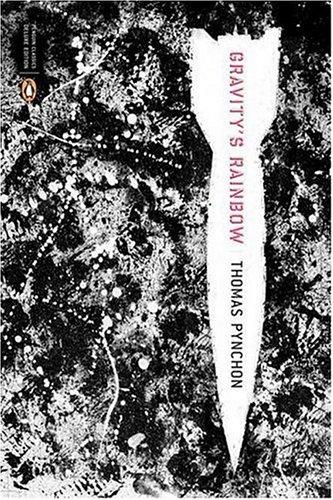
We’ve been making eyes at the postmodernists for a while, but up until this point have lacked the stones to go take a ride on daddy Pynchon’s rocket ship.
Now that we have a little experience we thought we were ready for a mature and sophisticated lover like Gravity’s Rainbow (1973): 800 pages long, and widely considered to be one of the greatest novels of all time.
…we were not ready.
It’s right back to clumsy virginal fumblings as we attempt to decipher the first 100 pages. A shameful and frankly demoralising experience for the boys.
Does it get easier?
Please dear god let it get easier.
introductory fumblings
Benny: Question for you guys. Is this harder than Infinite Jest? Or is my memory just failing me with regards to how hard Infinite Jest was at the time?
Rich: I can’t tell if I’m sleep deprived or not. I was gonna ask you guys —
Cam: I can’t read.
Benny: This must be a double whammy for you.
Cam: It’s my second kid.
Benny: Oh my god.
Rich: I don’t know. I want to say, to me it feels like not only is this the hardest, most confusing, gnarly book that we’ve tried to read on book club, it’s also the most bamboozling book I’ve ever tried to read in my life, and by a big margin. Like it’s not even close, unless I’ve forgotten what Jest was like. I got like the first 10 pages, I got it, and I reread it no worries. And from post-10 pages I have no idea what’s happening.
Cam: That easily beats me. First 10 pages.
Benny: That’s pretty good. Alright, you want to summarize the first 10 pages then, get us on track?
Cam: Well, I think… no.
Rich: Yeah, yeah, I can. I reckon. Okay, okay. So we’ve got a group of people being evacuated through wartime Britain along a railway into some old hotel and derelict building, and then we have a group of soldiers who are waking up in this ruined building, nursing their hangovers —
Benny: Genuinely, half of the first sentence that you said is news to me, to be honest. That’s where I’m at.
Cam: Alright. “A screaming comes across the sky.” That’s the first line, I think.
Benny: Wow. Okay, I actually didn’t realize they were being evacuated into an old building.
Rich: Well, the bit I fudged in my little summary is, I think it was civilians being evacuated, and then I fudged where we got to where all the soldiers are lying around waking up. I don’t know if that’s in the same building or if that’s actually a separate scene.
Cam: Yeah, it’s not clear when you first read it. I think I’ve read most of these little subsections more than once at this point out of necessity. But yeah, I think it kind of transitions from this dark evacuation scene to, yeah, it’s morning, and there’s the bananas growing and Pirate Prentice is, yeah, in this London kind of maisonette with some other soldiers.
Rich: What’s a maisonette? Is it a type of building?
Cam: I think it’s a little townhouse, you know, if you think of England, those little cottages.
Rich: So that’s a change in scene. That’s unrelated to the civilian dead-of-night evacuation. But everyone’s waking up that same morning is what I took from it.
Cam: Yeah, so potentially that’s a dream, right? And we learn one or two sections later that Pirate Prentice has a special ability where he can experience other people’s fantasies, so I suppose —
Rich: So that’s where I got totally lost. So you’re telling me the bit that I thought was straightforward is now all mixed up with the bit that I thought was really confusing, and nothing is safe.
Cam: Well yeah, I think the evacuation was potentially a dream, and they wake up in the morning. It potentially was another scene that happened the night before or a different time, or it’s potentially someone else’s fantasy.
Rich: Who would fantasize about that?
Benny: That’s where I’m getting confused. Like, how often are we inside Pirate’s fantasy? Are we supposed to know that? I can’t tell if we’re supposed to be able to demarcate that in the book yet, or if that’s actually supposed to still be unclear.
Cam: I think that’s one of the points. If anyone thinks they can, I think they’re fooling themselves. But yeah, I suppose actually that’s a good point. The fact that it points out that Pirate has this ability kind of maps onto the reading experience somewhat — you get this suddenly different scene or perspective, and like, is this real? Is this a fantasy? Is this experiencing someone else’s fantasy? And as the reader, we don’t really know.
Rich: Okay, so let’s back up a bit. Who is this guy Pirate Prentice? You’ve gone way too fast.
Benny: Let’s back up — we were on the first 10 pages, let’s back up a bit.
Cam: You lost me at Pirate.
Rich: Is he called Pirate because of like the Pirates of Penzance or something? Because it’s not even —
Cam: I don’t know. I’m sure there’s an illusion somewhere, um —
Rich: Close fit to his name.
Benny: Yeah, I’m sure it’s not arbitrary.
Rich: So we know initially he’s some kind of a soldier, and there’s a bunch of other soldiers who are all waking up from their drunken stupor. He climbs up on the roof of this building, where they’ve obviously been for a while because he’s cultivating bananas in a homemade hothouse up there. He sees the jet trails of a rocket going up in a parabolic arc and falling downwards — trajectory and explosion. And then he never sees the — there’s no explosion, which is weird. And which we later find out is because it wasn’t an actual rocket, it was like a message that was being sent to him personally. I’ve got the terminology wrong — like it’s a rocket but it —
Cam: I’m not sure it wasn’t an actual rocket, but there was definitely a message that came. I thought it was a rocket that had a… a target.
Benny: Get the rocket.
Rich: It doesn’t have a — I don’t know — like a warhead on it or whatever, like a bomb on it, right?
Cam: Oh, no, I thought it was a bomb. I thought it was a bomb blast that he went to, and there happened to be a message. Maybe it sort of hit like a barren landscape and there was a little silver capsule with a message in it.
Benny: I think we don’t know those are the same rockets though, right?
Cam: Yeah, I think he’s seen — I think he thinks he’s seen a chemtrail of a V2 rocket.
Rich: And then he’s waiting for the blast and it never comes and he thinks it’s weird or something?
Benny: Or he just thinks it’s landed somewhere else.
Cam: I can’t quite remember.
Benny: I mean, I think they see a lot of these, was my take, right? And it’s like, oh, this one landed somewhere else, I guess, far enough away that we didn’t experience the blast.
Cam: He interestingly called it A4 as well. I’m not sure if that’s just a synonymous name — someone else called it the V2. I’m sure everyone’s done a little bit of —
Benny: One man’s V2 is another man’s A4, you know? That’s bad.
Rocket warfare
Rich: No, they’d be precise about that, wouldn’t they, being like rocket dorks. The whole — it seems like a lot of this book is about living with the fear of rockets coming and wiping you out of existence. And so everyone’s interested in watching the skies and performing statistical analyses of which sector of London is most likely to get hit, and that kind of a thing. I mean, that’s the big theme of this first little block.
Benny: Yeah, and cause and effect, I think, is a big thing.
Cam: Well, should we quickly — we’ll quickly talk around these rockets, right? So the V2, developed by von Braun, which is the opening epigraph — who was a German scientist during the war. They are faster than the speed of sound. So it’s talked about occasionally, how sort of spooky that is.
Rich: You die before you’re aware of its existence basically. Just seemed to me — seems kind of nice.
Benny: Yeah, it would hit before you hear anything.
Rich: I think if you don’t have any time to be scared, it’s just — you’re dead before you know what’s happened. It’s like what they talk about in the Sopranos, right? Like, do you think you know when it’s coming, and they say no, you think it just goes black, the world just goes black. And that’s exactly how it ends. I don’t — it seems kind of nice. I’d rather die like that than huddled under a table.
Benny: Yeah, I don’t want to hear it coming.
Cam: I can see how it would trigger just a general feeling of anxiety and paranoia about your day-to-day. Like either you bury it and don’t think about it, or — I suppose that’s where statistics comes into it as well, you think you’re statistically unlikely to be hit. But I imagine it would have been — I suppose a feeling in the Cold War, not quite the same thing, but just this feeling that anything could happen at any time and you sort of can’t prepare for it.
Rich: Is Wernher von Braun a real person, and like, are rockets real technology, and I didn’t know about this, right?
Cam: Yeah, that’s a real person.
Benny: Yeah, yeah. And a real quote, I think.
Cam: Yeah, so he’s quite an interesting character because he was in Germany working for Germany during World War II, the Nazis, and then after the Allies won, him and some other top scientists moved to America. Like, America employed them and moved them to America, and he was a big part of the NASA space race, like one of the leading scientists that helped forward towards that. And there’s photos of him in an American office and stuff.
Rich: And they’re firing these things from what, like occupied France or something? Like, what’s the range on these things?
Cam: Yeah, I don’t know. I think at one point they say the range — it was long, it was part of the fear. I don’t actually know how big France and Germany are, how far away England is.
Rich: I was just surprised you could fire a rocket from Germany and have it land in London. I thought it was mostly bombing. But yeah, I don’t know anything about World War II really.
Cam: Yeah, it might be closer. And yeah, the opening epigraph is actually from this Von Braun. And it says — does anyone have the book?
Rich: Oh, I can read the epigraph, is that what you want?
Cam: Yeah, just the epigraph. Just why we’re talking about Von Braun.
Rich: Yeah, it is interesting. “Nature does not know extinction. All it knows is transformation. Everything science has taught me, and continues to teach me, strengthens my belief in the continuity of our spiritual existence after death.” So we’re going to get metaphysical in this book at some point, I guess, if we haven’t already, with the Pirate’s visions — some kind of life after death.
Cam: In this sort of Nazi rocket scientist, that’s quite deep and spiritual an opening line.
Rich: Oh man, I feel dumb now. Like, this V2 rocket was 100% a thing towards the end of the war, and they were like unstoppable, and the Allies were scrambling to try and figure out how to procure the technology and capture their launch sites and stuff like that. So that’s good context.
Benny: And does it say how far they could be launched?
Rich: It does say that they were the world’s first long-range guided ballistic missile, so probably they did just launch them from Germany, I guess.
Benny: Occupied territories.
Rich: And also, like, the first artificial object to travel into space. So that’s how high the arc is. Get a sense of it.
Benny: Damn.
Cam: So forget your space race and your Sputniks and all that. This was the first to get there.
Benny: It’s powered by alcohol and liquid oxygen — sounds like Cam’s weekend. You know what I’m saying?
Rich: It’s like Cam. It’s like the anti-Cam.
Benny: Yeah.
Rich: Oh man, I so want to read this whole wiki page. I’ll read it later.
Cam: Alright, so where were we?
Benny: Okay, should we —
Rich: Should we have a quick wiki break?
Cam: Not the wiki of the book, I hope. So yeah, we get this opening scene of this big banana buffet where Pirate Prentice is — they’re making all sorts of meals, right? Banana waffles, banana cake, etc. And I mean, we said — yeah, bananas, I know it’s like when you’re a kid —
Benny: Yeah, he makes a banging breakfast, right? He’s known for it, I think.
Rich: Well, it depends if you like bananas, but yeah, sure.
Cam: And you watch — is Barney the dinosaur global? That kid’s show — and they’re having like a banana split and you really want one, and then when you finally have one you sort of realize you don’t actually like bananas. And it’s like this guy —
Rich: The banana’s the worst part.
Cam: It’s like disgusting. You’re like, so hyped. And we said soldiers before, and they’ve all got — you know, they’re called captain and lieutenant and stuff like that, but they’re not fighting. They’re all kind of in London. And we’ll get to it, but there’s this kind of spy-type thing going on, controlling — there seems to be activity going on probably to do with the war, but it’s not like they’re on the fronts.
Rich: Yeah, well they’re having breakfast, the men have got to eat.
Benny: Yeah, they’re definitely, yeah.
Rich: So we can try and figure out what the organizational structure — or should we try and figure out what Prentice’s gift is? I suppose the two are kind of related. So what is it that he can do? Like, can you explain to me what is it that he can do? That’s the first thing I don’t really understand. Like, what does it mean that he can experience people’s fantasies, and why is that useful from an intelligence point of view?
Cam: Yeah, well, I don’t think they say why they want it. Or maybe it’s left — yeah, it’s a good question, actually. So why would it be useful? But I think we learn — I think it says, in the second kind of subsection, that we learn that he has this odd ability to experience other people’s fantasies.
Benny: And what was the example they gave? Didn’t they launch into an example?
Cam: Yeah, the first glimpse of it was some random — it wasn’t to do with the war, I think it was just some random man was looking at a girl drinking at a water fountain or something. He’s kind of being voyeuristic a little bit, and Pirate experiences that. And then there’s another example as well, which was one of the housemate soldiers’ fantasy around — I had to google it — but Adenoid or something, which is like, I think a mouth or a throat thing.
Rich: That sounded like a nightmare, right?
Cam: Yeah, like it was over London or something. Yes.
Rich: So we’re saying fantasy meaning more just like dream or vision rather than, you know, erotic fantasy or daydream?
Cam: Well, it seems like both. Yeah, true, actually. Well, maybe we don’t know exactly the mechanism of it, but we know he has this ability, and we know the Firm, I think, is interested in employing him, I suppose, because of this.
Benny: My guess is this is going to relate with Slothrop’s ability — or rather, the ability of little Slothrop to predict where the rockets are going to land.
Cam: Okay, well, I mean, let’s talk about it a bit, but like, even that I’m confused about — like, what exactly that is, from the text. Anyway, so where were we?
Benny: So after that I think is the —
Pirate, ACHTUNG, and the Firm
Cam: Teddy Bloat. Yeah, we first introduced to Teddy Bloat, who was just quite a humorous scene where he’s asleep sort of on the balcony at their house and he’s slowly falling off. It’s like there’s one leg or a shirt or something, like the only thing holding him on. And Pirate can see him slowly falling off, so he kicks his bed over to break Teddy’s fall, and then Teddy kind of wakes up a little bit and then just goes back to sleep. You assume he’s probably drunk or something. And then we get this little chapter where Teddy seems to be sneaking into this office — ACHTUNG, do you remember what that stands for, Benny? Something Northern Germany.
Benny: Yeah, it’s something about a clearinghouse. It’s the clearinghouse for technical units in northern Germany. But as I’m saying that, I mean, that’s not the acronym.
Cam: When I google ACHTUNG in German right now, German to English, it means “danger,” the actual word.
Benny: Okay, I could be wrong. But I think it’s, I mean, it’s an office there. He’s going to an office.
Cam: No, no, I think it was, you know, it’s an acronym. I think that’s Thomas Pynchon calling it — kind of like Infinite Jest, where it’s called ONAN.
Benny: Oh wait, no, no, I have it here. So it’s the reason I was — yeah, I was missing a letter. It’s Allied Clearinghouse Technical Units, Northern Germany.
Cam: Northern Germany, okay. So this is the office of Slothrop and I think someone else, and Teddy Bloat is sneaking in there taking photos of a map of London with stars or points on it with female names on it, or something like that.
Benny: Okay, I didn’t actually — are we sure he’s sneaking in there? I didn’t realize that.
Cam: No, maybe we’re not.
Rich: I think we are, in that he’s like happy when he discovers that they’re not there, and he’s got this plan to drop his little camera into his bag if anyone comes in. And then later on it seems like people know what he’s doing, or at least some people know what he’s doing. But the other confusing thing is, he’s photographing a chart of what we think are Slothrop’s sexual conquests, right? So it’s not like intelligence at all. It’s just like, he’s making a star chart of —
Benny: Yeah, his escapades.
Cam: Which is an odd thing to have anyway on your wall.
Rich: Yeah, but they also note that it’s odd even for him. It’s kind of like — so he’s this American, what is he, like, I don’t know, a lieutenant or something, I don’t know.
Cam: Yeah, he was a lieutenant. He’s American. Are they all American, or — we’re not sure.
Rich: I think most of them are British. I was imagining Pirate was British. Pirate and Cobra British. But it’s all Allies, right? This is probably a whole bunch of people in the mix.
Cam: Yeah, but at one point it gets into Slothrop’s background, and his American-ness seems important. His family background, I think, was from the early settlement of America. It went all the way back, and they used to be rich and then they lost all their money. And it quotes an Emily Dickinson line about crises happening gradually and then suddenly crashing. But, you know, he represents kind of a heritage American.
Rich: Yeah, and they use that as a partial explanation of why he has this habit of, you know, marking all the sexual conquests on a map. Like, maybe it’s some kind of leftover — what do you call that thing that Americans do at college, with the Greek letters?
Benny: Frat? Frat?
Rich: Frat, yeah, like frat boy kind of habit or something.
Cam: Oh okay, sorry. I thought you were just saying like a metaphor for, like, American imperialistic conquest or something like that.
Rich: Oh, that’s good. There you go.
Cam: Knocking out the whole world map or something.
Cam: But maybe it was more just our uni days of creating spreadsheets.
Rich: Benny’s map would be crazy. He’s covered a fair —
Cam: Yeah, the average, you know, average about 8.5, I think. 8.5 to 9. Right? Ratings.
Benny: Let’s keep this PG.
Rich: No, I just mean the geographic spread, that’s all. That’s all.
Cam: They can spread Louisiana. Louisiana, California.
Slothrop’s psychic schlong
Benny: You guys have left out a very important detail about Slothrop, which makes me think that I’m just crazy. I’m literally trying to Google it. So is it not the case that his — I can’t quite tell if it’s his sexual activity or just his erections — like, predict where the bombs are going to land?
Rich: That’s a spoiler, but it’s from the back cover, and I read it as well, and I’ve just tried not to think about it.
Benny: Oh. Is that how I knew it? Oh, shit. It’s on the back?
Rich: Well, it’s on the back cover of my book, which I did read. It’s on the blurb.
Cam: I’m not sure if you’ve read the fucking back cover, mate. Aren’t you on a Kindle?
Benny: I haven’t even read the book.
Rich: I figured it can’t be too bad of a spoiler if it’s on the frickin’ 50-word blurb.
Cam: Yeah, yeah. Although sometimes it happens with books — sometimes you read a book and it’s a big thing that happens, like, you know, in the third act —
Benny: I mean, that happened to us with Butcher’s Crossing. If you read the back of Butcher’s Crossing, it gives the whole plot — and then they get back to the town and it’s vacated and it’s empty and no one’s there anymore. Which, yeah, it’s crazy.
Cam: Buffalo.
Rich: Does it say that? I don’t know. I feel like you can’t ruin a John Williams novel. Or you can’t spoil a John Williams novel.
Cam: Yeah, well, I mean, Stoner himself is wrapped up in the first couple of sentences, I think. They sort of say his life arc.
Benny: Yeah, that’s true. Yeah, that is true.
Rich: It’s a self-spoiling novel.
Cam: But yeah, this one confused me as well, because I read this — especially I read the section, which we’ll talk about in a bit, but like Pointsman and Spectro chatting around causality and around Slothrop, they mention but they don’t say explicitly — unless you’re an extremely close and good reader, it doesn’t seem to say this ability of Slothrop’s explicitly.
Benny: Okay, so we’re not supposed to know this. That’s good information.
Rich: What does Slothrop do all day? He goes out on — is he involved in that dog-chasing? That’s what he does all night.
Cam: You haven’t seen the map, mate. No, well, he goes to the bomb blast, right? And so does Pirate Prentice. So he seems to be — so we know Pirate’s working for the Firm, and goes to the bomb blast. We don’t know if Slothrop is or not. But he also goes there to get the message. I think he’s there first, and then he gives the capture, the message, to Pirate.
Rich: Slothrop is lower-ranking or has less access than Prentice does, because he resents the fact that he has to sort of hang around on the outside of the scene, and meanwhile Prentice arrives in a jeep and picks up the message, and so on. And Slothrop has to charm his way — and can’t quite remember what he’s doing with the rocket blasts though. He’s like an investigator, or looking at —
Cam: It seems to be — yeah, I suppose. The first thing is like investigating the scene.
Benny: Was he just intel for the Americans? Like, he’s the only American we’ve met so far, right?
Rich: But what is he expecting to find at the sites of the rocket blasts? Exactly what sort of intel? Like fragments of — is he trying to recreate the tech, like reverse engineer the technology?
Benny: Yeah, good question. Good question.
Cam: I don’t think we know. Yeah, so I mean, if you’ve — there’s so many details in here that maybe is pointing to something. But putting that aside, yeah, I suppose he’s either doing that, or he’s just seeing what the target was, or they know the messages. I mean, it’s sort of a book like Infinite Jest that has been designed to be read more than once to actually understand what’s going on, which is a little bit gratuitous for a 900-page book.
Roger Mexico the statistician
Benny: The next thing I have in my notes is Roger Mexico. I don’t know if I just skipped stuff or —
Cam: Yeah, so we get this weird seance section, which I can’t really remember too much from, but it’s called The White Visitation. And again, there’s probably some details of some meaning here. But yeah, we get introduced to several characters, including Jessica Swanlake and Roger Mexico, who the next few subsections we get more of. And they seem to be, you know, in this romance during war.
Benny: Okay. A seance is when you’re trying to communicate with the dead, right?
Cam: Yeah, so I think there’s all these spiritualists who work potentially for the Firm, but I’m not sure. I’m not sure if we know. And Roger Mexico is a statistician. He’s kind of more of a square, who’s working for them. I’m sure there’s some clues about what the seance is trying to do — I don’t —
Rich: Was Roger part of the seance, or was that its own scene?
Cam: Well, they were — yeah, I think they were kind of maybe in the next room.
Benny: He seems like not the kind of guy who would be into a seance from how they describe him, right? He’s like the only one who’s just trying to do cold logical calculations of the distributions of the bomb droppings.
Rich: He keeps trying to explain the Poisson distribution or something, right? And he’s frustrated that no one understands statistics. I wondered if you might relate to that, Benny. I mean, they’re mentioning like chi-squares and Z-scores and stuff, right? So you know —
Benny: Just one person to relate to in this entire book. I was very happy. I want to read more about Roger Mexico. Yeah. Chi-squares, Rich. Oh, don’t call it G. It’s not Tai Chi, bro.
Cam: Richard’s doing the spiritual emphasis on it.
Rich: I was excited because I don’t understand any of the references in this book. It’s another little thing to mention — just like, you know, whatever references there are to people, places, events, literature, or songs or anything, I just have no idea. Every single thing is going past me. I’ve got nothing to grab. I don’t even know if they’re real or all made up.
Benny: I don’t know if we’re in one of his fantasies right now. We have no idea what’s happening.
Cam: I suppose that is one of the reasons why for us Infinite Jest is an easier read, because you pick up things like that around TV shows and stuff. And this was a book written in the 60s set in the 40s.
Rich: It feels like a parallel universe to me. It feels like I’m meant to know what these words refer to, and I don’t. But like, maybe no one knows what they’re — I was excited about the statistics thing because I was like, oh yeah, I kind of know what that is. Apparently I don’t, but, you know, it’s sort of vaguely familiar.
Cam: Well, one of the stats tidbits we’re probably familiar with, I think, is where Roger Mexico talks to Jessica Swan, like how stats is memoryless. If they are truly — I’m not sure who says this, but if they’re —
Rich: The Monte Carlo fallacy or something.
Cam: Yeah, yeah. If things are truly independent.
Rich: I actually had a question about that. So he says that the chances of a rocket hitting any given half-mile square of London is equal. And then the Poisson distribution just tells you what are the chances of successive hits, successive impacts in any given square, right? Is Poisson normal distribution, Benny?
Benny: No, no, no. It’s a separate distribution about the rate of discrete events.
Rich: Okay.
Cam: It looks like a fish.
Benny: Yeah.
Cam: No, I’m just checking.
Rich: Does it actually?
Cam: No, no, no.
Rich: Okay, so it’s like — oh, that makes more sense to me then. But I was thinking, if you had — you’re bombing London, it would be really weird if there was an even distribution over every square mile, because surely the rockets would be intended to hit some areas more than others, and, or at least have a central target and right around that.
Cam: I think interesting with the V2s is they couldn’t really — one of the issues with the V2s, they couldn’t have direct targets. So it was probably more of a bigger target zone, maybe the whole of London or something like that. And then it was kind of random. I remember reading that one of the differences between the V2s and the V1s — so the V1s, you’d have a target, and that sounded random, adding potentially to the scariness, similar to sort of terrorism and stuff.
Benny: From what I remember, they were wrong about this for a while. They thought there were specific parts of the city being targeted specifically, and then only after the fact did they realize, like, oh no, they didn’t have good enough control over their bombs to actually target that. So it’s actually just consistent with, like, as if you were just randomly throwing a dart over the city every time. But, I mean, randomness — humans do not have a good grasp of what true randomness looks like. So if you show someone a random sequence, often we’ll pick up patterns in it and think it’s non-random.
Cam: Yeah. Pick a number between 1 and 7. Or 1 and 10. Number 7. Completely random.
Benny: Totally random, yeah, yeah. Anyway. But what he was referring to there was the fact that, like, even if I tell you, oh, there’s been five bombs that have hit this block this week, and then you ask me, oh, surely that means it’s less likely that another bomb hits that block this week, and so it’d be safe — if we were to go to that block for this week. That’s the fallacy he’s referring to, because, like, just conditional on what’s happened in the past, it doesn’t affect what’s going to happen in the future.
Cam: But that’s when Taleb’s Fat Tony would go to that spot, smoking a cigar, and be completely safe, because he’s like, well, it’s probably not completely random. There was five hits.
Rich: So the other question I had there is, if what he’s done is run the numbers on the Poisson distribution and tell you what are the chances of so many events in such-and-such a time period, what else is there to do after that? Like, surely you don’t — I mean, for one thing, that information is not useful really, because of the fact that you can’t predict — because of the fact that the events are independent, you can’t do anything with it. So what is his job after that? Just — or does he do all kinds of statistics and that’s just one thing he keeps trying to explain to people, maybe?
Benny: Yeah, I don’t know what he was actually doing there. I mean, he might have been trying to figure out the rate at which they’re dropping bombs, and then trying to back-calculate how fast they’re building them and what their stores of ammunitions are like, or something like that. But I don’t — I think the text basically only says he’s tracking where the bombs are dropping. And I think he has a parallel map to Slothrop’s, right, where Slothrop — this is like a map of sexual conquest, and then Roger Mexico has his map of where the bombs are dropping. And they’re both map guys.
Cam: At this point, do we know that those are the same?
Benny: I guess based on what you guys were saying, I guess not.
Cam: Maybe you find this out later, and then when everyone’s talking about the first few sections, you kind of say, oh yeah, these two doctors are talking about reverse causality, and we know that he’s taking a photo of the map, and they kind of just assume it’s revealed at this point.
Reverse causality
Rich: Oh, is the dog experiment thing about reverse causality?
Cam: Yeah, well, they certainly talk about causality and reverse causality. So I mean, if we back up — so Jessica and Roger go to this abandoned house, and then Pointsman, who interestingly is referred to as Mr. Pointsman — in my notes I was typing down the names and I wrote Dr. Pointsman, but he said it’s Mr. Pointsman. Anyway, he goes to this abandoned house and he’s trying to catch a dog, and he stands in a toilet, which gets stuck on his foot, and he’s kind of humorously running around with a toilet on his foot trying to catch this dog with ether, I think with the help of Roger, and Jessica’s watching. And they fail to catch the dog. And then they drop Pointsman off to another doctor, Doctor Spectro, who is an owner of, quote, “the Book,” capitalized. And Spectro and Pointsman just start talking about Slothrop being this — you know, this point is an enigma to us, but seemingly important person that everyone’s trying — you know, we know Teddy Bloat has taken photos of, and then now these guys are talking about Slothrop. It’s important. But they all — no — maybe — I think every — I always have to have that caveat —
Benny: Wait, do we know what the Book is?
Cam: But I don’t think so. Maybe it’s like a Pavlovian book or something like that.
Benny: So yeah, he’s the Pavlovian guy, right?
Cam: Well, yeah, Pointsman is said to be a vivisectionist and psychologist, and I think Pavlovian. I’m not sure if Spectro is. Assume he might be as well, because that’s why they’re chatting. But Pointsman goes to visit Spectro, and it’s all very confusing because Spectro is injecting his patients that he refers to as Fox — and it says he refers to all his patients as Fox. So I think he’s operating on people that, for some reason, he calls Fox. And there’s this little quip he says, “if you manage to not think about a fox three times if you walk around the building, you can cure anything,” or something. Take with that what you will. But yeah, they chat around causality and reverse causality, and if that’s possible. And with our knowledge of potentially Slothrop’s ability, they may be hinting at this.
Cam: Or his penis at least does.
Rich: Yeah, later land — yeah, his penis is like a homing beacon for V2 rockets.
Rich: And they want dogs because — well, they get an octopus, and I remember that he’s mad about the octopus, because an octopus is a very visual creature, it doesn’t have a big auditory brain processing area. So what they need the dogs for is auditory, I suppose, so they can do some kind of experiments about responding to a sound. But then I’m confused, because I thought the whole point of the rockets is you don’t hear the sound. Oh, I see — that’s why? Because you don’t hear the sound of the rocket before it crashes, if you had reversed — if you were reversing that causality, you would hear the sound of the rocket in some sense before it actually impacted, because you’d be experiencing things backwards. Does that make sense?
Cam: I think so. I’m not sure.
Rich: You famously don’t hear the rockets coming because they travel faster than the speed of sound, but they’re trying to investigate something to do with reverse causality, and something to do with sensing things before they happen. In the case of the V2 rockets, if you were to experience reverse causality, you would in fact hear the sound of the rocket before the rocket impacted, because you’re experiencing it backwards, right?
Cam: Well, I suppose if you experience things backwards, that would happen, but it seems —
Rich: There should be some sound that would cue you in that the rocket is going to hit, in the same way that in normal causality, the rocket hitting tells you that you’re about to hear a sound. Or like a flash of lightning tells you that you’re about to hear thunder. But if you reversed it, you would hear thunder, and that would indicate that you’re going to see a flash of lightning.
Cam: I suppose you might not actually hear — there may be some other trigger, for whatever reason. Because they kind of talk about there’s something in the air or something that no one else can see, that —
Rich: It could be something visual. When he’s defending his choice of bringing him the octopus, he’s like, well, it could be a visual phenomenon, we don’t know.
Cam: And the other thing that happens in this section is Pointsman’s kind of frustrated or jealous that Spectro gets to experiment on people, I think, and he’s stuck with dogs and maybe an octopus.
Rich: What was that thing about kidnapping kids? And it was like maybe a pedo-type sexual thing, or maybe it was kidnapping kids for experimentational purposes. I didn’t quite know.
Cam: Yeah, at one point it did feel sexual. I can’t remember — there’s so much information overload.
Rich: Yeah, maybe that was like Spectro’s fantasy, or Pointsman’s fantasy.
Cam: I find myself constantly reading this book — you know that thing where you read for like a page, and sometimes a couple of pages, and you’ve obviously not been focusing and you’re just sort of reading the words, and you’re like, oh shit, you go back, and then there’s just some genuinely confusing things that come up every now and then. You’re just not sure what to make of —
Cam: I think we’ve covered most of the plot points so far, or the beats.
Benny: Okay, well, are we as unconfused as we’re ever going to be for this first part of the book?
Cam: Yeah, I think —
Benny: Should we try and do like we did with Infinite Jest, just 100 pages a week, and then meet to discuss what on earth happened?
Cam: Yeah, I mean, I think something like this, fairly frequently, is probably quite a good thing to keep us going.
Benny: This is very helpful for me, to be honest. This is really helpful for me.
Rich: It’s one of those books where I would have quit it almost immediately if I wasn’t in a book club.
Cam: Oh, hell yeah.
Benny: Yeah, oh yeah. How poor.
Cam: I mean, I was still thinking — I thought part of the discussion will be, are we still going to go?
Rich: Yeah, me too actually.
Cam: Let’s give it another few sessions. Well, what I’m worried about — so Infinite Jest, around — I can’t remember what it was, around 100 to 200 pages, it starts making more sense. Like you kind of know how the time works, and you know the characters, and these kind of normal plot things start happening. And I’m hoping this happens with this book. One of my fears —
Cam: The big adenoid above my city —
Benny: Is that it’s just like this.
Cam: Just continues like this.
Rich: Yeah, that’s gonna be — I might bail if it never becomes more — I also think, like, again, hoping that it becomes clearer — but I’m not really enjoying it, I don’t think. Like, I don’t really like it. It’s kind of annoying.
Benny: Yeah, I’m just so lost, it’s impossible to enjoy it. Like, the whole time I can’t appreciate anything that’s going on on the page, because I’m just trying to figure out how the current sentence relates in any way to the previous sentence. I’m trying to keep whatever’s happening in my head, crazy.
Cam: I’m so cynical, I can’t believe anyone enjoys it on their first read until they get, I don’t know, hopefully to a certain level. But yeah, every now and then I did see some comment saying, oh yeah, I really liked it, like —
Rich: IQ book or something. It’s kind of humbling. As I’m reading it, I’m thinking, how did any editor read it? And how did any critic think it was — it must have just been late enough in his career that people were like —
Cam: Yeah, what causes you to start it? It’s not that late.
Rich: That people were like, oh, it’s from Pynchon, it’s going to be really good. We’re reading it because of Lindy, everyone said that this is a great, wonderful work of art. But if I encountered it out of a wide blue sky, I would be like, this fucking sucks. I hate it. And I’m not —
Cam: Yeah, that’s interesting. I suppose he had two books out at the stage, I think, V and something else, so he probably had a little bit of a name about him. But yeah, what causes someone to keep going when it’s not a big deal?
Rich: What hero persevered through this enough to find out that it’s a great book? Because it wasn’t obvious that it’s a great book from the beginning. Like, the writing style is very interesting, I suppose, but it’s like pretty unhelpful writing or something. And also, personally, I don’t like the writing very much. It’s like all these endless lists of stuff. It’s like, there was one thing, comma, and then there was this other thing, comma, and amongst them all there’s this other thing, comma, and then another type of thing, comma, and then one normal sentence to break it up, and then there was this thing, comma, and there was also this thing, and adjective noun adjective adjective noun adjective noun. It’s like this long-ass list of, like, piece of string, and there was a rubber, and there was some newspapers, and it’s just boring, to be honest. That particular trope, I don’t mind it, but it just needs to be a rare thing.
Cam: I suppose partly a tasting, and then partly getting used to Pynchon’s style thing. Yeah, I agree, I don’t particularly like it, although I do quite like Wallace’s, and I’m just trying to think how it differs.
Rich: For me, I was finding it seems like there’s a lot of massive run-on paragraphs, which is just like all of these clauses that don’t really go together, of just listing objects or describing things in a way that — it’s like you should have just chose one way to describe it, or two at most. You don’t need 10 different ways of kind of saying something, or pointing out, like, extraneous details. Like, incredibly maximalist all of the time. It’s kind of exhausting.
Benny: It is exhausting. I’m never excited to sit down and read it. I have to force myself to do it.
Cam: Well, how many more stints do we ever go at until we wonder?
Benny: Well, let’s do at least one more.
Cam: I mean, it would feel like a shame if you get to 200, 300 and we’re like, yeah.
Benny: Well, so I just Googled, does it get easier?
Cam: Oh, I didn’t know which way you were going to go there.
Benny: And it seems like the consensus is roughly yes, although — I mean, someone has said to me the best — here’s a quote — to me, the best part of Gravity’s Rainbow is the first 150 pages and then the ending, which is crazy.
Rich: It’d be crazy if it got harder. If it got harder.
Cam: Yeah, there’s 100 pages of yes-shit like that. I don’t believe, unless you’ve read it like twice. I could imagine if you read it and then it’s like, oh, okay, suddenly this all makes sense, this is fun, I get why I get Teddy Bloat’s relationships with this office, I get the seancing — like, but the first time reading, I don’t really believe people that say that. Maybe they exist.
I didn’t get that reference
Rich: Yeah, well, I mean, even if you get the plot outline — do you guys know what I mean about references? Like, I’ll just read you one little sentence fragment. Okay, so this should be the bit where I say “and the context of this is blah,” but there is no context, so it’s fine to jump straight into a quote. Which is: “No, they’re making believe to be Narodnik.” So I’m like, okay, I don’t know what Narodnik is, sounds maybe Slavic or something. “But I know they are of Iași, of Codreanu, his men, men of the League” — capital letter League. So I’m like, what’s the League, who’s Iași, who’s Codreanu? I have no idea. “They kill for him, they have oath” — so I’m like, okay, there’s some kind of affected-English second-language who’s speaking this, I don’t know. “They try to kill me” — dot dot dot — “Transylvanian Magyars, they know spells, at night they whisper.” And then it just continues on to some other thing. I’m like, what does — I don’t know, I’ve never encountered any of those words before. And that’s just one paragraph of dozens like that where it just introduces all these things and names. I’m like, what is any of this stuff? Like, I don’t know if any of it’s going to come up again. I don’t think it will.
Cam: It is annoying.
Rich: That’s the other —
Cam: That’s the other problem with this as well, that you sort of don’t know what details are important to focus on and whatnot. Which is somewhat true of life sometimes, but I think also — it does feel true that when you’re reading at least this, or maybe Pynchon in general, you’re kind of meant to, or required to do a bunch of Googling — I mean, back in the 60s it would be much harder — of what all these things mean, because you’re not really expected to know.
Rich: Yeah, I suppose you could just go through and Google everything. And what is the Kipling period, what are beastly fuzzy-wuzzies, what’s dracunculiasis, what’s oriental sore, what’s “the Powers who would be masters of these horrid blacks,” what’s — who’s Cary Grant? I at least know the name Cary Grant. Makes me feel ignorant.
Benny: I know, it’s tough.
Cam: You’ll know them all after our second read of this.
Rich: I don’t think I will. And that’s why I’m not even that optimistic about a second read.
Cam: Yeah, if we do a second read of — I think — or if I do a second read, it won’t be for a while. So to the readers, it’s not just you, you’re not crazy, you’re not dumb. Well, maybe you are. You’re not more dumb than us. We’re confused and it’s difficult.
Rich: Fuck anyone who enjoyed this on their first, like, right from the outset. They’re liars.