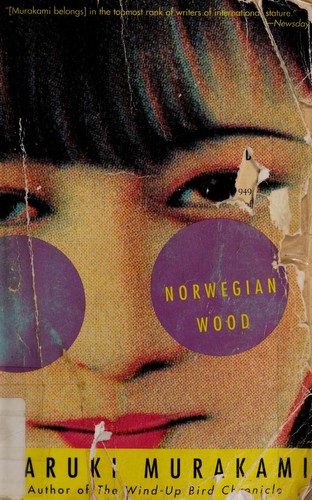
In 1987, Japanese novelist Haruki Murakami set himself a challenge: to set aside his magical realism schtick and try to write one ‘straight’ novel in the realist tradition.
The result was Norwegian Wood, in which the author-insert protagonist is transported back to his college days, breaking free of ennui and depression just long enough to sleep with a string of hot but crazy chicks (and giving each of them the greatest sexual experience of their life).
Naturally it was a smash hit among the youth. Murakami was propelled to fame and had to move to Italy, hounded from his home country by a mob of shrieking Japanese girls intrigued by his magical but sad penis.
But is the book actually any good?
The boys are divided on this. We talk about Murakami’s treatment of suicide, his portrayal of female characters, use of memory and nostalgia as a writing device, in which ways we relate to Toru Watanabe, which demographic this book aimed at, and in general whether this is a work of great art or should be relegated to r/iam14andthisisdeep.
If you’re a Murakami fan, please write in and tell us what we got wrong, and especially which other book of his you’d most recommend we read.
blather
Benny: The tough thing about dancing is you do go through an incredibly awkward phase at the beginning of just sucking, and you don’t even know how bad you suck for the first little bit, and then you realize how bad you suck and then it can be hard to make yourself keep going to socials and stuff. Because you sort of realize that everyone you’re dancing with — to get better, you have to dance with good people — and you sort of realize that you’re putting them through the ringer a little bit in terms of having to dance with you. You just need to do it and put yourself out there and have a bunch of really shitty dances and fuck up a lot and make a fool of yourself, and you just have to keep doing that for a couple of months to get to the point where you’re not absolutely dreadful.
Rich: I got scared off by a beginner class that I did. I mean, there were probably experienced dancers there too, but we did that thing where it’s like a big ring and you swap partners at the end of each little section.
Benny: Oh, rueda. That’s non-trivial. Rueda de casino — was that what it was?
Rich: I don’t know, I’m sure it was super basic, but I felt so bad that about halfway through I just like ran away.
Benny: Like, I’m out.
Cam: Do you think you’re particularly bad even for a beginner, do you reckon?
Rich: I don’t know, maybe. Yeah, maybe.
Benny: I mean, rueda is hard. If it’s what I’m thinking of, people are shouting out the instructions of what to do next, like a beat before it happens, and then you have to cotton on and organize yourself and everyone has to be doing the same thing for it to work. So that’s particularly challenging for a beginner to wrap their head around.
Rich: Yeah, that’s what it was. It was a rueda, yeah.
Benny: It was the most challenging form of rueda possible.
Cam: The last year was the first time — not skilled dancing, but just dancing itself. It was actually a couple of weddings, including yours, Rich, just that sort of being vulnerable. It’s hard for a lot of people to do, to just dance and not feel insecure. But once you do it, it’s extremely freeing and fun. And my guess would be you’re probably better than you otherwise would be as well.
Rich: Yeah, it’s such a hit game thing — you have to be uninhibited. But I’ve heard that the zoomers don’t dance anymore because they’re so terrified of being perceived as cringe or something, and because they could be getting recorded and uploaded to TikTok or whatever. So everyone’s way more self-conscious, which is my nightmare.
Cam: Yeah, yeah. My brothers weren’t dancing at our cousin’s wedding. They were sort of too cool, sipping their beers in the corner.
Benny: But it looks worse to not dance, because everyone can tell that you’re uncomfortable and not dancing on purpose. You think you can play it off, but you obviously can’t, right? You’re just sort of standing on the side.
Cam: I did wonder that, because it looked worse for, like — I was looking at them just saying it’s so cringe that they’re embarrassed and they should just do it, that they care about how they look. But then I wondered, would a 17-year-old girl who knew them have that same thought? And maybe they would actually judge the cringe dorks dancing. I don’t know.
Rich: Yeah, isn’t there like a valley of despair or something, right, where it’s like it’s better to not dance than to dance badly or half-heartedly?
Benny: I guess if you’re really bad, that’s true. If you’re absolutely a horrendous dancer, then it’s probably better to not dance. But I think it’s rare for people to be that bad.
Rich: And also, then how do you ever get good? Like you said, you have to be bad to start with.
Benny: Unless you’re American. There is something uniquely bad about American dance culture, I think, that I’ve never really experienced anywhere else in the world, in terms of, like, if you go to a club. So not like a social dancing scene, but if you just go to a club and then you watch guys and how they’re behaving in clubs. I mean, guys the world over are not dancing as much as the girls, clearly. But American guys in particular will just sort of stand on the periphery, do this very awkward sort of head-bopping thing — everyone’s just clearly looking for girls. But I think there’s like a fatwa against moving their hips or something. There’s like some bizarre, learned social behavior that you just can’t — you’re not allowed to sway your hips. And that’s very weird. It’s like something that is distinct. I didn’t experience that in the UK or anywhere else that’s still like predominantly white and European, but it’s uniquely bad in the US.
Cam: Fat Joe. “My boys don’t dance, we just lean back. Lean back.” What’s his song? I remember balls and prams — or younger versions of it. Just all the boys on one side and all the girls on the other, and just drinking your soda. Not wanting to jump into it as a 14-year-old.
Rich: I would love to see Fat Joe dance.
Benny: All right, well, speaking of sexual growing pains, should we talk about Norwegian Wood?
On memory as a writing device
Cam: I’ll do a quick welcome. Welcome back to Do You Even Lit? This is Cam, one of the Kiwis, joined by my friends Rich, who sounds similar to me — we’ll try to use names to distinguish us — and Benny, with the Canadian accent. And today we’re reading Haruki Murakami’s Norwegian Wood. One of his, I suppose, more plain — I don’t want to say vanilla, but — Murakami’s known for his magical realism and weirdness. This book is not like that at all. It’s kind of like a slice-of-life coming-of-age story about a young Japanese man reminiscing from his early 20s and his relationships, mainly with other women, but a few friends as well.
Benny: Somewhat autobiographical.
Cam: I had the thought. I assumed he was a similar age as the adult Toru.
Rich: He wrote this book — well, it came out when he was 38 years old, and the Toru at the start of the book is 37, 38 years old, reflecting on his past as a college student in the swinging ’60s, which were way hornier than I expected for Japan. Now, I don’t know if that’s Murakami-specific or if that’s how things actually went down, but — hot damn.
Cam: Yeah, any time they’ve been super horny, I keep thinking, does this happen? Maybe it just doesn’t happen these days.
Benny: Okay, so yeah, Cam, like you said, we’re following this guy named Toru. He begins the book — he lands in Germany, I think, right? Frankfurt or something. And on over the plane comes a cover of the Beatles, Norwegian Wood. And this reminds him of an earlier period of his life, and then the rest of the book is just a flashback to that. So I don’t think we even — or perhaps at one point halfway through the book we sort of come back to the present and he says something about still being on the plane, but aside from that, we never actually come back to present day. It sort of just stays in the past, which makes the ending a bit ambiguous. And I don’t know if you guys have thoughts on what actually happened there, but it seems like we don’t know exactly how things panned out.
Cam: Yeah, we don’t really learn much about adult Toru.
Rich: Why he bothered to do the frame story thing of being on the plane and having the nostalgic flashback, and then never returning to the present day — but it gives us a clue that things turned out for him okay, in the sense that he didn’t kill himself like every other character did. He’s visiting Germany and he’s a businessman, or I don’t know, an executive or something, and things have turned out okay for him. But it was pretty touch and go for a while there. So that adds one little bit of information to put the ending in context.
Cam: Yeah, it’s a good point — you know his outcome. The other thing is, one of the themes seems to be about memory itself, and he’s not necessarily a reliable narrator or remembering things exactly correctly, and is perhaps a bit impressionistic with his memories as a 20-year-old and his relationships. I did have a quick quote that came in the first chapter around memory:
Memory is a funny thing. When I was in the scene I hardly paid it any mind. I never stopped to think of it as something that would make a lasting impression, certainly never imagined that 18 years later I would recall it in such detail. I didn’t give a damn about the scenery that day. I was thinking about myself. I was thinking about the beautiful girl walking next to me. I was thinking about the two of us together and then about myself again. It was the age, that time of life when every sight, every feeling, every thought came back like a boomerang to me. And worse, I was in love. Love with complications. Scenery was the last thing on my mind.
Rich: So you’d like that, Cam, because you’re not going to get any extensive scenery descriptions.
Cam: Yeah, it’s funny though. That line did strike me, just the idea that experiences at the time, you never sort of realize the importance, sometimes. I suppose sometimes you do — certain meaningful events like births and marriages and things like that. But a lot of the time — it’s kind of a banal point, but when I think back to things that kind of crop up randomly, it’s like, yeah, at the time I didn’t really pay it any mind and didn’t think it was important. It’s just funny what sticks sometimes.
Rich: It’s interesting that he said that about a book in which events happen which very obviously would be significant at the time — the death of his best friend at age 17, and then —
Cam: And then she blew her brains out in front of me.
Rich: Yeah, spoiler alert, the death of his love interest also at her own hand at age 21, after a long period in which he hoped that she would be cured or rehabilitated. But then there’s lots of other little vignettes throughout of just interesting little scenes that I guess stuck in his memory that didn’t necessarily need to stay in there.
Cam: Yeah, I suppose it’s a little fleeting random instances that may be surprising. Like Norwegian Wood itself, perhaps.
Rich: He’s doing the Proustian thing as well, maybe — it’s a nod of —
Cam: Yeah, senses and stuff.
Rich: Yeah, and framing it like this, as you say, gives him license to just create a sort of a vague dreamlike vibe and not be too worried about the exact details or putting all of the connective tissue in there as well. So it’s not a bad little strategy — to say, I’m gonna give you my nostalgic reflections of a period of time.
Cam: Yeah, I’m allowed to make the nostalgia reflections of my three manic pixie girls, and don’t worry about the plausibility.
Rich: Yeah, I was listening to the Beatles and it reminded me of when I was a student and I used to absolutely slay with bad bitches.
Cam: Yeah, exactly.
Rich: Benny, are you talking? I can’t hear you, or are you just mouthing things? I thought you were rehearsing something to say.
Cam: Just say names. Kizuki. Reiko. Naoko.
Portrayal of suicide
Benny: I was gonna ask, how do you guys think the book portrays suicide? Do you think it sort of glorifies it at all? We have his — one of his best friends — so I guess we’re just full-on into spoiler territory. We’ll just go forward with that in mind for the rest of the episode. But his best friend when he’s 17, Kizuki, kills himself, and there’s lots of statements throughout the book to the effect of, lucky Kizuki, he sort of gets to stay 17 forever, he got to live in this prime part of his life and now he doesn’t have to deal with any of the complications afterwards. I wasn’t sure what the author actually thinks about suicide and the ethics of it.
Cam: Who says that? Does Naoko say that?
Benny: Both Watanabe and Naoko say that at different points, or sort of gesture in that direction.
Rich: Yeah, “only the dead stay 17 forever” is the quote that sort of stuck out to me. I don’t know if he’s taking a moral stance on that — didn’t even really occur to me to ask that question. I was more interested in the fact that none of these suicides were very well telegraphed. Well, they were — I mean, Kizuki’s wasn’t, explicitly. It was like, this guy seemed happy, he had a great girlfriend and he was successful and at the start of his blossoming life, and then he just inexplicably killed himself. And then Hatsumi also later on — that’s the girlfriend of another character — kills herself. And it’s always just quite abrupt, it comes out of nowhere. With Naoko, it makes more sense because Naoko is in mental health institutions for, I think, probably a year or two, and has this long history of depression. But I don’t think I know enough about depression to know how accurate this is. It felt to me more like he was just trying to use suicide as this blunt tool to add weight to the text or something, and it kind of felt like it hadn’t justified itself very well. It was just like, and then he killed himself. It’s kind of like this teenage thing of, what’s the worst thing that could happen, that could throw someone’s world and really upset your friends and family?
Cam: I kind of like the abruptness of it. Well, I suppose it depends like who we’re talking about. But I imagine that’s often how it feels, especially if you’re not super close with someone. But I mean, maybe he was closer than Kizuki, so it kind of falls down.
Benny: But it also might seem very abrupt as a 17-year-old, or as an early 20-year-old, that might not really be on your radar as a possibility. And even if your friend seems sad, you might not think they’re about to kill themselves, and then they do. So it might just be more of an accurate depiction of how someone would feel about it at that age, right, where it did seem to come out of nowhere. But perhaps a 40-year-old interacting with the 17-year-old Kizuki could have seen that coming.
Cam: Yeah, but even then, it’s very common — you hear about celebs and stuff who you don’t know at all, but you hear about someone’s death and it just sort of shocks you, that you didn’t even know what they were struggling with. I mean, if Toru himself had killed himself sort of out of nowhere, it would have been a bit of a failure, I think. But sometimes when the side characters do, you can make an argument that maybe we didn’t understand where they were coming from enough. But on the flip side, you’re saying, well, maybe Toru — this is kind of from Toru’s point of view — yeah, maybe someone’s a little bit self-involved and just — that kind of David Foster Wallace point of never fully understanding what it’s like. That sort of communication language problem.
Rich: Yeah, maybe he actually just overplayed the hand by the sheer number of times he did this. Whereas if it was Kizuki and Naoko, that would be one thing, but then it’s like, oh, and by the way, now Naoko’s older sister, she killed herself. And then near the end of the book it’s like, oh, and Hatsumi, this lovely, charming lady, by the way, she slit her wrists in the bath. And it’s like, okay, well, you can’t just keep playing the suicide card over and over in a book this short without it sort of cheapens it. I felt it cheapened it a little bit.
Cam: He’s kind of surrounded by it.
Rich: And just maybe to jump to the heart of my criticism or feelings about the book: I didn’t really care about any of these characters, and this book didn’t move me at all. I didn’t care when Naoko died. I didn’t feel the sort of gut punch that you would expect that you should, if you’ve been closely involved with a character throughout a book of this length. It didn’t resonate or land with me really at all. I could imagine reading a book like this where you should be crying as you hit that page or something, right, where they’ve really tried to bring you with them and make you feel the significance of it. And I was just like, oh yeah, and she killed herself, anyway, what happens next? So I’m curious if you guys actually resonated with these characters, and if this book moved you in that way.
Benny: Yeah, so I really liked the book, but I think I liked it more as a sociologist than someone who had some deep emotional connection with the book. So like you said, I didn’t feel attached to any of the characters, that if something tragic happened to them or something happy happened to them that it made me happy or sad. But I was very fascinated with their own lives, how they thought about things, how they processed events and what they chose to do and how they related to one another. So yeah, I really liked it as just a study in the dynamics of friendship, and also a bit of a throwback to what it’s like to be in your early 20s or late teens, when you’re navigating romantic relationships for the first time and everything seems weird and surprising and confusing, and certain things that aren’t that big of a deal in retrospect take on some huge significance at the time. So yeah, I sort of agree with you in that I didn’t have a huge emotional connection with the book, but I really enjoyed it nonetheless.
Cam: I felt sad, for instance, when Naoko died. It did connect with me, I think, in his portrayal of depression and depressive tendencies. I’m still not sure if Toru himself has depression, but certainly almost everyone else does. And the kind of dullness — which maybe somewhat explains this lack of emotion — but yeah, this dullness and flatness that especially Reiko, the older woman who’s kind of a guidance figure, and Naoko have, that’s kind of hard for them to explain. That struck a chord with me, someone who deals with a bit of that on and off. So yeah, there were certainly times where the book hit me a little bit of like, yeah, this is capturing that feeling sometimes. But I kind of know what you mean — you didn’t care.
Rich: I’m just such an easy crier these days. I cry in movies all the time, I cry reading a book. I find it easy to get emotionally invested in characters. And it’s interesting that I didn’t for this, which — maybe that’s not the point or something. But I’ve cried over much less acclaimed literary figures or movies than this.
Benny: I mean, movies is an unfair comparison. Movies have a lot going for them to try and make you cry — there’s the visual aspect as well. So I think that’s sort of unfair. But do you cry often at books?
Rich: Maybe not often, I’m trying to think. Like when we read Hemingway — when we read A Farewell to Arms, I found the ending quite devastating and upsetting, from memory. I’d have to look back through some of the other recent stuff. But it felt more like a tragedy. This felt more like a Shakespearean tragedy or something, where you’re like, and Macbeth dies and his wife dies and the suitors die, and you don’t really care, you’re kind of reading it for other reasons. I mean, you do care a little.
Benny: I was pretty shocked when he got the letter that Naoko had died, to be honest. I did not see that coming at all.
Cam: Yeah, I didn’t either, and then I felt a bit embarrassed about not seeing it coming. But yeah, it kind of feels obvious now that he’s longing for this girl that he could kind of never work out with, and that is one of the explanations for — but I think just quickly on him potentially overdoing his hand by too many people dying, I suppose it’s maybe just a little bit of that bullet-holes-in-the-plane selection effect, where it is true that some people are surrounded by a lot of depression and a lot of suicide, and some people are surrounded by kind of zero. So maybe it’s not that unrealistic for people suffering this sort of thing that there is quite a lot of it. Although there was an awful lot in this book.
Benny: Yeah, I mean, we should also remember on the suicide point that Japan has a unique culture around suicide that I think might be slightly hard to relate to in the West, right? So they have this whole history of seppuku — is that what it’s called? Seppuku.
Cam: Yeah.
Benny: Sudoku.
Cam: Whenever you fail Sudoku, you have to stab yourself in the stomach. Fortunately, I stopped Sudoku, otherwise —
Rich: That Shogun book and TV series, like every other line someone is saying, “Oh, most dishonorable, I will disembowel myself immediately.”
Cam: It kind of sounds like a Family Guy joke.
Rich: Well, this feels — I thought about that, and I thought, this is different. This is more like Western depression, isn’t it? Like, I didn’t feel like people were killing themselves because they’d brought dishonor upon their clan or whatever.
Benny: No, no, no, this is — I’m just saying it’s a culture where suicide in general might be more understood. I think there’s maybe some sort of stigma around suicide in the West, where it’s like, you’re gonna do that to your friends and family. And I think people might be more tolerant of it in Japan. And I was just looking up the stats, the empirics of how many people kill themselves in Japan, and throughout the 1960s it was reliably much higher than Canada, the US, France, Germany, all these other places.
Cam: But Kiwis, Kiwis is just like off the moon now, right, in the 2020s, depending how you count them — 80-plus year olds.
Rich: Canada’s catching up.
Benny: Sudoku has arrived in Canada. We’re in trouble.
Rich: Oh, that’s interesting though — you got the facts. What are we talking? Is it like a material difference versus the States, for instance?
Benny: Uh, so Japan early 1960s is about two and a half times Canada. So it’s looks to be about 28 per 100,000 people. Canada’s at 10. Germany’s at about 12. France is under 20. US is like 13. So, you know, depends how you want to read those numbers. In absolute terms that doesn’t sound huge, but you know, it’s at least a two-and-a-half-fold increase over sort of the US and Canada.
Rich: Yeah, that is pretty high. Is that for youths or is that just population level?
Benny: No, that’s the entire population. Youth would be interesting.
Toru Watanabe character analysis
Cam: So what do you guys think of the main character, Toru Watanabe? Did you like him? Were you rooting for him?
Benny: I kind of was. I kind of felt he was kind of relatable in that he was having a hard time. A bit bookish. He was very much his own person, and he was really having trouble, I think, finding what he was interested in, and was pretty unimpressed with whatever the trend was going on around him. So there’s this funny part in the book where the students erupt in protest at whatever university he’s at — just the University of Tokyo, maybe — about some issue, and this goes on for like all summer, and he just has absolute disdain for the actual protesters. And when the protests come to an end seemingly out of nowhere, it’s not like they actually got what they wanted. He recognizes they were just protesting on their own behalf, basically. So he’s not one to really get caught up in campus trends. He feels fairly isolated from most people. It’s not like he has a huge group of friends; he’s one or two friends on campus and they’re pretty different than him. So I felt some sort of empathy with his struggle to actually form an identity and find his interests and figure out what he was interested in and navigate these tough relationships.
I also found it cool and appealing that he would spend so much time with people if they just asked him. So people would ask — Midori would ask him to come to her father’s shop and cook her dinner and hang out with her on Sunday, and he’d always be willing to do that. Same with Naoko, if she wanted to go on a four-hour walk or a 12-hour walk around Tokyo. It’s not like he’s ever saying, oh, I have some work to do, or I want to spend time by myself. He’d always spend time with these people, which I thought was pretty cool. And which a lot of people of university age definitely wouldn’t do — I think they’d be more concerned about their own development or whatever.
Rich: But it also speaks to what a blank slate he is, right? That he just doesn’t have other things going on. Sunday is his day to do laundry and maybe sit around listening to records. It’s not like going to hang out with Midori is pulling him away from studying or enriching himself or working or hanging out with his other friends, because he’s got no friends really.
Cam: He’s a bit of a loner.
Rich: Yeah, I do sort of like his character. It’s like a proto-hipster or something, where he knows what he stands against, he’s kind of aloof from other things that other students are doing, but he doesn’t have any kind of positive vision that I could discern. It’s a bit of a shallow kind of young man thing to do, I think — we stand apart from other people, but not in service of anything in particular, because you haven’t actually figured out any positive vision. He didn’t lay out any interesting philosophical ideas or have a framework for how he should be going through life or anything like that. He was just sort of drifting along, rejecting certain ways of being, but not moving towards some other way of being. Which is definitely relatable, especially for a professional contrarian like myself, but it doesn’t — yeah, I don’t know.
But the vibe that I get with this book is — it’s very strange to me that a 38-year-old man wrote this book, actually. Because it reads very much like a 19-year-old wrote this book. Which you could say that he did a good job, because he captured what it’s like to — but it’s also just like very immature or unsophisticated or something. But maybe young men are just like that.
Benny: Yeah, I mean, oddly, I have two defenses in my head, and they’re both sort of contradictory, so I’m not sure.
Rich: We’ll just say neither of them because they cancel out.
Benny: On the one hand, I wanted to say, well, what do you expect of a 20-year-old young man? Of course they’re not going to have some life philosophy worked out. What were any of us like at 20? I was much less sophisticated than him and much more willing to go along with the crowd. I think I had less of a personality at 20 than he ultimately does. He has a very quiet personality, but I think it’s a relatively staunch personality. I was much less willing to carve out a space for myself and go against the grain than he was. And so maybe it’s that aspect of him that I actually find pretty refreshing, because it was sort of the antithesis of what I was like when I was 20. I was much more of a people pleaser, going along with the trends, trying to go to the cool parties or do whatever the cool kids were doing at that time.
Rich: Yeah, but I kind of think you should do that. I’m drawn to people who are passionate about things, and this guy just doesn’t really have any positive impetus in his life or passions. He likes jazz, which is cool, and he has a couple of little hobbies, but he doesn’t really care about — I can’t even remember what he studies, because he doesn’t even care about what he’s studying at university. And he’s just sort of a daydreamer who sits on the porch and reads books and —
Cam: Well, yeah, I mean, he reads pretty voraciously. It’s funny, I had a thought of a slight sort of envy or jealousy around him, because when I was younger, I was so caught up in going to parties and essentially trying to be cool. And yeah, this is just a type of person who’s a bit more lonely, a bit more quiet, and then meets some people that he’s interested in and has time for it. I still didn’t really ever do that. I thought it might be quite nice to be on the —
Rich: You want to go sit in the library all day. That’s what we’ve figured out, right?
Cam: Well, I don’t know, I imagine. Yeah, sure, that does sound pretty good.
Rich: He’s kind of similar to The Razor’s Edge — to Larry, right? A little bit of Larry.
Benny: Yeah, no, he is. He’s loafing. He’s really loafing. Like, you get the sense that he’s just kind of waiting for something to happen. And I don’t know, I can respect that somehow. I think I can respect that even more as I get older, because it’s so clear how much bullshit there is and how much of what I was doing at 20 ultimately didn’t matter. And he’s very self-reflective. I kind of disagree he doesn’t have interests. I mean, he works at this record shop, he really knows his music, like Cam was saying he reads quite voraciously. What more of a personality do you want?
Cam: I want to say a quick point on the reading, because there is a line that I’d come across before: “If you only read the books that everyone else is reading, you can only think what everyone else is thinking.” Which is a great quote. And I didn’t realize it came from this book, and I was also a little bit surprised when I came across it that it came from a character’s mouth — which is a bit stupid now in reflection, because Murakami is a novelist and of course that’s how novelists say quotes like this. And I kind of found it funny because it’s this really good quote, really true quote I think, but the context of the line is, I think Toru Watanabe is reading The Great Gatsby. Like, his example of this esoteric — he’s not reading this esoteric PDF or something that might scare everybody or whatever. It’s literally Great Gatsby.
Rich: Another one in here is he’s reading The Catcher in the Rye.
Cam: Yeah, yeah, there’s this other big one. They’re like, wow —
Rich: And that’s like, he’s a Holden Caulfield-esque character, right? Like, you always talk like him. He’s like, I’m so different, I’m not like everyone else, and he’s reading like extremely famous mass-market literature.
Cam: Maybe it’s because it’s in Japan in the ’60s, things weren’t as globalized then, and everyone else has written Japanese. But yeah, it was still pretty funny.
Rich: He’s reading — what else does he read? Like Hermann Hesse, I think, which is cool.
Cam: Yeah, potentially Hemingway. Thomas Mann, The Magic Mountain — that’s what he was reading when he met Midori, I think. I can’t remember. But yeah, so he meets his friend Nagasawa reading Great Gatsby, and they kind of become friends because of that, right? They’re both fans and read the book and he’s like, “Hey man, why read in public?”
Rich: Yeah, he’s kind of like a Jay Gatsby, the character himself, actually. He’s sort of apart from this very dramatic scene, observing it in people’s chaotic lives and getting tangled up in it a little bit. I haven’t read The Great Gatsby in forever, but he gives me like a Holden Caulfield, Jay Gatsby, Larry kind of vibe.
Cam: It reminded me of that movie — oh, what’s it called? The one you recommended.
Rich: Oh, not Jay Gatsby, by the way. Who do I mean? Who’s the other guy? Not Gatsby.
Benny: I forget the characters.
Cam: I just know the movie. The Spider-Man one.
Rich: What’s his name? Nick Carraway.
Cam: Have you read it? Because I don’t know if you should read it.
Rich: Oh man, that’s embarrassing. Wait, have you never read it in high school? Come on.
Cam: I was trying to avoid what everyone else was reading.
Rich: Oh, okay.
Cam: So I can think different thoughts.
Rich: I was reading Russ Roberts.
Cam: But the fact he’s reading a bunch of Western stuff reminded me of that movie, that recent Japanese movie by — with a Western director, the one you recommended, I’m forgetting his name. Sorry. A Perfect Day, Perfect Days. How he’s really into like Lou Reed and — you know, I forget who else.
Rich: Oh, Perfect Days, yeah.
Rich: I wondered if it was inspired by this, or if it’s just tapping into some kind of general Japanese aesthetic. But it’s interesting because I love that movie in a way that I don’t love this book, even though they’re kind of trying to evoke a certain mood, and they’re both sort of more impressionistic, not very plot-driven.
Cam: Yeah, about loneliness.
Rich: I cried in that movie for sure, but not in this one.
Cam: I wondered — so Murakami himself, so I assume he went to university in Tokyo in his 20s. But I was just wondering, like, when he went to America and yeah, just part of it might be his personal tastes, and maybe he felt a bit of an odd sort as a young Japanese man who was more kind of into the Western canon.
Rich: So I know for sure that after he published this book, it got so popular amongst Japanese youth that he became like a rock star and he had to leave the country. So he was pretty uncomfortable with his own fame, and he went to live in Italy, and then he ultimately settled in, I think, Massachusetts or somewhere on the East Coast. Because I read his memoir, so I weirdly have like a decent amount of background information about him before I ever read any of his actual fiction. It was a book about running. Like, what he writes about is his running, and he’s a marathon runner. Like, a pretty good runner, but not that good — he’d be sort of self-deprecating about his split times per kilometer.
Cam: Yeah, exactly.
Rich: It’s like, a pretty good runner, but not that good.
Norwegian Wood as a teenage boy fantasy
Benny: How’d you guys interpret the ending? So Naoko dies. He phones —
Cam: Reiko.
Benny: Reiko comes to Tokyo. She’s left the sanatorium for the first time.
Cam: Do you want to give a little bit of background on Reiko? Quickly.
Benny: Yeah, so Naoko — well, I guess we really haven’t talked plot at all. Very condensed: Naoko was Kizuki’s girlfriend, and her and Toru and Kizuki were sort of best friends in high school. Kizuki committed suicide. After that, Toru and Naoko, even though they didn’t really have much of a friendship beforehand, start spending much more time together, just going on long walks and everything. And it wasn’t at all sort of a sexual or romantic character until one night when — maybe it’s her birthday, is that right? Or his birthday or something. Anyway, she comes over one night, they end up sleeping together, and Toru learns that Naoko had actually been a virgin. So she had actually never been able to sleep with Kizuki. But she finds it sort of hard, and she actually leaves — she drops out of school after that. She goes to what is basically a sanatorium, although he never actually uses that word, up in the mountains. And Toru goes to visit her there a few times, and her roommate there — Naoko’s roommate, that is — is this older woman. Not that much older, but late 30s, I think, named Reiko. And her and Reiko, that is, and Watanabe become close friends while he’s there, I would say, because they’re both sort of looking out for Naoko.
Cam: And the big shtick at that place is being honest, and so they’re being quite open and vulnerable with each other.
Benny: Sounds like a pretty cool place, to be honest. I wouldn’t mind spending some time here.
Cam: If you’re severely depressed, that’s probably one of the cooler places to go to.
Benny: Yeah, it’s probably one of the places to be — this cool little monastery type thing up in the mountains where you’re not sure who’s a doctor and who’s a patient. Sounds pretty good. So after Naoko kills herself, Reiko decides to leave the sanatorium for the first time since, I think, she had gotten there, and she stops by Tokyo to see Toru. She’s not going to stay in Tokyo, she’s got, I think, family maybe in Kyoto or something, but she stops by to see Toru. They hold sort of an impromptu funeral for Naoko where they play a bunch of songs, and one of the songs she plays, I guess, is Norwegian Wood by the Beatles, and that’s where the book gets its title from. And they also sleep together, in a somewhat odd turn of events.
Rich: He slept with every other —
Benny: He slept with everyone else. You could sort of see it coming.
Rich: And he’s also like the best lay that she’s ever had. She’s like, “I’ll never need to have sex again.”
Benny: Yeah, she was very wrinkly despite being 30.
Cam: Yeah, it was kind of ecstasy with those two.
Rich: It’s very funny, like, this is the other thing that makes me think this is like an adolescent fantasy, is that Toru Watanabe is kind of — he has his charms, but he’s not really a remarkable person. And yet all of the three women in this book throw themselves at him. One of them, when she sleeps with him, she gets wet for like the first time ever, or the only time ever in her life. And he’s like this amazing lover. And then the other one is this woman who hasn’t probably had sex in 10 years or something, and she insists on sleeping with him multiple times, even though that was previously a very platonic relationship. And then the third one, Midori, is like a hypersexual manic girl of your fantasies or whatever, and also is extremely flirtatious and sexually interested in him. So he’s three from three, despite not having much obvious game. I don’t know, it’s pretty suspicious, to be honest.
Cam: Well, he was learning some game from his friend, right, almost quite explicitly. I mean, maybe the author should have captured a few unsuccessful or less successful encounters, because there’s that period in his life where he’s chasing girls as an end. I mean, the ending with the older woman and then having sex kind of caught me off guard, like in the same way as I remember this movie — what’s his name? Alfonso Cuarón, the Mexican director of Gravity. He had that famous movie in the early 2000s, Y Tu Mamá También. Yeah, two guys and an older woman, and everyone’s having sex with everybody. And it feels a little bit surprising, and it’s probably meant to be — I don’t know, maybe symbolic or something else. But it kind of reminded me of that. But then I kind of thought about it a bit more, and I thought, you know, this Reiko character, who has been struggling with her mental health and sex and sexuality for a long time and gets very close with this guy — maybe didn’t feel crazy that that could happen.
Rich: Yeah, I think this is, before we get to the ending, a good place to bring up that the big recurring criticism of Murakami that I’ve seen — when I was reading about the reception to this book — is the way that he writes female characters. Apparently this is very consistent. So I don’t know, because I haven’t read his other books, but supposedly —
Cam: What is it, like a male gaze type of thing?
Rich: Yeah, like every woman is crazy about the sad-boy hipstery generic protagonist and don’t necessarily talk or act in ways that most women would. Really hypersexual, or — I mean, the things that Midori does is pretty crazy. Like, when after her dad dies, she gets naked and shows him her puss in front of his shrine or something. It’s like, “Look at this, daddy,” or something. It’s really weird. And wants to take him to a porno theater, wants him to jerk off and think of her. This is all while she has another boyfriend. So there’s like a lack of realism, and also just kind of a male fantasy or something about the way that these characters interact with him to sort of demonstrate his worth or something. I didn’t — it didn’t really bother me that much while I was reading it. I didn’t think it was very realistic, but I didn’t really care about it being misogynistic or whatever. There’s probably better examples. I was reading one comment that said there’s this one other book where there’s like 70 references to the size of the one female character’s breasts. And it’s like, you know, she breasted boobily down the stairs or whatever — that kind of bad writing, or male gaze-y writing.
Cam: There’s, I suppose, two things. There’s a male gaze of like, you come across a female character and you notice their body and sexualize them. And then there’s this other criticism potentially that it’s unrealistic, or it’s not capturing their motivations enough. And I suppose that can have overlap. I think it’s not bad to read this male gaze sometimes, if you’re never reading it. If you’re capturing it accurately, it can be good. But I can certainly see why it would be tiresome for people.
Rich: But that would be male gaze as in, say, from a male’s point of view that he was noticing her breasts or something — that would be fine, because that’s maybe just how reality is, somewhat. But this is more like the female characters are constantly comparing their breasts or talking about their boobs, or saying that they would love to know what Toru’s dick looks like, or — they themselves are behaving in a way that is like an adolescent fantasy of what women are like.
Cam: Yeah, I mean, definitely like Midori, you can imagine that being a fantasy. And I remember reading it and thinking, this is — I don’t even meet a girl like this. But I suppose like they do exist. She’s pretty nuts, right? And it would leave a lasting impression on you.
Benny: Yeah, I mean, one possible response is that there are ways that he’s sort of broken and looking for himself, and that he’s found other women who are the same way, and they’re just like broken in a particular way and are obsessed with various sexual things. Another possible response is to say, well, again, this is someone writing from the perspective of their self. And these are the kind of things 20-year-olds remember. These are the kind of things you’re focused on at the time. That second defense is perhaps not the best, because you can sort of get out of anything like that. If you write a book where it’s an older character recollecting their younger days, then you can always put down any sort of inconsistency or flatness of character or anything like that just onto memory being fallible. And you can just say, well, this is how they remember it, so how can you fault them for writing a character like that? So that’s maybe too much of a deus ex machina close to comfort. But like, I don’t know, it’s like everyone in this book is definitely flawed and feels emotionally a bit stunted or broken in some ways. And it seemed like the overt sexuality of a lot of the female characters was just coming out of that somehow. But then you might say, why is it about sexuality for all of them?
Cam: I’m also thinking around maybe not capturing their motivations enough. It seems similar to what we were talking earlier about the suicide and the depression maybe coming abruptly. So perhaps one defense is, this is from Toru’s perspective, right? And he doesn’t fully understand the female characters. He’s kind of this external observer, and he doesn’t fully understand the mental health as well. Now you could coherently say there’s a criticism of the author and the writing that it would be nice to capture that, and then also capture where the others were coming from.
Rich: I think it could just be like a dose-response thing again, where sure, female sexuality is super diverse and all types of people exist — Midoris exist out there. But then if you just have three quite edge-casey type sexualities in the book and they’re the only female characters — and then apparently people say, well, actually all Murakami’s female characters are like that — then you start to think, okay, this guy’s got either like a kind of a fetish, or is just like not very good at portraying reality. So maybe he has failed in his one attempt to write a realistic novel. I want to read one of his surreal novels now, because I think we accidentally picked maybe his most atypical book, where he set out to write a straight book. I want to read a weird book with like the ghost of samurais and —
Benny: I’m gonna read a gay book. How are these straight books?
Rich: Well, we got to read Mishima for that, I think.
Cam: Yeah, I think that’s right. I also wonder — Naoko didn’t feel that unrealistic. I mean, she is a bit forward sometimes. Midori was noticeably —
Benny: Yeah, Midori was the craziest of the three for sure.
Cam: It was just kind of, yeah, easily fit into like a fantasy archetype. And then Reiko, I suppose, turned into that. I don’t know. But Reiko did — she was this kind of conflicted, struggling older woman who — yeah, I didn’t struggle with her motivations quite as much, I think. Sorry, I’m not really saying much.
A profound and deeply moving ending
Benny: So, I mean, do you think he gets together with Midori at the end of the book?
Cam: Do you mean like in a relationship?
Benny: Yeah. I mean, because he sort of realizes after he sleeps with Reiko that —
Cam: Nah, I think it’s a one-off.
Benny: No, sorry, Midori, not Reiko. So he sleeps with Reiko, and then he realizes Midori is important to him and wants to, I guess, spend the rest of his life with her. Goes to call her. She asks, where are you now? And it has this moment which I’m just still not sure how to interpret.
Rich: Read the last lines of the book if you’ve got it handy.
Benny: Sure. Okay. So, yeah, I have the quote.
I phoned Midori. I have to talk to you, I said. I have a million things to talk to you about. A million things we have to talk about. All I want in this world is you. I want to see you and talk. I want the two of us to begin everything from the beginning.
Midori responded with a long, long silence. The silence of all the misty rain in the world falling on all the new-mown lawns of the world. Forehead pressed against the glass, I shut my eyes and waited. At last, Midori’s quiet voice broke the silence. Where are you now?
Where was I now? Gripping the receiver, I raised my head and turned to see what lay beyond the phone box. Where was I now? I had no idea. No idea at all. Where was this place? All that flashed into my eyes were the countless shapes of people walking by to nowhere. Again and again, I called out for Midori from the dead center of this place that was no place.
Thoughts?
Rich: Hmm, that’s deep.
Benny: I’m pretty lost with that last bit, to be honest.
Rich: I cynically want to say he just threw in a deepity at the end of the book. I don’t think he had anything in mind in particular. It’s just a little poetic flourish to have ambiguity to end an ambiguous book on.
Benny: A little Ubik-style — Glen Runciter has Joe Chip’s face on the coin?
Rich: Oh, you’re still mad about Ubik, huh?
Benny: A little trip-up. I’m still pissed. I’m going to go to my grave pissed about that dude. I’m furious. Yeah, I know. It did feel like that a bit to me. I was looking for the profundity, but I just couldn’t find it. I think the biggest lesson to draw is actually what one of you said at the beginning, which is that the fact that he’s writing this from memory means that his 37-year-old self is alive and well and hasn’t committed suicide. And that seems like one of the important lessons here, that he didn’t follow everyone else’s path or Naoko’s path in particular. But this actual ending, I have no idea what to make of it.
Rich: Yeah, he definitely could have fumbled the bag with Midori, because he really pissed her off before, when he went off for months and didn’t contact her after he fell into his depression. And they had a tempestuous relationship. Also, she seems like a crazy kind of a woman, and someone who you wouldn’t necessarily end up having like — never mind the fact that she still has a boyfriend. Oh no, she doesn’t by that point, actually.
Benny: She broke up with him at the end. But yeah, the fact that she was doing all this with him while she had a boyfriend, like, that’s, you know, who’s to say she wouldn’t do that with the next guy that sort of came around, right?
Rich: Yeah, so you could definitely read it as him being like, man, remember when I was young and there were all these crazy hot chicks, and what would have happened if I’d gone with Midori instead of waiting for Naoko to get better.
Cam: There was a point where he’s in that double bind when he’s keeping them both at an arm’s length reach, but he obviously wants Naoko more, and he stops talking to Midori for several weeks. But it doesn’t work out — I can’t remember if — no, that’s not when she commits suicide, but I might be misremembering. She’s not interested in him, and then he kind of goes back to Midori, and then she’s upset that he hasn’t been talking to her for two weeks. And I imagine he’s thinking, oh yeah, I should have kept talking to her. So that ending, the whole “where he’s from a place that is no place” — is that kind of what you’re asking about, what the meaning of that is?
Benny: Yeah, all of that. Those last five sentences, not sure what to make of it.
Rich: Yeah, she’s like, “Where are you?” Doesn’t she ask where are you? And you’re like — but like, “Wait, where am I?” You know, it’s like, dude, you’re standing at a payphone and you’re in the station. But like, where am I, you know, think about it.
Cam: And he says “a place that is no place.”
Rich: Yeah.
Benny: Yeah, not the most impressive ending, I will admit.
Cam: I suppose this may be symbolizing that he still hasn’t found — he still feels unmoored, you know, about life, frightened. I don’t know. It’s not resolved. Things are not resolved for —
Final judgments
Rich: We’re definitely rejecting the hero’s journey in this book, and the traditional character development arc, and so on. Which is fine. The ending is kind of in keeping with the rest of the book. It’s just like, life just happens sometimes in strange ways, and it’s not always easy to figure out what it means or what you should have done. He’s still groping around, he’s still this fairly lost young man who’s been served up some hard knocks by life, and I’m not sure if there’s really too much more to it than that. And then the question becomes, like, do you like this vibe? Do you like this picture that Murakami is painting, and do you enjoy being along for the ride? And for me, the answer is not hugely, to be honest. But I don’t have an objection — I don’t think it’s bad necessarily. And also I reckon maybe I would have liked this book a lot more when I was 18 or 19, probably. So I’m on the fence. I don’t think it’s a bad book, but I also just didn’t really like it.
Benny: Yeah, I’m not sure what I would say if someone asked if I recommended it, but I did just enjoy the reading experience. I liked every page. I thought the characters were interesting. I did want to see what was going to happen. Like I said earlier, I wasn’t emotionally invested in a way you would be in a great work of literature, so I agree with you, it’s not up there on the list of great works that we’ve read. But yeah, I can’t help but actually liking it.
Rich: That I do want to say something a bit more strongly about is that I thought this was meant to be like literature. I’m sure I’ve heard Murakami’s name get thrown around for Nobel Prize nomination and stuff like that. But my really cynical take, based on just having read one book, is that I think this is more like very accessible kind of mass-market book. I don’t want to say young adult fiction, but it has vibes of young adult fiction to me. And the writing is very plain. I don’t think it’s particularly good. And then a really cynical idea would be that this guy got big in like the ’90s and noughties, and everyone was obsessed with Japan, and you have — also like magical realism is really hot, and you have like a bit of exoticism — like, oh, it’s a book but a Japanese guy wrote it, you know? And anyone can read it. You don’t need to be well-read to read this kind of a book. This could be your first serious novel that you read very easily. And so it seems more like maybe a popular, good but entry-level popular book than some amazing work of literature. But yeah, I definitely want to read — I’m going to give him one more chance. Benny, have you read other Murakami books?
Benny: No, this is my first one.
Rich: Okay. And Cam, have you?
Cam: No.
Rich: Okay, well, I’m gonna give him one more chance. I’m gonna read one more of his apparent bangers and not write him off. And then if I’m not wild about that one, I think I’ll probably just move on.
Cam: Yeah, I think that’s right. I mean, I did like it. Maybe part of the reason I did like it is because of what you just said — it was sort of accessible, more just like a story, rather than quite tough books that we’ve read in the past.
Benny: Cam’s next pick is going to be A Court of Thorns and Roses.
Cam: I don’t actually understand the reference there. Yeah, anything else?
Rich: Yeah, that’s not a criticism — it’s good to have books like that. I’m reading this Western book at the moment that I love that’s called Lonesome Dove. I don’t know if you guys have heard of it. It’s awesome. It’s just so easy to read. I can read it while I’m giving my son the feed, and it’s just fun. It’s just like a romping Western. I doubt I’m gonna think about it much or dwell on it much for the rest of my life, just like I’m not gonna think about this book much. But that definitely doesn’t mean that it’s a bad book.
Cam: Good miniseries as well, apparently.
Rich: Yeah, I think it’s got Tommy Lee Jones. Have you seen it?
Cam: Yep. And Duvall? No, no, I just have read about that book.
Rich: It’s a banger. I’m on a Western tier after Butcher’s Crossing and Blood Meridian.
Benny: Cam’s read about more books than he’s read books.
Next book announcement + One Battle After Another argument
Rich: Cam, have you got a next book announcement for us?
Cam: Yeah. So I was just thinking — been a bit in conflict about it. Where I’ve landed is, I think maybe we do try Thomas Pynchon, Gravity’s Rainbow, if you guys are up for it. But it’s a bit long. And hopefully there’s payoff.
Benny: Sure. Let’s do it.
Rich: It’s time.
Cam: I was bouncing around a few options, but yeah, I think it’s time to try it.
Rich: It’s time.
Cam: We’ll get there eventually, and talk about it.
Rich: Pynchon’s in the news at the moment because he’s got a new book out, and the Paul Thomas Anderson adaptation is probably going to clean up at the Oscars, I reckon. So let’s get on the Pynchon train. I don’t know, I thought it was an amazing movie. Have you guys seen it?
Benny: No, I heard terrible things. I don’t really want to see it.
Cam: I’ve heard mixed stuff.
Rich: Are you kidding me? You’re the only person I’ve heard good things from.
Rich: What the fuck, dude, it’s an amazing movie. You gotta go watch it. Who’s telling you terrible things?
Benny: Well, it’s not like I’ve paid tons of attention, but like Dave and Tamler talking about it. Actually, they liked it, but the way they talked about it made me not like it. And then Robert Wright also talked with Nikita Petrov about it. And basically, yeah, they said some stuff that I was like, oh, I’m not going to like this.
Cam: Yeah, there’s quite a lot of discourse about it.
Benny: So, anyway.
Rich: Oh no, that’s wild. Go see it. Don’t listen to — I thought Dave and them were like — yeah, no, just watch and make up your own mind.
Benny: I think the issue is that I think it’s going to be hard to watch it apolitically. Because, like, I know it was filmed before Trump even came into office and stuff, right? So it’s not actually a commentary on the current political moment, but I think everyone’s looking at it that way, and it’s going to be hard to not.
Rich: I just ignore them, fuck them. Like, that’s not what — I watched it apolitically because I know that’s not what PTA is trying to do or cares about. He’s just a weird-ass filmmaker, and it kind of accidentally lined up.
Cam: Well, I think there are arguments that he is — that it is the most political of his films.
Rich: I mean, even if it is, it doesn’t matter. It’s just like an amazing work of film on its own merits. Well, anyway.
Benny: Yeah, I should watch it. What’s it called again? What’s the actual —
Rich: It’s called One Battle After Another. And it’s an adaptation of Vineland by Pynchon.
Cam: Yeah, I remember. I think I saw Bret Easton Ellis’s negative review as well — he felt a bit, again, like in the current era it felt kind of musty or slightly dated.
Rich: If your culture-brained, you might find it hard, because you might be like obsessed with trying to read into it a bunch of political stuff. But like, it’s based on a novel —
Cam: Well, a lot of criticisms — oh, sorry, carry on.
Rich: Well, it’s based on a novel about — it’s like, what, you can’t make a film about revolutionaries anymore because it’s too — because people are going to map it onto current events, or something?
Cam: I think a lot of the criticism of it is it is culture-brained itself, and like PTA has perhaps maybe Trump derangement syndrome or something like that. This is just sort of discourse. I haven’t seen it.
Benny: But again, it was filmed before Trump even came into office, right? So it’s hard to say that I — it’s a commentary on the actual current political moment.
Rich: I think it has a lot of impact accidentally, perhaps, for that reason. I mean, there’s some scenes in there that are quite incredibly grim and moving, I think, because it is a lot of stuff about like immigration crackdowns and stuff like that. Which, again, he didn’t — yeah, it’s not a response to Trump, it’s pre-Trump. This is just like things that governments do. This is like from the ’60s and ’70s. Anyway.
Cam: Also speaking of Murakami, speaking of fetishes, isn’t there a bit of — isn’t that one of the themes of the book? The Sean Penn character. Yeah.
Benny: I’m in Norwegian mode.
Rich: Yeah, yeah. Oh, it’s so funny as well. It’s like an incredibly funny film. I can’t believe you guys don’t want to see this film. It’s got fucking Leo in the top role. It’s like, oh, okay, okay, anyway —
Cam: I didn’t say I didn’t want to see it. I just said I’ve had mixed reviews about it. I’ve actually asked — I asked Ellen to see it, but we haven’t got around to it. I also think it could be paired well with — I haven’t seen it either, but Eddington is also a recent movie, also seemingly about — maybe touching some other themes. Have you seen that one?
Rich: No, but I don’t want to watch a movie about current events. I want to watch like an auteur filmmaker make a crazy-ass film about, like, I don’t know. To me it’s not about current events, it’s just — you can set your movie in a certain setting, and he’s chosen this particular setting, and that informs the way the characters act and so on, but it’s not first and foremost some political message or something. It’s absurd, it’s got like —
Cam: Yeah, the critical discourse I’ve seen is that it is about that, and but you’re sort of saying, actually it’s not.
Rich: Well, culture-brained people just are totally incapable of having interesting takes about movies, I think. You’ll read a million thought pieces about how Barbie was the, I don’t know, woke feminist scourge of blah, blah, blah, whatever. It’s like, no, it’s just a good fun movie. It’s got heaps to recommend it. I think if you go in with that frame, you’re never going to be able to escape it. Like, were you taking Ben Shapiro’s view on what movies are good or something? These people’s brains are like rotted by politics. But Dave and Tamler, I would have thought, are not really tarnished in that way.
Cam: I’m just wondering — why not have Ben Shapiro’s favourite films?
Benny: BJ Birch definitely does not like this film.
Rich: I just remember him — he had some hysterical thing about Barbie or whatever, so that’s why it came to mind. But yeah, of course.
Benny: Also about this movie, I think. Also specifically about One Battle After Another.
Cam: Oh really?
Rich: Yeah, anyway, if you do watch that, I’ll be interested to hear your thoughts.
Benny: I also didn’t see Barbie. For that exact reason. But I am dressing up as Ken for Halloween, so I’ll do my best to get laid as Ken to hold up the patriarchy.
Rich: Watch the Barbie movie. It’s a fun fucking movie, it’s great.
Cam: Yeah, it actually is quite fun. I ended up — I wasn’t intending to watch it, but Ellen’s watched it several times. So it was on once in the house, and I ended up sort of just putting the laptop down and watching it. Yeah.
Benny: Do you have a Barbie that you were going with, Benny? Or are you just solo Ken?
Benny: Uh, no, I don’t. You got to go without a Barbie and find a Barbie.
Cam: I dressed up Saturday night, because Ellen went with her girlfriends to a Pitbull concert, and it’s this meme now to dress up as Pitbull — you guys may have seen — with ball caps and glasses and suits. And they had a spare ball cap. I just dropped them off, but I put it on, and I sort of shaved down to like a goatee, and had sunnies, and I just looked like a wife beater. So I took a video of myself.
Rich: Nice. All right, I gotta bounce, you guys.
Cam: Yep, nice to see you. So I guess good to see you guys and good to hear things going well, Rich.