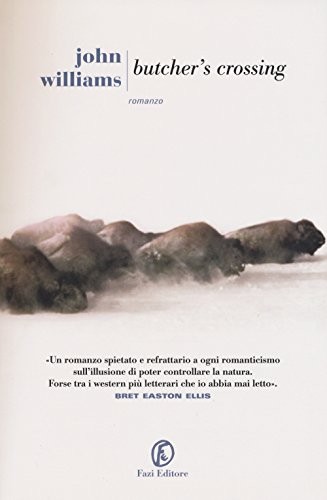
Back to the novels. This week, the DYEL boys decide to try Butcher’s Crossing, the first novel from John Williams, the author famous for writing the so-underrated-it-might-be-overrated-but-probably-is-now-just-correctly-rated novel Stoner.
As to be expected, it’s not on the same level of Stoner but we still enjoy it.
Decline of the buffalo: Rich reminds Cam that we already had this discussion in our episode of Blood Meridian but Cam forgot it and found himself in new disbelief on the staggering decline of the North American Bison.
Emerson and finding yourself: It turns out Rich went through an Emerson phase. Well, actually more of a Thoreau phase but the both had three names and wrote around the same time so it counts. We discuss Emerson’s idea of transcendence and whether this novel is meant as a refutation or embodiment of it.
Miller: Not on the level of the Judge in Blood Meridian but a memorable character in his own right. Rich has some small gripes with his characterisation.
Intro
Cam: I did come across a passage this week that seemed related. Have you guys heard “Buffalo, Buffalo, Buffalo”?
Benny: Buffalo, Buffalo, Buffalo, Buffalo. Not bad, eh?
Rich: Yeah. Wow.
Cam: I won’t get into the meaning because—
Rich: Is it how many buffalo are left?
Cam: No, no, it’s a grammatical sentence with the longest— it’s all verbs and nouns of the same word. So “Buffalo” is from Buffalo, and to “buffalo” is, I think, to either intimidate or to bully someone, which is a verb that no one uses, which ruins the passage a bit. But so: Buffalo bison from Buffalo bully other bison from Buffalo.
Benny: Oh, okay. I sort of figured it out, but yeah, I thought it was some kind of horrible modern poetry or something.
Rich: Yeah, that was Miller’s poetry out in the mountain. Miller used the verb “buffalo,” so I believe you.
Cam: Did I miss it?
Rich: He said something like, “by get dad gummit, I’ve got them buffaloed” or something. Yeah, it is a verb.
Benny: I thought you were gonna say Millie is with “Buffalo Buffalo Buffalo Buffalo.”
Cam: Okay, so welcome back to Do You Even Lit, the book club podcast where three former non-fiction supremacists, STEM and finance bros, try to bootstrap themselves to a liberal arts education and become lit bros instead. This is Cameron speaking, and I’m joined by my fellow Kiwi Rich, who may sound kind of similar but apparently has a bigger vocabulary than me. Hey Rich.
Rich: Hello.
Cam: And our Canadian friend, the forever student, Benny. Hey Benny.
Benny: Hello. Mature student.
Cam: Who hasn’t quite left for Kansas yet.
Benny: I keep getting older but the undergrads stay the same age.
Rich: He’s just an image.
Benny: I’m just trying to live Stoner’s life, guys. Give me a break. Yeah, yeah. Trying to protect myself from the outside world. Not like William Andrews.
Cam: So I’m going to give a quick summary. I thought, could we get a really quick yay or nay on this? Should fellow aspiring lit bros spend their time reading Butcher’s Crossing? Is this a readable book? I’m a yay.
Benny: Yeah, maybe I don’t want to divulge too much off the start, but I don’t think it was as good as Stoner. I don’t think it’s his greatest hit, but I think it was worth the time. And so I’m a thumbs up.
Rich: Weak yay. We should say we chose this book because we loved John Williams’ more famous book, Stoner. It was one of the first ones we did, and we all fell in love with it. So it was a good chance that we’d like this. And I did like it, but I didn’t feel anywhere near the same way about it that I do about Stoner. It’s still positive, but it’s soft.
Benny: Yeah. Soft positive.
Cam: Yeah, so as Rich said, today we’re reading John Williams’ novel, Butcher’s Crossing. John Williams is best known for writing Stoner, which is not about weed, for better or worse. We’ve actually got an episode on that. However, it was one of our earlier episodes, so it was a bit unpolished, perhaps. However, it turned out to be one of the best books of all time, so you should go read it and then listen to the episode, maybe.
Rich: I mean, we might do a reread on that at some point, if nothing else, then to have a better episode on it. Once we run out of books.
Cam: Yeah, once we run out of books.
Benny: We’ll be rereading books before we run out of books. We’ll never run out of books.
Rich: Yeah, that’s the problem. That’s the problem with our habit.
Cam: Nah, surely. Surely we’re making a dent. How many books can there be in the world? A couple hundred? I’m sure we’re doing well.
Rich: Dude, didn’t we figure out there’s 10 to the 2 million? There are more books than there are atoms in the universe.
Benny: Yeah. I literally put a footnote in my most recent paper about Borges’ Library of Babel and said there was approximately 10 to the 200 books in that library. I was talking about log-log rates. It doesn’t matter. But I was very proud of myself that I put it— or it made it into a footnote.
Rich: Yeah, see, there’s news you can use.
Cam: Trying to keep up with all the books. That’s why Richard’s reading all the self-involved 2020s novels, just to make sure at least he’s keeping up with the amount of books coming out.
Rich: Yeah, I got to stay on top of it.
Cam: Yeah. So as Rich said, on the strength of Stoner, we decided to try Williams’ first novel, Butcher’s Crossing. He only wrote three novels, so it’s actually not that hard to be a Williams completionist, even for me. Maybe he can be my first completionist author and I can answer the question from our listener, Sonny, of what author do you read every book on? So I’m two-thirds of the way there for John Williams.
Benny: Damn, that’s some quick mental maths, man.
Rich: Yeah, yeah, makes sense.
Benny: You should be writing my math papers, my god.
Cam: I forgot to mention that Benny’s a math student.
Benny: I’m just gonna try and fact check you in real time. I swear he had more than three books.
Cam: I think he had like an unreleased— I was weaseling out of it. No, no, we’re like an unreleased— what’s the word— like he didn’t want to claim his first one. I’m not sure if it’s out there to read.
Rich: I saw in a review someone said that he had three mature books, or books that he had written as a mature author, which sort of implies that maybe when he was younger, he wrote some other books or some short stories or something. So depending on how you define completion, you might have to get around.
Benny: No, he has got another novel, unfortunately, Cam.
Cam: Nah.
Benny: Let me just figure it out. And it’s 1,200 pages long. Sorry.
Summary
Cam: All right. So Butcher’s Crossing is a Western, or an anti-Western perhaps, I’m not sure. It is only about 300 pages, so it’s pretty short as far as novels go. And like Stoner, it’s quite readable and it’s non-pretentious writing. And it’s about a main character, like in Stoner, also called William. This time, William Andrews, who is a young Harvard student in the 1870s and decides to leave Boston to travel to Butcher’s Crossing, which is a fictional town in Kansas on the frontier, to experience the Wild West. Somewhat of an inverse of Stoner, perhaps, which is about a country boy who packs up and wants to experience academic life.
Andrews is set on experiencing a buffalo hunt, hence the buffalo jokes earlier on. And his only chance is by joining and funding, really, this skilled and experienced but enigmatic hunter Miller, who has been wanting for a few years to travel deep into the Rockies in Colorado where he saw a large buffalo herd. And Miller and Andrews are joined by two others: Charlie Hodge, who’s an old, quirky Bible thumper, and Fred Schneider, who’s a somewhat impatient, curmudgeonly but experienced skinner of the buffalo. So the four of them make the journey. The journey is treacherous — they lose their bearings at points, they struggle for water, they get sore, they get caught in a blizzard — but they make it. They find the buffalo, and Miller shows us that he’s good at what he does, and they start hunting buffalo.
Emerson’s transcendentalism
Before we get too much into the hunt and stuff, I thought we’d start with William Andrews and his motives. Early on we find out he reads Emerson — Waldo Emerson inspires him. I had a thought: Richard, did you have an Emerson phase in your early 20s? Did you find yourself like William Andrews?
Rich: Yeah, I went out and slaughtered a rare animal. Yeah, it’s a traditional rite of passage. No, I did have an Emerson phase. I actually used an Emerson quote as the strapline in my blog, which I started, Deep Dish.
Cam: Yeah, Deep Dish. Yeah, yeah, Emerson was actually from Chicago originally.
Rich: Now my strapline was “all life is an experiment,” which I’m pretty sure comes from “Self-Reliance.” And yeah, actually, I mean I was more of a Thoreau guy. Like, I love Walden and that was very influential on me.
Cam: I was just— three names, right? The three-name crew, the person—
Rich: Yeah, exactly. Yeah. David Foster Wallace. Yeah. So it was sort of— I think it was the guiding philosophy for me, actually, even though I didn’t read Emerson until a bit later on, but I read Thoreau at the time. Like, the transcendentalist movement is about the importance of— and it’s like a pine individualism basically, and like non-conformity and striking your own pathway through life and not being like the huddled masses, which is very appealing when you’re a sort of arrogant 25-year-old trying to carve your own path through life. That’s very intoxicating. But how it manifests here is more to do with the veneration of nature specifically, which is like the other big strand of transcendentalist thought, and that’s the one that never actually particularly resonated with me. Like, I enjoyed reading about it — Walden has got some really wonderful nature writing in it — and I sort of vaguely had some fantasies of going to live in a log cabin, or at one point I was planning to live in a van to do the van life. But I never followed through on them, and I think I learned about myself that that’s not what I’m about really.
And I actually almost am tempted to say that that’s a mistake, or that this novel is almost lampooning that a little bit, because for me personally it’s bad for me to be too individualistic and I need to be around other people more if anything, and like less of a contrarian. If I went and lived in a cabin, that would be really bad for me.
Yeah, so anyway, that’s my history with it. I’m curious if you guys think — I mean, I don’t know if you guys have read Emerson or Thoreau or not, but if you have, or if you’re familiar with it, whether you think this book is actually sort of lampooning it or criticizing it, or it’s like an instantiation of what Emerson was talking about.
Benny: Yeah, I mean, I actually am not super familiar with Emerson or transcendentalism in general. Looked it up a bit in preparation for this because, like you said, Andrews mentions— I think he mentions Emerson explicitly, right, as part of his motivation for going on this hunt in the first place. So yeah, I guess that’s what got me curious. And so I guess, yeah, correct me if I’m wrong, but the idea behind his thought, just for listeners, is that as an individual, you should go off by yourself, unencumbered by the norms of society, tradition, etc. And you should sort of go find yourself, often in nature, but going on some grand adventure by yourself. And that’s the way to truly discover your own identity, to come to true knowledge about the world, etc. So it’s very much like an unconstrained vision of human nature, perhaps. Is that roughly right?
Rich: Yeah, it’s partly about that. And it’s partly about taking transcendent joy from the mundane and the everyday. For instance, Thoreau’s whole thing was like living very simply and frugally, but not as a means to an end necessarily, just so that he could enjoy the normal gifts of life and nature. And he would just sit on his stoop watching the world go by and take pleasure from simple food and that kind of thing. That’s this through line from the Romantics, who we’ve talked about before, with the individualism and throwing off the constraints of society, but then also a little bit of Puritanism and maybe Stoicism or something like that. We’re just trying to not get swept up in these ever-expanding lifestyle traps. Like, Thoreau’s the OG frugal, early retirement, minimalist type guy, basically.
And he’s very wise. There’s a lot of great stuff in Walden that is well worth reading, insightful about how hedonic adaptation works, and how people trap each other in playing certain status games, and how difficult it is to cut through social consensus, stuff like that. Very insightful stuff.
Benny: I see. Okay, so this came after Romanticism, right? But not as a direct response to it — like there’s like a hundred-year gap-ish there.
Rich: There’s not that much of a gap, and maybe it is just a little after it. I don’t know what the exact intellectual influence is, but it just seems to me that it’s continuing in that tradition, but with more of the fixation on like having direct spiritual connection as well, not through religion. It’s like anti-religion. It’s more through having—
Cam: Nature is divine.
Rich: Yeah. It’s kind of like Cam’s worst nightmare.
Cam: I’ve been appreciating nature more and more, I think, ever since we started this book club. It’s like every day I sit on my back porch and I look at my little garden with seven flowers in it and I think to myself, god damn, this is nice. Dead possum corpse.
Rich: Yeah.
Cam: I became a transparent eyeball walking past that dead possum, to quote Andrews quoting Emerson. But yeah, so Andrews does directly quote Emerson, I think at one point when he’s a bit embarrassed talking to Charlie Hodge. Charlie Hodge mentions his dad’s a former minister or something like that, and then he realizes he doesn’t actually know the Bible that well. When he goes, he knows he mainly read Emerson — like Emerson was kind of his replacement. And he quotes him saying one line was “I become a transparent eyeball,” which—
Benny: Like, what does that mean to me? Yeah.
Cam: Sorry, yeah, because I suppose it’s not obvious. I mean, my take on it is that kind of egoless consciousness that people talk about meditating, or doing certain drugs, or perhaps you can just get there when you’re going through nature where you are experiencing nature, kind of feeling a oneness. I think Freud called a maybe related feeling an “oceanic feeling” of this sort of oneness, eternalness with the universe. There’s another quote he has — he had a feeling that his head was bathed by the clean air and uplifted into infinite space in nature. That’s what he’s seeking, which—
Rich: I mean, well, the nature stuff — maybe there’s, you’ve got some quotes of where it does reach the sublime or something. But for me, it was the reason why I thought it was maybe lampooning it a little bit, is just because he sets off on this journey and is immediately just in extreme discomfort. Like he’s just riding for hours and hours and it just hurts. He’s got like blisters all up his leg. And it’s just a featureless environment too. Like, I don’t know if it would be wildly fascinating to be part of that nature. It’s just the same thing, and just little bushes and scrub, and it hurts and it’s horrible and he’s thirsty. And then they just keep getting in more and more shambles of not having transcendent experiences but just being like really thirsty, really hot, really cold, almost dying. Nature is almost hostile, and it certainly isn’t like a nice — what we would think of as our relationship with nature, of having like a really nice stop, going for a nice hike, or going on a really fun adventure holiday or something. It’s just agonizing and deadly.
Cam: Oh no, that was funny. I did relate. I did relate to that a bit.
Rich: Which is — I mean, William Andrews especially, who’s the novice. It’s just sore.
Cam: Although he’s quite— you’re reading that first bit going, I fucking told you. You’re sort of not allowed to mention it. He doesn’t complain though.
Rich: Yeah.
Benny: Anything more on Emerson? So maybe just a meta note — yeah, I kind of still want to talk about Emerson, but it would require talking about the ending, and it seems like you want to do things more linearly, so I’ll just follow your lead I guess. But I don’t view it as the kind of book where we’re really spoiling much. Even the back cover of my book, for instance, gives everything away until they get back to town and the fact that it’s a ghost town and everything. So I don’t think it’s meant to be the kind of novel where it’s like we’re trying to hide exactly what’s going to happen from the listener and everything. But anyway, I’ll leave that up to you. But I do have more to say once we actually divulge what the ending is.
Cam: Okay. Yeah, maybe let’s pause it for now, but we’ll definitely plant a flag and come back to it.
American Buffalo: Decline, hunting, skinning
So yeah, the other point I had was just to talk around the decline of buffalo in North America, or the American bison, which, in terms of a snippet of history to learn about, this book is quite a nice synecdoche of sorts of that period of history. And, you know, I’m not American, so I didn’t know too much about this before going into it. I know it was sort of alluded to in Blood Meridian, or maybe that was just from my additional readings around that book.
Rich: Yeah, it’s probably because you’re not American. I’m assuming most Americans have the plight of the buffalo in the 1800s — I’m sure everyone is well up on that. After the American eagles.
Cam: Yeah, exactly. I had seen a Simpsons episode, actually. But I mean, they know the plight of the buffalo, but do you think the average American knows the extent, you know?
Rich: I was being sarcastic. The average American doesn’t know that other countries do this.
Cam: Yeah.
Benny: I always thought this gets a little bit overrated because America is the size of Europe.
Cam: And America is like, yeah—
Rich: But Europe’s the size of Europe.
Benny: Yeah, but knowing all of Europe is kind of similar to knowing all— like a lot of non-Americans don’t know all the different states and stuff.
Rich: Well, and even if we do, the confounder there is America is the empire — like, is the world.
Cam: Anyway.
Rich: I’m loving the empire, baby.
Cam: So yeah, just to put some numbers on it, early 1800s, there were more than the atoms in the universe—
Rich: Cam’s doing nothing but reading the Wikipedia page on buffalo for the last two days. He’s ready.
Cam: Well, there were 30 to 60 million in the early 1800s. And by the time of the early 1870s, which is this book, it’s down to about 10 to 15 million. But this is when it kind of ramps up, this period. So they’d been killing a lot of buffalo over the previous 50, 60 years, but in the 70s is when it ramps up. I think there was some innovation around tanning of the skins and stuff. And then I think by the end, by 1880, there’s like a million or less than a million. And then by 1900, there’s like 200 or 300. It’s just super endangered and going to go. And then it’s back up to, I don’t know, 400 or 500,000 now. But even that kind of overstates it a little bit, I think, in terms of like wild buffalo, mainly in Yellowstone, where you see videos of tourists getting too close and taking selfies for their TikTok. So yeah, this is kind of the background history.
And I think even on their journey on the way there, Miller even mentioned it. Miller, his eyes straining at the distant herd, said, “I can recollect the day when you never saw a herd less than a thousand a head, and even that was just a little bunch.” He swept his arm in a half circle. “I stood at a place like this and looked out, and all I could see was black. 50, 60, 70, 100,000 head of buffalo moving over the grass. Packed so tight you could walk on their backs. Walk all day and never touch the ground. Now all you see is stragglers like them out there, and grown men hunt for them.” He spat on the ground.
So part of the setting is, it’s a bit harder to hunt buffalo than it was even fairly recently, and that’s why they are going deep into the Rockies to find this kind of mysterious herd that Miller’s been talking about for years. And you know, I suppose we see why they went extinct, or almost extinct, with Miller’s approach.
Rich: Do you know what they were actually using all the hides for?
Benny: Well, in case there’s a blizzard it’s good to have two hides — one to make an open sack. No, four hides I think. Two facing new and two facing— eye.
Cam: Well, I think different purposes, but mainly for the winter coat is why you want the winter buffalo. They have the nice lush coat. I think leather, you use it for leather. I think in the Civil War in the 1860s — meat, of course. So it was a major food source of Midwest Indians. And I think part of the reason why the American government were okay with killing a lot is it helped for any battles with them.
It’s crazy to think, eh? There was 60 million, got down to 300.
Benny: We see with Miller’s slaughter, there’s almost like an inhuman efficiency he displays when he’s actually doing the killings.
Rich: Yeah, I’m surprised you guys don’t remember this. We already talked about all this in Blood Meridian. You’ve got to lift your anchor game, man, with terms of like 60 million down to X million down to—
Cam: My bad, really. Yeah, yeah. Jesus Christ. But I still — I really like this because I didn’t know — in Blood Meridian you see the after-effects, like all of the piles of bones, and it’s just sort of, oh that’s right, 30 years later into that. But you don’t see it in action.
Rich: And what I really enjoyed about this is that basically the whole plot is like four men go on a buffalo hunt, more or less, and you get heaps of detail on exactly what a buffalo hunt entails, which I just never would have guessed at. In my mind I just sort of have a vague idea of like some guy with a gun and he shoots the buffalo and that’s that. But it’s like this big logistical exercise where you might need some venture capital, and you got to get all your provisions, and you need a specialist skinner — one guy on shooting, you need to be rotating guns to cool the barrels down, you need to be making and refilling your own shells and casings. And then there’s like a strategy for shooting the buffalo so that they don’t just scatter, and that’s crucial so that you can make like a big stand — which also, I didn’t know what a stand was before. You can just keep picking them off. If you get clean shots and you do it in the right way, you can just be way more efficient about killing. And Miller’s obsessed with getting a really big stand.
Cam: Yeah, it reminds me of just like “reality has a surprising amount of detail” kind of thing. And I found that I quite liked just hearing about the process and detail, which is most — a huge chunk of the book. It’s just really just sort of normal, quite neutrally detailing what’s happening. It made me think that I probably would like Moby Dick, which I’ve heard is — like a lot of it is just the mechanics of hunting whales.
Benny: And if I had to guess, I would guess that this is a big homage or inspired by Moby Dick. Because Miller sounds a lot like Ahab, right? Like a relentless, obsessive killer who can’t be moved from his goal, even when it will risk the lives of his own crew and that kind of thing. I mean, I’ve only started Moby Dick because I can’t read it without my boys. But I’m pretty sure that’s how it goes.
I wonder how Williams himself learned about all these details. He must have just been reading some old books, some old manuscripts on buffalo hunts. And I wonder how — I want to trust him and say that this is pretty realistic, but I guess you always have to actually ask that question.
Cam: I wonder if you try to skin a buffalo.
Rich: Yeah, exactly. Well, even the skinning is fascinating, right? You have to make this particular series of cuts, and then you use your horse — you tie a knot around the hide and you use your horse to rip its freaking skin off. I would never in a million years have guessed that’s how it’s done.
Cam: Yeah, it was — yeah, genuinely cut around the balls.
Benny: Yeah, don’t forget that, to quote Schneider: “Don’t throw out the balls.”
Miller’s stoicism and characterisation
I also think it’s not crazy to think that Cormac McCarthy’s Judge in Blood Meridian was in part based off Miller. Because Miller does have this relationship with nature where it will beat him down but he’ll never quite succumb to it. Like, regardless of the situation, in the emergency, somehow he always gets them out of it — whether it’s day two of being without water and then finally they find this stream, or whether it’s when they get snowed in in the canyon and he knows what to do to keep them warm. He doesn’t have quite the same supernatural skill set as the Judge has, perhaps, but there’s something about his command of nature around him which gives me Judge-like vibes. Like, somehow if you stick with him, things might get bad but you’ll never die somehow. He gives you that sort of masterful vibe.
Cam: Yeah, he’s certainly very stoic, isn’t he? Like, one of my stoic characters, I think I’ve come across. Any bad thing that happens, he goes, “well, you know.” So when they’re out — after they’ve killed all the buffalo — the blizzard happens, which is a nice scene. There’s like the first snowflake hits and then suddenly they’re like, oh shit. Charlie Hodge starts crying and—
Rich: Oh no, no, no.
Cam: No, yeah, Charlie, man. And so the pass gets snowed in, and they stay for a few days within a blizzard, within the buffalo hides, and then they realize they can’t get out. And I mean, that’s crazy. Like, William Andrews asks Miller how long are they stuck there, and he says, what is that, like, the winter, right? It’s going to be like five or six months.
Rich: And for context, this was going to be — he promised this would be a six-week trip, quick in-and-out adventure tops, you know, like two weeks travel each end, two weeks of killing, come home to Butcher’s Crossing and spend your big thousands.
Cam: Yeah, so when these bad things happen, like, Miller’s very stoic, and he often is right to say, well, there’s nothing we can do, we’ll do the best thing now — whether it’s running out of water, whether it’s on the way back when they lose the buffalo hides. But I sort of had a thought, something around like, he almost felt too stoic or something, like the negatives being stoic, because he’s just— well, I don’t know what it is, but like a lot of these bad things happen because of insufficient planning, or because of an obsession, you know, like you say, or greed, you know, of “we have to stay here to get every last buffalo,” even though half of them would have been enough. And then therefore the bad thing happens, and then when the bad thing happens and you’re stoic about it — and you know, there’s nothing we can do — so well, yeah, we could, if you listened to me being non-stoic and complaining, like, two days ago we could have avoided this. I don’t know if that point makes sense.
Benny: Yeah, I mean, it’s definitely not pure stoicism, because he just goes into full bloodlust mode at some point and is obsessed with not letting the buffalo get away. You know, at one point there’s 200 of them left or so and they make a bid to try and get out of the valley and charge away, and Miller gets obsessed with cordoning them off. But, you know, at this point they’ve collected so many hides that they know they’re going to have to make multiple trips to collect them regardless. And like, he’s just absolutely obsessed with killing them all for some reason that I think the reader isn’t entirely privy to.
Yeah, now that you guys mention it, I didn’t love Miller as a character, and I think I have a better sense why. Which is that there’s some bit of inconsistency here of having like this hyper-competent and admirably stoic person who’s like, you know, Jocko, you know — “oh, winter’s coming and you have to build a bivouac and spend six months under snow, good.” Like, he just effortlessly pivots and he never gets mad or anything, and that’s a very— that’s the kind of figure that you aspire to be and that you’re— it’s like so admirable.
Rich: Just imagining Jocko out there, right? “You know, lose all your hides that you spent six months— lost it all, like lost ten thousand. Good, good.” Yeah, yeah, still taking pictures of his watch or whatever.
Benny: Yeah. Yeah. It’s weird to have like such incredible emotional regulation but then in other facets just be like a lunatic basically. And I think it’s— I don’t really buy that such a person exists. It’s a bit jarring, and I just never quite fully bought his character. From being like this friendly old-timer at the pub, and yet like this crazy obsessive — like a person like that should be more violent, they should have worse emotional regulation, they should get into more fights with Schneider, for instance.
Rich: I think— I mean, okay, I don’t know if I agree with this. I mean, for one, I think he does get in fights with Schneider, right? At some point Schneider comes up to him as Miller’s shooting the buffalo and says, “what are you doing? Let’s get out of here.” And he says, “you better crawl away right now. And if you spook the buffalo — if you’re too loud, you spook the buffalo — I’m going to shoot you.” And so there’s this underlying tenor of violence where if you don’t go along with Miller, I think he’s totally okay exacting retribution on you. And I don’t know, I think you can have obsessiveness coupled with competence. So think of any— maybe even Elon Musk is an okay example here, right? Where the guy is, you know — just take it pre-Twitter days — just obsessed with rockets or electric cars or something. You wouldn’t call him emotionally regulated exactly, judging by the stories that have been written about him. But you would call him quite competent in actually carrying out whatever his goals are. So I don’t see those as necessarily orthogonal personality traits.
Cam: Yeah, I suppose another way of looking at it is— when you think about the Judge, you have the sense of inevitability that he knows exactly what he’s doing and it couldn’t have been any other way. It’s not that he got lucky, it’s that he’s got his finger on the scale, on the cosmic scale somehow, and so he’s very zen as he moves through the world. With Miller, I don’t have that impression. I have the impression that it sort of works out, at least insofar as that they don’t die, but it’s not because Miller is a brilliant genius — it could have gone the other way. They could have not found water and died of thirst, you know, four days in or whatever. And they could very much have died in the blizzard. And, you know — but spoiler — one of them does die at the hands of nature.
So yeah. But no, I take your point. Yeah, it’s not a totally dying character. It was an interesting sort of scene where it’s showing that Miller didn’t know the country as well as he used to, which makes sense because it turns out it’s been, I don’t know, five to ten years since he’s last been there.
Benny: Ten years, I think.
Cam: Yeah, and they almost don’t get water and seemingly luckily get it one night, and then from then on they have water every day. But Miller sort of says he just needs to get used to the country, he’s looking at it too closely and needs to get a feel for it. So in one sense he’s lucky, but in another sense maybe that was just true, because the other thing is, people didn’t necessarily believe him about this buffalo — like, you’re crazy to want to go there, it might not even exist, you’ll not be able to find it. But he found the buffalo, which is this super isolated herd, one of the last big herds left. So I was sort of weighing up as I was reading it how confident he was, or something. I think once I was in strife I would definitely trust him to take the best possible course of action, and the other characters do because they have no choice.
Benny: Yeah, but I wouldn’t trust him to not get me in strife. He gets them in strife multiple times, and that’s why Schneider keeps being like, “god damn it, Miller, you fuck,” you know, because he’s like, “you have done it again, like, you have put us in the situation.” And now he knows he has no choice but to go along with him. But yeah, it could have been another way.
Schneider’s empty (Chekhov’s) gun
And just on Schneider quickly — he also felt like a Chekhov’s gun that never fired kind of thing. Because he kept getting into these spats with Miller and had this real aura of menace about him, right from the very start where he’s kind of saying very crude things about Will’s crush Francine the prostitute. And there’s this little air of violence about him. He has these blowups with really violent outbursts against Miller, and you think at any moment he’s going to betray them, abandon them, they’re going to come to blows. At one point he starts wearing his pistol on his hip again. He’s got this little pistol, and when they’re in their winter confinement with each other he’s wearing his pistol, and I was like, “oh yeah, we’re getting to the big blowup here, actually, a literal Chekhov’s gun, he wears the pistol on his hip.” Means nothing. It doesn’t get fired, and then he just sort of deflates and does what he’s told every time. And that cycle of conflict resolving the same way every time felt like a missed opportunity to me as well from a narrative point of view.
Rich: Although that’s sort of the John Edward Williams thing to do. I remember Stoner was like that a bit as well, right? Where he’d build up the tension, especially between Stoner and Lomax I guess — who Lomax was the other professor in the department, right? With the hunchback or the weathered hand. Yeah, with the hunchback student. But Lomax was the professor, I believe. And there would be all this tension between them and you’d think this would have to resolve somehow, and then it would just slowly ebb away because Stoner would take some non-violent course of action basically. And like, yeah, so I think — for whatever reason, John Williams as an author likes to play with you a bit as the reader here, which you can read as annoying, or you can read as like, maybe this is just more likely to be how life actually goes. Where people like confrontation up to a certain point but don’t actually love to resolve it in epic movie-like fashion.
Benny: Yeah, I mean, it did get resolved in a different sort of way, I guess. But maybe — and maybe that’s the point too — like, something had to happen, having set Schneider up as a semi-hostile force that needed to be dealt with.
Cam: I guess so. And he did deal with it. I mean, we keep skirting around it. We’re gonna talk about it.
Benny: I mean, so yeah, I was gonna say maybe Miller was like the Judge and saw that big log coming down the river and sort of looks over, sort of winks at you.
Cam: Yeah, so they built that up. So Miller — partly at fault for what happened. He’s determined to load up the wagon with too many hides probably. Like, otherwise it’s a waste of money — they can come back. We come back, get the three, four thousand that we’re leaving behind. But like, I want to load heaps up, just sounds like a big fuck-you when I arrive.
Rich: Like Dad stacking the station wagon when you’re going—
Cam: Yeah, yeah. Yeah. And kind of knew something was going to happen with these fucking hides. They kind of foreshadowed at one point — I think Miller’s making fun of Schneider for his cut of the pay, because Schneider’s getting this fixed rate of, you know, 60 bucks a month or something rather than a proportion. And he’s like, “well, you’d make— if you’re a cut—” and Schneider’s like, “I know, I know.” And then he sort of starts wondering, doing math, “so, you know, if you have one, even if you have one—”
Rich: “Shut up. You haven’t got your hides back and paid for yet. I wouldn’t count your money just yet.”
Cam: Yeah. Cut in Norm Macdonald, the shaggy dog story of “don’t count your eggs before they hatch.” Yeah. So eventually they try and cross this river, which is tough to do and precarious, but it’s not actually that — they sort of had bad luck, and a massive log comes down and sort of violently kills Schneider’s horse, and then Schneider falls in and drowns.
Rich: But it is still Miller’s fault, to be clear, because they crossed that river on the way there when it was probably just a tiny little stream, and now it’s a raging river on account of the snow melt from being trapped there through winter.
Benny: Did you guys ever read Into the Wild? I think that’s what it’s called, where the kid goes off — speaking of transcendentalism actually. Yeah, yeah. The kid goes off to live in the woods by himself and for a couple months. And then when he’s finally ready to return home, he realizes that it’s the spring runoff and the river is bloated and he can’t cross it. So he has to try and stay there for a few months and dies because he eats some poison berries.
But yeah, it very much reminded me of that. Like, you stay too long, nature starts fighting back against you.
Rich: It’s an interesting parallel, because yeah, he had this very romantic vision of going into the wild, right? And it was super naive, he wasn’t prepared, and nature killed him. And I think the historical consensus is that he was kind of a moron.
Benny: Is that right?
Rich: Yeah, just underprepared.
Benny: I don’t know more. I mean, he did survive by himself. I wonder if there’s a hot take, yeah, actually he did pretty well.
Rich: Yeah, that could be fair. No, that could be fair. Yeah, but he was definitely losing weight and stuff, because — I think he was taking pictures of himself and videos and stuff, and you could tell it was not sustainable, is my understanding. Like, he was obviously losing weight and whatnot, and surviving, but not eating as much as he should have.
Benny: Yeah, he ate some berries that were like non-nutritive or something because — I can’t remember, maybe they’re slightly poisonous or the body doesn’t process them well.
Rich: There’s real “Secrets to Your Success” type stuff. Francis Galton’s advice, cousin of Darwin: “Eat the berries the birds eat.” This is his trick.
Cam: Do you want to summarize the rest of the ending as well?
Benny: Yeah, well, they get back without their hides, and the town is kind of a ghost town now. And this character McDonald, who is the main hide seller, he is broke, and the economic boom of buffalo hides has passed. And McDonald accuses the hunters of flooding the market and causing a price crash, and doesn’t want to pay Miller anything for the 3,000 extra hides that are still out there.
Rich: Well, he can’t pay him anything. He offers him land, right, which is valueless as well now.
Cam: Yeah, I think they were going to get $4 a hide, and now he says they could maybe get 10 or 20 cents or something tops. Yeah, and he can’t give away any lower-quality hides. And he also says if they’d come back when they were meant to, he would have been able to pay them in full, and yeah, they would have been the ones to help bankrupt him, but they personally would have made all of that — they would have made that fortune. So, like, if Miller’s greed hadn’t been so greedy and obsessive—
Does Miller’s motive make sense?
Rich: I actually don’t know if it is greed. We never really talked about this. What is Miller’s motivation? I don’t get it. What the hell is going on there?
Benny: It’s just about timing the market perfectly.
Cam: Just not, yeah. No, I don’t think it’s greed. I think — although he doesn’t say no to the money at the end, like, the idea of it — but he just seems obsessed with killing every last bloody buffalo, right? Yeah, he just goes everyone, because Schneider’s saying like, “this is impractical, right? Like, I have to skin all these and we’re not gonna be able to skin them, we can’t leave them a few days because then they get stiff.” And he’s like, “I don’t care if they get stiff or not, like, we’ll get skinning, and I’ll help you, but like, we are skinning everyone here, I’m killing every buffalo there.” And he’s already killed more in one stand than he ever has before, but he’s determined to get every last one.
Rich: So yeah, it seems like this mania, almost. And especially given, like, if he— let’s say that he’s something approaching like a rational profit maximizer. Surely the play is, you’ve got this secret sauce of buffalo while the rest of the market is disappearing. Don’t kill them all. Kill half of them, come back in five or ten years, they probably will have fully replenished, the rest of the buffalo population is gone, you’ve got access to the only buffalo. You could make an absolute killing for the rest of your life sustainably. The last thing you’d want to do is kill them all. It makes no sense whatsoever. So that’s why it’s hard to be like — is it a profit motive? Something more than that.
Benny: Yeah, you feel it’s a vendetta against the land or the actual animals themselves, right? Like, it feels like — I mean, one open question I think here is, like, what’s the history of Miller in that land, and what’s the history between him and Charlie, right? Because at some times Miller gets quite protective of Charlie, especially around Schneider, and you kind of get the sense that maybe Miller was the reason that Charlie lost his hand in the first place and is sort of a cripple now. And I wonder if that had to do with some sort of first escapade into this land when they were younger. And if Miller feels some sort of retributive desire because, you know, something happened where he was out there and he feels like he needs to now show dominance towards, you know, these animals or something like that. That’s the only thing I can think of, because I think yeah, it definitely extends beyond any sort of rational calculus of why you want to stay there so long. He just seems to go into full bloodlust mode.
Rich: Yeah, so you can very easily see why John Williams the author has portrayed it this way, because it’s very cute to do this parallel of like, you know, we’ve heard the story a million times — how rapacious are humans on the environment, and how unsustainable was the use of natural resources and so on — with this wonderful example of the slaughter of the buffalo. But from a psychological point of view, he hasn’t, to me, he hasn’t made that connection. And it’s a bit of a cartoon, and it just is in service of this environmentalist type or capitalistic type message, which — yeah, that’s maybe why I’m not a huge fan of the Miller character. The psychological profile is not fleshed out enough for me to see what’s going on there. Because we don’t really get — I mean, maybe there’s stuff that I’ve missed, but we just don’t really get that much other context about who he is and what he’s trying to accomplish.
Cam: At the start he’s determined he wants to do his hunt. That’s maybe why this hasn’t been done before, because he’s been talking about it for years, that he wants full control. I don’t know why he has to kill every last one. I mean, there’s an obvious kind of metaphor — it’s sort of metonym or synecdoche of the decline of the buffalo in general, right? I mean, just what you were saying around sustainability. I suppose there’s just this game-theoretic answer — I mean, not so much for Miller because, as we said, it doesn’t seem to be— yeah, for other people it makes sense to behave like that. This is the one time it doesn’t make sense, maybe.
Rich: So yeah, if it is like a — what did you say — a metonym or something? Yeah, I forget the difference between metonym and synecdoche, but a kind of example of something greater. Yeah, I think that’s kind of bad writing if it is that, or at least it’s not the kind of thing that I really like. Right, it isn’t quite — it’s not quite consistent, is it? Like, he’s more of this kind of unexplained obsession.
Lesser work to Stoner
Do you guys reckon, if you’d done a blind test — like, you read this book and Stoner and you had no idea what order they came in — do you think you would have been able to tell that this was the earlier work and Stoner was the later work?
Benny: I wouldn’t have, personally. I’m not sure.
Cam: Yeah, I doubt it.
Rich: Someone, someone would have been able to.
Cam: How about you?
Rich: I thought I may be good, but I might be fooling myself. I thought it was kind of a more immature work, like, didn’t quite hang together as well. And I even found some actual mistakes and inconsistencies that I would have thought that an editor would catch. Yeah, like, right at the beginning Schneider is described as having like hooded eyes and looking really sleepy, and then within like one page later it’s like Schneider looks really alert. And it like perfectly contradicts itself where you get a bit of whiplash. And just quite small things, like using the same adjective two times in a sentence — like, you know, “the moon shone luminescently upon the still luminescent order” or something like that, where you’ve sort of forgotten to vary your language. And anyway, I’m probably dreaming and I wouldn’t have been able to tell.
Benny: Trigger warning. This could ruin Stoner for you.
Rich: Yeah, oh, if you’re gonna go back and read Stoner— actually, dude, I’m curious now. I’m like, wait, was Stoner that good? Like, maybe it’s not that good. Because there’s all the— at the other— okay, you can see what it’s got in common: the violation of show, don’t tell, which we picked up on when we read Stoner but we didn’t mind it, where you have this god’s-eye narrator who just tells you exactly what Stoner is thinking and how he’s responding to the situations he’s in and what that all means, and does all the work for you. Which makes it really easy to read. And this book was also easy to read for the same reason. Like, you’re not at all guessing what Will’s thinking or feeling about anything. But yeah, I don’t know if it works quite as well, maybe just because I don’t relate to Will very much, whereas I related to Stoner a lot.
Anti-Emerson
Benny: Yeah, I mean, I think the consensus is that Stoner is the masterpiece and this one is kind of a good book. So to bring it— yeah, to come full circle back to Emerson. I mean, it seems — and again, I’m saying this from a viewpoint of someone who doesn’t know Emerson’s thought very well — but it does seem you can make a case that Charlie, Schneider and Miller are all like anti-Emersonian archetypes. In the sense that, well, Schneider dies when he goes out into nature, and so that doesn’t seem super Emersonian. And then Miller and Charlie seem to come back not learning much of a lesson of what happened out there, and in fact Charlie seems to explicitly forget. He seems to have so much trauma about what had happened out there that when he’s later talking to Andrews, he’s forgotten that they’ve gone out in the first place, and has transported himself somehow six months or, I guess, almost a year back in time to when they’re wanting to go out on the hunt in the first place. So he sort of wiped the whole event from memory.
And then the very end is sort of Miller riding off on his horse and Charlie going with him, and I think you’re supposed to think as the reader that they’re going to go off and maybe do the same thing in another town, right? And like Charlie will just be that much more traumatized or whatever. And so they seem to have learned nothing. Nature didn’t bestow on them any form of knowledge. They didn’t have great self-discovery when they were out there or anything. And that seems quite anti-Emersonian.
And then Andrews himself, you could make a similar argument. You could say, like, he doesn’t seem to have come back and now have a bunch of self-knowledge, but at the same time, he comes back and at least seems to know that his earlier self was naive somehow. And he does make some significant life decisions when he comes back. He decides not to go home for one — so he realizes he’s never going to go back to school, to Harvard. He leaves, he spends about a week with Francine and then leaves and decides to just go to another town. And so that sort of leaves open the door to some sort of self-discovery process that could be happening there. Like, you’re not maybe learning positive things about the world, but you are shedding some of your misconceptions. And so you could make like a slight Emersonian case I think for Andrews. Curious what you guys think about that.
Ending and nihilism
Cam: I even think with Andrews they kind of flip this transcendentalism, this kind of oneness with the universe, on its head a bit when he gets back, and they kind of turn it into a nihilism. Even when he comes back, he sees Francine several times and he starts kind of getting out of his head during that, and feeling empty and kind of witnessing this and wondering the point.
And we didn’t mention, but Miller burns down McDonald’s hide shop out of anger, but even then there’s this kind of meditative, trance-like nature there. But he kind of views life as meaningless, right, near the end, was my take. And I think McDonald says some quote around “life’s full of lies,” and that kind of hits home with Andrews. This naive Emersonian kind of spiritual journey was maybe a bit of a lie to reality.
Rich: Yeah. Who’s got some text from the end bit, from Will’s final thoughts? Anyone got—
Benny: Yeah, can someone read that?
Cam: Yeah, I’ll try and find it. That I was extremely confused about. There’s a lot of flashbacks to the look in Charlie Hodge’s eyes and Miller’s powder-stained fingers and stuff like that.
Benny: That’s the one I’ve— yeah, give me— give me what you got.
Cam: So, yeah, I should probably actually read the preceding paragraph as well just to set up the context. So he’s in Francine’s room and looking out the window. And it’s— so he writes, quote:
As if balancing himself finally at the edge of an abyss, he turned from the window and looked again at the sleeping figure of Francine. He could hardly crawl now the passion that had drawn him to this room and this flesh as if by a subtle magnetism, nor could he recall the force of that other passion which had impelled him halfway across a continent into a wilderness where he had dreamed he could find, as in a vision, his unalterable self. Almost without regret, he could admit now the vanity from which those passions had sprung.
It was that nothingness of which MacDonald had spoken back in the sleeping house as he stood beneath the lantern that flickered weakly against the darkness. It was the bright blue emptiness of Charlie Hodge’s stare into which he had glimpsed and of which he had tried to tell Francine. It was the contemptuous look that Schneider had given the river just before the hoof had blanked his face. It was the blind enduring set of Miller’s face before the white drive of storm in the mountains. It was the hollow glint in Charlie Hodge’s eyes when Charlie Hodge turned from the dying figure to follow Miller into the night. It was the open despair that ripped McDonald’s face into a livid mask during his frenzied pursuit of Miller in the Holocaust of the Hides. It was what he saw now in Francine’s sleeping face that sagged inertly on her pillow.
And it’s a hard— I mean, that’s a genuinely hard paragraph to make sense of.
Benny: I mean, the sentence preceding that paragraph is, you know, again, “almost without regret, he could admit now the vanity from which those passions had sprung.” So there does seem to be some sort of recognition that his earlier self didn’t know much about the world, was naive, wanted to go on this grand adventure just because, and he can sort of look back at himself and realize that he was wrong to some extent. But then like what he’s actually learned, or where his head is at now, is extremely hard to decipher for me.
Cam: Yeah. And he also makes a connection with, I think, his initial kind of fear with Francine when he doesn’t go through sleeping with her, to his revulsion of the buffalo carcass when he first had to cook it and gut it and stuff. Which again is this kind of seeing what reality is like.
Rich: So the ego thing there is that you have to become a man and you have to be able to sleep with women and kill buffalo and like feel nothing, you know, or overcome — or do it enough that you become inured to your senses in the way that Miller and Schneider are. Whereas William — what’s his name — Andrews, vomits, he throws up when he has to gut his first buffalo, at the stink of it and the visceralness of it. So we’re meant to think that he rejects that as being an ego-driven journey.
It was like — coming back to transcendentalism, I think none of us, unfortunately, are very qualified to like give the best assessment, but the idea is dominion over yourself and self-knowledge, not dominion over nature or exploitation. And maybe it’s when one of those things serves as a vehicle for the other, then that’s like the mistake that’s been made. Because, you know, you can get self-knowledge and insight, you can imagine, by just like going on a similar voyage but where you don’t try and become very bloodthirsty and try and wipe out, you know, do like a genocide and slaughter as many things as you can. You can still have to survive against the elements and using good observations of the land and reflecting on small comforts of life and that kind of thing, without trying to be like a badass tough guy, money-making outdoorsman.
Cam: I’m just now thinking of this end, but I think part of it was, he was hoping to kind of find his self, his true self. There must be this true self to human nature that we only get with this sort of thing. And then when he does it, he doesn’t find it. And actually, he describes it when he looks at Charlie Hodge’s face, Francine’s face lying there. There’s this nothingness or this emptiness there. And this idea of a true self, I think, is an illusion. What he realizes, he thinks. But, you know, as Rich just pointed out, I mean, maybe it’s not an illusion, and you know, you do something as hard like this, it’s gonna harden you. Or you get unlucky as well, like, because that’s the thing — it’s like they were a bit unlucky, right? It was all for nothing. You might over-index. It’s sort of like you have the expected value is there, and it doesn’t come through, because one, you lost all your shit, and then two, sort of the market hollows out just before you sell. And then you’re like, what’s the point of anything, you know? There’s no meaning in life.
Rich: But I think Andrews wasn’t too worried about that. I mean, obviously he was annoyed, but he never really— for him it was all like a big “Boy’s Own” adventure. He was never really about them making a fortune. It was to have this true authentic experience with the land, and learn about what it’s like to be in the outdoors. And he got that, for better and for worse.
Benny: I think that’s right. But I do think losing all this stuff and it all being worth nothing at the end really sort of drove home, like — like we just said, we spent a winter in the wilderness, like almost died like three or four times, but— and someone did die — like all for nothing. There was no point to all of it.
Rich: Yeah, again, awfully convenient from a narrative point of view, compared to like if they all came back into town triumphant, gigantic sacks full of cash, and he’s like, “I’d love to, I’d love to learn something about myself, but this money is making it pretty hard.” It’s pretty good.
Cam: But even the idea of what Miller wanted — like he came back with this big wagon of hides and everyone has just been dismissing him for years. I can imagine they’ve been quite triumphant.
Benny: Yeah.
Rich: That’s true. That’s one little insight that we do get about Miller’s character. He wants to show everyone who’s been scoffing at his wild tales.
Outro and next picks
Cam: All right. Well, is it time for Rich to tell us the next book?
Rich: Oh, is it? Uh-oh. This week we’re not reading.
Cam: We’ve given up on books. There’s no point.
Rich: Yeah, we’re doing movies now. We’re all going to watch the new Superman for next week. Learn about Israel and Palestine.
Benny: I’m just imagining— what would the central character be called in the Roman book? Like Willius or something.
Rich: William Caesar, it turns out.
Cam: William Caesar.
Rich: I haven’t picked a book, so we can add it in the show notes afterwards.
Cam: Yeah, that’s like John Williams’s Miller-like obsession. “I must call my character William.”
Rich: Yeah, I mean, I didn’t notice that until you pointed it out. This is definitely some author-insert stuff going on perhaps.
Cam: Yeah. Wrap it up, Cam, bring us home, baby.
So, don’t forget to email us. We love your feedback, and you can find us at doyouevenlit@gmail.com — and that’s “you” with a U. So “do-you-even-lit,” the letter U, at gmail.com. And we’ll respond, or talk about it on the podcast with your feedback. And we’ll choose a book, or a short story at least, for next time. Anything else, Rich?
Rich: Bye-bye. See ya.