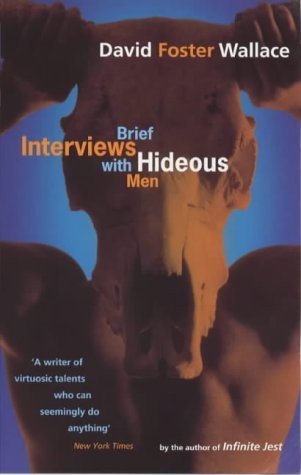
Starts with light and breezy over-sharing of our masturbatory habits, ends with a downer discussion about how we should re-contextualise Wallace’s work through the lens of the abuse allegations against him.
Brief Interview #59: Logically coherent masturbation fantasies
Rich: So did you guys watch Brief Interviews? Because I cannot imagine how the fuck they turned that into a movie.
Cam: Yeah, I watched a bit of it.
Benny: I watched about 20 minutes.
Cam: Anyway should we—
Benny: Should we — what, sorry?
Cam: Start.
Rich: Well, that was my segue. You fucked it up.
Cam: Yeah, now I’ve ruined it. Can you repeat that, Rich? You were sniffing.
Rich: I’ve got a cold again. God damn it. All right. Yeah, let’s do it.
Benny: I’m self-conscious about how close this furry, fuzzy thing is to my face now.
Rich: You sound sexy. I’m like the alligator over here. I’ve got like, I’m perma-hard.
Cam: Got the alligator cock. Yeah. I ain’t talking Lacoste.
Benny: It’s a deep cut joke.
Rich: Yeah, to something that no one listening will have heard.
Rich: So we’ve got — should we start with brief interviews? Because there was a couple, the first ones were like the bewitched one and the “what do women want” convo.
Cam: Have we started?
Rich: Fuck up!
Benny: This is so much editing for Rich.
Cam: This is the good stuff, mate. The banter, as they call it.
Rich: If you go meta enough times, then it somehow becomes not hack and cool, right? That’s what David Wallace thinks.
Cam: Yeah — David Foster Wallace and Seth, whatever, Family Guy, both converge on.
Benny: I don’t think we talked about the number 59 last time either, right? Which was the kid who developed these very involved masturbation fantasies that involved pausing the rotation of the earth, but then he had to deal with all the metaphysical ramifications of his own view, and was spending hours trying to sort out precisely how the physics of all the situation, because he needed everything to be logically coherent. I thought that was hilarious. That was honestly one of my favorites. It was a more light-hearted story, but I thought it was hilarious — and somewhat that was just him being funny, and he’s really funny. Okay, somewhat relatable.
Rich: Okay dude, I low-level have something like this.
Benny: Dude, me too. What the fuck?
Rich: I wonder if this is — well okay, what I mean by that is being somewhat, not only logically coherent, but somewhat reasonable. Like it has to be, in some sense, imaginable.
Cam: Totally, that’s exactly it. Spell this out — sorry, spell it out for me.
Rich: So let’s say I was thinking about someone that I was jerking off, like obviously in my pre-engaged —
Cam: Yeah, I haven’t wank-banked in ages — I’ve never porn life is what you mean, bro?
Rich: I’ve never even thought about another woman. But if I had, then I would start off by imagining a person — let’s say a celebrity or a film star or whatever. And then after a while I’ll be thinking, well hold on, like how am I having sex with insert hot actor or actress? And then I have to come up with a little backstory to try and make it plausible. And then I find flaws in the backstory, and then eventually I’m like, fuck this, and I inevitably just maybe think about a real person and just a memory of a time that I’ve actually had sex, because I’m like — the plausibility of me sleeping with this person is unassailable, because it actually happened. But otherwise yeah, it’s exactly like this.
Cam: Yeah, you can’t gonzo it.
Rich: Nah, it’s because the lack of consistency distracts me in this exact way. And I’ve never even thought about it before until I read this story.
Cam: It’s funny because it seemed like more of a thing of porn preferences, like back in the day people might need a bit of story, might need it plausible. But these days I think everyone’s just straight to the fucking — well, I imagine. But I think even with porn, some people sort of had those preferences. I mean, maybe no one ever did. I always remember there were jokes in like Seth Rogen movies, like, “you know, needs a bit of the story” and stuff. But yeah, certainly for our own fantasies. So do you agree, Cam? I’m just wondering if this is actually sort of a universal thing, at least among men?
Cam: I certainly have backstories of — oh man, I remember, first public episode, I was dating this girl in uni and she had a real hot sister, and I had kind of —
Rich: We just jerk off on Cam right now, I think.
Cam: Now I’m more worried about incriminating myself. It’s my uni girlfriend — like she had a pretty hot sister, so I had a fantasy about — and it was all like, yeah, she was at home, like, you know, the day off, and then she was playing Crash Bandicoot 3 Warped, and I sort of walked her through it. It was sort of plausible. We could have, you know, we shouldn’t be doing this.
Benny: You’re wearing neurotic around?
Cam: Yeah, yeah, yeah. Third one — run, run. Sort of take over the controller, you know, touch her hand. But I’m not sure if I got neurotic around, like if that was plausible or not. But I certainly always had a bit of a backstory.
Rich: It’s interesting because you associate it with like women or female sexuality, right — that they want to have some kind of story that’s more than just bumping uglies basically. But for me it’s not like that. It’s not about creating a broader context or an air of romance or whatever. It’s just about maintaining logical consistency and not getting distracted by the outlandishness of the scenario. Now this is such a good reductio ad absurdum — he becomes God basically. He’s like controlling the flow of time across the entire universe, and he’s done deep cosmological calculations while he’s got his presumably limp dick in his fist, right? And then eventually he’s like, I reached these heady — at age 17 he’s been celibate ever since. He’s like, “I became a god and I renounced the power. Who among you can speak of love or speak of sex? Like, you don’t know the power that I held.” It’s fucking crazy.
Cam: I’m just imagining him just fully naked, but with the general relativity textbook, yeah, forcing himself to understand metric tensors.
Benny: He didn’t even work out exactly where the planets would be if they needed to pause.
Rich: Yeah. Honestly, I thought this was an unbelievably insightful story of him to write. This is one of those things where you don’t realize how relevant it is to you until someone points it out. Do you guys used to do the Bewitched thing when you were kids or no?
Cam: I think I’ve definitely thought about that before. Maybe like Adam Sandler Click influence rather than Bewitched.
Benny: That’s kind of how I was imagining it.
Rich: Yeah — well, what’s the difference? Is it Bewitched, because I didn’t even watch — people, I don’t know. I assume it’s the same.
Cam: It’s the same thing, yeah. Like if you had a remote control basically, where you could pause, fast forward. It gets to a rapey, doesn’t it?
Rich: Oh, big time. Yeah, yeah, yeah. But I think the girl, the object of the fantasy is not paused as well, right?
Cam: No, she was off and pause but — when I was like 12, you oh, he’s getting the story — you know, the rape element, by making — I imagine a more universal one is when you’re 13, you pause the hot teacher and you sort of make your top off and stuff.
Rich: Yeah, it’s a Ring of Gyges sort of thing, right? Like, what would you do? Yeah, I mean, we fucking 12-year-olds are just little psychos, right? And plus, you know, fantasy.
Cam: I had this teacher when I was 10. She looked like the sister in 10 Things I Hate About You — Bianca, she was like a dead ringer. And like, oh man, I would click the shit out of that. Strictly speaking in fantasy.
Rich: Yeah, strictly speaking. And sometimes it wasn’t — I think you were young enough you probably weren’t fucking then. So it was more like seeing people naked or in a bra. It’s like if you could look at someone’s underwear or whatever unposed.
Cam: It’s like that Patrick Stewart Extras one — suddenly their clothes are gone, they’re freaking out, they cover up, and he’s like, “but I’ve seen everything.” And there’s like, if he was to write X-Men in real life, like what would you do? Which also is getting at this universal thing. But the joke was like, he’s this old creep, and it’s like always this new thing — like this police woman tells him off for walking on the grass, and then suddenly her clothes are gone.
Rich: Maybe it is like an archetypal male adolescent fantasy. Or maybe we’re just sick fucks.
Cam: Yeah, I doubt it. I reckon we’re probably about the normal amount of sick perverted.
Rich: Yeah, well, it sort of brings me to — that’s a good podcast name. Normal Amount of Perverted.
Cam: Yeah, I’m exactly the right amount. It’s like how I’m exactly the right amount of muscular, because, you know — yeah, yeah, we’ve talked. It’s like how I’m perfect size. I don’t like the big ones. It’s amazing how lucky I am — girlfriend dick.
Rich: Yeah, I got told I had girlfriend dick once and I didn’t know what it was, and I found out, and I was like, I guess — is it a backhanded compliment? But I chose to interpret it as a compliment in the end.
Benny: Wait, I’ve actually never heard that. What is that?
Cam: I think it’s like, probably not too big.
Rich: Yeah, it’s like — what they say, I think, it’s a thing that they actually like. It’s not just pure coke. It means that you can have sex regularly without needing to rest and get torn up or whatever.
Benny: Yeah, that makes sense.
Cam: Yeah, a good size but without being challenging, or being good enough that it needs a lot of prep and a lot of foreplay and some rest and that kind of thing.
Brief Interview #28: the modern femininity double bind
Benny: That actually does make sense. Yeah, it does. So the next one is this conversation — basically, what do women want? And it’s a whole bunch of people discussing. So basically the quick recap is that women are expected to be liberated and autonomous, but they know that some girls still let themselves be used out of a lack of self-respect, and they want to differentiate themselves from that type of woman. So the double bind according to this story is that they have two mutually exclusive responsibilities — to modernity, which is this feminist idea of being autonomous sexual agents, and to biology or history, which is basically this idea that they need to find a permanent stable mate and settle down. And the argument they make is what they really want is to find some way to absolve these responsibilities and have a man come in and sweep them off of their feet passionately, so that they don’t actually have to make that — they can find a way out of the double bind by abdicating their responsibility to someone else. So yeah, what are you guys’ response to that? I personally don’t really buy the argument. I don’t think that there even is a double bind. But yeah, what was your guys’ reaction?
Benny: My sense of the story is that we’re supposed to take these guys as justifying, in some sense, why you want to be very assertive when it comes to women and relationships. So basically talking themselves into whatever kind of behavior they deem necessary to get a girl to sleep with you or to keep a girl around in a relationship, etc. And I think them appealing to sort of these post-hoc wonky sexual selection evo-psych kind of explanations that are pretty loose and pretty hand-wavy is Wallace’s way of saying these guys are sort of being like armchair psychologists for women, and thinking themselves smart for figuring out what women want, but mostly just using it as a justification for continuing to treat women however they want to treat them.
Cam: Yeah, it’s definitely like proto pickup artistry stuff, right? And these discussions which you see online and in that space — they use a lot of evo-psych reasoning. And I agree, evo-psych in general can be a bit just soy, but I also think there’s a there there.
Benny: Yeah, of course. But it’s just easy to come up with post-hoc explanations for whatever you want to justify, if you’re doing it in a lazy way. Evo-psych is so open to permuting it in whatever way kind of suits whatever objectives you happen to have.
Rich: For me, I got the sense that they were potentially — and maybe I just didn’t read it the same way you guys did — but I got the sense they were potentially talking about more serious mistreatment of women. I got some hints of rapey type vibes from these guys. I don’t know if you guys picked that up or if I was just misreading. There was a line that was like “no doesn’t always mean no,” which is — yeah, like that kind of stuff.
Cam: But you see that in the pickup artistry space. Like 50 Shades of Grey is the most popular bookable time, and it’s dealing with kind of close to that level stuff. And Aella talks about rape fantasies and stuff. It’s probably hard to talk about, but I think there’s something there around what girls want, or maybe you’re pushing the line or not. And then but that goes against our current culture of like that could be the worst thing. And then maybe there’s no desire for that at all by most or many girls, because that’s crossing the line.
Rich: Yeah. I think if you just think about a woman that you know in your life, to me it just seems like a fake double bind, which is why it doesn’t really work for me. There’s no problem actually here except in the minds of these men. Because Wallace puts this argument in the voices of hideous men, I doubt that he exactly agrees with it. And I was trying to think what he means with the story. Maybe it’s something like, we’ve replaced one set of regressive norms with another set, which is isolating and which requires people to go through this weird sort of charade where we can’t just be honest with each other, we have to have this ritual. But I don’t actually think that that’s true. I think you can totally be an autonomous sexual modern woman and still settle down and have a family.
Cam: I think how I’d rephrase what you’re saying, Rich, to say that it’s all just incels coping — would be: yes, it’s true that for a lot of people, normal people, like you and your wife and my partner and most of my friends and their girlfriends and wives, they’re just normal people. They respect each other, and there’s none of this gender war culture worship, and they’ll have body counts and it’s fine. No one’s got hang-ups about it, and they’re happy and they get married and it’s normal. I think that’s true. And therefore the manosphere guys go too far saying, you know, everyone’s past it if your body count goes too high. But I think it’s also true there are these dynamics at least descriptively for a lot of people, and maybe to a milder extent for most people. And dealing with that — we’re kind of just talking about the sexual revolution now. It’s like having as much fun in the sexual revolution as possible, sleeping with a bunch of guys in your 20s, and then settling down and trying to always find someone better. And then when you’re older and you’re married or had kids, it’s like, suddenly it becomes really hard. I flatted with a girl, and I saw that happen — she’s in her 30s and she didn’t know what was wrong with her, she could never land a guy. And I was kind of thinking, well part of it is guys not being emotionally available, part of it was her standards just seemed miscalibrated, totally. Because what she could get for a guy who just wanted to come and fuck her was really good-looking guys, and then they wouldn’t, and she’d never settle for some guy that was less good-looking. That seems accelerated from the dating culture. But also maybe she wasn’t a catch — if she’s more of a catch, she just settles with a guy and it’s fine. So I suppose I’m — what am I saying? I think some of these dynamics are there, but they’re way overrated by the manosphere types. And when I think of all the normal people I know, they respect women and respect their wives, and it’s fine, it’s not an issue at all.
Benny: Yeah, I mean, I think you might be imposing — so remember that this book was published in ‘99, right? Modern culture war issues, I think you’re reading a little too much into it. It’s interesting to have a conversation. I think it’s kind of proto modern culture war manuscript talking point, but I doubt it was a commentary about future culture wars written in ‘99, right?
Cam: No, I think it’s just interesting that it obviously somewhat existed back then. I think it’s probably accelerated because of dating apps, that particular dynamic that I was talking about.
Benny: I mean, yeah, I think the dynamics were particularly different in the 90s.
Cam: Well, the sexual revolution started. The modern dating scene is getting more and more, right? It’s just been more accelerated. People are sleeping around heaps.
Benny: Well, actually, isn’t there data that people aren’t having sex as much?
Cam: I mean, it’s probably — it’s not evenly distributed, right? Like, no one’s getting married anymore. It’s true that marriage and fertility is way down.
Rich: It feels like the feminists that he’s talking about here are like straw-man bra-burning feminists. The literal quotations are things like, “I don’t need no man” and “I’m responsible for my own sexuality” and so on. And like, okay, sure, those type of people exist, but I don’t think it’s —
Cam: Those do exist. I think I agree with you that you’ve gone too far if you think all women are like that and that’s your view of women. That’s just not the case. And then you can perpetuate it yourself, and you never land with someone because you think all women are like that.
Benny: Yeah, there’s a huge difference between saying like, “what do women want” and what is a failure mode that some very small subset of women might fall —
Cam: Well, it might not be that small. It’s an empirical question of how common the problem is.
Rich: Yeah, it’s also unfalsifiable, right, to come back to what Benny was saying before. It’s like a cute story, but I don’t really put much faith in it personally. And it’s not well articulated. If you try really hard to articulate what the exact nature of the double bind is, it doesn’t really seem like an actual double bind — that women want to have sexual autonomy and that they also are biologically driven to have a stable long-term relationship. That’s not mutually exclusive.
Cam: Well, there’s a tension between the two potentially, unless everyone — so like Aella is an extreme example of complete sexual autonomy, and there’s a tension with the type of guy she can get that will settle down. You can’t. And if she was more scaled back to a normal level, this isn’t the same. Like, you don’t get tattoos on your faces, but every normal nice girl has a little tattoo on her shoulder or some shit now, and it’s not going to impact what guy she can get. And that’s the new normal now — every girl and guy has like five to ten sexual partners by the time they’re 25 these days, and it’s not going to impact them in terms of who they can get. So there’s no tension there.
Rich: But I didn’t read this story as women being miscalibrated about which kind of guys they can get.
Cam: Yeah, that’s a different point.
Benny: I think the way they put it, right — there’s this conflict between wanting sort of an assertive dominant guy, because of these quote-unquote selection pressures that they appeal to, and then wanting to assert independence and freedom and sort of third-wave feminist style. And the way they set up that dichotomy does seem like a problem. But I think I fall where Rich falls — very few people actually think like that. It’s a weird naive view to have of where women actually end up. And I’m assuming Wallace knew that, and so I view these guys as basically painting this odd picture of where women fall in this sexual mating landscape so that they can justify treating them however they want — basically not listening to them. What they’re saying is they want a guy that can come in, sweep them off their feet, brush aside their fears, not actually listen to them. Because what they’re saying is a bunch of jumble and is confused, because they don’t actually know what they want, so they won’t be able to vocalize their preferences because they’re paradoxical, etc. But deep down what they want is just us to come in and sweep them off their feet.
Cam: I mean, there certainly seems to be a trope of like the mean guy gets the girl and the nice guy doesn’t. You can think of this really feministic guy who’s really nice to girls, and then this guy who’s more of a chad comes in and gets the girl. Looks and stuff is a big confounder there. And you can talk about generally, humans don’t necessarily know what they want — their stated preferences are not necessarily the same as their actual preferences. And then you could either make the claim that women are even more prone to that, or just women are just as prone to that, and this is how it gets instantiated in the dating market. I remember dating this girl, she’s a mixed race girl, and she always talked about how much she hated white guys, but her whole dating history is white guys, right? That’s just one instance of what she thinks she wants is different to what she actually wants. So it could be true in other scenarios.
Rich: No, I think you’re right about that, Cam. The bit that I want to critique is, there’s this idea that the reason the sexual revolution was a mistake is that women are like the proverbial dog chasing the car, and once they’ve caught it, they don’t know what to do with it. They can’t actually handle that responsibility. And what they really want, but can’t speak — and hence the double bind — is for someone to come in and absolve them of that responsibility. So it’s like an unfalsifiable, incredibly patronizing thing that you can imagine people saying about basically any minority group. That we shouldn’t have civil rights for blacks because we know what’s best for them better than they do. And I think the only possible stance you can take is to give people the freedom to make mistakes and explore their problems.
Cam: I suppose it hashes out in terms of, if you think feminism, like wave-X feminism, one, is good for society, but two, has it been good for women? And it’s been mainly driven by women. So if it hasn’t been good for women, it kind of depends where you land on that. And it’s kind of like, there’s still a neo-trad movement, you know, of like, well, actually everyone just wants a husband and cook for him and shit, which is obviously not true. But in terms of a matter of extent, maybe the average woman doesn’t want to work as much as the average man works. But —
Rich: Just narrowing the focus to what they’re literally talking about in this story, rather than trying to —
Cam: Yeah, sorry, I can’t — the entire second wave —
Rich: Well, the responsibilities they’re talking about specifically are that women can now have consensual sex, where their consent determines whether or not sex happens — that’s unambiguously a good thing — and that they can have sex outside of marriage. They can be promiscuous if they want, they don’t have to be. So that’s the issue on the table, rather than all the other stuff. It seems crazy to think that like, oh, it’s great for men to be able to do that, you wouldn’t give that up, right? But oh, we can’t let women do this because it’s actually bad for them in some sense. I just think that’s a terrible argument. You can look at ways in which it goes wrong, which I think it totally can, where you have — even he talks about it in here — some girls are not having sex for empowerment purposes, but having sex to try and derive their self-worth from other people, and specifically probably mostly from scumbag men and fuck-boys and stuff, right? That’s definitely a big failure mode. But I don’t know that you can avoid that. I’m sure there’s ways that you can improve the situation, but you can’t improve the situation by saying women should no longer be allowed to have sexual autonomy. That’s not going to be the answer.
Benny: Yeah, I’ve seen people make that argument, and I reject it like you guys. Even if it’s a small subset of women that would prefer the control taken away, it would obviously be stupid to take it away.
Cam: That seems like a bit of a luxury belief, to be honest. I feel like the women typically espousing the view that they want sexual freedom curtailed — when they say “taken away,” that strikes me as probably these are not the women who have faced a lot of sexual repression in their life. These are mostly highly online, probably highly educated and wealthy maybe. But I think you do have to deal with why 50 Shades of Grey is literally the most popular book of all time, and then why it comes up in tropes — and like Beauty and the Beast. I mean, what is 50 Shades of Grey? It’s like this guy coming in and taking her to places where she didn’t realize she wanted, and been swept up.
Rich: But it’s a separate — it seems similar, but it’s like — yeah, it feels great to have someone come in and organize your life for you, and just arrange things for you and make things happen and introduce you to new things. And it’s good — women in particular are attracted to assertive people who just make things happen. But in the fantasy world, it’s the kind of person who is not actually a psycho or a threat. It’s someone who perfectly knows the inner world of the woman and can give them the fantasy that they dream of, right? It’s not that they actually want to be subjugated.
Cam: Yeah, yeah. Like, I’m definitely not denying there’s a huge market for sexual assertiveness, and assertiveness in other areas of life. That’s definitely a thing, and it’s also important. It’s not even like one-sex thing, although I’m sure it mostly goes the other way. I think it probably goes the other way. Fuck-boy is another example. We watched this show, it’s called like Fuck-Boy Island. It was a super show, but I watched a few episodes, and the whole idea is half the guys are quote fuck-boys and half the guys are nice guys, and the girls don’t know. If you choose the fuck-boy at the end, you kind of lose, so you’re trying to choose a nice guy. But they’re all complaining about fuck-boys — but then you’re the same girl saying, who lost the last 10 guys you dated are all fuck-boys. So in some sense they like the fuck-boys.
Rich: Well, there’s that class of people who are having sex in a way that’s not actually empowering, and that might not be good for them. And we should acknowledge it. Like, maybe what I’m hearing from you, maybe that is a thing that happens, and I agree with that, and it’s pretty sad. They’re not empowered women living their truth in the world or whatever — they’re incredibly insecure and desperately seeking approval from men. And ideally you have cultural norms and stuff that deal with that, right? The idea that we have a healthy enough culture where you can handle that by conversation and norms and helping women decide what sort of sexual relationships are the most fulfilling in the long run, etc. But I think changing the norms could totally look like making sex sound more special again, more sacred, without taking away people’s rights to do what they want. We’ve had this hyper-sex-positivity trend where everyone’s expected to do everything, and there’s no kink-shaming, there’s no criticizing. The pendulum could swing back on that, and I think probably it will.
Cam: I think it’s already started a little bit.
Rich: Yeah, but not in a way that’s negative or restricting what people can do, and more in a way of saying, the reason that you should be thoughtful about it is because it often is a deep emotional act, and it can’t always be done in a totally detached clinical way.
On His Deathbed, Holding Your Hand
Cam: All right, let’s move on. Should we do “On His Deathbed”? The playwright one. Or Church?
Rich: Okay, yeah, I’ve got a lot to say about this. But does one of you guys want to go?
Cam: How about, Benny, you start off and then we’ll react?
Benny: What, should I just summarize maybe?
Rich: Yeah, yeah, that’s actually — I think that’s a good idea.
Benny: So we got this father, he’s on his deathbed. He’s talking with someone unknown — well, possibly known at the end, but at the beginning someone unknown — discussing that he hated his son basically from the moment he was born all the way through his adulthood. At the beginning, he stole all his mom’s attention, didn’t let her sleep, hijacked the parents’ relationship. And in the father’s view, this is all for his own ends. When he was a little baby, he was just doing it — he was a sickly kid, etc. And then as he got older, he seemed to do it more knowingly. And the father never let on that he didn’t like his son. Until the rest of the world acted like — he acted like a good caring father, which ruined his relationship with the mother basically, because she from his perspective always believed that he was this caring father, but he actually hated his child this whole time. And he basically thought the son was manipulating everyone around him throughout his entire childhood and then also his adulthood. But he would always receive positive feedback from teachers and other family, etc. And then at the end, we find out that the father even thinks the son might have convinced himself of his own lies. So the son might be under his own illusion in some sense. But the father’s on his deathbed now. He’s never said anything for the rest of his life, and now he feels obligated to let the world know that he’s unleashed this monstrosity into the world, and feels like he should say something. And sort of right at the end, we realize he’s actually been talking to his son and his son’s family this whole time. He thought he was maybe talking to a nurse or something like that, but it seems like his son was actually there the entire time. And so we’re left, I guess, with the question of, to what extent was this unreliable narration? To what extent was this true? Even if it wasn’t true, it’s sad that the father felt like this for his whole life in relationship to his kid. There’s a lot going on here. But I guess maybe the first question is, to what extent is he an unreliable narrator? Maybe I’ll just put my cards on the table and say, I think by the end of the story, we’re supposed to really question the father’s judgment. I think at the beginning he makes some almost semi-compelling points where you almost start thinking, oh, maybe this kid was sort of a psychopath and did know what he was doing. But I think by the end of the story I’ve basically taken the kid’s side, and I’m convinced the father was just not seeing the world clearly. The father made a couple of unrelated things — mistakes. Like he said one he later corrected: he said Sophocles wrote Oresteia instead of Aeschylus. And then I think there was another mistake he made that he didn’t correct, which I saw someone else online —
Rich: I didn’t even pick that up. I didn’t notice that, but he’s still quite confident. Right. Yeah. Oh, that’s a great catch.
Benny: So it’s like little bits of evidence that he’s unreliable. And then the fact that the rest of the world loves the son. Was he a Plot Surprise One? And his teachers throughout school thought he was great, and he had top grades, and people always thought he was nice. And then I think you start thinking, okay, to what extent was this just some inbuilt genetic aversion he had to having his kid? And how badly did this warp his relationship with his kid his whole life, and were even his descriptions of his wife early on staying up with their sickly child, helping him through the night at the expense of her own sleep and her own health — was this even true? And so you start basically questioning the whole thing. I basically come out on the side of, this was extremely sad that the father felt like this about their son, but it was not the son’s fault. And in some sense the dad was, maybe not a psychopath, that seems like the wrong word, but severely deluded maybe — or just set on hating his son for whatever reason. I’m not a dad, but I can imagine this being a legitimate fear in the sense of, you’re worried about having a kid, you have a kid, a kid’s a lot of work, and you can imagine if things don’t go well, you sort of put that at the kid’s feet and you think, fuck, we shouldn’t have had this kid. I’m more tired now. It’s ruined our relationship a bit, or at least changed the relationship with my wife. Why did we do this? And I can see that anger sort of spiraling out of control. And I can see why someone like Wallace would have been worried about having a kid for these sorts of reasons — worrying that if he were to have a kid, is there a possibility I’ll just hate this kid without any reason and not even be the kid’s fault?
Rich: I’ll jump in here because I’ve got the sort of new parent perspective. I really love this story because there’s a sort of a Freudian reverse Oedipal complex idea going on here, where instead of the son wanting to kill his father out of jealousy for the affection of his mother, the father wants to kill his son, or wants his son to die or to have never been born. And for some reason I’ve never heard that before. I’ve never thought about it, and I haven’t seen it depicted. And then I was thinking, I think part of the reason why is that we’re all so blind to the true nature of what small children are like, that it’s crazy to see it articulated, actually, from what at first is, in my opinion, a quite clinical, correct, sober perspective that we lose sight of. So objectively speaking, think about a small child. At first they’re pure id, right? They sleep and they eat and they shit. And they’re quite literally sucking nutrients out of — they’re a parasite, right? They’re feeding on another person. They have no theory of mind whatsoever. They don’t even conceive of you as a person. So then they start developing theory of mind. But with it doesn’t actually necessarily come empathy until quite late on. So instead, what is theory of mind good for? It’s good for manipulation and deception. And again, you’ve got ego, but you don’t really have the supererogatory bit yet. So mostly you are learning how to manipulate social reality. And in some sense, I think children are kind of — I don’t want to say they’re sociopaths, but if we held young children to the same standards that we held adults, we would be like, you’re a fucking psycho and I don’t want you in my life. And of course, the reason that we don’t do that is because it’s just so baked into us that, a, these are developmental stages that everyone, including ourself, went through, and b, it comes in the package of this small, cute, neotenous figure that is not really a physical threat. Like, you don’t actually feel scared of a child. But I just found it absolutely delightful to just get some objective clarity on what an alien anthropologist might think if they didn’t understand the life cycles of humans or whatever.
Cam: Yeah, there’s this interesting inversion that — sorry to interrupt — that maybe he’s not — only is he not deluded, is the father the only one that isn’t deluded? Like where he’s seen it clearly, and he’s describing a kid clearly. Obviously there’s something wrong with his father that most people don’t therefore then hate their child and start judging them like a person.
Rich: No, I think he is wrong. He is wrong about it in the broader sense, with the context that all of us bring to the table. It’s just that he’s right from a certain point of view. And so here’s a little dark secret that I’ve discovered along with fatherhood. So part of his beef is that his wife has changed irrevocably in some sense, that he feels she is in thrall to his son, and she’s not the woman that he married, or that he loved before they had the child, right? So there are these crazy changes that — I think Tyler Cowen had a guest once who was really good talking about vampire economics, or vampire experiences.
Cam: Yeah, maybe describe it.
Rich: So it’s when you have some kind of life event which permanently changes the preferences of your future self in such a way that your past self couldn’t even hope to evaluate the consequences.
Cam: Yeah, yeah, doing that. You can never do the expected value calculations beforehand.
Rich: Of getting married or having a kid, because after it you’re like a different person. Exactly like getting bitten by a vampire. Before you get bitten, the most horrifying thing in the world is to drink someone’s blood. After you get bitten, it’s unthinkable to not do it, right? And there are these strange events in life. I think Russ talked about it in his book Wild Problems, perhaps. Or that’s where I heard it — like, someone else is famous for thinking of the philosophical thought experiment.
Cam: Yeah, but like parenting is the classic case, right? Things that you previously would have thought were grotesque or odious become, if not neutral, maybe even positive experiences.
Rich: And it happens for men as well, but the interesting dark secret I think is that a lot of men in particular don’t love their children when they’re born, right? They don’t have this vampiric transformation overnight. It takes months, weeks, maybe even years. And so if you go on the Reddit forum for dads or whatever, there’s all these posts that crop up periodically being like, “I don’t love my baby yet, is there something wrong with me, am I broken?” And then in the comments people will be like, “don’t worry, bro, this was how I felt as well, takes a year or two.” Panicking.
Cam: Yeah, seriously. It’s so interesting, as talking to people about reading Infinite Jest. Keep going, keep going.
Cam: Yeah, the father character, when he talked about — the woman’s pregnant, right? He’s probably quite insightful about why that happens. You haven’t gone through the last nine months of it.
Rich: Did he say that in this book, or was I just importing that as part of the reason why? I don’t remember.
Cam: I think it’s actually partly socially constructed.
Rich: It’s partly biological for sure. Like, one of the weirdest, crazy experiences in my life was being in the hospital — the whole birth is one of the most batshit crazy things that you can ever experience — but they hand the baby straight into Phoebe’s arms, and then in this instant she transforms into a mother. Right then and there, something shifted. I could just see it — her being, the way that she held the baby, in her face, and she was like an insta-mother in a way that she hadn’t been while she was pregnant. It was a strange thing, and it honestly felt like some kind of divine transformation.
Cam: That’s crazy.
Rich: Yeah, I’ll never forget that moment.
Cam: It is amazing how intense it is.
Rich: Yeah. But it doesn’t happen like that for men. But my N of one is that — I think the reason I think it’s partly socially constructed is that I do love my kid, and I always have, even though it took a while to build up to. I mean, it’s a blob — it’s a blob for so long. It’s not that interesting. Phoebe and I were both would say to each other, we love each other a thousand times more than we love this kid. But if you are equally hands-on with your kid and do the same amount of feeding and changings, and just generally spending that maternity-paternity leave period hanging out with them, you develop the exact same bond. Maybe slightly less, because you’re not breastfeeding. But for all intents and purposes, my guess would be the difference is probably still quite stark, and a lot of it is cultural.
Cam: But I imagine the biological differences on average — just thinking the idea of, the kid’s sick at home, you know, as a 10-year-old or something, the father works all day, and the mother is thinking about the kid the whole time. I just imagine they’re more likely to do that. And of course, people differ and it’s a matter of an extent.
Rich: No, you’re right. Like at the population level, there’s a difference in how much women and men, how good they are at advising versus the systematizing stuff. But I’m just saying that it was surprising to me that I could even approach the same level. So I think people make more of it than there really is.
Cam: Yeah. Anyway, I got some more notes, but someone else jump in for a bit. Well, one thing I was thinking about — kind of talking about it earlier — was, if the father’s kind of right, like at least narrowly, that it’s not only hard work but, like, what was the word he used — despicable. Okay, so let’s say he’s right and we’re all a bit deluded, or he’s kind of wrong ultimately, but that’s what he honestly feels. In both of those cases, he’s keeping it to himself and he’s lying about it. And it just felt like, well, okay, the theme here — and it seemed related to themes for all of these stories, but more so in relationships between men and women dating — of honesty of being honest around things you find despicable, hideous, or that you hate, or that you’re just trying to autistically describe. And we don’t do that a lot of the time. And that seems healthy to an extent. But it is kind of just interesting that, to go back to the very first five-line story, the radically condensed history of post-industrial life, everyone’s kind of lying to each other. Part of that is that they want to be liked, and that’s maybe the reason for it. But the guy who introduced him doesn’t really like the couple, and they didn’t really like each other that much, and no one’s saying that. And this father has kept this from the son. Is that an ethical thing to do? Perhaps. I also wonder —
Rich: Is it, right? What do you think?
Cam: What do you think? It’s an interesting question. And they pose the same question in the story about the mother. Yeah, I don’t know. To take Harris’s line, you’d say, well, you should be honest to your child that you hate them. I just feel like that’s the wrong thing to do probably.
Benny: Yeah, this is pretty effectively pushed back against all of my anti-lying rhetoric. I found this seemed like almost a perfectly crafted counter-example. Because usually with friends and partners, you probably should — because then you’re in a toxic relationship and you should end it. But then when you’re suddenly talking family, in this case, it seems like this is something that therapy is for, right? Where you should recognize maybe that, at the beginning it seems somewhat normal if not expected to find your kid to be a little, somewhat bizarre creature, right? Maybe not to actively despise them, but maybe to not love them is quite normal. But then to feel feelings where you feel active hatred towards them, and then that doesn’t subside over time — seems like something where you should — something you want to address for sure. But like, the question is, do you be honest on us, right? And you probably never want to be honest, I mean, you may get to the point where you can’t and be like, “no, no, I literally hate you with all my guts.” You don’t need to tell the kid, right? Like what Benny’s saying is —
Rich: You’ve got this — first you’re having this relatively normal experience, then you keep it a secret. Yeah, of course you should. Then the experience becomes pathological. You don’t talk about it with your three-year-old kid, you talk about it with a therapist or with your wife. The reason that this works so well is that I think often it’s actually praiseworthy to keep things like this to yourself. And like, speaking as someone that’s often gotten in trouble and hurt people because of some misguided sort of fixation on the truth or radical honesty or whatever, I need to learn sometimes to just like — bite it.
Cam: It’s not you, it’s me, sometimes. Yeah, just say it’s not you, it’s me. No, just lies of omission.
Rich: “No, it’s you, baby, it’s you. And there’s all the reasons why it’s you.” It’s not like lying, it’s just choosing not to say certain things, right? So I think that this works, because this is a case where he should have spoken up after a certain point in time. He should have talked to his wife at least, even if it meant some challenge for their relationship. Because otherwise it’s become this completely toxic thing, which is — he is untethered from reality, right? I believe that he is an unreliable narrator and that he’s wrong, basically. And his kid is just a normal, fine kid. And so he should have got help. He should have talked about it. Instead, he was doing the stoic — trying to be stoic and trying to spare his wife from this pain, thinking that he’s a good guy. But that was his mistake, was not seeking human connection and not communicating.
Benny: Yeah, I do wonder if the fact that he was accidentally telling his kid — and we find out he’s actually telling this to his kid at the end of the story — was supposed to be indicative of the fact that maybe throughout his life he wasn’t as good at hiding it as he thought he was. Right? So he thought he kept this brilliant secret, then he thought he was only telling the nurse at the end of his life, but the fact that he got that wrong maybe betrays the fact that he got it wrong throughout his life as well. And maybe his wife realized, maybe his kid realized, maybe the rest of the family knew.
Cam: So I actually didn’t catch that, Benny. Do you think he was confessing? I thought he was confessing to a priest. Or do you think that —
Benny: Right at the end there was a reveal that it was the son for ages. You think he’s talking to — maybe — yeah. You think he’s talking to, in the hospital, probably, because he keeps saying “father,” right? He’s probably talking to some sort of religious figure in the hospital. And then at the end, it addresses that the one time it’s not the father talking — and it says “it’s you,” but “you’re the son” — and he’s heard the whole thing. And I think it’s ambiguous whether the father knew it was the son, or knew it was the son afterwards. That’d be a hard thing to hear. It was L.A. Paul, by the way, who came up with the vampire thought experiment. Transformative, she called them. Transformative experiences. And then the vampire experience was a particular study.
Rich: Yeah, it’s a great analogy. Just when you get the perfect analogy that just captures the phenomenon that you’re talking about, and just use it as a concept handle.
Benny: Okay, sadly I’m going to have to —
Cam: Are you out, Benny?
Benny: Well, I don’t know. We’re going to have to —
Cam: Let’s go quicker so we can have a girl. We’ve still got like three more big ones to do. So we got your — we got your favorite stream-of-consciousness one, and then we got — we got the last and the granola cruncher. We got the granola cruncher. Yeah. Suicide. Wait, is the stream-of-consciousness Church With No Hands? Yeah.
Rich: I don’t have much to say on that one to be honest.
Benny: I don’t have much to say either, but I really don’t have much time. Like if I — I’ll be kind of exhausted tomorrow. I basically — I definitely can’t do three stories.
Rich: Yeah, it’s late for me and we got started late.
Benny: Yeah, damn. I am happy for you guys to finish it though. And I’m happy to listen back.
Rich: Yeah, let’s just finish it.
Benny: Sounds good. What are we reading this week by the way?
Rich: Ooh.
Cam: What do you want to read, Benny?
Benny: I don’t know. I’m down to start Pynchon if you want. I’d also be down to do Razor’s Edge. Do you guys want to crank through that, if you want another short one?
Rich: Razor’s Edge is probably more like a Stoner type book. I’d be keen for a break from pomo stuff.
Cam: Yeah. Razor’s Edge could be a strong shout.
Rich: Yeah, should we do that?
Benny: I was reading it in parallel a couple of months ago, but then I kind of lost some of it. I’m like halfway through, but I’m down to restart and absorb.
Cam: We’ll get through it pretty fast. I think we’ll probably do it in two sessions. It’s like 300, I think, or just under, but it’s a pretty easy read.
Rich: Okay, cool.
Cam: It’s 283. Anyway.
Benny: Yeah, if you guys want to do that, that’d be sweet. That’d be a good one to have. I think we’ll all identify with good old Larry in that one.
Rich: Nice. Is he your second favorite, Larry?
Benny: Yeah, I don’t know. He contends for my first.
Rich: Who’s your first? Larry the Cable Guy?
Benny: I’ve been crushing Curb.
Rich: Oh, right, yeah. All right, boys.
Benny: All right, get some sleep.
Cam: All right, see you guys.
Benny: See you.
Rich: Where were we? Just you and me. All right, let’s talk. I’m getting worked up with how hard this is.
Cam: Yeah, this is going to be the edit, man. It’s going to be a nightmare. But you don’t worry about that. It’s going to be — meta stuff, I’m going to make it worse.
Rich: I’m frozen, bro. I feel like a Wallace character. I don’t know what to say right now.
Church Not Made With Hands
Cam: You can’t handle responsibility. You just want someone to charge you on their white horse. So here I am. You just sit back and relax. So let’s do Church Not Made With Hands.
Rich: All right, I’ll say my quick reaction and then you explain it for me. Yeah, I’m not even going to bother trying to do a synopsis for this.
Cam: No, I mean — okay, no, you know what, fuck that. All right, quick synopsis. Take 17.
Rich: An art therapist struggles to deal with an accident in which his stepdaughter is left permanently disabled and for which he was at fault, through the power of various alternatives to — ah, fuck it. Anyway, let’s just do it. You say what you think. I don’t even know how to do it. It’s not going to ruin anything.
Cam: I found it difficult to track, probably in the same way I find stream-of-consciousness and poetic stuff difficult. And it was hard to know what was going on.
Rich: Yeah.
Cam: And especially to extract meaning from. I mean, that’s kind of it. And then I was like, I knew you guys had read it a couple of times, so I was going to rely more on you guys to unpack this one. And now Benny’s gone, so I think it’s just on you, on your shoulders here. But it certainly felt like an odd fit with everything. You have all these semi-related things, and then you just have this one that isn’t — well, it’s kind of about consciousness, self-consciousness perhaps, but it’s certainly not pomo or recursive, it’s more modernist. And even thematically, I mean, you can tie some things again with this sort of just your internal thoughts and not necessarily saying them and stuff like that. But —
Rich: I’m going to try and find a way to link it to the collection as a whole. But yeah, I agree that stylistically it really is a strange sort of a mismatch.
Cam: And I imagine it’s quite a nice little present in there, to use Zadie Smith’s language, that you’re sort of dealing with all these things, and like, yeah, it’s a lovely little story.
Rich: Yeah, some people’s tastes. I think the word here is impressionistic. So I think it’s going to be much less fruitful to try and analyze exactly what this refers to and what the correct interpretation is. I think that’s the wrong way to go about this particular one. Just let the mood sort of fall over you a little bit. To describe my experience, I didn’t know what any of this meant on the first time I read it, but I found it weirdly affecting and moving. And then sort of, I reread it, I’ve gleaned a better sense of what it’s about, but I still think primarily what it’s doing is evoking a feeling where everything is disorientating. It’s deliberately sort of very dreamlike, including actual dream sequences, and it has the sensation of like you’re moving in slow motion, or you’re in a dream and you’re trying — you sort of vaguely know you’re in a dream but you can’t quite wake up. Everything’s just a bit off. And then I was listening to the Very Bad Wizards recently — they had this podcast where they did a sort of conceptual analysis of weirdness, and it helped me get a sense of what this story is. Which is that what weird fiction and weird art does is more about maintaining a mood than it is having a detailed or an info dump or whatever. So it’s like capturing and sustaining a certain kind of mood or impression. And I think this piece does that really well, even if it’s not obvious as to what it’s about. It makes you feel a certain way.
Cam: I feel like something I struggle with is — because that all makes sense to me, and I’ve heard people say it as well, just with dealing with certain poetry: just let it hit you, and just see how it feels and don’t worry too much. But I literally find it quite hard to get lost in this type of stuff. Maybe because I’m too literal-minded or something, and I’m trying to understand it too much, and it’s hard to lose myself. And maybe it’s a skill that you can eventually get. But in terms of struggling with boredom slash frustration, I find it hard to get into that state. It’s probably less hard in certain artistic movies, because it feels more passive, and it just kind of washes over you a bit. But the reading and being intentional and focused about it, I find it hard to sort of get there. And it’s more of a me thing.
Rich: In your defense, I want to defend you — that for one thing, we know that David Foster Wallace has things that he wants to say. Something that’s mildly annoyed me about this collection is, if anything, he’s maybe like too didactic. And so it’s not — your instinct to try and figure out what he is saying here is the correct, normal instinct. And then the second thing is that, because he’s not typically a prose writer, like a poetic prose stylist, I don’t think that this is actually necessarily a very great poetic piece. It’s just different, and it takes you by surprise.
Cam: Yeah, it’d be interesting how it weighs up against — someone kind of blindly judging them, or whether it’s just the juxtaposition of Wallace’s usual style. I certainly think the aspects of modernistic Woolfian writing in Infinite Jest — after I kind of knew the story and I’d done the work to figure out, I did quite enjoy the Joelle piece in there, where you’re not sure what her — it’s more of a mood thing, this Joelle thing, what’s her memory, what’s reality. I sort of did like that. It takes more effort to sort of get there, I think.
Rich: Yeah. You have to be receptive to it. But anyway, let’s leave all that aside and try and figure out what it actually means. So starting with the title, Church Not Made With Hands. At first I was thinking it’s like, you know, when you pray, you’re making a steeple with your hands. And the art director — I don’t even think of that. The art director is actually steepling his hands exactly like a church steeple, right? But I was thinking it’s like, we’re looking for an alternative to prayer. I still think that’s kind of true, but the direct reference is straight out of the Bible. It’s from Corinthians where Paul says —
Cam: Well, before you say that, I was kind of thinking it as like literally building a church. And if you don’t build it with hands and tools, it kind of doesn’t exist, but a church could kind of be everywhere. You don’t need anything for your church. Anyway, so what’s the Bible?
Rich: I mean, that’s exactly what Paul is saying in Corinthians. He says, “Don’t you realize that all of you together are the temple of God, and that the Spirit of God lives in you? God’s temple is holy and you are that temple. And this is the only temple where God dwells, one not made with human hands, rather in you together.” Sorry, that’s not a direct bit of scripture, but that’s sort of the interpretation. I don’t actually fully know if my reading of that is correct, but it’s certainly a reading. So yeah, I think the idea there is something like salvation lies in connecting with other people. It’s a classic theme that Wallace is just actually fucking hammering us with throughout this entire collection. And that it’s not about the building, it’s not about the institution. This God is all of you together in community. So a couple of other little tidbits. His knees are sore. His knees are really sore because he has been praying, I think, while he’s doing his dream paintings. He’s been asleep or dreaming overnight on his knees in the prayer position. And then there’s one more little reference where the art director says something like, “your one best church leaves no hand free to open the door,” which I’m interpreting as — again, if you imagine that steeple position — if you’re praying, your hands are not free, right? You can’t actually do anything. So I think my reading there is something like, prayer is sort of trying to put the responsibility on someone else to make things right — i.e. some benevolent world spirit — but what you actually need to do is take some kind of firm action in the world using your two hands. I’m sure there’s probably homilies about that within Christianity. I don’t know that much about it.
Cam: Yeah, yeah, sure.
Rich: Yeah, so I think that’s the main thing. And there’s also one argument that the main character is also a narcissistic person and is in some way like the other damaged characters in this book — and he keeps making this tragedy about himself. It’s like the thing that he’s trying to get past is his own failures and his own limits, that he couldn’t save Esther, and that this is a reflection upon him, and he’s too self-conscious, as are all the other characters. And then the textual evidence for that is — so when he does his dream paintings, which I think is basically a way of saying he’s dreaming but he’s sort of recreating the scene through art in some sense, because he’s an art therapist — in his dreams he’s floating up into the sky towards Esther usually, and I think it’s kind of referring to the blue skies, the swimming pool, and he’s trying to get up to her so that he can save her and redeem himself. And what happens in his dreams is he reaches a certain point and then gets pulled back down to earth and comes out of the dream and fails. And the reason that it happens is, at least at one point, his boss is wanting him to close the eyes which are in your head — that’s his piece of advice to him. But instead, when he’s floating up and he’s making his ascent and he looks down — he looks down at the ground because he wants to see his progress and how far he’s come. And it’s at that moment that he fails and again returns to earth. He’s too focused on himself basically. He’s getting distracted by his own trajectory and his own success. And previously he’s been distracted by his own internal judgment and his own self-loathing. So he’s making it about his own ego and wanting to transcend the limits. And even in his dream he’s trying to rescue Esther — this is something that’s happened to him, so he hasn’t quite fully let go yet.
Cam: Yeah, yeah, I think so. I think so. Well, it’s an interesting — just around stream of consciousness in general — because one thought I had was, well, if we go to some of the other stories, they’re kind of — they read like, the depressed person, that reads like the mind of a depressed person and just keeps running the loops, totally obsessed with the self and can’t get out of it. And then you read this and it’s more the vibe of a non-identity or just consciousness in general, rather than the self looking out and thinking about it. But then I got confused, because I thought the whole point of like Virginia Woolf style writing is, this is meant to capture what the mind is like. But the mind actually a lot of the time is kind of like the depressed person and just gets stuck in loops. But I suppose aspects of the mind is just more this ephemeral. But then this other layer of, this guy is still a bit caught up in his own mind as well. And if you fully transcend it, there’s no more loops at all, and it’s just kind of pure consciousness and connection with others. This is just kind of getting there halfway, maybe.
Rich: Yeah, I don’t think that this writing piece is trying to do the qualia, inject you into someone’s head, run someone’s routine thing. I think the reason I compare it to Joyce is just — it’s probably not even a great comparison — it’s just because it’s more poetic prose. It’s verging on purple prose. And I think it’s not actually that good. I’m thinking I liked this piece, actually, maybe just because it was refreshing to not be in one of those exhausting running routines of a neurotic smart person. It just made for a nice change from the rest of the subject matter. And I’m not sure, in isolation, if I actually would really love this story. It’s just interesting to see him flex his writing muscles in a different way, even if the outcome of it is not necessarily all good.
Cam: It must be scary for accomplished writers that have a style to try these new things — for you, or new things in general. And artists in general, right? It’s like Kanye West or whoever, Thom Yorke, to really go, no, fuck it, we’re just totally going to change direction and try this new thing. And usually because they’re talented, it’s also really great. But it’s very brave to do. I mean, what I’m saying is banal, going back into the —
Rich: Well, this is to do with my realization that I love David Foster Wallace, but I also think that there’s a lot more to life than David Foster Wallace, because I don’t think he really managed to keep transcending himself and reinventing himself. I don’t know if I needed this collection. Maybe because you’re starting with Infinite Jest, but Infinite Jest itself probably was a massive —
Cam: Well, he wrote this after.
Rich: Yes. I’m not sure about this particular story, but this collection came out a couple years after Jest. And I think some of them would have been before. I think probably the brief interviews would have definitely been after, but it’s kind of the same era.
Cam: Yeah, that’s fair, that’s fair.
Rich: But I suppose it’s like — okay, roughly at the same time then. That’s what I’m saying. Like, I would prefer to see him dabble with different forms and try new things. And I don’t need — maybe I specifically don’t need to have this message just beaten into me. And the point I said earlier, where I actually weirdly think this book gets too didactic — I’ll save that for the last discussion.
Cam: Well, just quickly on that though, just in general — it’s interesting because one way of this book, I feel like, that you can read it a different way, if we take the main stories as being like dealing with men and women, like misogyny and troubles with the sexes. And you can kind of read it both ways at times. How much does Wallace really agree with these guys? And it kind of depends on the reader. I think Zadie Smith even said that at a point — he’s kind of testing us of, how much do I agree with what this guy is saying? And is it just pointing out that it’s pure hideousness, and there’s a big problem with sexism? Or is it pointing out that these guys have a point, and that’s how ugly the truth sounds? Or is it somewhere in between, where it’s like a little bit of that, but these guys are kind of assholes? And what complicates it is, they’re kind of aware of that as well.
Rich: Well, I think — I’ve said before, I don’t think this book is about misogyny and battle of the sexes at all. That’s just tangential to the actual point of the book. It’s like a framing device to get at the actual point he wants to talk about.
Cam: I think I agree with you, but I think the deeper themes are this kind of loneliness and connection — connecting with another one, and with another woman, and connecting with the reader. And it’s similar themes to Infinite Jest. However, I think the gender dynamics is important, because I think that’s an important part of understanding the gender dynamics. This kind of language problem and connection problem and loneliness problem is important with specific gender dynamics. And men find it hard to relate to women, and women find it hard to relate to men. And sometimes that results in women saying “fuck all men,” and sometimes that results in men saying “you stupid bitch,” and you’re dealing with your own stuff and you’re dealing with their stuff as well. And there’s truth to it. I’m getting mixed up with the stories now. I also wanted to talk about the Viktor Frankl story, if we hadn’t — but we can sort of talk about both of them. Should we move on?
Rich: Are we moving — yeah, let’s move on.
Cam: Sorry, I don’t have too much to add but — more to the Church. I got nothing to bring for the granola cruncher, so why don’t I just queue you up for that and you just monologue?
Rich: Yeah. Did you read that one, and did you read the Viktor Frankl one?
Cam: Yeah, I’ve read both of those.
The Mary Karr abuse allegations
Rich: Okay. My comment is, it seems a little too on the nose and too didactic, and it basically sums up the big theme that he’s been talking about this whole time. But — which story am I talking about? The granola cruncher. And it puts it in the most reductio version possible, like the most caricatured, hard-to-believe, crazy version, that love and human connection and intently focusing on another person can literally save your life. That’s my note. I got nothing else. I didn’t really like it or dislike it. So — oh yeah, that’s the other thing. I think we should talk about the Mary Karr stuff in the context of the story, which it’s hard to. And in the context of the collection as a whole, because we haven’t talked about it, and it’s kind of like the elephant in the room.
Cam: Yeah, let’s talk about it now then. Because I also think it relates to — so okay, for our audience, Mary Karr was an author herself, or became an author, and Wallace met her at a drug recovery program. And they kind of fell in love. So they both obviously have lots of issues with depression and substance abuse and stuff, and it got fiery at points. And then since he’s passed away, she’s come out and said he was very toxic, and pushed her out of a car once, I think. Or showed up to a house with a gun one [time], like — it’s just like totally manic. I think those are maybe the worst things. But in general, he stalked her, he got her phone number repeated times, he followed her kid home from school, he threw a coffee table at her or something. There’s a whole bunch of stuff.
Rich: Yeah, yeah.
Cam: So everyone suddenly thinks, well, he wrote this whole book about hideous men. Was this a way of dealing with it? The other bit of context with Mary Karr for this book is a slightly different point. Her book was called The Liars’ Club, and it’s a fairly biographical book around a young girl who used to get abused by family members and stuff. So that’s her background. Which felt — and so at the time of writing this book and Infinite Jest, Wallace has a relationship with her, and then is in a toxic relationship and non-relationship with her, and probably still in love with her. I see her — I think there’s probably her and Joelle, and there’s potentially her in some of these stories. When we’re talking about this guy talking about the Viktor Frankl story — so I think that’s number 46 — so potentially he’s thinking of her, of someone who’s been through some terrible abuse, and is the person she is now because of it, and can get through it as well. But anyway, that was a separate point. Some of her history might be in there. It is interesting to think around his attitude towards women. And I mean, I’m not sure how much I’m telling on myself, but my read of the whole Wallace–Mary Karr scenario was more like, Wallace had depression so bad that he killed himself, right? So he’s dealing with some shit. And like, I know depressed people, I know how bad that shit can get. It reminds me of Freddie deBoer’s essay around Kanye West — the subtext of it with the mental illness and the anti-Semitic stuff. And everyone says mentally ill doesn’t mean racist, like there’s no excuse. And to be honest, no, fuck them — mentally ill sometimes does mean racist. Like, that’s what it means to be compassionate towards mentally ill people. It means doing some fucked up shit down the road to someone else, some stranger, right? And that’s what we have to deal with. And it means doing some fucked up shit in your relationship sometimes. I’ve been with a girl that suffered pretty bad, and if I was to rattle them all off, it’d be real bad. And I feel like we have to not forget that Wallace was suffering as much as anyone can suffer. And Mary Karr probably was as well. This is not to excuse the behavior — it’s more to sort of understand it and not forget about it.
Rich: Do you know for a fact that when Wallace did all these things — it sounds like a lot of things over some period of time — I mean, for one thing, he had depression, not mania, not psychosis or anything, right? So how is there — it seems to me that’s more —
Cam: Yeah, I’m reading between the lines a little bit. I don’t know. I suppose my more general point is, mental illness versus bad behavior, sometimes it becomes a blurry line. And sometimes that line can get used to justify some bad behavior as well. But let’s not talk about that whole meta issue, let’s talk about specifics. So Wallace was — well, I mean, what I’m trying to say here is, we don’t know specifics.
Rich: We know some specifics that she said. And we don’t know the whole story, right? So the issue here is, Wallace did a bunch of bad things towards woman that we know about, right? You’re saying, well, mental illness — but that’s not interesting unless it directly bears upon the things he did.
Cam: So okay, what I’m saying is, reading between the lines a bit, of stalking a woman that you’re in love with, and then killing yourself five years later or 10 years later — it’s not hard for me to see that as being, that sort of behavior has been related. Doing some crazy shit. I mean, he’s probably suicidal at the time as well. This is not to excuse it. I just feel like everyone kind of forgot it when all that shit came out. I know someone who killed himself. He did some fucking crazy shit at the worst of it, that, if you just rattled them off, you’d no longer have any sympathy for him. And it was related to his mental illness. Not all of it — like, some of it’s, and that’s why it’s this hard meta issue, and it doesn’t necessarily excuse it all either. And it certainly doesn’t stop Mary Karr’s suffering. But I think if you just totally ignore it and forget about it, and just say like, “oh, you know, Kanye, we should be less racist, and David Wallace should be less bad with throwing a plate at this woman he loves,” it’s kind of like — well, yeah, and he also shouldn’t have killed himself. I find it hard to remove it, I suppose.
Rich: Yeah, but I feel like we’re talking past each other. I completely agree with you. Let’s take Kanye, for a good example. He says crazy, pretty nasty stuff when he’s having psychotic breaks and when he’s having manic episodes. And it’s a direct manifestation of his mental illness. He’s not taking his meds, right? Like, I’m with Freddie deBoer on this point completely. But you’re just saying that, because David Wallace had — we know he had depression because he ultimately killed himself, therefore it was because of that. We don’t know that.
Cam: We don’t know. But we have no idea — like, instead, we have lots of —
Rich: Yeah, but we also know what that behavior is like.
Cam: Crazy towards women. No, there’s other stuff too. He harassed students in his graduate class or something like that.
Rich: Okay, so well, I wasn’t talking about that stuff, or even limited to the Mary Karr stuff then. I was — I’m not saying you’re wrong, but you’re like, we don’t know that. We don’t really know, right?
Cam: I agree we don’t know, but I think I’m kind of reading between the lines a bit, that, you know, you’ve got Mary Karr who’s got trauma and abuse issues, and you’ve got Wallace who’s got abuse issues and depression. And then you get this toxic relationship. We also don’t know what she was doing. This is not to excuse his behavior, but if you’re stalking someone with a fucking gun — I mean, you’re mentally well, right? Like, that almost just — I know it’s circular, but it’s kind of evidence of itself. And then if he blows his brains out, and you’re sort of saying, yeah, what a sexist —
Rich: Yeah, sure, that would have been horrendous for her to go through, but he blew his brains out — let’s say —
Cam: Hold on, he killed himself, but he didn’t — I know it might not be —
Rich: He was remarried, he’s with a different woman.
Cam: No, I know, I know, but it’s not crazy to me to think he could have been suicidal then. And yeah, I agree, we sort of don’t know how much it’s just him being an arsehole versus actual mental illness. And I’m sort of thinking a counterfactual, where he blows his brains out a week later, and you’re kind of like — oh look how — look how bad he was to me. It’s like, yeah, sure, that was terrible, but — yeah, anyway, I think I’m repeating myself. Yeah, maybe we cut this whole section out.
Rich: But like, my stance is that — David Wallace is a fantastic, interesting philosopher, literary figure. I think probably he had various less-than-fully-admirable attitudes towards women, and towards racial minorities and gays and stuff. And okay, the way to think about art and artists’ distinctions is that you don’t really need to worry about it, except insofar as the art is directly informed by those particular things. So for instance, I don’t care. It doesn’t matter to me when I’m reading Jest or whatever. It matters to me in a story like the men talking about whether or not no really means no, or whether you —
Cam: No, I agree with you. It matters that the author —
Rich: Stops someone, and that makes me not like that art. Do you see what I’m saying? It’s relevant to that art.
Cam: Yeah, I agree with that wholeheartedly. If Michael Jackson’s album is about dealing with relationships with kids, his behavior in real life informs that. And if it’s not about that, then it’s very easy just to separate and judge the art itself. And Woody Allen’s an interesting case — to get away from the object level, if whatever he did was bad — but like, a lot of his movies, suddenly, you know, you have relationships with young girls, right? And then it’s kind of like, his stuff kind of informs that. And, you know, David’s attitudes towards women — I mean, forgetting death of the author considerations as well, which we have to do, because we’re kind of playing the intentional fallacy here, that the intentions of the author actually matter for judging the art. Which I think you always want to consider a little bit.
Rich: Yeah, you’re right that that contradicts my pro-death-of-the-author stance in some sense. But I think I can reconcile that by saying, like I said when we were talking about that story, I don’t think it’s a convincing argument in the first place. Therefore, I don’t like it. I don’t even need to know about — yeah, yeah. I think the reason I don’t like it is the same reason why David Wallace is not someone that you should necessarily aspire towards in terms of his relations with women or his thinking about gender dynamics.
Cam: I think there’s kind of two separate things that I separate. Like, there’s his stuff with Mary Karr, which I view as probably related to sorts of the toxicity towards mental illness, probably on both parts of the table — not to say that they were equal or anything. And then there’s his general attitude, maybe towards dating younger grads and black people in Infinite Jest and stuff. And I view that more as a function of 90s culture. People will have different views of how bad that truly was, but even if you grant that it was really bad, it was kind of more of a function of, it was more acceptable. Someone’s homophobic a little bit — at school, everyone was homophobic, right? Including us. And then we transitioned in the 2010s to that being not okay, and now we’re in the place where everyone’s quite homophilic. And I think Bill Burr’s got a joke as well, when he was sort of talking to Joe Rogan about masks — Joe Rogan was giving him a shit about masks, and he’s like, “we all wore masks.” His joke was like, we’re all rollerblading, and then someone makes a homophobic joke, you know, and everyone’s throwing their rollerblades out and pretending they never rollerbladed.
Rich: But yeah, I agree with all of this. Again, what I’m saying is, I don’t particularly care that David Wallace was more or less a standard product of his times. But the point is, we’re reading him in the year 2024, as are lots of other people. The point is, right now you may or may not take some moral guidance or stance or clever line or observation from his writing. And I’m saying that this is a thing to be wary of, where I think his thinking is — if he was alive today, he would not say things like this, hopefully, and he would have shown some personal growth. So that’s all I’m saying. I’m not saying we need to burn him at the stake or whatever. I mean, the guy killed himself.
Cam: I know. Then there’s a sort of separate discussion of how bad it was in terms of this. And you don’t view him — but the reason I said that is because a lot of people don’t like Wallace specifically because of the Mary Karr stuff, and then because of all the other stuff. And I think maybe he’s a product of 90s culture, and we should revise that, and maybe he would if he was still around. Maybe he was worse than the average 90s if you’re informed by the Mary Karr stuff.
Rich: Yeah. Anyway, I think we’ve given enough context.
Cam: Yeah, yeah. That’ll probably do it. Just a little 30-minute footnote. Great Wallacian. I think this probably is interesting content for others, but maybe not. I don’t know about it. It’s hard to know. But maybe it’s not interesting to you.
Rich: I don’t find it interesting. I thought we’d quickly acknowledge that he did bad things and say that we should read his work within that context, and think that perhaps his thoughts and attitudes on these particular issues are not necessarily that great. And that yeah, if he was alive today, he probably would have grown and developed along with the rest of us. But I think it is a slightly jarring aspect of reading his work. And I think it’s weird to be such a dick writer to not acknowledge that. Not that I’m saying that that’s what you are, but that is what some fans are.
Cam: Yeah, and it’s what I’m doing a little bit. I think on a meta level, I find it interesting why I’m more interested in this than you are, and we have similar tastes otherwise. And also I think on the object level, how bad was the mild sexism or racism or homophobia in the 90s? How much should that be apologized for now? We may have different instincts on. In another sense, I just feel like I can imagine every discussion you hear about Wallace and this, there’d be this kind of boilerplate caveat, like, “by the way, you know, Wallace’s — we should really reanalyze Wallace’s work with a feminist lens now, because we know about a bunch of stuff from his personal life.” And I’ve heard that like 10 times, and like, yeah, maybe it’s right, but in some sense, it’s like, not adding anything new. And maybe —
Rich: But I think it is right, and that’s why we’re going to acknowledge this and then we’ve done it. We still can spend 98% of the time just talking about the stories for themselves. But when you have stories that directly touch upon the actual behaviors that he did in real life, of course you should acknowledge it, and you should reinterpret it through a more modern, more advanced perspective on it. Like, I think that’s just straightforwardly right, even if it’s boring that people use it as a weapon to say that David Wallace sucks or whatever. Just ignore them. But to the extent that people’s complaint is, fans aren’t updating on that, then you’re just proving them right if you don’t acknowledge that. You’re just proving them right, that there are these regressive, toxic David Wallace bros out there, who think that every word he speaks is the gospel handed down from on high or whatever.
Brief Interview #20 and #46: The Granola Cruncher and the Viktor Frankl guy
Cam: Yeah, I think I maybe need to think about this more. And maybe we should move on. Yeah, I’ll probably have to go soon. So yeah, do you want to talk about the granola cruncher?
Rich: Well, I want to talk about that and Viktor Frankl, the content. But I mean —
Cam: So the Viktor Frankl one, to remind you, is this guy talking about Viktor Frankl’s Man’s Search for Meaning — goes through the Holocaust and then finds meaning from it. And then he’s talking to this woman and saying, well, what happens if someone’s been brutally raped? Could that be good for her? And he has all these million caveats of saying, well, it wouldn’t actually be good for her, but could it be good for her? I did a philosophical paper where actually we were kind of dealing with this question, of a thought experiment of, if a girl, a young girl, loses her arms and legs and then becomes a gold medalist Paralympic swimmer, and her life’s much better than it would have been — a regular life would have been — can harm, which directly causes good results later, like, ever be a good thing? And just trying to deal with that. It just reminded me of that a little bit. And then there’s also a thing of, it might not actually be good and beneficial, but just, should you try and deal with it? What’s kind of interesting is, it feels harder to do with rape than even something like the Holocaust, like, finding meaning in it. It feels yucca to think about that. And the final thing is, what this guy was doing in the story was, he was kind of using it as a weapon. Even if he’s right in some instances, where, technically maybe this person could benefit from it or could find meaning from it, or could be okay — the way he was very aggressive to the female interviewer, kind of using it as a weapon. The way that swear words can be used, or the way that even just culture war stuff can be used as a weapon of making people feel uncomfortable. Like, what if I raped — even says at one point, “what if I raped you right now?” And in some sense that’s a philosophical thought experiment of, how would you — but in another sense, he’s just being aggressive. I don’t know if you want to add anything to that story.
Rich: Not really. I didn’t like that story for kind of similar reasons, I guess. I think it’s fake, and I’m not really sure what the point was, except it was like the little twist where he reveals it was him all along or something. And maybe trying to —
Cam: That’s left ambiguous as well. This is what it was made.
Rich: I think it’s definitely meant to be him.
Cam: Oh, what’s meant to be him? That was the victim?
Rich: That’s what happened to him.
Cam: Yeah.
Rich: And so he’s engaging in this big cope, basically. So it’s like he’s —
Cam: Why would it be cope?
Rich: He is evangelizing the benefits of cope as part of his own cope, that this happened to him. He’s desperately trying to convince other people of it because he needs it to be true.
Cam: Yeah, interesting. Yeah, I kind of missed that. I think that is a good reading for it. But I think he’s wrong. So like in your paper, where did you settle on?
Rich: I have a strong sense that no, it’s not good that the little girl should lose her arms and legs, and it doesn’t matter that she wins the gold medal. And I think it’s obviously —
Cam: Even he was saying that as well. He said that several times, that obviously, if you had the choice, you wouldn’t ask for that. And his point was slightly different. What if you don’t have the choice?
Rich: The reasons he gives as benefits are incredibly weak, in my opinion, and obviously not worth it. So do you feel otherwise?
Cam: I feel on the average case, of course, it would be bad for people. I feel like I could plausibly imagine someone being — maybe it would be someone weird, but I can imagine Aella. I mean, people call her out for cope, because she’s been abused, and she talks about it not being that bad. Dawkins has talked about it not being that bad. And people call her — that’s just symptomatic of abuse, and her current lifestyle is more evidence of that. But I could imagine that whole “it makes you who you are” sort of thing. I’m now thinking of Mary Karr as well, this person at the time that Wallace was in love with, and had this connection with that he had like no other, who had been abused, and was using that now in her art and in her view of life, and compassion perhaps, to influence the last story, and wondering if she’s sort of a better person for it. Yeah, I don’t know. Going back to the discussion of just letting it flow over you and hitting you — I feel like both of these stories kind of did that for me a little bit. Just, it’s so dark, and same as the father hating someone — it was so dark, but then they kind of leave you with some of these questions, and just feeling a bit uncomfortable.
Rich: Yeah. It wasn’t really pleasant spending all this time with these people, was it? I mean, it was interesting, but it was pretty oppressive. That was my experience.
Cam: Yeah, yeah. And I’m kind of glad that we’re done, and I don’t want to do — yeah. No, I was getting tired of it by the end of it. Yeah, no, I’m interested that you don’t like the last one. I saw a lot of commentary, and read it — there was a lot of people’s favorites, this cruncher.
Rich: Well, you should make the case for it.
Cam: Well, I’m just sort of mindful of it going on for a while.
Rich: Yeah, yeah.
Cam: I feel depressed now. I feel like the fun, the energy is gone, and it’s like drudgery. Yeah. So maybe let’s wind it up. I’m just trying to think if I have something quick to say about that. I agree with you, it kind of captures the whole kind of series of this. It kind of makes the themes more clear, where this person’s got fear, where he sees aspects of his behavior with this really bad rapist behavior. And then even that rapist received compassion and broke down from that. And he’s kind of breaking down from it himself with kind of his fuck-boy behavior. And he’s ultimately kind of scared of connecting with women, and that’s the reason why he’s not available.
Rich: Yeah, I think I just sort of — which is kind of a theme of these other ones. Yeah. I was surprised that this one’s so popular, not only because of the rugged subject material, but to me it just did feel like way too on the nose.
Cam: Well, I wonder if that’s because we talked about it so much, and we kind of gleaned the main lessons from the story. But if you sort of had — and you’re going through, you get a few of these random stories, a few funny things, and you sort of get this and it’s like, oh wow, this meaning of this has kind of come together now.
Rich: But part of it for me, maybe, is — I don’t know, almost like magical realism element of it, where this never happened and this never will happen.
Cam: Yeah.
Rich: The nature of the universe. It’s like incredibly cheesy and fake.
Cam: Yeah, and it makes it less interesting as well, like going for the most outlandish version. I was a little bit affected by it though.
Rich: Yeah.
Cam: It is a bit absurd that’s happening, but when I tried to imagine it happening — yeah, I don’t quite know how to — it felt meaningful. It’s the wrong word, but just like, her actions, and then his reactions.
Rich: Yeah. It’s like a fable or a myth or something, right?
Cam: Yeah. So the natural thing that happened in the world — some kind of aspirational idea. Definitely. It felt sort of mythical. And then, can you relate, or transcend the attitude towards our everyday lives, of showing compassion to the worst people, and having human connection with the worst people, and what that means, and how hard that is to do, and how kind of angelic she was for doing it. But I can also — touching on the other topics — it could go into rape apologist sort of territory as well, of like, this woman’s forgiving this guy, and this guy has fallen in love with her for it, and viewing his own kind of potentially toxic behavior — like, forgiving that, you know, you could kind of get into that territory as well. But anyway, I’m kind of out as well, so let’s call it.
Rich: You can deal with it. How do we do a high-energy sign-off?
Cam: Yeah, sorry, this one dragged on a little bit. I don’t know what to do with this, but let’s talk in the chat. If we don’t use much of it, that’s fine.
Rich: Sweet.
Cam: Yeah, cool. All right, man. Good show, man.
Rich: See you next.
Cam: See ya.