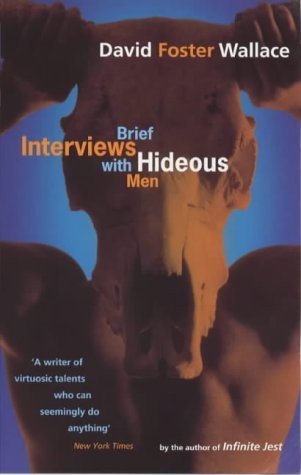
This week’s discussion is loosely based around the story Octet, but really we just drill down on what David Foster Wallace is trying to achieve in this collection.
How much metafiction is too much metafiction, does DFW stray into self-indulgence, the leap of faith he asks from his readers, is it possible to tactically and deliberately try to be sincere (or is this another double bind), and whether Brief Interviews is really about toxic masculinity.
The paradox of trying to come across as sincere
Rich: I read the Zadie Smith essay in her collection. It’s so good. I highly recommend you guys check it out. And it really transformed my reading experience with this book. And even with Wallace in general — I’m thinking this book paired with her essay is probably the best introduction to what David Wallace is concerned about and what he was trying to get at throughout his entire corpus of work. If you were going to choose one thing to understand who he is as a writer and as a philosopher.
Cam: But to be honest, I think you’re overrating Smith a little bit, Rich. I think it was good. Fine. But I’m surprised how much you loved it.
Rich: Yeah, okay, that’s interesting that it didn’t —
Cam: Oh, no, it was good. I liked it.
Rich: The main thing that was good for me was it crystallized what my actual objections to David Foster Wallace’s work are and what they aren’t, because she defends him really nicely. And now I have a way better sense of what frustrates me about him and where I think things tend to go wrong with my reading of him.
Cam: Do you want to talk about that?
Rich: Yeah, it is sort of meta but — my big meta criticism, I suppose, is that he’s quoted in that Zadie Smith essay saying that what great writers do, aside from the talent they possess which is just table stakes, is to give something to the readers, and to not be sort of selfishly doing their own therapy or flexing their muscles and trying to show off. Basically not being egoistic about it, but trying to pump empathy and help people connect with others. It’s like a giving thing where it’s not about the writer, it’s about the readership. And my metacriticism is that he basically falls short of that sometimes, even though that’s what he’s trying to do. Often it tends to come across to me as more like he can’t help but dazzle us with his virtuosity. And it’s like a dose-dependent thing, I think.
Cam: Would you say usually succeeds, usually fails?
Rich: So my experience of Wallace: I read Good Old Neon from the Oblivion collection, and I was absolutely dazzled by it — the stream of consciousness, recursive cleverness of metacognition, layers of metacognition inside the mind of a really smart, thoughtful person, and how torturous that can be. I thought, wow, he just let me figure out —
Cam: Just like me, fr.
Rich: Yeah, exactly. But I connected to it. And I also just thought it was so clever. I was impressed by not just the content, but the form. And then we read Jest. And then I’ve read all three of his story collections now. And he keeps using the same structures, the same tricks to try and access those states, trying to put you into someone else’s mind. And it’s just too much. The second time it’s impressive. And then the third time it’s like, okay, you’re neutral towards it. And the end time you’re like, alright, I’ve seen this trick before. I would rather if he wrote more simple, sincere stories like Forever Overhead — that one that I really loved from this collection where there’s no clever recursive nested clauses, sentences, ruminations of ruminations of ruminations. It’s just a beautiful experiential story.
Cam: Like, The Depressed Person was so long, it’s like holy shit. But to be honest, after the fact when I looked back even last week, The Depressed Person — I think that was pretty good. And even like Octet, right? You get a little — you’re sort of starting like, what’s the motherfucking running quizzes? This is so cutesy and stuff, and you sort of read and then you get to part nine — which we’ll talk about more in depth — of like, oh my god, you see the trick straight away. Now he’s talking about himself writing and all the recursive loops but thinking about the reader. And I was just spellbound. I don’t know if you guys felt similarly, but that unlocked the other ones as well, reading that part nine. So what I’m saying is, yeah, sometimes I feel that with Wallace — you’re getting bored or annoyed or frustrated, and you laugh every now and then, you think they’re smart every now and then, but overall you’re getting a bit frustrated, and then sometimes it just hits you and you’re like, wow, it was all kind of worth it. Which is maybe kind of what you’re saying as well.
Rich: I had a different reaction to Octet, but I don’t want to — yeah. I mean, it’d be more interesting to hear you guys talk about it first, because I can imagine I would have a very different reaction reading that the first time perhaps, or reading it at the end of a two-year period in which I’ve read almost all of Wallace’s works, fiction and nonfiction. And being like, I’m fucking sick of metafiction. And I don’t think Wallace gets a pass for being clever about it just because he goes one extra layer.
Cam: But the thing with Octet part nine is he was so aware of like, yeah, everyone’s sick of metafiction and everyone’s aware of what he’s doing and aware of his work. He’s aware of all his worst tendencies and he’s laying it bare and then he’s saying, and I’m doing this all as this way to connect to the reader. And am I failing? And I’m aware that my worst haters — not like us, but smart people that don’t like him — have just been so annoyed these last four things, and I’m pointing out all the exact reasons why and they probably agree with. And then I’m kind of doing this meta thing as well, and then he’s saying, yeah, am I nakedly lying down for you and directly asking you questions? I kind of liked just reading about it. I thought it captured the frustrations of writing quite well — of getting into these recursive loops about the reader, thinking about how it comes across. I think it did succeed in that. I agree with what you said earlier, that to sum up what Wallace is trying to do, maybe Infinite Jest era onwards was realizing that metafiction wasn’t doing itself. It’s trying to connect to the reader rather than just dazzle. That’s his goal. And he’s terrified of not doing that as well. And then he wants to lay that bare as well, and he knows part of that fear is this kind of obsession with his own work and a genuine desire to connect with it. And it’s very hard to do, this style of writing.
Rich: Yeah, I’ve definitely got a reaction to that, but I want to hear, Benny — how did you feel about Octet? How did you go with it?
Benny: I think I may be more sympathetic to him than you are, Rich, because I viewed the earlier pop quizzes slash short stories as basically him as a way to say that it’s extremely difficult to thread the needle between writing something that’s too complex and too simple, and being in your own head and too recursive, and writing straightforwardly. So one criticism that you laid out before was that, you know, why can’t he just do less of the meta stuff essentially, and just write words on the page. And I think my sense is that he feels if he does that, he’s not involving the reader sufficiently. My sense is that he thinks reading has to be quite an active engagement with the work, right? Hence something like Infinite Jest and hence giant footnotes where you’re flipping 300 pages to the back of the book every page, right? This is the definition of an active activity. And so I think he views good reading as requiring a lot of activity on the part of the reader, and hence the author taking the reader seriously and asking more of them than simply perhaps reading a story once, or writing something more complex that can just simply be absorbed with 100% clarity the first time you read it. And I think that’s the needle he’s trying to thread, and why he feels like he can’t simply write as clearly as sometimes you want him to. Sometimes you’re begging him as the reader, please just tell me what the fuck is going on here. You want him to cut out the parentheses and the acronyms and all this stuff. But it’s like he wants to make you work for it. And he’s scared that in doing that, he’s going to give himself away as an elitist in some sense — showing off his own intellect. And that is a hard needle to thread.
Cam: Yeah, the bigger question is, how self-indulgent has he been? And it’s kind of hard to answer that. You think of lots of artists like that — how self-indulgent has Tarantino been with his movies? You can talk to some people and they’re just like, hey, self-indulgent works. But Wallace is aware of that. And he’s aware that’s not the goal he wants to do. The only difference — you know, you might listen to an author talk and they come across as an arrogant asshole. The only difference with Wallace is maybe he’s aware of that. But he’s still being self-indulgent at the end of the day.
Overdosing on DFW’s schtick
Rich: Yeah, I see. So we have to take it on faith that he’s being sincere in Octet and this is not all some artifice, and he’s really trying to reach out and connect. Great. I see that. I still find it ultimately self-serving and self-indulgent because he makes everything about him ultimately, right? If you read too much David Wallace, it feels like you are just reading essentially his own therapy being done in public, where all his characters are the same character fundamentally. They are people who are terrified of being alone and can’t connect with other humans and have pathological ways of avoiding connection.
Cam: I mean, I’d argue that’s kind of universal rather than all the same character.
Rich: I don’t think it is. I think there’s a reason why Wallace appeals to a certain type of person like us. It’s because we share his exact neuroses and we have, at least for myself, a self-consciousness that is pathological, and I get into these exact kind of loops that he portrays so nicely. And that’s why I loved him initially. And I still love him, of course — I want to put my criticism within that context. I fucking love this guy. But yeah, it’s just maybe dose-dependent for me, that it just wears on you to read the same kind of concerns hammered over and over again with some of the same tricks. The metafiction tricks and the recursive tricks — they start to lose their charm, I think. But I don’t necessarily think all of this is a criticism so much as how I’ve gone about the project of his work as well.
Cam: Yeah, I think there’s a dosage concern and you can overdo it. There might — one of these stories we could come back to and just read the single story in like a year. And it might be a story you found a bit annoying now, and you’re like, oh, it might be fine. And it hit well.
Rich: Yeah. I can’t get past this thing that Zadie Smith says, that Wallace didn’t like Forever Overhead and considered it juvenilia.
Cam: Yeah, I was aware of that.
Rich: And I’m like, dude — if you had even more self-awareness, maybe you could have circled around and seen that that is the most sincere, unaffected story in the collection.
Benny: That’s my favorite one.
Cam: It’d be interesting to hear you talk about that.
Rich: Yeah, anyway, I cut you off.
Benny: I think one piece of textual evidence that you can summon to back up the claim that he’s actually being sincere is the first story of Octet, where it’s these two homeless guys and one vomits all over the other one. I think one interpretation of that is — someone wrote an essay about this, I can’t remember, it wasn’t Zadie Smith I don’t think — the one question he asks is who dies, which one of them dies right at the end of this. And it’s just these two homeless guys, but one way to interpret it, I think —
Cam: Yeah — so one’s really sick and the second one gives the coat to help him, I guess?
Benny: Yeah. One way to interpret this is, he’s the one who’s vomiting all over you, right? He just has this shit in his head that he’s trying to get out onto the page. And it’s sort of like a high-energy, pathological maniac sort of energy. And he’s not sure how to do it correctly. He just ends up vomiting all over you. And the question is, do you accept that and put your coat around him? Or do you get up and walk away and stab him so that he dies?
Rich: Yeah, that’s so good. I did not pick up on that at all. Yeah, like Zadie Smith says, what he wants is faith from his readers. He wants them to trust him and accept him for who he is. And I see that, and I still think that it ultimately goes against his own authorial intentions of offering a gift freely given to your readers rather than asking something from them. And of all the things he asks from his readers, I think some are worth giving — like deliberately using these ten-dollar words and these highly recursive multi-clausal sentence structures and stuff like that. I get what he’s doing with that and I actually respect it. But I’m not entirely sure about the purity of his own motivations all of the time. And I think if he is portraying himself this vividly, he clearly is the kind of guy who is aware that self-consciousness can verge into narcissism, and that you want to be pushing your awareness away from yourself and towards other people.
Cam: It’s interesting — one of the main themes of this and Infinite Jest is recursion. And infinity itself famously has recursion and infinite things. But he has had this longstanding argument, somewhat in print as well — I think in a TV interview — with an author, Mark Leyner, who I didn’t really know much about, but I think was a popular 80s author. Very clever fiction, very clever guy. Wallace accused Leyner of not caring about the reader and just entertaining and being clever.
Benny: Is he a postmodern writer, or what’s his style?
Cam: Somewhat, yeah. But I don’t really know much of his work. And Leyner in defence says that he thinks entertaining is a sufficient goal for the writer. And if you’ve entertained them — whether it’s a movie and you had two hours and you just lost yourself for a bit, or this is a book — then that’s fine. And Wallace thinks that’s not a worthy goal. You also need to help the reader and connect with them. I just believe he’s trying to do that. Maybe you do too, you just think he’s failing sometimes because, as he says in This Is Water, the default settings you always go back to even when you know about — five minutes later you go back to the default settings.
Rich: It’s partly that, and it’s partly that he’s telling us who he is. It kind of reminds me of some of these hideous men interviews where they weaponize their own self-awareness, right? Where they’re like, oh, I’m an untrustworthy and unreliable person, and I really need to be upfront and honest about that with you. And he’s doing that to us. We kind of know who he is. We know that he is like an egoist — I mean, as we all are, but that is where his particular damage lies, right? And so you can’t help but frame his attempts to reach out and connect — you can’t help but be a bit suspicious about it, because in the process of doing so, he’s told you that he’s the kind of guy who is obsessed with being understood and being seen and being perceived. It would be hard to set that aside. And so when you have these stories like Octet — which basically, because it’s an infinite regress with the layers of meta — you do have to just decide, is he being sincere or is he not?
Cam: Yeah, I think — to invoke Kierkegaard — you just need a leap of faith at some point. Because you can’t stop the infinite regress, and you think this guy’s trying to connect, and he’s obviously this brilliant mind that has these sometimes frustrating habits that he’s aware of and agrees with you about.
Rich: Yeah, I love him, and so I find it endearing, and I’m willing to do the work. But I can imagine other people being in the position of the friends of the depressed person who are like, oh god, just please go away, that’s enough.
Cam: Oh yeah, people hate him. Well, here’s something I find that supports your side. When I see it myself — and I know some, Ben, a little bit as well — like, more likely to interrupt than some other people, right? We know that’s sometimes fine and good, and not interrupting and talking past each other is bad, and you need interrupting. But we also know sometimes there’s excesses of it that’s just annoying and bad, and we’re aware of that and we apologise for it. But then like, the next fucking episode I’m doing it again, and I obviously can’t care about it that much, because I’m not doing it, and I care more about seeming like I’m aware of it and apologising for it because I know it can be annoying. But yeah, at the end of the day, I’m not fixing it. And Wallace might be in that zone, you know? He knows that and at the end of the day, he does all these excesses.
Benny: He also might just have difficulty writing another way, right? Just as in conversation, some people just have less patience for conversational lulls. I think that’s what separates Vaden and I, and why if we have a guest on, he ends up talking more because he can handle pauses just less than I can — he gets more uncomfortable in pauses. I actually don’t know what it is. I think it’s an interesting insight, though, and does lead to an asymmetry in something like a podcast where if you’re OK waiting a microsecond more to speak, then you’ll often just do less speaking.
Is Wallace stylistically rangebound as a writer?
Benny: But anyway, my point was just that we think of him as this godlike figure who can write in any style and could choose to convey whatever he’s trying to convey in whatever style he wants to convey it. But that might not be true, right? His just personality and skill set might lend itself to a certain style of writing. And he might constantly feel that it’s much easier to write in a particular style, but also feel that I’m aware that me leaning into my style as a writer is possibly alienating the reader. And that’s just part of his struggle.
Cam: I know he said at grad school he used to write other people’s essays because he could mimic other writers. He said he always had a good ear to mimic other writers — and even with Infinite Jest, he talks in different dialects sometimes. But it’s almost a schizoid aspect to it where he might be able to mimic a Richard essay and a Benny essay and his own essay. But every piece of Wallace writing is very recognisable. You don’t need to know it’s him.
Benny: And he might feel that if he was doing that, he would be being insincere, right? That might be too hard a pill to swallow. There’s one thing to be able to write as someone else, but to feel like you’re truly writing something — often you have a style, and a style does emerge for a writer. Like Scott Alexander has a style. You guys have a style when you write. Everyone sort of develops a style. And he might find himself in this awkward position.
Cam: Well, every 20-year-old IY guy mimics Wallace for a bit, and then eventually they find their own style.
Benny: Realizes their vocabulary isn’t half as good as his, and realizes that maybe I should just go back to writing things clearly.
Rich: The David Foster Wallace subreddit’s really funny. I went on there once and there’s a bunch of guys who are clearly just aping his writing style and talking amongst themselves. It’s so fucking cringe. But yeah, Benny, that’s a super interesting point. I feel like this is an empirical question, right? Because we can look at his writing and we can see whether this is — this is a realization that I had reading this collection specifically: that for all this talk about empathy, fiction is an empathy pump and this kind of thing, he’s not actually very good at inhabiting the minds of other people as far as I can tell. Almost all of his characters are recognizably Wallacean, as you say, Cam. They have these very baroque internal thought processes that typically revolve around the same kind of things. They all magically have incredible vocabulary and are extremely erudite and eloquent and so on. Maybe he actually struggles to write characters who have inner experiences very different to his own. I think that might be part of my complaint — which is not really a complaint — which is just that you don’t get this broad representation of humanity. You get different interesting facets of the same type of humanity. And if you’re trying to read fiction to inhabit other minds, then you’re going to not want to just read Wallace, because you’re really getting one type of thing.
Cam: You’ve made this point before, and I feel like you might be overstating it, and maybe I’ll know better once we reread. But I think with Jest, part of it’s that. But Don Gately is a very different character to Kate Gompert, who’s a very different character to poor Tony Krause. So I think you may be overstating that case. Although I do agree his writing is very recognisable as well.
Rich: Yeah, you might be right about that. I’ll have to think about that some more. I’m not sure if we get internal point of view on some of those. We definitely do on Kate Gompert.
Cam: And even like these books, the hideous men — they’re quite different to some Infinite Jest characters, but they’re all quite unifying themselves. I mean — sorry, you said something, Benny, and then…
Benny: Well, I was gonna say something — I’m not entirely sure how related it is, so maybe if you have a point, finish it up. There’s a quote in one of the semi-octets that I’d like to bring up.
Cam: Yeah, do you think I have a point? I’m no motherfucking point, man.
DFW’s take on empathising with the reader
Benny: You always think I have a point. Okay, maybe I’ll just throw this into the fray and then choose to deal with it how you wish. He has this quote in there where he says, “There are right and fruitful ways to empathize with the reader, but having to try to imagine yourself as the reader is not one of them,” which I found to be quite a fascinating sentence coming from an author. I would have imagined that he did try and imagine himself as the reader and put himself in the shoes of the reader and then think to himself, what am I thinking right now as the reader? What better way is there to try and connect with the reader? So anyway, I don’t know if you guys had thoughts on what exactly he’s trying to say there. But it’s like he’s lamenting the fact that he’s possibly not connecting with the reader, possibly just making himself look good, is having trouble communicating and empathizing with them, but then also says that trying to solve that problem by actually imagining yourself as the reader is not the way to go, which seemed odd.
Cam: And the reason why it’s not the way to go is that because of this fundamental barrier — we’re all stuck in our own head — you sort of can’t do that. And as soon as you try to do that, you’re imagining yourself as the reader and you’re kind of defeating the purpose of it.
Benny: I don’t know. He doesn’t fully elaborate on it.
Rich: There’s the writing advice line that some of your best editing you do is when you get some distance from your own work and can see it from the perspective of someone reading it for the first time. I think if you want to connect with people, that’s almost crucial — to not typical-mind people, and to try and imagine how it might come across to someone who doesn’t have all of your background context and knowledge. And yeah, he just refuses to do that basically. And I’m not always convinced by the argument. The argument is basically this idea — what you mentioned before, Benny — that art that is good must be fought for. And there’s something about forcing you to pay attention that is supposedly doing you, the reader, a favor because you’re not allowed to read it passively. I’m going to make you work for it through the choice of vocabulary and the structure and so on. And I wonder if he gets a bit carried away with that idea, and you can hide a lot of bad behavior behind that — you could say that it’s deliberately obscurantist or elitist or off-putting. And that’s why I love some of the simplest stories, which I know that he’s capable of writing, because they’re more accessible and more straightforward, and you don’t have to pause to look up a word once per sentence.
Cam: So like in Octet, he’s sort of self-consciously talked about, sometimes it’s better to directly ask the reader. If you could just directly ask him, “do you like me?” At least you’ve been honest. And this is kind of a theme of the next story, Adult World, where she’s in this narcissistic loop that her husband’s not getting pleasure. It’s complicated because I think we learn in the footnotes that he probably isn’t getting pleasure. But she can’t just ask, that’s terrifying. And I relate to that in certain instances. But to go back to Octet, he’s talking about it, and he’s kind of doing it — he is kind of asking the reader, “do you like me? I am partly concerned about this but I’m also trying to connect with you.” And I suppose it worked for me. I felt like I connected.
Is Brief Interviews really about toxic masculinity?
Cam: And I’m aware of coming across as the Dave Foster Wallace guy and the fan, and you meet some girl and she’s dated a hundred of these guys, and she’s sick of them because they all tell her, read this, read this. And then part of it’s like she reads it and then…
Benny: Is that a potshot, dude?
Cam: It’s like a type of girl in this case talking about a type of guy, and she’s got a point. We’ve talked about the frustrations of Wallace, and also there’s this gendered element — like, it’s a bunch of white guys that she dates who love this white guy. But also part of the reason she doesn’t like it is because he’s a white guy. Anyway, we get too close to culture wars, but sometimes you read some criticism, at the end of the day, it’s like — it’s Wallace being a white man.
Rich: I saw this funny story recently where this guy was saying how he went on a date — it’s apparently a thing, a bookshop date, you go to a bookshop together, it’s a very New York thing to do, it’s a cool idea — but he was on Hinge or whatever, just standard dating, but you arrange to do your date there. So he casually makes it so that Infinite Jest is nearby and pulls it out and is like, “oh yeah, I’ve read this one.”
Cam: It’s like a scene of fucking Brief Interviews, man.
Rich: And starts talking about it. Well, this is it. So the girl picks up Brief Interviews with Hideous Men right off the shelf next to it and is like, “oh yeah, I don’t need to read this. This is every single Hinge date.” And then that was the end of the date.
Benny: That’s such a brilliant comeback. Always works.
Rich: Yeah, it’s fucking awesome.
Cam: There’s something about these brief interviews — I find it hard to articulate, but it’s capturing something around, in this case men, othering women and objectifying them sometimes, and also being recursively aware that the person they’re talking to is like this feminist that will view them as a sexist, which complicates it. But also, there are these gender differences. Sometimes I see the reverse of the woman casting aside Wallace and all Wallace types of guys essentially — it kind of boils down because it’s a white man who’s a bit annoying, a bit of a know-it-all, mansplains and all that. It’s kind of coming from a similar place of otherizing the person. And I’m getting into kind of culture wars and dating discourse, but if I think it’s one of the themes of this book and what’s driving it — to go back to loneliness and fear and stuff — fear of connecting with humans and being judged. I don’t quite know what’s driving it, but it seems to be a thing that descriptively drives a lot of behavior — whether it’s outing another group tribally or a political group, but certainly the other gender. And both seem to happen.
Rich: But it’s not an exclusively male thing, right? I was surprised by this book. In spite of the title, I don’t think it really has anything to do with gender or misogyny. He just —
Cam: I think the brief interviews do, certainly. And they’re very gendered.
Rich: I guess so, but only because he set it up that way. I think you could equally do a toxic femininity work which sort of inverted some of the…
Cam: Yeah, well that’s kind of what I was trying to say — that you could have an inversion of all this. It’s capturing something around our inability to connect with women sometimes. And then sometimes we fall into these tracks of like, well, we just say she’s an idiot, or that’s just a dumb feminist, or you objectify them. Guys can do that as this way of dealing with their own shit. But girls do that too, in a different way. Maybe I’m missing the thread here.
Rich: I think women would dream of having men who are as self-aware and eloquent and thoughtful as the hideous men in this book — if they weren’t misusing their gifts in these incredibly elaborate, baroque ways, right? These men to me are not, most of them are not even really what I would consider stereotypically masculine, because they have all this incredibly good theory of mind which they’re misapplying. Again, it feels like a fairly small subset of men perhaps, but the recurring theme in a bunch of these is a guy sets up this incredible Rube Goldberg machine mechanism to date a girl, have sex with a girl, break up with a girl, whatever — some bad behavior in a way that employs very up-to-date therapy language, extremely good introspection and self-awareness, extremely good verbal fluidity. So they’ve got all the tools at their disposal. And the theory of mind where they know exactly how this will make the woman feel, or “the subject” as they call it — the subject, sorry.
Benny: It seems like they have access to Aella’s data as well. “Do you want to be tied up?” That’s got to be high up there on the fetish list.
Rich: Well, that guy’s just got a vibe for it, right? He’s got the fingertip feeling for it.
Cam: Okay, so here’s an example, which — I’m not sure if this makes me look bad or not, and I’m a little bit worried about sending this to other message next door — but I remember dating this girl years ago, and she was really into mindfulness, and some of it was a bit much for me. We got together, stuck with her — but she was really focused on wanting to connect. She’s big on like, “look in my eyes” and sort of shit, and I wasn’t vibing that, man. And it reminded me of one of these little stories, I think, where one of the hideous men is struggling to perform, and then he says this point of view and he’s like, “well, fuck them, I’ll show you,” and then he ends up fine. And there was something there. I was just sick of this shit. I didn’t disagree, I didn’t talk about it, but I was just like — I don’t want all this lovey-dovey shit. But part of it, I think, was a fear. It was a fear of connecting with this person, and failing on a sexual level, but also on a humanistic level of connecting with this person, and then wanting to blame them maybe. But then also what’s complicated is, yeah, it was a bit bright-eyed bushy-tailed. Like, come on. Yeah, I don’t know if what I’m saying is making any sense. Benny, I’m opening my heart to you right now.
Benny: Once the hideous men start talking, I’m out.
Rich: Alright. Cam and I will continue this for a bit. I’ve got to go pretty soon too.
Benny: I can hand over, I can stick around for, yeah, maybe a couple minutes, to talk about Cam’s —
Cam: Well, do some sign-offs, man.
Rich: Can I ask you guys a quick question, because it’s something that I don’t know much about, about Wittgenstein and the language stuff?
Benny: Cam’s issues.
Wittgenstein and the language problem/solipsism
Rich: So apparently the reason that David Foster Wallace loves Wittgenstein is that he reconceptualizes language such that it goes from being purely a denotative thing — where little symbols refer to elements in the real world — to becoming a thing which is mediated by human interaction and connection. And so that solves the problem of solipsism, where in some metaphysical sense language never maps directly onto reality, it’s only some pale mimetic imitation of reality — but at least you’re trapped with everyone else together. And that’s the insight that makes him love Wittgenstein. Do you guys have a sense of — is he saying that language is not universal, or is he saying some other metaphysical thing about, like, language does not map directly onto reality? Because if so, why would that be a problem? I don’t understand that at all. I don’t understand why he’s so depressed about that.
Cam: So Wittgenstein’s mimesis was stuff like, the word “tree” is this kind of signifier of something that really is like the tree that really exists. And it’s not one-to-one — the word “tree” is not mapping, and that’s — I think maybe that’s what we have. Because I always remember, you go on some language app or something, everyone’s like, hippies have got the — they always have that Wittgenstein quote: “the limits of my language are the limits of my world.”
Rich: Yes. So this is something different to Sapir-Whorf, I think, which I hadn’t thought about before. I’m sure it is a problem in some sense because these are smart guys, but I don’t know why it should matter.
Benny: How symbols actually get their meaning, right? Is that what you’re kind of asking?
Rich: Yeah. It’s kind of like the map/territory thing, I think, where anytime you use language, it is inevitably somewhat clumsy because it doesn’t have a perfect one-to-one mapping onto an underlying thing.
Cam: Are you asking what’s anxiety-inducing around realizing that the map’s not the territory, and all we have is the map? Isn’t it just that there’s the fear of solipsism and connecting with people?
Rich: No. The solipsism would be that everyone else, like —
Benny: I really have to go, but this is very interesting. I’m going to regret it tomorrow morning, waking up all fucking tired and groggy. You’re like, oh yeah, right at the end, ask about Wittgenstein.
Rich: I’ve just thrown in this incredibly complex new thing to try and bait you into something. Just a real simple question before you go.
Benny: Fucking serious right now. That’s a great question. I don’t have much to add. I mean, Wittgenstein was famously concerned about how symbols actually get their meaning, right? This is disjoint from sort of the stuff that Popper was criticizing him for, but a large part of his work was just, you know, we’re writing down these symbols. And to my mind, it’s almost a neuroscience question what he was after, but he obviously thought it was just this philosophical question about — whether it’s a letter or a drawing or whatever, or even just things you see in the world — how is that actually mapping onto things in your head? Why this would be lonely is maybe just that if you don’t think you have a shared sense of reality, then you can never explicitly talk about the same things. Even if we think we’re talking about the same things, perhaps we’re not. And there’s no way to bottom that out. There’s no way to make absolutely sure that we’re sharing the exact same concept for something. So in some sense, you’re always alone with your conception of the world.
Rich: That’s the language problem stuff, right?
Benny: Yeah.
Rich: Okay, I understand that. I thought that his resolution to this was — Wittgenstein writes this other book, which basically says, aha, you know, it’s not that language is merely mimetic and involves reference to things in some platonic real world that we can’t access. In fact, language only exists in the context of relationships between people. And that’s why it’s incoherent to say that you could have a private language. And so he saves us from solipsism, David Wallace says, but he doesn’t save us from the underlying metaphysical reality that we are separated from this real world. And I guess that’s the part which I don’t really fully understand. It’s like, is this some platonic thing of being mad that we don’t have direct access to reality, or that words — I mean, the language problem part is more interesting to me, I’d put it that way — of struggling to convey your own subjective experience with perfect fidelity to other people.
Benny: Yeah, it feels related. My understanding of Wittgenstein’s turn is that he basically said, okay, to understand each other you actually don’t need — like, understanding or being able to communicate effectively doesn’t actually require understanding someone with perfect fidelity. It requires this context around this shared game that we’re playing, the shared illusion. And for the purposes of picking up this telephone or whatever, we can engage in some sort of language game that’s basically good enough such that we can do whatever we need to do. But I don’t think he — I hesitate to say “solve” the problem because I don’t think you could solve this problem — but I don’t think he perhaps to Wallace’s mind satisfactorily resolves this puzzle of the fact that you are living in your own head in some sense all the time. And there’s no way to transmit perfectly what I’m thinking to you. So I should read more Wallace on Wittgenstein. But Wittgenstein, I think my sense is, he more just changed his mind about how big of a problem this language thing is, as opposed to actually solving it. It’s not like he came to the conclusion that we actually are sharing — we have direct access and experience with reality and we share this perfect reality with each other. I don’t think he came to that sort of view.
Rich: Yeah. Okay, that’s helpful. Should we leave it there?
Cam: Yeah, maybe let’s just — should we talk next week about remaining stuff, including some of the stories we missed this week that we’ve read?
Rich: Yeah. So we did a lot of meta stuff. I actually think it was way more helpful to go to the meta level this time than go through every individual story and then go down to the object level to back up a point. But we should specifically talk about Church Not Made With Hands, I think.
Benny: Yeah, it might be a good way to do this.
Cam: There’s definitely odd tidbits to talk about object-level from the story that is interesting, as well. Not now, but just interesting to hear what you guys’ thoughts are.
Benny: Should we wrap up with Cam’s therapy session, if we return to Cam’s issues?
Cam: I mean — what? No, no, no. All I was saying is that it seems similar.
Rich: Hold on, I’m just going to pull up Twitter. Alright, go for it.
Benny: Screens going on.
Rich: Do we want to try and finish the whole book, or is that too ambitious by next week?
Cam: I’m happy to do that. I mean, we’re not going to talk about all the stories anyway, so I’m happy to just — but I imagine we’ll talk about this Church one that you guys liked, and then probably some of the brief interviews in the last one, and so it doesn’t really matter if we haven’t read them all.
Rich: Sweet. Cool. See you next week, fellas. This was a good one.
Cam: We can skip the Date Dictionary fucking stuff. Datum Centurion or whatever.
Rich: Oh yeah, I actually did not read that. I was like, nah, it’s too…
Cam: I started right now. This is Wallace mannerism.
Rich: Yeah, that’s exactly my thought.
Rich: See, you’ve got a threshold too. That’s interesting.
Cam: Oh no, no. I relate to what you’re saying for sure. I think you’re right. Maybe I don’t get as annoyed at him, I just sort of skip it.
Rich: Oh yeah, I wasn’t mad about that one because it didn’t make me read like 20 pages of footnotes and stuff. Sweet. See you later, boys.
Benny: I’ll see you guys.