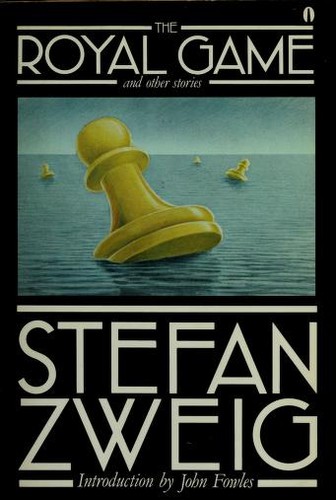
This week’s between-novel quick read is Stefan Zweig’s The Royal Game: A Chess Story, written in 1941, immediately before Zweig obliterated his map.
We argue over the perfect answer to the ‘desert island book’ question, whether it’s possible to fracture your own mind into pieces, why Cam sucks at chess, and whether we should pressure our kids to become pro athletes/chess prodigies/concert pianists.
plot summary
Benny: All right, Rich, you only got an hour, right?
Rich: 50 minutes actually.
Cam: I’ve just been playing this conversation in my head as well.
Benny: 17 different ways. I’m expecting you to react to something else, and then — oh, you already said that.
Cam: It’s already happened.
Rich: Who’d be the easiest to model of the three of us? Maybe me. I don’t know — it’s me or Cam, probably.
Cam: There we go.
Benny: I don’t know. I think we’re all maybe somewhat easy.
Rich: We would be good at modelling each other because we don’t disagree enough. But this will be a spicy one for sure.
Benny: Yeah, this one’s very controversial, I would say. Did you guys appreciate my pick? My palate cleanser? Did you like it?
Rich: Yeah, fun one. Dare I say, you could probably knock it off in one session.
Cam: I almost did. I did two sessions.
Rich: Oh okay, that’s good.
Benny: That’s some sort of record for you, no? That’s like 35 pages in one session. That’s amazing.
Cam: Well, the page count’s probably overrating it as well, because they’re very small pages, and big margins, and big text. Yeah, kind of the opposite of Gravity’s Rainbow or something like that.
Benny: Yeah, I figured we deserved a treat after Gravity’s Rainbow and Moby Dick.
Rich: It was good. It was good to read and gave me some ideas and thoughts relatively straightforwardly.
Benny: Well, don’t hold us in suspense. What you got? What kind of thoughts you got there?
Rich: Well, should we run through the plot? It’s a pretty simple plot.
Benny: Sure. Does anyone feel particularly excited about summarising it?
Cam: I can. Quickly. So, I had some notes. It’s written by Stefan Zweig. Or Zwieg. Do you know how to pronounce that one, Benny?
Benny: My mental model of you is — you say “I’m going to summarise something quickly,” and then 10 minutes later you wrap up.
Rich: I’m pretty sure it’s like a 30 second —
Cam: I was just trying to get the names. Anyway, it’s about a narrator who’s on a boat, I think to Buenos Aires — like Richard recently — from America, and he’s playing chess, and the world champion, Mirko Centovic, is on the boat as well. And we get a little bit of backstory of this world champion. He’s described as quite a mechanical sort of player. I think he doesn’t visualise lots. And he was a peasant himself, I think, from Eastern Europe.
The narrator kind of wants a glimpse at him and even wants a potential game, and sort of sets up a game in one of the lobbies. And there’s this other character, McConnor, who’s a businessman, who’s just an amateur but very cocky in his ability and even gets offended when he gets referred to as an amateur by the narrator. And they realise they can play against this world champion if they pay a fee and the world champion is willing to play. And they organise that, and the world champion is obviously easily beating them.
And then there’s this other character, Dr. B, who’s kind of in the background wandering by and sort of starts helping, I think, the second game. Maybe move — I’m not sure about that one sort of thing. And then plays the world champion to a draw. And then the world champion is keen to set up some other games with Dr. B.
We get Dr. B’s backstory, which is probably the main thing of the book, where he was captured by the Nazi Gestapo and forced in isolation, and manages to get his hands on a chess book, and then just spends his time first reading that and then just imagining games in solitary confinement and kind of going crazy. And he’s eventually let out, happens to stumble across this chess game, and sort of brings it all back for him. He plays against the world champion in a couple of good games, but also gets kind of re-triggered.
Rich: He’s fresh out of the loony bin, right? He’s like a couple of weeks out of recovery.
Cam: Yeah, actually, I didn’t know how long he’d been avoiding chess boards.
Benny: But it had been a while since he played, right? 20 years or something, I think he says.
Cam: They say near the end, 20 years without a chess board, which I didn’t know if that meant — because he didn’t have it in solitary confinement the whole time. I don’t know how long he was in confinement.
Rich: I think he played a few games when he was a child or teenager, as most people do, and that’s what he was referring to. And he wasn’t counting his solitary confinement intensive learning from the grandmasters.
Cam: He even said he was surprised when he first ran into these guys playing. He was like, oh yeah, that’s how chess works. It’s like two people facing each other and a board. So I don’t actually remember how long he was in solitary confinement, but I was wondering that. I suppose history constrains it a little bit, like how long the Gestapo could have kept him.
Rich: It was a period of months, not years or longer. So maybe three to six months or something like that is my guess.
Cam: That’s all it takes. 80,000 hours, be gone, mate. A couple of months. Just optimise it.
Rich: Dude, this is — yeah, you gotta lock in. If you’re serious about something, you gotta lock in. No internet, no porn, no femoids. Yeah, just play chess in your head against yourself in solitary confinement. If you actually care about getting good, that’s how you do it.
Cam: Just get those reps up.
What’s the perfect desert island book?
Benny: All right, so with that, Rich — what were your thoughts?
Rich: Oh man. Okay, well, my first thought was, he’s describing the solitary confinement and it sounds like absolute hell. He’s got no one to talk to, there’s nothing in his room, and the guards just come at periodic intervals to interrogate him. They’re trying to find out where he was a banker or a financier for the church and maybe some Austrian businesses or institutions. So they’re trying to seize the assets, basically, and find out where they are. And he’s going insane already and just staring at one crack in his windowsill over and over.
And then he manages to steal a book from one of the guard’s coats. He doesn’t know what type of book it is and he’s so excited. And he gets back to his cell and he’s like — oh come on, it’s chess puzzles. Like, who gives a shit about chess. He was hoping it would be literature, right? He wanted it to be great literature.
Cam: I was imagining that happening. Imagine if you got a book you didn’t like — got Gravity’s Rainbow or something.
Benny: You’d probably love Gravity’s Rainbow though, to be honest.
Cam: Yeah. Actually, that would be a good book for the — yeah, definitely turn you crazy.
Rich: But I think I’ve taken the wrong lesson from the story, because I’ve inverted my answer, which is — you know, like the Desert Island Discs type question, like what book would you bring. Previously I would have gone for length and complexity. I would have gone for like a big tome with lots of stuff there to read. And now this book got me thinking, no, you want something like this.
You want — yeah, it needs a formal system with infinite, or not infinite but near-infinite complexity and depth, that you could iterate forever. And it doesn’t matter — it could be a really slim volume. It doesn’t matter the size of the book. It matters whether it’s combinatorial or not. So I’ve flipped my answer.
And actually, my question for you, Benny, because I was thinking, okay, what would be another good example? There’s games you could play, like chess or go or bridge or something like that. But the problems are, can you compartmentalise sufficiently to play each side of the board, which he does manage to do in this. But even if you can do it, at great cost — I think that’s probably why he goes nuts, is he’s fracturing his mind into white and black so that he can play himself. Because you imagine playing chess, like, you’re trying to bamboozle your opponent. It doesn’t really work if you know exactly what your opponent’s going to do.
So then I was thinking, what would be a formal system that doesn’t have an adversarial nature to it? And I thought, what about maths? What if it was like a book of maths problems, and you could just take it in as many different directions as you wanted? Would that be the perfect desert island book?
Benny: Yeah, I think you’re right. I think what you really want is a sophisticated graduate-level maths textbook, so that the material itself is quite hard to master and you could spend years actually ironing out everything in the book. But then once you’ve mastered it, it was advanced enough to launch you into the research side of mathematics, basically. And then at that point you’re set, because there’s infinite numbers of interesting questions you can ask once you’re mathematically mature enough to know what’s interesting and what’s not. And then the adversary just becomes maths itself. It becomes you versus trying to understand these things. And so I think that would be far superior to any much more constrained game-like situation. So I think you’re right. Yeah, I agree with you.
Rich: Yeah, but what level do you think it would work? Like, I think it would work for you obviously, but it wouldn’t work for me, because I’d need the world’s longest maths textbook to be able to get up to speed and cross the inferential divide or whatever.
Benny: Yeah, I mean, I guess so. It depends what level you’re coming at it with. But yeah, I don’t know. My sense is that if you really were in his situation of having all day every day to think about this subject, my guess is you could eventually sort out what most maths books were talking about.
Rich: Even if you had to sort of reinvent — try and reinvent maths would kind of be a fun intellectual exercise too, right? It’s just, you’d never have a tutor or anyone to give you the answer, but you could still work backwards from what’s in the book.
Benny: Yeah, I mean, these books — they’re typically self-contained, right? The biggest barrier for someone new would actually just be understanding proof structure. Like, okay, what counts as a proof? Why are they doing — you know, they’re writing down some theorem. Objects would be well-defined. They’d be like, there’s this thing and we have these kinds of operations. And they’d typically tell you all of that. But then they’d write down a theorem and then they’d prove the theorem, and it would probably be trying to understand what the proof was actually doing that would be the hardest part of it. But once you’ve grokked that — and I think you could grok that just by thinking about it for long enough or looking at enough of the proofs and trying to understand their structure — then I think once you’ve grokked that, it’s just a matter of slowly wrapping your mind around the actual complexity of the maths itself. But all of that, again, would be defined in the book, as complicated as it may be. So I think you should just take like a Terry Tao analysis book — graduate-level analysis book — to a desert island, and he’s a good enough writer that you’d be entertained for years.
Cam: I don’t know if it’s just me, but I don’t think taking a maths book to an island would suddenly turn me into Srinivasa Ramanujan and just like thinking theories in my mind. I don’t know. I think I’d probably still take the Bible or the complete books of Plato or Shakespeare or something.
Benny: What about a cooking book?
Cam: No. That’s like a fucking cooking book.
Rich: A cookbook. I think Chesterton’s answer was like a shipbuilding 101 or something like that, which is good. But your ceiling’s gonna be your ceiling, Cam. It’s not like, you know, this one weird trick to become a genius. It’s just — what gives you the most variety without needing to make contact with anything in reality. And I think maths or logic, something like that, would be the best candidate.
Benny: Or language. What about language?
Cam: What do you mean?
Rich: It doesn’t contain a rule set, so you can’t prove things.
Cam: A dictionary?
Benny: True, yeah, it’s not a rule set. It’s not as formal as any actual formal language, but I don’t know. I feel like you could entertain yourself trying to learn another language with an English to Spanish dictionary or something.
Cam: I just — have you ever played those puzzle games, like on a video game version? I forget what they’re called. There’s one that captures the idea of, apparently, what it’s like as a physicist. You’re trying to understand the physics of the room and conjecture. It’s really Popperian, by the way, Benny. You might be into these games.
Benny: Nice.
Cam: But have you ever played this? Sometimes you just get fucking stuck on the night. And it is so infuriating. And you end up having to give the tips online. Just imagine being on this island, day after day, stuck on like question five.
Rich: Burning your sudoku book on day three and then you’re like, no, what have I done.
Cam: Yeah, yeah. I know. The beginning one, the medium one, you find — and then as soon as you get that hard sudoku — oh god, should have taken Harry Potter.
Rich: Anyway, now we know what to send you if you end up in the Gulag or in the El Salvador mega prison. I’m sending Benny Terry Tao’s graduate problems. I’m sending Cam Harry Potter one.
Cam: I still think the length probably is helpful.
Rich: Okay, Harry Potter 7.
Cam: I’ll take the whole series if I can.
Rich: Yeah, that’s going to be fitting in a guard’s pocket.
Cam: Yeah. That’s quite — the guard must be quite accomplished, carrying around a chess book. That’s how much society has declined. Our prison guards used to just do their own chess problems in their spare time. And now no one reads.
Rich: Yeah, what would be the modern equivalent that a prison guard would be likely to have in their pocket? Like what book? Maybe it would probably be like The Subtle Art of Not Giving a Fuck or something, right?
Benny: 12 Rules for Life.
Rich: What was it — pet a cat if you see one?
Benny: Make your bed. You’re like, done — what next?
Cam: I don’t reckon 12 Rules was that bad. I haven’t read Subtle Art of Not Giving a Fuck, but man — I remember someone I knew grabbed that book. They don’t read, and their granddad definitely doesn’t read. I remember him seeing that and he goes, “looks like a good book,” you know, just from the title.
Rich: Yeah, that’s a good point. It’s orange, it’s got the word “fuck” in the title.
Cam: And there’s a moment as well — every bookstore now, there’s just an area in the bookstore with like 10 to 20 books of swear words, with the asterisks in it.
Rich: It was an interesting phenomenon. I started trying to read that book and it was so bad that I just couldn’t understand how it was so popular. But maybe you have to read the whole thing, I don’t know.
Benny: I actually read it and thought it wasn’t terrible.
Cam: It’s probably alright.
Benny: It’s one of those books where you understand the main message in the first example he gives, the first five pages, and then the rest of the book is entirely superfluous.
Rich: What is the thesis, if you had to state it quickly?
Benny: Oh, that you should just care less about — on average you should care less about other people’s opinions, which I think is just true and is valuable to keep in mind, and is something I remind myself of quite often.
Cam: Not a bad lesson. Oh, fuck it, I’ll take that book. Good for the cell.
Rich: You’re stranded in solitary isolation, you’re really worried about other people’s opinions of your actions — the worst possible.
Benny: Yelling at the wall, fuck you.
Tulpas and fractured psyches
Cam: I wonder what you guys thought of — well, I don’t know, your experience with chess, but just like playing yourself, is that plausible? Because I had that same thought that Richard mentioned. It’s kind of like, you can never get one up on your opponent. If I surprise him with the queen here, he knows it’s always spoiled. But I think some people do play chess for themselves. I don’t know — is that just from a Pixar little short film or something, when the old man moves the seats?
Rich: One idea I had is that — I mean, first of all, it seemed not very plausible, but then, in an intense boiler-room pressure environment, maybe you can fracture your psyche like that. And then I remembered — have you guys heard about tulpas? Do you know what that is?
Cam: Nein.
Benny: No.
Rich: So this is when people usually deliberately fracture their personality and have more than one voice or person sharing the same body. So kind of what people refer to as multiple personality disorder, but usually self-imposed. There’s tools that you can use to create a tulpa. And one of my housemates in San Francisco had a tulpa, and they were two distinct entities in the same person, and would change their outfit and hairstyle and stuff like that when they were switching between who was coming to the fore at any given point in time. I feel like it’s one of those crazy things that everyone should know about or should be a huge deal, but you just almost never hear about it. It’s interesting that you guys have never heard of it.
Cam: Bit of an info hazard. I think I had — with the Sissy Cult — I think they try and do that before they murder someone.
Rich: Okay. As a huge — of course I don’t know, but this person would have to be playing the world’s longest con game, or incredibly consistent acting over a period of months and years to sustain the illusion. Or could be mentally ill in some other way, but I don’t think so. So to me that’s kind of like a proof that this is possible. Although maybe they could access each other’s memories, I don’t know — I’ve sort of forgotten about it.
Cam: I’m just imagining one side has access — you know, there’s huge advantage in the chess game — the other one’s just in the dark.
Rich: Yeah, your tulpa is getting a little uppity, so you just school them in all of your chess matches for a while.
Cam: Yeah. It’d be funny if one side’s worse, like way worse. Need a better opponent, eh? One side’s just bad at chess.
Benny: Yeah, the analytical side of your brain would be great at it, and then the artsy side would suck.
Cam: But I mean — I imagine even if you didn’t split it, just playing against yourself constrained, I suppose it’d be a different sort of game. But you’re trying to do the optimal move, kind of with common knowledge that they know your strategy. And I imagine you still could play somewhat. It’s like you’re sort of playing a co-op game — both sides are just trying to be optimal. And probably would end up as a draw, would be my guess. Unless at one point you made a mistake, and then you take advantage of that mistake on the other side, and just crush it.
Benny: Yeah, I mean, I think the issue is, like, you can always just play the best move at the time. But in chess, they’re often looking several moves ahead, right? And the whole point is to try and play in such a way — so if it’s about having the foresight of setting a trap for five, six, seven moves ahead, then the logic of just playing whatever the best move is right now, regardless of whether the other person knows, sort of disintegrates. And so they’d probably actually devolve into fairly uninteresting games because you’d just be trying to take advantage of very local moves.
Cam: Well, I assume AIs play against themselves. It’s kind of how they get good, right? This is the allegory of AI in two months. Just put it in solitary confinement, and it comes up and beats Garry Kasparov.
Benny: This was the original reinforcement learning, with Stefan Zweig.
Cam: The strategy didn’t work though, because Kasparov just took five minutes between his return and still came up a second later. And he just lost his mind.
Rich: I know it’s not intended, but this does read a bit like an AI parable, right? But it kind of goes the other way too, where Centovic is this unthinking idiot savant, unfeeling, and he’s just described as machine-like. And then you have this very beautiful, fragile human player who reaches great heights but is sort of psychologically vulnerable and then ultimately loses on that basis.
Cam: Yeah, because the way Centovic is kind of described, it’s almost like he doesn’t quite understand the love affair that people have with chess and the creativity aspect to it. And then Dr. B, you know, goes crazy. But then, yeah, as you say — maybe these AIs just do understand the beauty of chess.
Rich: Yeah. Do chess savants exist? Oh, they do, right?
Benny: For sure, yeah, I think so.
Cam: What do you mean? Just like randoms that haven’t trained?
Rich: People who are intellectually impaired in all areas except they’re incredibly good at chess. And maybe learned chess super rapidly or in unconventional ways.
Cam: Oh, that’s fine. I still don’t get that. Unless you’re just socially retarded or something. I don’t know how that happens.
Rich: Well, I like how intelligence can be so spiky.
Cam: Yeah, compartmentalised, I suppose.
Rich: This is what we’re learning with AI, right — that intelligence is really jagged. You can be insanely good in certain areas while being seemingly more stupid than a child, or completely useless in other areas. And it’s surprising, but it’s more and more in that direction, not less and less.
Benny: So why do we think Zweig had Dr. B lose the final game? Like, go crazy. What did that actually add? Was that just the fact that you can’t survive isolation? You know, he lost it when he was actually learning chess and was under the thumb of the Gestapo. He sort of lost his mind and started wrestling himself in his room and throwing himself against the wall, and the guard came in and he attacked the guard, and then he tried to throw himself out the window, got himself landed in the hospital. So he sort of cracked under the pressure there. And then as soon as he comes back to play the game, he’s able to get through one complete game where he beats the world champion. And then sort of halfway through the second game, loses his mind and doesn’t make it. So one thing I can’t quite figure out is — what did the ending mean? What would have been different if he had just beat Centovic and then stopped?
Cam: Just psychologically healthy. Just like a strong chess player.
Rich: Yeah, if he didn’t, it would have had some pretty different implications. It’d be like, hey, those Nazis — they didn’t do everything wrong, you know.
Benny: They created some fantastic chess players.
Rich: It would sort of unironically support the lock-in joke of like, yeah, you just got to get yourself captured and put in solitary confinement for six months and you’ll become a genius world-class chess player and have no other lasting problems in life. It’s like, yeah, great. I’d probably take that deal.
Benny: Yeah, I mean, maybe that’s what it is. Because I think my sense is, Centovic’s play is supposed to be reminiscent of the Gestapo, right? He deliberately takes his time as he’s playing Dr. B to sort of let him go crazier and crazier. And he’s mechanical, he’s uncreative, he’s slow and plodding. He’s very literal. He needs the board in front of him. And so I think, yeah, you can probably draw analogies there to the Nazis and Gestapo itself. And so I guess the point was to have them win in some way, for it to ultimately be a tragedy.
Cam: Have you guys ever played a game — I don’t know if you guys are big board gamers — where someone’s just taking ages? Like, I can see which move you’re…
Rich: That’s the big part of why I don’t like playing board games that much, is it takes too long for people to play. It’s infuriating.
Cam: Yeah, board games take ages.
Benny: You just gotta set timers.
Cam: I’m someone that gets analysis paralysis as well.
Rich: Even then, like, you get to someone’s turn and then you can see that they just start thinking about it then. And they haven’t been thinking. And then, even if you had a timer, it’s like, okay, well, everyone’s going to use the maximum timer, and there’s like eight people in the game.
Cam: Oh, timer helps though, big time. Like, it shortens games. But it can be hard in person to keep doing — it’s just annoying.
Our own chess performance
Rich: By the way, are you guys chess boys?
Benny: I’m not, no.
Cam: Very — you know, I’m probably more of a McConnor than a going-to-Dr.-B, I think. Yeah. To be honest, I get too impatient with chess. Like, I just eventually blunder, because every move you have to be like — I’m not good enough to have a bunch, you know, for it to be intuitive. And so I still make blunders and then eventually, yeah. So I actually prefer speed chess.
Rich: So you make intuitive moves but they’re wrong, because you can’t —
Benny: Because you suck.
Cam: Yeah, eventually.
Benny: Do you know openings and stuff?
Cam: I know some. Not heaps. I’m pretty — I have a pretty low elo, and I don’t really play anymore. I think I prefer games with variants, for better or worse. People say there’s a reason they love chess — it’s because it’s pure skill. I like a bit of luck there. I like that pump you get when you roll the right number you’re looking for.
Benny: Are you, Rich?
Rich: No, no. I know how to play, and I probably played 50 games in my whole life or something. But I did — I dated this girl once who liked playing chess, and we were both just amateurs. Obviously, then I looked up one or two openings, and I looked up whatever the meta tactics of how you should control the board or whatever, and then I immediately started winning. And then we stopped playing. So that was what made me realise, like — oh, you’re not actually meant to just play games over and over. There’s principles that you can learn and positions that you can learn and memorise. Kind of obvious in retrospect, but —
Benny: It’s very memory-intensive. I think if you’re actually trying to play to get good, I think a lot of it is memory.
Cam: Well, I think even more so now — and that’s maybe one of the problems with the metas — is people just can memorise whole playthroughs of a line. And it’s like a memory game. It’s like, who’s the first to —
Rich: Wait, is that true? That can’t be true, can it, because of the combinatorial explosion?
Benny: Like, aren’t you in a new chess game within 16 moves with extremely high probability or something?
Cam: I don’t know, but there are definitely, for Richard’s question, definitely some matches where they’re essentially just trying to remember the optimal line here and the optimal —
Rich: We could memorise every early game.
Cam: Yeah, all the top players have memorised all the early game stuff.
Benny: Interesting. And I guess you memorise parts of games — like, okay, if you’re in roughly this kind of position, you know, these kinds of things tend to work. And then you have 15 games off the top of your head where they were in similar positions in the mid game or the end game or whatever.
Rich: Yeah, I heard of it more like that, which is more like heuristics, right? You see a pattern and it looks similar to other patterns you’ve seen, but it’s not like this exact game because it’s almost certain that that exact game hasn’t been played before. It’s just like you see the similarities.
Cam: Well, I mean, maybe I’m wrong, but I definitely remember reading or listening to someone talk about this. Sometimes it’s just a memory game, and sometimes they choose to do that. So I’m just going to try to play a line and try and remove this. Yeah, I suppose you’re right though — as soon as someone forgets the best optimal defence of that line, then you need to counter it and it changes the game.
Benny: You’re in a new game.
Cam: But it’s like — yeah.
Rich: It would only work if both players were trying to play the same game, right? Otherwise, someone would do something you don’t expect.
Cam: Well, I think that often happens, and it’s first to forget the optimal move — then is that a disadvantage, I suppose. And yeah, then if they’re a better intuitive player, perhaps.
Rich: Okay, yeah, yeah.
Cam: Man, I play against chess — this one time we were in this dinner party, and there’s this chessboard in the corner. I played against one guy and we set a timer. And I was going slowly. Eventually ran out of time. But like, I had him, man. As Centovic would have said — I forgot his phrasing — you know, “not at all badly conceived.” I feel like I had him. And then the time ran out, and he wouldn’t fucking acknowledge that he was in trouble. And he’s just like, “good game, you know, shake hands, unlucky.” Like, he just readily took the win. And I was just like, yeah, fair enough, I did run out of time, but surely say something, surely. You know, like, “try to have you checkmate, like, four turns.” And then just had the whole dinner — I was just sitting there angry, eating my potatoes.
Benny: You’re fuming.
Cam: Yeah. Turning into Dr. B.
Rich: Centovic move.
Benny: It’s weird that — I kind of started out liking Centovic, because he was just this poor peasant kid who then found this skill that he had to play chess really well. But then by the time you meet him on the boat, and then you go through Dr. B’s story, and then he’s playing Dr. B, then you start to dislike him, and I wanted Dr. B to kick his ass.
Rich: Yeah, I was not expecting his character to be developed that way. I guess I’m too familiar with the trope of the brilliant talent hidden amongst poverty or something. And then now he’s just a gigantic asshole, and won’t give the time of day to anyone despite his humble origins.
Rich: Yeah, another thing I was thinking of is that it was an interesting juxtaposition of one guy who, at least when he was in prison, would be desperate for any social contact and any kind of human interaction to the point of going insane. And then this other guy, or just any celebrity really, but I think particularly this guy, Centovic, who’s just deluged with way too much human contact, and everyone wants to hang out with him and talk to him and he just doesn’t want to bother. And he’ll grudgingly do so if you pay him a high enough price to endure your company, kind of thing. And even then, he’s not exactly going to be Mr. Chatty.
Rich: Don’t know where you guys sit on that spectrum.
Cam: Well, I did think about it as well, because it’s just crazy how solitary confinement turns you. It’s like kind of the worst thing ever. I suppose we have things to distract us, but a lot of time I spend by myself doing things and it’s quite nice. But you just need that small element of socialisation to avoid you going crazy. During lockdowns, I struggled — I remember, but not everyone did, but I got to the point where I was getting pretty down on it. Even though my life was like 90% the same.
Benny: It’s like the optionality of just knowing that you could see someone if you want to.
Cam: Yeah.
Rich: Were you locked down with Ellen?
Cam: No, no. We were after that. I had a flatmate, but his mum was having issues, so he often went to stay with her.
Rich: Hmm. It should be paradise for someone like you, right? You get to read and study and read 35 pages at a time on a big day.
Benny: Makes me want to read some other Zweig stuff. I think this is the only thing of his that I’ve read.
Cam: He’s a nice writer.
Benny: Yeah, he’s a very good writer.
Cam: I mean, I really like his non-fiction. I only read — he’s got a little, and it’s very small as well, but a small biography on Montaigne. But as Wiki says, here’s one on like Dostoevsky and maybe Mary Queen of Scots.
Rich: Nietzsche, I think.
Cam: Nietzsche, yeah.
Benny: Cool.
Rich: Yeah. Also, I heard that as he’s in the manuscript for this book, he also penned a suicide note, and then he and his wife killed himself. So it could be interesting to learn a bit.
Cam: This was the last book, right?
Rich: But yeah, it’s the last book. And I think that’s probably something to do with the answer to your question, Benny, about why did Dr. B crack and go mad? Why was he the loser? Because he’s an Austrian Jew fleeing the Nazis, right? And this is before the end of the war. And I think he just thought it was hopeless, or had irreparably damaged European intellectual life or something like that.
Benny: Yeah, that’s true. I mean, I guess it does have the straightforward reading of just — light and creativity get ground down by this slow mechanistic play, whether it’s the Gestapo or the other chess player. And there’s just no escaping it, even if you can temporarily — ultimately it’s just this futile struggle against the machine.
Rich: Yeah, you survive but your mind is broken anyway. And I’m sure that applied to a lot of people who did survive the Holocaust, but probably were not mentally intact afterwards.
On monomania and pressuring kids into sports/music/chess
Cam: Yeah, I think it’s also just a case study, a psychological case study — a little bit like Crime and Punishment, you know, of the mind breaking and what trauma is like and being triggered. And then also — I think Richard kind of alluded to this as well — this balance between excellence and monomania and insanity. I remember reading like Andre Agassi’s book as well, and whether that’s necessary to have true excellence, where he just had this — he hated his father and he hated tennis for so long because he was forced to do it, and he’s the best in the world, right? I mean, there is a case — I’m not sure where she ranks now, but at one point she might have been the best female chess player, Judit Polgar. And she was just this interesting case where her father just like forced her and her siblings to play chess as a kid to crazy levels. And then she became the best woman in the world. Which kind of goes against the staunch thing that you can’t mould someone, and even like a behavioural genetics thing potentially. But I assume her father and herself would have been high IQ and had an interest in chess. But it does seemingly point to, like, you could get someone to that level. I’m not sure her relationship with her father in chess as well — I don’t think she said anything that she had. But I know there are cases where the kind of sacrifice for true excellence is, yeah, potentially your sanity or peace of mind.
Rich: Yeah, I think that’s true for lots of things. Like, I wouldn’t want my kids to be pro athletes — which is not going to be something they’ll have to worry about anyway with their genetics. But yeah, if it were, it’s just — you have to sacrifice everything and just grind and grind and grind, and you’ll probably still fail. I think it’s literally a bad outcome or a bad thing to aspire to. I’d put other things in that category too, like pianist, or I don’t know, whatever else you need to do unrelentingly from a very early age, and it’s just a grinding type endeavour.
Cam: What if they got real into it, but then you also had to kind of push them further?
Rich: It’s partly like — I guess the outcome versus the expected value, or whatever. Like, you look at the people where it worked, and you’re like, oh, maybe it was all worth it. But for every one of them, there’s like a hundred or maybe a thousand other kids and young adults who just burned out the best, most creative, energetic years of their lives and didn’t become Serena Williams or didn’t become Judit Polgar or whoever. So there’s that. But also there’s just the inevitable trade-offs that when you’re young in particular, you have more neuroplasticity, and that’s the time to diversify and try lots of things. If you don’t try lots of things because you can’t, because you already have a monomaniacal focus, then it seems less likely to me that the one thing you do do is actually your true passion, or whatever. Especially when you have parents putting their thumb on the scale, and or just having pressure and expectations. Yeah, I think that definitely happens.
Cam: I have talked to a couple of people who kind of regret their parents not pushing them a bit further. It’s really sort of anti-taking-children-seriously thing. But like, they just thought — whatever field it might be, but sports is the obvious easy-to-measure one — if they had just kind of forced me a bit longer, I would be at a better level now, and then I’d be at a place where I can enjoy it more because I’d be at a higher level. They wish their parents were a little less —
Benny: Probably especially with something like musical instruments, where you sort of keep that skill — not all of it, but if you became really good at the piano or really good at the guitar, even if you stop for 10 years, you can probably pick it up and still be decent at it. Whereas, you know, I think a lot of people give up something like the piano before it’s a transferable skill to adulthood. And then you probably wish — like, I wish they just kept me in lessons for two years longer or something.
Cam: Yeah, I mean, that’s what happened to me. I remember breaking my arm and I stopped and I never went back. Oh, yikes. Thanks, Rich.
Rich: We might have to jump off the call here. I’ve got to go, and I think, Cam, you’ve got to go too.
Rich: Sorry for abrupt ending.
Benny: Yeah, fair enough. All right, well, join us next time for the first part of Atomised — or maybe the whole thing, unclear.
Rich: Oh, really? Okay.
Benny: I don’t know, it seems also short. I haven’t started it. I don’t know about you guys, but it’s not that long.
Cam: Um, by the way, I don’t have to go this second, so I’ve got a couple of minutes actually.
Rich: I don’t.
Cam: Well, I just need to send a —
Rich: I probably do.
Cam: But yeah, we should still tie it up some.
Rich: Well, I got five minutes actually.
Benny: Nice. I mean — can you get really good at anything without being obsessed over it? Then you have to develop some sort of obsession with it and spend a huge amount of time with it to get really good at anything, like top top sort of percentile.
Cam: I think these days, now everything’s so fucking optimised — I think back in the day, you used to have these instances of these people that are just kind of phenomenal at things, and they’re like, oh man, it’s real natural talent here. Of course, a little bit of training, but now I just think how optimised, like, sports —
Rich: But Benny, you’re asking more about whether you’re passionate about it, right? Like, you need the internal drive in order to get to that. But this is where I get confused, where I think — I don’t know, I think the Deutschian perspective seems wrong, which is that you do whatever’s fun, and whatever it is you do is your revealed preference. That might not be what everyone thinks, but that’s roughly what people think, right? So it’s like, oh, if you’re a world-class violinist, then clearly that’s what you love doing. But I don’t think that’s true. And it’s not how my mind works, and how most minds work, I assume. Which is that you can be in conflict about your own actions and your own wants and desires, and you can feel on some level “I really want to do this” and on some other level “I really don’t want to do this.” And then the fact that one triumphs over the other doesn’t mean that you’ve got this wonderful unified desire, and that you’ve spent your life in the way that you ought to have. It feels really reductive to model it like that. So you can be wrong about what you want to do or what you like to do, and you can even know that you’re wrong, and you can still do it anyway. So I think — I don’t know how to untangle that.
Benny: Yeah, I guess I’m not disputing that. I’m just trying to think back to your comments about not wanting your kids to do professional sports. But I would want my kids to be really good at things. And I think to get really good at things, you have to spend a lot of time doing it. I guess the difference with sports — like, you know, if you want to be a really good writer, you got to spend a lot of time writing. You want to be a really good academic, you had to spend a lot of time reading and researching and thinking. And I think that’s basically true of any career. I guess the difference with professional sports is that only the top few percentage of the top few percentage actually make a living with it. Most talented kids would stay in the game until they’re 16 and then all of a sudden realise they’re not good enough, and then realise they may have thrown away large parts of their childhood doing something that perhaps they didn’t love, or that in retrospect they wish they had spent in other ways. Whereas maybe that’s not the case for something like being a writer or whatnot, where there’s maybe just a longer tail of success that you can inhabit, even if you’re not the world’s most famous writer. You can still be just a moderately successful writer or something. But I just — yeah, I don’t know if there’s that big of a difference between the world of sports and being really good at anything else.
Cam: Well, the other thing with sport is there’s a whole like John Stuart Mill thing of like, Socrates versus the pig in the mud. Like, we’re kind of literary Brooklyn suburbanite types — I’m not sure if we’d like a life of a professional sport then.
Benny: No, definitely not.
Rich: Wait, what is this John — I don’t get the reference. What’s the pig, what can he —
Cam: Yeah, like being a professional athlete versus being an acclaimed artist or writer.
Benny: Higher and lower pleasures, I think.
Rich: What, like, which would you rather be? I’d love to be a professional athlete, are you kidding me?
Cam: All right, it’ll be both, yeah, but still —
Rich: What do you fantasise about more? I fantasise more about probably being a famous athlete or something.
Cam: My fantasy is quite narrow and specific. I kind of wish I had a few years of professional things and then I quit and I got into reading and stuff like that. But I always say, “oh yeah, you know, back when I did a year of that.”
Benny: Really?
Rich: Oh, man. Cam, you’d like this. We had some friends over yesterday for a glass of wine. The kids were playing soccer in the backyard, which is just chasing after the ball — they’re two years old. And one of our friends did this really nice kick to return the ball to them. And I was like, wow, you’ve got some skills. And she was like, yeah, I used to play for New Zealand.
Cam: No.
Rich: Holy shit, you kept that under your hat. That would be cool, right? You could just be like, yeah, I used to be national representative football.
Benny: Whoa, that is cool. Was she sort of insulted that you didn’t know already, or no?
Rich: No, no, no, no. I mean, she’s a lawyer, she’s a mom, she’s got this whole post life. And then, I presume when she was in her teens or 20s, she used to play football for New Zealand.
Cam: The problem is you can’t use that to boast anywhere else in the world. “I was like, yeah, I used to represent New Zealand” — when you’re in America, no, no, no — I’m joking.
Rich: Okay, but you know what I mean. Come on. I’m sure she wasn’t making the big bucks, storming the world stage, but it’s still pretty badass.
Cam: No, but that’s the exact sort of phenomenon. Yeah, oh yeah, in a past life. Yet a few years in a band — maybe that was relatively successful a few years before — and then just doing my own thing now.
Rich: You want people to have sort of heard of the band, or to vaguely know, but still be able to walk down the street and not get mobbed.
Cam: Yeah, no, exactly.
Benny: Well, we already host the world’s most successful book club podcast, so if that doesn’t get us recognised in the street, then I truly do not know what would.
Rich: We’re no-more-posting Face, so I think we’re gonna be okay.
Benny: All right, until next time, fellows.
Rich: We’ve got listener mail, but we don’t have time to do it now. But the mailbox is looking a little light, people. So get your mail and ask a question, ask us how we are for once. Just anything — just say hello. This is your opportunity. douevenlit@gmail.com — just the letter “u,” not the word “you.” It’s very easy and simple to remember. We look forward to hearing from you. Okay, I gotta go, see you later.
Cam: U, what are you?