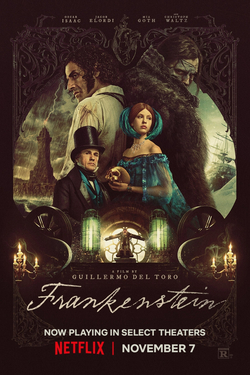
Quick film review before we get back to the final part of Moby Dick.
Guillermo del Toro’s long-awaited Frankenstein adaptation is absolutely cleaning up in the Oscar nominations, including a nod for Best Picture.
Benny and Rich make the comparison with Mary Shelley’s source material and find it to be sadly wanting (altho we do have some nice things to say).
On the dumbing-down of nuanced morality stories, and the ubiquity of daddy issues/therapy speak in modern media. Can’t a guy just be a crazy hubristic scientist anymore??
Look how they massacred my boy
Rich: Hello my sweet darlings, it’s Richard here. Just a quick note before this episode plays. So Benny and I recorded this when Frankenstein came out on Netflix, I think back in November, and I never got around to publishing the episode. Partly just because I forgot, but also in the back of my mind I think I’ve been feeling a little bit uncomfortable about even the lukewarm praise that I gave this film in the review that you’re about to hear. And now it’s up for a bunch of Oscars, including Best Picture, so it’s back in the conversation. I thought, oh, I really should put this up. But I can’t bring myself to do so without adding a little note to say that the more I think about this movie over the last few months, the more I’ve come to think that it just doesn’t even make sense to talk about it in the same breath as Mary Shelley’s Frankenstein, when really it’s just a very different thing. It’s just a sort of a big fun Netflix exposition dump of a movie.
Rich: As to why I’ve flip-flopped on this, I think I really wanted to like this movie, in part because I’m a fan of Guillermo del Toro’s films, and I am a sucker for his whole Catholic, Gothic, Mexican vibes. But even on that front, I think he’s kind of at risk of disappearing up his own ass at this point. Anyway, you astute listeners would no doubt notice in the review that follows that I am damning it with faint praise, but I just couldn’t let it go without adding this note. Anyway, on to the review proper, and some bit of a compare and contrast with the Mary Shelley version.
Benny: Dude, we’re fully becoming a movie podcast.
Rich: I wonder — yeah, you said in the chat that we’re reading Thomas Pynchon’s Gravity’s Rainbow. I don’t know if I can even use the verb “reading” to describe what I’m doing with that book.
Benny: I know. I’m looking at it. I’m looking at the book.
Rich: And it’s like — yeah, you said it’s made us turn into a movie podcast.
Benny: Yeah, it’s rough. On like Thursday night, I was trying to read Pynchon, and then somehow just ended up watching Frankenstein. And I was halfway through Frankenstein before I’d realized what had happened. But damn. Okay, yeah.
Rich: Yeah, so much easier, so much more fun. So, context for the listener: we read Mary Shelley’s Frankenstein last year and we all loved it. I think it was like on the podium for you, Benny, right? Like maybe it was one of your best books of the year, or for one of us — for someone it was.
Benny: I forgot about that. I think that’s right. I think that’s right. Yeah.
Rich: But we all loved it, and I think it generated quite good chat as well, because its themes are extremely prescient today, or relevant today, and it’s just like an incredible book. So I had the idea that this film was going to be a really faithful adaptation of Mary Shelley’s Frankenstein, and I love Guillermo del Toro — like, I really like some of his movies — so I was so excited for this movie. And then watching, I realized it’s not a faithful adaptation at all. It’s wildly different from the book. So it’s very much its own work of art. And yeah, I’ve got no one to talk about it with, so I’m super excited to talk about it with you, because the compare and contrast versus the book is wild, right? Like it’s just totally doing its own thing.
Benny: Yeah, it’s so different. How early into the movie did you realize, oh, this is extremely different from the book?
Rich: Well, the opening scene is immediately different. So in the book we get this elaborate frame story of Captain Walton in the Arctic — I think he’s writing to his sister and he’s telling her about this strange man that they found out on the ice, and this distant figure that they saw in the background running away on a sled, moving away across the ice. And in the movie the opening is so cool — it’s like we get the monster right up front and center, and he comes and attacks Walton’s boat, and it’s like “give me Victor, bring out Victor,” and we’re seeing his freaky face, we’re seeing his incredible strength. And I actually really liked it, and it’s one of the changes from the book where I was like, okay, great — this is in some sense better. I think it’s more cinematic. And I remember being a little bit bored in the beginning of the book in a way that I totally wasn’t at the beginning of the movie.
Rich: And then unfortunately I think almost every single other change he made is for the worse, and I prefer the Shelley plot lines and themes. So I think generally speaking all the changes are for the worst, but it’s really hard for me to disentangle the fact that I just read — you know, I had one version of the story in my head and that feels like the canonical one, or, I mean, it is the canonical one. And so maybe I’m not judging it fairly. But also, just to get out on top: I really enjoyed watching this movie, and I think it’s really fun, I highly recommend it. But I do think it’s, like, story-wise worse, quite a bit worse than Mary Shelley’s Frankenstein.
Benny: Yeah, yeah, yeah, nice. So I agree, I think the movie was fantastic. And to be honest, I was nervous before watching it because I wasn’t sure how a movie could pull off, you know, the making of the monster and even showing the monster in a way that wasn’t going to be overly cartoonish. And they totally pulled it off. Like, I think — so Jacob Elordi surprisingly plays Frankenstein, I think he does it extremely well, the makeup is phenomenal. And they even do the whole — I mean, he’s not green, but in terms of like, you know, the makeup symbolizes stitched-together body parts and stuff, and so it’s traditional Frankenstein in that sense, but they make it somehow look not ridiculous, which I just wasn’t even sure was possible going into it. So I was just really pleased to see that the movie was not cinematically a joke, which was very cool.
Benny: It’s funny, actually, that we were talking about The Hobbit earlier, because I think what the movie does that the book doesn’t do is make the line between good and bad much less ambiguous than it was in the book. And I think it still works in this movie’s context, and so I don’t necessarily dislike the decision. But I think just in terms of the richness of the story, the book is still better for that reason, because there’s just much more ambiguity and it makes you think much harder about what you actually might do in that situation, or who’s at fault. It’s much less clear who the good actors and bad actors actually are in the book, and you can sort of make a case for either of them. Whereas I think the movie really leads you in one direction.
Rich: Yeah, exactly. That’s my number one criticism, and yeah, exactly the same reaction as you — I like the book version better. And this is, I think, honestly, it’s a dumbed-down story. It’s like a spoon-feeding good-and-evil morality that strips out a lot of the ambiguity. Not all of it, but almost all of it. And that was something that I just really loved and was surprised by in Mary Shelley’s Frankenstein. Like, I didn’t realize it would be that delicately written, or, you know, that complex of an ethical quandary of who is at fault for the chain of events that takes place. And in this one it’s like just very clear. I mean, okay, so where should we go first?
Benny: We should just say — I think we should just say there’s going to be spoilers from here on out, and we should just launch into it.
Rich: 100%. Yeah, 200-year-old book spoiler warning if you didn’t get to it yet. Um, okay, so we’ve got the opening scene which I loved, with Walton’s Arctic expedition. Well, I think the character has a different name in this iteration. But — oh, was he?
Benny: And he’s Russian for some reason. I wasn’t sure about the choice to make the entire crew Russian. I don’t think that’s the case in the book, right? I think he’s just an English explorer.
Rich: I thought he was Danish. I mean, were they speaking Russian? Oh, okay.
Benny: Yeah, I think so. I think they were Russian.
Rich: I don’t — it doesn’t make too much of a difference.
Benny: Yeah, it didn’t make too much of a difference, anyway, no.
Rich: But then the next big change was Victor’s upbringing. In the book, from what I remember, he is something of a prodigy, and he has his own intense passions and research directions that he explores, and they’re quite sort of at odds with society a little bit — like he’s very interested in obscure alchemists and strange scholars, and he’s like super internally motivated. And in this book — in this movie — they have to do the thing of, like, making it all about childhood trauma and daddy issues. So like his dad is like a cartoonish villain who beats him when he can’t recite the correctly memorized medical fact, and wants him to uphold his good name as a surgeon. And I didn’t like that. It’s like — I don’t know if you’ve noticed this, but every Disney and every kids’ movie nowadays is all about childhood trauma, and about how you have to throw off the shackles of your parents’ overbearing or controlling personalities or whatever. And there’s a lot of good in that, but it also just feels like weirdly kind of infantilizing or fatalistic or something. It’s like, can’t a guy just be a crazy hubristic mad scientist out of nowhere, like out of the blue sky? Does it have to be — does it have to be Freudian? Does it have to be his daddy issues, or, you know, a reflection that he didn’t get enough hugs as a kid or something? It’s becoming overplayed, I think, this trope, for me at least, where I kind of rolled my eyes at that.
Benny: Right. Yeah, yeah, yeah, yeah. That’s true. I mean, you can understand it, I think, from a filmmaker’s perspective, because it does provide this very legible motivation that you can grok as an audience member, right? His dad’s overbearing, his mom dies, he wants to take it out sort of on his overbearing dad. And then he’s — I mean, one interesting part of the movie is they sort of bring supernaturalism into it, not just with respect to the creature, but, like — so there’s other sort of hints of supernaturalism on the side. So he gets sort of perhaps visited by some sort of archangel-type being, who sort of promises he will one day have the power to overcome death. And it’s a bit unclear — which I sort of like — whether this is just all happening in his head or whether he’s actually receiving some sort of visitation. Yeah, might have just been a dream. But, you know, they sort of portray it pretty realistically in the movie.
Rich: The angel.
Benny: But anyway, yeah, I agree. They go really out of their way to provide Victor’s backstory, and you know, why he’s trying to actually overcome death in the movie. Whereas in the book, he’s just extremely curious and just like a huge nerd, basically, who’s pursuing all of his interests and is just wondering if he can fight back death.
Rich: The book explores something that — it feels like a rarer thing to explore these days, which is this more pure Promethean idea of, like, hubristic humans trying to meddle with God’s laws, or trying to escape from the bounds of the human condition, like in a kind of almost quasi-Deutschian way of trying to push the boundaries of what’s possible, and having that be your pure motive rather than something that’s more like, “I’ve got a chip on my shoulder because I’ve got something to prove,” or, you know — this is probably more realistic and more relatable, but over-explored or over-relied-upon. Um, yeah, I mean, I don’t really have a huge issue with it at all. And it gives you this recurring cycle of, like, fathers and sons, which is very relevant to the whole story.
Rich: And also, maybe I’m misremembering — do you remember what his relationship with his dad was like, or with his parents was like in the book?
Benny: Yeah, I don’t — that’s a good question. But I think maybe it’s notable that we don’t remember, because it might have just been — I think they were a pretty happy family. Right? And that’s why the eventual death of his sister was so gut-wrenching for him in the book, because they had this pretty happy family that he would go back to in the summers. And then, like, the monster kills —
Rich: The one thing I remember was his dad saying, like, “Don’t get too caught up in your studies, and make sure you write your dad once in a while,” you know — like, “Make sure you send us some letters and let us know how you’re getting on.” So yeah.
Benny: OK, right. Yeah. So like pretty caring for like an 18th-century father, actually. Like pretty happy family, all things considered. Yeah. Okay, so I feel like the next departure — the next big departure is the introduction of this character, Henrik Harlander, who’s this, I guess, German aristocrat who turns out has syphilis, I think. So he wants to fund Victor to pursue this science project because he wants eventually his brain to actually be put in the body of the creature that Victor is creating, because his own body is decaying. And so Victor is giving some preliminary, sort of experimental results to some sort of scientific society — maybe like the precursor to the Royal Society or something — and this aristocrat Henrik Harlander’s in the audience, watches Victor do this, realizes he’s sort of close, and then wants to use all his money to basically support Victor, and sets him up in this giant laboratory with all these lightning rods and builds him this, you know, perfectly conductive —
Rich: Awesome lab. Like, so cool.
Benny: It’s like the dream lab. The dream lab. Exactly.
Rich: This castle out in the middle of the countryside, and it’s got huge gargoyles and stone faces carved in the walls.
Benny: This is really what the billionaires of today should be doing. They need to be taking lessons from Henrik Harlander and just funding crazy science projects. I’m only half-kidding. I think that needs to be sort of a new norm for the uber-wealthy.
Rich: Yeah, I mean, this is, you know, what’s-his-name — Brian Johnson, he’s doing the boring-ass version of this where it’s like, what if I slightly tweak my biochemistry by one molecule all in this direction or that direction and see if I can live for 12 seconds longer.
Benny: Yeah, what if I make sure I get 10 hours of sleep a night.
Rich: It’s lacking in vision. But again, you have this muddying of motives, right? Where Victor’s — he’s feverishly — I mean to be fair in this — in the movie as well, he’s very much obsessed with his work and he’s absolutely internally driven, but again, it’s like he has a patron who is facilitating it, and who has his own ulterior motives. I don’t actually hate this change, but probably at least in part because I love Christoph Waltz, who is the actor who plays — what’s the character’s name again?
Benny: Henrik Harlander?
Rich: Yeah, Henrik Harlander. And it’s a fun — I don’t know, I just love seeing him on screen in pretty much anything.
Benny: He’s so good. Yeah.
Rich: And it was a good reveal when he whipped off the wig, and it turns out that he’s got, like, lesions on his scalp. And he’s drinking — there was a cool line about mercury as well, I’ve forgotten what it was, something about mercury and Venus.
Benny: Oh yeah, like, “one night —”
Rich: “One night with Venus, a lifetime of mercury,” or something.
Benny: Yeah, there we go. Yeah, exactly, something like that. That is a great line. Because, I mean, yeah, just to state the obvious, like, at that point syphilis would have been totally untreatable. So you get it and you’re just fucked, and you just know you’re going to die, I guess, in a matter of months to years. So his motivation is understandable, but no character like that was at all in the book. But sort of as you say — I mean, both because he’s such a good actor, and I don’t know, somehow I think it is in the director’s purview to sort of layer on the motivations like that. I don’t actually mind that change as much.
Rich: Yeah, the bigger beef I had — yeah, I don’t mind that change. The bigger beef I had is how Victor — you know, when he’s giving that demonstration to the Royal Society or whoever, and he’s already got a corpse that is being animated by electricity to the point that it can like bellow out noises and stuff — so he’s always —
Benny: And catch an apple.
Rich: Yeah, can catch an apple. In the book, Victor is aware that a hand will reflexively clench itself if you put electricity through the nerves — you know, a dead hand, something like that. But it’s a long way away from partial reanimation of a corpse. And then we get robbed of the moment when Victor sees the consummation of all his work in one moment, which is very powerful and also way more closely aligned with my preferred theme of, like, Promethean humans meddling with God’s plan. So in the book, there’s that really cool moment when the monster wakes up and opens its eye, and Victor just suddenly realizes what he’s done all at once and has a change of heart. And this is a huge change in this movie. Victor’s, like, mucking around with partially animated bodies and he thinks it’s awesome, and he’s not, like, repelled by it or grossed out or questioning his decisions. He only questions his decisions later when the monster presents some threat to his personal safety. But he’s not at all worried about the enormity of what his technology has brought into the world or anything like that. And I think that’s a change for the worse, and just robs it of, like, the main thematic horror of the story.
Rich: But then I was thinking, as a visual medium, Mary Shelley could get away with so much that is harder to dodge on screen, of, like, specifically, how do you actually do this? And I remember when we were reading the book we were surprised to learn that there’s no flashes of lightning, there’s no Igor and that mad assistant — it’s just sort of obliquely hinted at but never described. But in here they have to say, like, it’s about putting a battery behind the lymphatic system in the right spot, and we’ve got the huge silver lightning rod, and it’s like all that stuff from my point of view kind of sucks, because it’s like fake silly science. But also, I don’t know how we could have got around that, how you’re meant to show it happening without having some mechanism in place. So, um, a bit more forgiving of that.
Benny: Yeah, it’s funny because it sort of makes it both more realistic and less realistic, that there was more of an incremental advance. It makes it more realistic, I think, as someone in the audience watching the movie, because it would be hard — just as you were saying, it would be hard to go from making no progress to total reanimation of a corpse instantly on screen. That would just be a very hard thing to pull off and have it look realistic or be frightening or anything. But it makes it less realistic because the fact that he’s sort of partially reanimating corpses, at least for, you know, sort of minutes at a time, makes you think that if that had in fact been done, there would have already been tons of ethical questions here to grapple with. And that act in and of itself would have been so interesting. Like, is this thing conscious? Can it suffer? Does it have a soul? Like, what’s going on here? Can we talk to it? What does it know? What is it like? Does it have a personality? And, like, surely you would have spent a lot of time just investigating those questions, given that you’ve made this partial advance, and maybe not launched right away to, like, okay, now I can wake this thing up for a minute, now I’m going to try and wake it up forever.
Rich: And it should also have been the precipitating event that got you kicked out of all reputable circles, or hounded out of town. And maybe it did, but I think if it did, they didn’t quite make a big enough deal of it — of, like, after that demonstration he should have been turned into a pariah perhaps, and had to continue his work in secret. Which I guess kind of is what happened, but they didn’t quite stress that, if that was what they were going for. Because, yeah, like, someone at the end of the demo is like, “this is unholy” or whatever, but other people are like, “oh, that’s pretty interesting.” And certainly from Victor’s point of view, he’s not reflecting on it.
Benny: Yeah, like, “this dead guy” — yeah, which is definitely the unrealistic part. Like, there would just be so much of interest there. And it’s a good point that, as someone watching the movie, you do get robbed of the moment when he had first done any sort of reanimation, because surely that would be an absolutely incredible moment. You’d spend a long time thinking about, and “how exactly did that happen?” Do you sort of regret that they brought lightning and stuff into it? Do you think they should have done — even if they had done sort of this sequential-style reanimation where they don’t do it all at once — do you sort of regret that the final act of reanimation was done in a thunderstorm, you know, it’s dark out, and he’s climbing up to the top of the tower to screw some lightning rod in, which seemed dangerous enough in and of itself? I was like, dude, what is going on here? Yeah, that part seemed a bit silly, I think, to me.
Rich: I mean, honestly, I do think this is a bit of a cartoonish film, and I don’t say that in a derogatory way. But, like, he went in that direction and then just stayed consistently true to that. And so it’s fine within the context of the film as a work of art. So I’d have to be, like, counterfactually being like, what would be my — how would I make this movie in my preferred way or something. So I think it’s all kind of internally consistent. It’s just like a bit of dissonance of being like, oh, that’s kind of a bit silly or goofy, or, you know, at the very least, it’s like very different. But in time-honored tradition having the thunderstorm — I don’t have a problem with that. It was cool when he climbed up the tower with it, like, slung over his back, and it’s funny — like, he puts probably the last stitch in and raises him up and then, like, a storm conveniently comes along at that exact moment. And there’s a lot of stuff like that in this film where all the events of it happen with, like, perfect timing for the plot. And, yeah, you can get away with so much more in a novel in terms of letting things breathe more, letting things be hinted at rather than having to visually actually come up with something to show on screen, and so on. So, yeah, my main beef is just that I prefer the Promethean horror of “what have I created?” over the — Victor’s horror almost just comes from the consequences that follow. And maybe he gets there in the very end, or towards the end, but he doesn’t have that — you know, we talked about, like, the post-nut clarity kind of moment, where you’re like, “oh my god, where have my passions led me?”
Benny: “What have I done here?”
Rich: And I wanted — I got to do, like, a compliment sandwich here, because it sounds like I’m being critical, but the visual language of this film, the set dressing, the color grading, the props, the costumes are absolutely delicious. Like, every frame of this movie is like a little piece of art that you could look at for ages, and it’s so distinctive, it’s so del Toro. Like, it’s very much his vibe. And I loved all the costumes — the livery of the footmen, you know, the coffins with those face pieces that lifted in and out — so cool.
Benny: Phenomenal. Yeah. Oh yeah, that’s cool. We should do coffins like that. I think we should bring those back. Those were cool.
Rich: Yeah, there’s just so many flourishes like that. That was just, like, so visually striking. And as you said, the makeup and stuff like that — I think they came upon a really nice way of doing it, without it being — it’s kind of stylized or something. It’s not super realistic, the way that an actual body stitched together would be, and it’s not a cartoon green guy, but it’s like this interesting stylized middle ground.
Benny: Yeah. So I guess let’s just jump to the moment when he actually creates the monster. So the thunderstorm comes, the lightning gets channeled via these four rods and electrifies the body via the lymphatic system in some symmetric way. Like, it’s funny that his final moment of realizing — yeah, it’s like the final — it’s like he just had the rods in the creature’s back in slightly the wrong place.
Rich: Oh yeah, symmetry, symmetry.
Benny: And then he has a moment of insight where he puts them in symmetrically around the spine. And then that’s what does it. I’m like, dude.
Rich: Where was he putting them before? Just like three on one side, one on the other or something? Like, what was —
Benny: I know, like, come on, man. Um, anyways, the lightning comes, but it doesn’t actually — or he doesn’t think it worked immediately. So I actually forget what happened here. I guess the creature perhaps woke up for like 30 seconds or something and screams, but then it sort of, like, limply falls down, right? And he thinks it’s just another failed experiment, so he doesn’t think it’s actually woken up for good. And then he basically falls into bed and goes to sleep for the night.
Rich: Yeah. My best guess, after seeing how the beast can’t die, is that the lightning animates it then kills it, and he’s like, “oh, it died.” But then he doesn’t realize that it’s gonna come back to life again later, or that it’s, like, very hard to kill.
Benny: Yeah, yeah, the amount of lightning just was enough activation energy to kickstart the monster. And anyway, so Victor goes to bed thinking he’s failed, then wakes up in the morning only to find the monster at the foot of his bed just staring at him. Which — that was a pretty funny moment, actually. Sort of wakes up in some dreamlike state and then realizes all of a sudden that the experiment actually worked. And then they kind of have these tender moments where he’s just totally enthralled with this creature that he’s created, and the creature is very gentle and just curious, like a giant child. And they sort of hug. Victor gets the creature to say his name — “say my name” — and he’s trying to teach him about the world. And we get sort of a couple minutes where Victor’s just totally blissed out with his creation and is excited, and we think he’s just got a nice little happy family that’s gonna live together forever.
Rich: Yeah, that was fun. That was, like, a cute way to do it. Very different reaction — but when they’re reaching out the hands to each other, and yeah, like — what, you wake up and you’ve got this gigantic freakish thing looming over you, and he’s like — I think he does gasp for a moment, but then he’s absolutely delighted and immediately trying to play with it. And yeah, “my big baby.”
Benny: Yeah. And then so what — I mean, what goes wrong here, basically: he’s trying to teach it things about the world, but it’s not learning fast enough. And he sort of keeps it — he’s not sure, I guess, about its strength or capabilities, or just its general nature. So he sort of treats it like halfway between a child and a dog, sort of. And, like, at night — he’ll hang out with it during the day and try and teach it to speak, try and teach it about concepts, but then at night sort of chains it up in the basement of this castle where he’s living.
Rich: Yeah, on, like, a bare concrete pad as well, right? And we give them, like, a thin cloak to wrap around them. And then meanwhile Victor is sleeping in this incredible four-poster bed — what is it called, four-poster bed — with velvet drapes, and yeah.
Benny: Yeah. So this is where it just starts to get unambiguous about who the good and bad guy are here. So, like, Victor has reanimated this thing. Basically spends a few days giving it the benefit of the doubt and trying to teach it as much as possible, but very quickly sort of starts to think that the creature is dumb, is incapable of learning more than just a few words, is incapable of really growing intellectually or probably understanding much of what’s really going on in the environment. And starts to treat it more and more just like an annoying pet that he has to deal with, and is, like, increasingly cruel to it. He’s whipping it when it doesn’t do what he wants, or when it doesn’t repeat after him or something. And I mean, del Toro really paints the idea in your head here that the creature is just this innocent being that’s been birthed into the world, and Victor’s increasingly turning hostile to it for basically no good reason. That being said, I mean, you can understand some of Victor’s frustration, and I think we’ve all been there in situations where you’re trying to teach someone something and they’re not grokking it fast enough, and you get frustrated, but it’s sort of that on steroids.
Rich: Yeah, he’s going for, like, repeating the cycle of trauma, right? Like he’s doing exactly what his dad used to do to him, of saying, “you are a representation of my work and my name, and I need you to perform at a high level, and when you don’t, I’m gonna hurt you and torture you,” kind of thing. Especially because he learns that the monster can self-heal — I guess he’s, like, stabbing it, or even, like — yeah, and then it cuts itself on his razor and that’s how he learns about the healing. But —
Benny: Yeah, I think the creature cuts itself somehow. It grabs something the wrong way.
Rich: Then later on it has, like, a wound in its side that is from Victor’s beatings, or — I think.
Benny: Right, right, right. And then, yeah, so there’s zero ambiguity about what’s good or bad. And, like, in the book there’s tons of ambiguity, because you can blame Victor for certain things, but then the monster just does lash out and take revenge in what seems like perhaps too hasty of a way. But there’s just none of that in the movie. Which, I think, that was the most disappointing part for me.
Rich: Yeah, the more I think about it, actually, just bulldozes all of that, doesn’t it? I mean, in the book, some of the things that are different are: the monster murders William, who is actually a child in the book, still a child, I think. And not only that, but he frames one of the beloved family servants for the murder. And in general is, like, quite vindictive. And it’s like — there’s ambiguity even as to whether he intended to kill William, but there are other events where he’s very much, like, plotting and enacting revenge upon his master, including in the murder of Elizabeth, which is just — like, he says, you know, I can’t remember what he says exactly, but, “make me a bride or you’ll regret,” “make me a companion or you will regret. There will be consequences.”
Benny: Yeah, your sympathies are totally with the creature. And, like, Elizabeth forms a relationship with the creature, and actually asks the creature to take her away sort of as she’s dying with him. And so even her sympathies are totally with the creature. And then, you know, him going to spend time at the farm — actually, like, the most realistic part of the movie, I think, in terms of portraying how the book portrayed it, is his time spent on the farm, or, like, in this little house where he’s sort of living in — I don’t even know what to call it — like some abandoned part of the house where he can sort of watch this family.
Rich: Yeah, the milling shed or something, maybe, where they mill their grain.
Benny: Yeah, yeah, yeah. And all of that was pretty realistic, I thought. Or at least —
Rich: I think he even made some improvements over the book there a little bit, because, for one thing — in the book he learns to speak by — oh, no, that’s the same actually, just by listening. And then he learns to read by, like, stealing books and bringing them back. But in this one, he just hangs out with the granddad — the blind granddad — for quite a long time, and is therefore able to have long conversations with him, read to him, learn from him directly, rather than just everything by passive observation, which is not really how learning works. So yeah, that was good. I thought the bond with the old man —
Benny: But does that not happen in the book at all? Like, does he not expose himself? Because, isn’t the grandpa also blind in the book, or no?
Rich: Yeah, but what happens in the book is he’s been listening and hanging out for a long time, and then he builds up the confidence when everyone else is away to go introduce himself to the granddad, and then they come back and are revolted and hound him away. But in the movie, everyone leaves for like several months to go — I can’t remember what the pretext is — and so the monster is able to actually spend months hanging out with and befriending the old man directly, not just, like, a one-time meeting before everyone else gets home. So you can develop more of a poignant — like a proper relationship, proper two-way relationship — and the granddad calls him his friend and pats his head. Like, so he gets more of a proper father figure in the movie. Whereas in the book it’s more like a parasocial relationship where he fantasizes about being part of this family, but his actual interaction with them is incredibly short.
Benny: Yeah, it’s very cute. Yeah. Okay, I forgot about that. Yeah, no, that was very enjoyable. I don’t think in the book they used wolves or anything, right, as, like, a threat to the family? That was also, I think, a good trick.
Rich: And the granddad doesn’t die or anything like that. I mean, to be honest, again, that’s where the movie’s a bit more Hollywood-ized — that they come back and they think he’s killed the old man, or also the fact that the old man gets killed by wolves, which is something that would never happen, I don’t think. That’s not how wolves work. And then he runs back and holds him dying in his arms, and then the family arrives back from their months-long trek at that exact moment.
Benny: Yeah, yeah, exactly. Yeah.
Rich: Oh, really bad timing for granddad and for the creature. But that was fun. It was good. I don’t know, they had to compress all this stuff. So the creature’s out in the woods and he’s frolicking with a deer, and then it’s probably the first creature that he’s met, and the deer is not worried at all, and the deer just gets headshot. So all this stuff is kind of cartoonish, right? It’s like how things would be in a video game or something. It’s like non-stop action that means something.
Benny: Also, I mean — yeah, I’m now just harping on this point, but so the people that shoot the deer also then try and shoot him, because they see the deer and then they see this, like, giant hulking figure. They have no idea what it is. They try and shoot him. Then he actually finds the farm by following these two hunters back to where they came from. And they’re actually living at the farm, these two people. And still he doesn’t develop any sort of long-standing animosity towards the people who shot them. Instead he starts living in this mill attached to the barn and does all these good things for the family. And so again, in the book, it’s just nothing is that clear cut. So here, you’re just — it’s shoved down your throat that he has a fundamentally good nature, because he’s not vindictive at all, even towards these people who shot him. Whereas in the book, none of the relationships are that clear cut. And he actually will hurt people who have never hurt him, just, seemingly, impulsively. And he acts much, much more rashly. That was one detail I actually didn’t like about the farm. I felt like he could have just stumbled on the farm without it being the same people who had, like, shot the deer.
Rich: That’s how it is in the book.
Benny: Yeah, he just stumbles on the farm.
Rich: He does get shot by hunters, but it’s a separate incident. He rescues a little girl from drowning or something like that.
Benny: Oh, he does. Okay, right.
Rich: I think he rescues a little kid, right? And then his reward for his efforts is people, like, freak out and shoot at him. And then finds the farm separately. And the farm is, like, his first source of what he thinks are good interactions with humanity after having been betrayed first by Victor and then by these hunters after he’s tried to do a good thing. I can’t remember, but it’s separate from the farm. And crucially the young man of the house in the book he really likes and idolizes — so, like, the son. Whereas in this one the son, I assume, is one of the guys who shot him. It’s kind of a bit weird, and actually doesn’t make a whole lot of sense when you think about it.
Benny: Yeah, no, I know, it doesn’t make sense. Yeah, he’s, like, not tempted at all to hurt them or anything in the night. He just develops a fascination with this family — with these people who tried to kill him moments before. It is a bit weird.
Rich: And then they arrive home, the sons or whoever they are, and they think he’s killed the old man, and they shoot him and stab him. He walks straight out the door without harming them. He only harms the guy who is literally attacking him, but he doesn’t try to take vengeance or anything. Which, again — so he’s like this extremely pure moral figure, which is slightly strange. These are men who have shot him without any cause at first, and called him a monster and so on, and then have shot him and attacked him again a second time, perhaps like with cause, and he just walks out the door. Or maybe he wants them to kill him at that point, actually — I hadn’t thought about that. But maybe he would like to die. And that’s when he realizes that he can’t die, when he gets shot in the snow and just wakes up, like, hours later, and has somehow come back to life.
Benny: Right, yeah. That is another difference with the book, right? It’s not that he’s sort of immortal or self-healing in the book. He’s just incredibly big and strong, so it’s hard for people to attack him. But I don’t think he actually self-heals, does he?
Rich: I don’t think so. I think it’s more like, because he’s made out of dead parts, like, how do you hurt dead parts or something like that? But I think theoretically you could burn him or disassemble him or something. I don’t remember immortality in the book.
Benny: Right. Yeah. The dynamite scene was cool, but a bit hard to believe — you’d think, dynamite, like, if you just exploded all these parts far from one another, surely they’re not just gonna find each other and reassemble like nanobot style. Um, so yeah.
Rich: Yeah, that doesn’t make any sense, really. Like, a limited form of quasi-immortality or, like, toughness or something makes sense. Tissue that re-knits or something, or accelerated healing, like Wolverine style. But, like, all your bits, all your component atoms, just somehow find their way back together no matter what — yeah.
Benny: Yeah, exactly. I mean — but to be fair, I mean, once you realize that you were basically immortal, it would be quite terrifying. And you can really imagine at that point wanting to seek out Victor so he could make you a companion, because also you’re not sure what your lifespan is, you know. If you can’t be sort of bodily harmed, you might also be worried that your brain is just going to continually regenerate any sort of dying neurons or decaying brain parts, and you’ll never actually age either, and so maybe you are just functionally immortal and now destined to just be alone forever on this planet. That would be an absolutely horrifying thought, and certainly would encourage me to commit some sort of violence to get some sort of companion who I could spend my days with.
Rich: Or just try and find ways to die, right? Like, yeah, it’s a funny thing — I’ve been thinking about this lately in the context of quantum immortality. Have you gone down that rabbit hole? Yeah. And, like, quantum torment. And it’s actually probably the scariest thing I’ve ever heard of in my life. Like, the idea of living forever, and with just no way out, no way to stop, and increasingly alone — more and more alone as time goes by, as everyone else dies and everyone you’ve ever known dies, and you just keep waking up in the body of a person who’s managed to survive in some branch of the multiverse.
Benny: Right. Someone who’s still alive.
Rich: Yeah. It’s like, I would be obsessed with trying to find a way to die. Companion secondarily, because even a companion is not gonna — I mean, it’s gonna be a lot better than nothing, but — I don’t know how to square the fact that I’m terrified of dying, but I also — the idea of immortality is, like, the scariest idea I’ve ever heard. I want it all.
Benny: You’re really — you’re never gonna be happy. You’re really screwed. Yeah, you’re like, “well, I don’t want to die, but I want the choice to be able to die if I want to die.”
Rich: I guess that’s it. That’s how to solve it, right? I just want the option. I want the right but not the obligation.
Benny: Yeah, yeah, exactly. That is scary, but it also would be interesting if indeed that is the case, like, there would be some sort of corroboration of many-worlds, right? Like, if you find yourself in these increasingly bizarre scenarios where you keep living despite all these odds, and other people around you are dying at normal rates, then you might be tempted to be like, okay, I think there’s something to this quantum immortality thing. You know, all these accidents or something keep happening to you and you keep surviving. Or — I mean, I guess it applies to old age as well, but it’s a little less clear-cut, I think, in that case, right? Because, like, is —
Rich: I think in the case of old age, they’d say it’s possible that we find a way to extend the human lifespan, it’s possible to solve old age, and therefore there’s a branch in which that happens.
Benny: Right. So there’s a branch where we do. Yeah, yeah. Sure. I mean, there you go, dude.
Rich: No, I — it’s horrible to think about.
Benny: But what you should think about is that in any particular branch — in that branch, if you decide to die, you can’t. So you’re kind of good. And then in another branch, you just decided not to do it. So you’re exercising, in some weird way —
Rich: Yeah, of course you can. But how does that help, if you just — for all intents and purposes, the consciousness that is you just continues on and on and on forever? It’s not like some other thing. It’s just you.
Benny: Because in the branches that you’re continuing, it was by choice. It was a choice to continue.
Rich: No, in the branches you continue, it’s like every time you just keep —
Benny: Oh, I guess not. Like, you try and commit —
Rich: Shooting yourself in the head, wake up, shoot yourself in the head, wake up, shoot yourself in the head, and it just doesn’t work ever. The gun jams every single time. And in the world in which you find yourself capable of making observations, the gun has jammed, and you’re leaving behind this trail of misery as well, because you’re dead in many, many branches, and so everyone’s grieving for you. Plus everyone you know keeps dying, because there’s no need for your quantum immortality to coincide with anyone else’s. So all of your family, all your friends die in all of the worlds that you keep popping up in. You’re the only one who keeps going, and this is this terribly lonely tortured consciousness until the heat death. And apparently I just learned that even the heat death is, like, up for debate now. So there’s no escape.
Benny: You are going to be tormented by this for eternity.
Rich: I know. Yeah, I’ve got plenty of time to think about it. Anyway.
Benny: Yeah. As you’re floating alone through the void of space, though, at least you’ll know that the many-worlds interpretation is true. That will be your one consoling thought. Okay, I know something about how the universe works — that’s nice.
Rich: This is the first time that I’ve found something about many-worlds that actually seems like it changes something about reality. Whereas everything else, it’s like, okay, it’s really cool, but all of our decision theory is identical, probability is identical, even though it technically doesn’t exist. Like, nothing changes. And then for this it’s like, oh no, this actually does have a huge implication for my experience of life and consciousness, and it could be bad.
Benny: Does it have implications, though? Like, what does this change about your day-to-day life? Other than your amount of background anxiety.
Rich: It doesn’t change my day-to-day. I mean, it’s kind of like saying, “hey, hell exists, and not only exists, but you’re going there inevitably.” Like — we were going to get sidetracked. I’m gonna — I need to think about it more. Yeah, it was like when we were talking about your religious upbringing, and how I thought it was funny that you were worried about heaven being eternal, and you were like — one thing you thought was that you’re a shoo-in for getting into heaven, which is funny in and of itself.
Benny: Oh man, yeah. I totally understand the fear. Yeah, yeah, yeah. For sure, dude. I’m not going to hell, are you kidding me?
Rich: And then you’re so ungrateful, you’re like, “oh, it sounds, like, too long.” But I do think that’s it — like, even heaven would be —
Benny: It’d be terrible. Yeah. Yeah, I know. Damn. All right, well, anything else on old Frankie?
Rich: Um, what did you think about the reconciliation at the end, where Victor apologizes and the monster, I guess, forgives him and calls him “father”?
Benny: I mean, I guess I ended up liking it in the context of what had happened in the rest of the movie. Because, you know, given that the monster did have this just morally pure and good character in the movie, and Victor was sort of ugly and poor towards him, then the reconciliation was nice at the end, right? It was, like, Victor demonstrated some sort of moral arc there, where he understood that he had fucked up basically. Um, and so because of that, I could appreciate the ending. But I still prefer Shelley’s story more, where it’s just more ambiguous and there’s just no real reconciliation at the end, and it’s just horror all the way down.
Rich: Can you remind me what happens at the end of Mary Shelley’s version? Is it just pursuing each other across the ice indefinitely?
Benny: Yeah, exactly. So the monster had committed some atrocities in a village, I think, because — so, Victor — okay, just to try and also remind myself: so the monster tracks down Victor, asks Victor to give it a mate, Victor refuses. The monster hurts Victor and kills a bunch of people in the village where Victor had escaped to, which was way up north, possibly in Denmark, as you said, or something. Then Victor realizes that he just has to chase the monster down and try and kill it. And then I think — yeah, I think the book ends with just them sort of chasing each other, or Victor chasing the monster, who’s like now committed to going around and committing wanton violence until Victor, you know, makes it a mate, basically. But there’s no sort of happy ending in sight there, and both are sort of just committed to their own ends. And I think that’s how it really ends.
Rich: Hmm. Yeah, they’re both sort of tragic figures, aren’t they? Like, they’re very much mirror images of each other in the book. They have some of the same good traits, and some — locked into some of the same, like, toxic behavioral patterns, or whatever you want to call it, like self-sabotaging, self-destructive. Damn it. Yeah, as I was saying —
Benny: Some toxic masculinity in the book, for sure.
Rich: Yeah, it’s like — oh, shit.
Benny: Yeah.
Rich: Been going to too many DEI seminars lately. Yeah, this is a movie about toxic masculinity, written by a girl boss by the name of Mary Shelley. Yeah.
Benny: Yeah. Oh boy. Yeah. So yeah, I still like the arc of Shelley’s story, but given what had happened in the movie, I could appreciate the ending. What about you?
Rich: Yeah, yeah, yeah. I mean, as the movie went on, I do think I somewhat liked it less and less, because I just couldn’t help but be thinking about the ways in which the book is better. But I think that wouldn’t happen for someone who wasn’t familiar with the book. And it’s still just a great visual feast of a movie. I don’t know if this is going to be considered, like, a great movie in the fullness of time that people will be talking about for a long time. And I also want to say that I love Guillermo del Toro’s aesthetic, but I think he’s made a better version of this movie, which is Pinocchio, his Pinocchio adaptation.
Benny: Oh, really? Interesting.
Rich: Yeah, it’s really good. It’s incredibly weird, and he’s able to go full send on his visual style because it’s animated. And it tells pretty much the same story thematically — it’s about, like, a father accepting his son for who he is, and about grief and mourning, and the decisions that it causes people to make, and growing up, and acceptance. And it’s a really great movie that actually emotionally resonates with me a lot more than this one did. I honestly think it’s one of his best movies, even though it’s, like, you know, on the face of it a musical kids’ animated film. So yeah, I recommend that to anyone who likes the visual element to it.
Benny: Nice. Yeah, I never watched that. I never watched Pinocchio, so I’m stoked, actually.
Rich: Very weird, but once you get over that — cool. All right, I guess now we have to talk about Gravity’s Rainbow again. Hey, I can’t wait till the Odyssey movie comes out, because that can be another little distraction. When’s that coming out? People are mad about that. Have you seen the discourse?
Benny: Yo, when is that coming out? We need it. No, why?
Rich: I don’t know, it’s like the costumes are anachronistic, or they’re upset about the casting decisions. And people are preemptively hating big time.
Benny: I mean — I don’t really care about Tom Holland one way or the other, but I really like Matt Damon, so I’m happy for him to be Odysseus.
Rich: Yeah, I got no problem with that. Tom Holland is a weird — I don’t know, like, he’s not a good leading man. I guess he’s not the leading man, but —
Benny: But that’s kind of the point of the Telemachy — is he’s a bit of a pussy, and I think Tom Holland is — I can kind of understand why they pitched him for it. Like, he’s kind of whiny, he’s very indecisive. He would sort of play that character pretty well, I think.
Rich: Yeah, he’s a grown man who still looks like a boy.
Benny: Who still looks like a boy. As someone who has the same affliction, I can understand the pain.
Rich: True. I was about to say something mean, and now I’m not going to.
Benny: Yeah, yeah.
Rich: Have you seen these perfume ads? There’s, like, every bus stop in Auckland has got these perfume ads, and it’s his face, and it’s like, you know, this kind of glowering look. And it’s like, that’s not a sexy man, that’s a boy, that’s, like, a child. Like, no one is — I mean, he’s very good looking, but he’s not — you’re used to seeing, like, Johnny Depp on the Dior ads or whatever, like a rugged — I don’t know. Maybe it’s for twinks or something, I don’t know. Like, it’s like —
Benny: But he’s pretty. Like, he’s not — yeah. Yeah, it’s not the same. It’s not the same. Yeah. Yeah, it could be. Yeah. That’s funny. Oh, God.