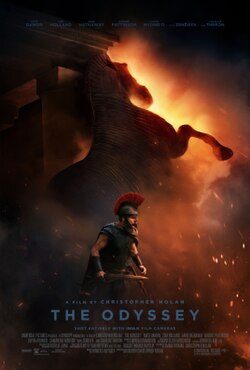
Rich reflects on his truly deranged reaction to the film, after entering a manic state and staying up all night penning a 2500 word rant.
Meanwhile Cam had a nice time at the cinema and gives it a soft seven. Benny liked it too, until he thought about it, and is now hopelessly hung up on whether you can fairly judge an adaptation of something you know so well.
Just after we recorded, Emily Wilson came out swinging with a review in the London Review of Books, in which she shares many of our disappointments:
Nolan’s Odyssey lacks many of the elements that make the poem great. It has nothing convincing to say about time, memory, history, war, or about the relationship between one warrior’s glorious return and the lives of his family, adversaries, comrades, friends and neighbours. It lacks psychological, emotional, political and ethical depth. Its narrative structure is gimmicky. The writing is abysmal. None of the characters has convincing motivation for their actions or words.
Oof. anyway, 7/10
a normal and proportionate reaction
Benny: Wait, can you guys hear me now, or is everything fucked?
Rich: You’re maybe a little quiet now, Benny.
Cam: A little quiet.
Benny: Oh, now it wants me to be louder.
Rich: Oh, your waveforms look tiny. Like a tiny baby.
Benny: I know. Well, now I’m having learned helplessness, because they looked perfect before.
Cam: We could ask Nolan’s team, who just nailed the sound.
Rich: Yeah, that is in keeping, actually.
Cam: Man, you were right, eh? I was blocking my ears.
Rich: Did you take earplugs? I told you. And that wasn’t even IMAX, right?
Cam: No, I should have. It probably varies theatre to theatre, but yeah.
Rich: Yeah, I had hearing loss for days afterwards. It’s just come back, I think.
Cam: Yeah, well, anytime it got close, I just blocked my ears.
Rich: Yeah, I was tied to the cinema seat. Like, I wanted to leave, but I’d instructed my friends to strap me in so that no matter how aggravated I got, I couldn’t walk out.
Benny: Were you annoyed immediately, or did it take a while after the movie finished to gather your thoughts and then become annoyed?
Rich: No, I had a crazy experience. I was seething from start to finish. I don’t know if it was literally from the first scene, but it was certainly within the first five minutes.
Benny: Wow.
Rich: Yeah, I think I entered some kind of manic state. I had a really strong coffee before I went, and then the sensory landscape was very oppressive and claustrophobic, because I went to the IMAX — it’s New Zealand’s only IMAX, and it’s pretty old and shit. The seats are really close together, I was jammed up against other people, I was right up the front in a bad seat so my head was crooked upwards, and the sound was so loud that I felt like I was being brutalised the whole time. So I was just absolutely seething. And then when I got home after the movie I just stayed up all night. I couldn’t sleep, and I wrote like a 2500 word rant.
Cam: You’re at a heightened state, just projecting your bad experience.
Rich: Phoebe was mocking me. She was like, oh yeah, you tell that Mr Nolan. You tell that billionaire Mr Nolan, he needs to hear what you think about his movie.
But no, I had a crazy experience, and I know that it was a totally disproportionate and unfair reaction. I feel like I didn’t watch the movie properly because it so violated my expectations and I just couldn’t calm myself down. So I’m going to watch it again. I’m going to watch it again in like a few months or a year. I’m also not in a hurry to do that, because I don’t think it’s an important or particularly wonderful movie, so I’ll watch it for fun at some point in the future anyway.
So obviously I’ve got tons of criticisms. Benny, you’ve read my blog post. Did you read it already, Cam, or did you want to get it straight from the horse’s mouth?
Cam: No, I’ve seen the title. But now I understand where you’re coming from, I’ll discount everything.
Rich: Yeah, you should. I feel like I was in an altered state. Basically my big beef is it wasn’t a faithful adaptation, is the simple way of putting it. But particularly, he just sort of used the characters and the setting of the book as a vehicle to tell his own unrelated story, which is very heavily in tune with modern sensibilities, modern morality stories, modern versions of what makes for a good masculine hero, and things like that. Which I just find pretty boring and trite. We can get into the detail of that, but I want to hear you guys’ hot takes.
Cam: I’m not as down on it as you are, although I agree. I suppose the main thing is that Nolan’s Odysseus is not quite Homer’s, which I think we’ll get into. But in terms of just the movie experience, I had fun. I was immersed for most of it. I thought actually it started a bit slowly — Rich, you said it was fast paced, which it ended up being, but that first third seemed a little bit exposition heavy and slow. And I talked to people who didn’t know the source material as well, and they were a bit confused for the first while, because there are all these different characters and all this exposition. Then it kind of coheres near the end when he comes back.
We’ll get into how it does or doesn’t stay faithful, or maybe even subverts the original. But I think it is an interesting question of how do you judge a movie. I think it’s probably fair game to judge a movie on whether it does that, but it’s also — given Nolan’s changed it, does that work?
Rich: Sorry, whether it’s fair to judge a movie on what?
Cam: On how faithful it is, or if it subverts the source material.
Rich: Oh, yeah. Let me just say right up front, there’s absolutely no problem with doing an adaptation, and you can do whatever you want with it. I just didn’t like what was done with it, put it that way. I mean, probably I was a bit disappointed to not see it be more faithful as well. But if you’re going to make changes, I just hope they’ll be for the better. And it seems like often they’re for the worse, and therefore it’s disappointing — of what could have been.
Cam: I think my overall take, and this is my take with Nolan in general, is that it’s fine. Nolan’s movies are mostly fine, and they’re Hollywood blockbusters.
Rich: Wait, let’s get Benny in here first before we get too much further. I want Benny’s hot take.
Cam: What’s your rating?
Benny: Yeah, I mean, the issue is I’m not sure if I have any really hot takes. During the movie I was entertained, for sure. As one of you said, it was an immersive experience for three hours, and there were some cool effects, some cool shots.
Then reflecting on it after, I’ve become, I think, more and more dissatisfied with the elements he chose to pull from the original, what he chose to highlight, and his spin on the story — his entire framing device. But I’m still not — I think it’s very hard to do this well. I guess what I’m struggling with is, do I think anyone could have done it that much better? I’m not sure. Would I prefer that no one had done it, just so we left this pristine epic poem unsullied by a sort of subpar film adaptation? I don’t know. I think I’d prefer that this movie be out there.
So as a movie standing on its own, I think it was cool. And it seems to be getting people into the Odyssey, which I think is great. Like, hopefully a bunch of people go read it.
Cam: Yeah, exactly. I think it’s definitely good that it exists.
Rich: I saw some guy reading it on the train in Melbourne today.
Cam: Yeah, I think four of the different translations are on the bestsellers list.
Rich: Shaking your head when Odysseus is committing violence, so that everyone knows that you don’t approve.
Cam: I think it’s cool, and I think the movie was cool.
Homer’s Odysseus vs the Matt Damon character
Benny: Oh, sorry — maybe my one hot take is just, I don’t think it was well cast. I don’t think Matt Damon was a good Odysseus. Basically all of the characters, I didn’t find them believable at all. I think Rich actually had a good line in his essay where he was like, I was watching these characters be themselves on screen. That is how I felt. I couldn’t get past the fact it was Matt Damon or Zendaya or Tom Holland. I think he almost would have been better to just go with unknowns.
Rich: Total unknowns would have been so much better.
Cam: No, I totally disagree with you. I think you want star power. It’s this epic blockbuster.
Benny: And Menelaus as what’s his name? No way, man.
Rich: Yeah, Jon Bernthal. He’s like, listen up, listen up here, Telemachus, let me tell you.
Benny: That was embarrassing. Genuinely embarrassing.
Rich: He’s doing his face and doing all his usual tics. And that scene where they’re stalking the birds, and he’s just swaggering through the garden and firing an arrow off screen while he keeps talking and stuff. It was so fucking silly, man.
Benny: Yeah, it’s so bad.
Cam: Oh man, you guys are real down on it. No, I think you definitely want the star power.
Rich: Okay, whose performances were good? Whose performances were good?
Cam: Okay, well, everyone seems to agree that Robert Pattinson seems to be maybe the best of the lot. And he just seems to be good in everything — it’s kind of funny, the Twilight guy is just everyone’s favourite actor now. People like that line, he’s like, get these beggars out of here, and other lines and stuff.
But I totally agree with you that Matt Damon seems miscast, and this is going to get into Nolan’s Odysseus not being Homer’s Odysseus, because he’s very serious and brooding. My first thought was, well, I’m not sure if it’s Damon’s fault, because I don’t think Damon would have gone rogue and not listened to Nolan. I think Nolan would have gotten him to play Odysseus this way. But then I had this thought — Matt Damon’s kind of always serious. He doesn’t really have this cunning or levity side to him, and so he’s miscast in that sense.
Rich: Are you kidding? Are you kidding me? Matt Damon’s a great actor. The Talented Mr Ripley — he’s literally a con man. A charming, charismatic con man.
Cam: No, Matt Damon’s a good actor, and he was a good actor in this. Mr Ripley’s the one exception, but most Matt Damon —
Rich: Or even, what about the Andy Weir movie, The Martian, where he’s the funny badass?
Benny: I think he’s got you here again.
Cam: No, no, okay. You guys were just saying Matt Damon’s being Matt Damon, and now you’re saying Matt Damon’s Odysseus.
Rich: No, I’m saying it’s Nolan’s fault. I’m saying Matt Damon is a good actor. I’m saying Nolan miscast him and made a boring Odysseus and just didn’t give him much to work with, is my guess, and gave him horrible dialogue.
Cam: Nolan definitely did that. But I had the thought, I think Matt Damon is the wrong casting — and then I kind of thought, who would be the right casting? And one of the issues is there’s not many leading men that aren’t old. Timothée Chalamet, of course he would be bad. He maybe could be the son.
Rich: Chalamet 100% should have been Telemachus. It’s a crime that he wasn’t Telemachus, because he’s the only good young actor. And maybe Jacob Elordi.
Cam: People are kind of discoursing about that with Nolan’s movies anyway — he’s got his new movie and Zendaya’s in it again, Robert Pattinson’s in it. But Harrison Ford as Han Solo, I think — this person who is kind of heroic but also cunning and deceitful, and also just funny and likeable, and likes kicking ass, you know what I mean? He’d be good. I can imagine a prime Russell Crowe. I mean, I’m kind of surprised Christian Bale maybe wasn’t cast, because he’s worked with Nolan before as well.
Benny: You know what? That wouldn’t have been a bad shout, actually.
Rich: I think he would have been probably better for this brooding tough guy Odysseus. I’m less sure about the trickster, emotive, messy Odysseus.
Cam: Before we get into the casting, let’s focus on why Odysseus was different, what problems we had with the themes, but also a particular focus on Odysseus as well.
Rich: I’ll just give my rant, which is that every single character got flattened out and made less interesting, in my view, than their original source text material. Which is kind of okay, because you’re already trying to cram so much into a three-hour runtime, you have to make people more like archetypes. But the one unforgivable person to do that to is Odysseus. And I argue that Odysseus from the Odyssey is not in this movie. It’s just a different guy. It’s just Matt Damon who’s called Odysseus, and he has nothing in common with the Odysseus of the Odyssey except that he’s a badass warrior.
But in every single other respect he’s just a modern action hero type. Like a safe, positive masculinity type of guy who is a badass warrior, but he’s self-aware and self-reflective, and feels guilty about his past, and loves his wife and is faithful to her, loves his child, is stoic and tough and doesn’t reveal his emotions except when it’s socially appropriate to do so, et cetera, et cetera. Like a total Marvel superhero archetype guy in the body of a bronze age hero. As I’ve seen it described somewhere, this movie is wearing the Odyssey and its characters as a skin suit. And that was the thing that made me the maddest by far — Odysseus being such a boring modern hero. And in the end with the suitors and stuff, that was when I was like, oh, for fuck’s sake, this is just ridiculous.
Cam: Let’s get into the suitors later, because I don’t actually know what you mean by that. But otherwise I 100% agree with what you’re saying. I’m less down on it — I think it does kind of work as well. It is a different archetype. I don’t love it, but I don’t hate it.
Rich: He’s internally consistent and coherent, to be clear, with a couple of exceptions that we’ll get to.
Cam: Yeah, I think mostly. There are some exceptions. Well, okay, what do you think the exceptions are? Because even the people I was with — at one point, when he shoots the Cyclops as they’re leaving, it’s kind of like, that’s to create some plot so they’re angry at him and Poseidon’s angry at him. But someone was just asking, it didn’t even fit with his character. They were very confused by that.
Benny: But interestingly, that happens — not with the arrow, but that happens in the book. It’s different, but he taunts him.
Cam: I do want to get to the Cyclops scene in general as well.
Rich: Okay, so it is inconsistent, because they made him this modern morality guy, but then they added a slight tiny flavour — so maybe I overstated it — with a couple of things like that, where they gave us a tiny taste of what the real Odysseus was like. The other key example for me is being tied to the mast for the sirens. This Odysseus is not that kind of guy. He’s a boring-ass guy. He would never do that.
Cam: And he even makes a joke about it in the movie, which felt inconsistent. I think they said, why are you doing that? And he said, because it’s never been done, or something. I can’t remember exactly. Which didn’t really fit with his character.
Benny: Yeah, that was a weird line. I feel like there was a bit of self-reference going on there.
Rich: Yeah, so there was that, and then there was the slaughtering of the suitors, or at least some of them, which undercuts the movie’s revised theme. But we will talk about that — let’s just leave that whole discussion for later. Benny, did you like this Odysseus?
Benny: Yeah, not particularly. I think I disagree with your characterisation of the movie Odysseus as flat and basically just a modern superhero equivalent. I think there is more dimensionality to him in the movie than maybe you’re giving it credit for. But it’s the wrong kind of dimensionality. So it’s not what he’s about in the book.
Cam: What’s the dimensionality? You’ve got to back that up.
Benny: So here’s what I can’t forgive Nolan for in the movie. When he’s on Calypso’s island, Calypso’s keeping him there against his own will, right? So she’s feeding him the lotus plant so that this wipes his memory and gives him this feeling of the utopic vision or something, and sets his mind at ease and just makes him into this perfect sex slave. In the book, of course, this is —
Rich: He’s getting roofied.
Benny: Yeah, he’s getting roofied for seven years. And then, you know, he sort of comes out of it. Also, that whole plotline just doesn’t make sense. All of a sudden she wakes up one day and she’s like, I’m going to set him free and help him get his memory back. The whole thing makes no sense.
Rich: There’s even a line in there where she’s like, I think you’re ready, or something. It’s like, what? After seven years? What the fuck are you talking about?
Benny: Also, there’s been no change to his character in seven years, because you’ve just been keeping him as this adolescent sex — like, the whole thing doesn’t make sense.
Cam: Well, on that as well, I wanted to make that comment. Even just within the movie, in the three hours — even if you just grant that’s fine, we’ll change him, he’ll be guilt-ridden and flawed and stoic rather than the normal Odysseus — there doesn’t seem to be any character development during it. He starts off like that, right from the sack of Troy which happens inside, and he’s just constantly like that in every different episode. And you kind of think all these different episodes would change you a bit. The Cyclops thing maybe would add some humility, or something, if events had been slightly different. Or other things as well, like Calypso’s island maybe even tempts him — in the original, one of the themes is that he’s struggling with not returning home, but overall this nostos, or wanting to return home, trumps that. Which you don’t have. It just kind of seemed the same track the whole time, over the whole three hours.
Rich: Yeah, there’s all those parallels that we found of addiction, you know, the difference between wanting and liking, and having different sub-components of your soul that are pulling in different directions. And again, it’s so much more sophisticated than what we get here, where no, he’s just been captured by this insane or evil woman, depending on how you look at it, and held against his will when of course he wanted to go home.
I love that in the original text he’s sitting on the beach crying, but then he’s also like, well, I’ve got this amazing beautiful goddess girlfriend.
Cam: And Calypso tells him, right? She’s like, I’m so much better than her, look at me, I’m like an angel. And he’s like, you’re kind of right, but it’s my wife. It’s my wife and my home, and I have to go to that.
Benny: He agrees in certain ways. And in the book, the whole point — you’re wrestling with the question of legacy and immortality, right? Calypso offers him the opportunity to be a god and live with her forever. And he’s faced with this question of, do I turn this down? Do I go back to my wife, or do I become a god?
And then he talks to Achilles in Hades, in the underworld, and Achilles says, you know, I chose this short life — a short life in which I’m a hero, in which I’m renowned. But I actually think I made a mistake. I should have chosen the long life of being relatively unknown, but being happy and living forever. And these tensions that are all throughout the actual poem are nowhere in the movie. So some of the central questions that Homer is asking, Nolan just refuses to engage with. And it’s those sorts of things that really piss me off.
Cam: The other big one as well, which we’ve touched on, is this guilt-ridden, burdensome thing that Matt Damon’s Odysseus is going through. And that’s just totally inverting, I think, what Odysseus was like. If anything he was kind of proud of it, and he wanted to show off. He’s not apologetic about the sack of Troy or any other misadventures he goes on.
It’s kind of like — I’ve seen this elsewhere and I agree with it — there seems to be this sort of Christian or Catholic subversion to it as well. It’s almost like he’s a war vet. You can imagine a Vietnam War vet or a War on Terror vet. I think they even mention a couple of times that they’re Trojan War vets, which feels very modern. You can imagine feeling bad about killing that Iraqi kid or something, and being racked with that. But to be honest, I don’t mind that. That’s a coherent story that I don’t mind. It’s not the Odyssey, and I maybe would prefer the Odyssey, but then there’s the question that it is kind of hard to do.
One approach is you just go, okay, let’s just go bronze age morality, and let’s still do that. And that could be a good art house indie film — I think Robert Eggers’ The Northman is kind of that, and that lost money. And this one’s going to make like a billion bucks.
Rich: Oh damn, I was going to use that as an example of how it can be done. Or Mel Gibson’s Apocalypto is the other one I had in mind. And I don’t know if that was commercially successful, but it’s a great film.
Cam: Well, it can be done. That is another one. And that would be a good Odyssey film, but it wouldn’t be a blockbuster. And I don’t hate that this blockbuster is the way that it is.
Rich: But here’s another way of putting it. You’re a gazillionaire, you’ve got a storied career, you’ve got so much financial and social capital within Hollywood. Take a fucking swing. Take a risk. Do something different. I mean, I know that that’s not how it works. He is the guy that he is. He’s interested in the ideas and stories that he’s interested in, and it’s served him extremely well.
And it’s only since watching this film that I’ve seen the comparisons being made that he’s essentially just telling the same story over and over — of a regretful man trying to make up for the errors of his past through some kind of elaborate journey. He sort of just hits the same tropes over and over. So it’s sort of silly for me to say, oh, it should have been other than what it was, because as you say, Benny, at least someone made this movie, which is cool. Someone made this huge, by the looks of it highly successful movie. I haven’t seen the numbers, but I think it’s doing wonderful numbers.
Cam: Yeah, it’s massive.
Rich: So maybe we get more. Maybe this triggers a new cycle of adapting the classics. Maybe we get a new Iliad movie, or an Aeneid or something like that. That would be cool. I’d be fine with that. Or even, maybe it’s easier to get art house versions of this type of film signed off on in the wake of this.
Cam: And I think it’d be okay to like those ones and also this one. They’re kind of different things. One thing I like — and Nolan seems to be one of the few that’s this sort of vestige of the monoculture. Everyone’s going to this movie. People that go to one or two movies a year, if that, they go to this one, and all Nolan movies. Taylor Swift is another example I thought of. That’s a bit more gendered — I mean, Nolan’s a little bit gendered as well — but I kind of like that. I like that we all go, and you talk to people.
I got a voice note — I feel embarrassed saying I get voice notes, I don’t usually get voice notes — but one of my friends gave me a voice note of his take on the Odyssey, and surprisingly he was familiar with the source material. It’s very similar to what we’re saying. Overall he was like, yeah, six or seven, that was still good. Which is kind of my take as well.
nostalgia for Nolan blowing our teenage minds
Rich: Yeah, the other thing to say is they’re good films. Should we just talk about Nolan for a minute? The reason why I had high expectations is that I really like Christopher Nolan’s movies, and I have so much nostalgia and affection for him as a director, because when I was a teenager it was his movies that were the first movies that kind of blew my mind and gave me a sense of what a real movie could be.
Cam: Yeah, they’re kind of gateway movies, aren’t they?
Rich: Yeah, gateway movies, totally. I mean, it was that era as well — the turn of the millennium, when you had all these mindfuck movies like Pulp Fiction and The Matrix and Richard Linklater’s films. That’s what you get into when you’re a teenage boy. Memento was my gateway, and I was like, holy shit, this is awesome. And I watched Following, The Prestige, and then since then I’ve seen every movie of his except for Tenet, actually. And I reckon they’re all good.
Cam: Which people say is trash.
Benny: Yeah, I also don’t want to watch it.
Cam: People tend to say that’s not as good a one. But carry on.
Rich: Okay, well, I was going to say I think they’re all good, with maybe an asterisk for the third Batman one. And some of them are — I don’t want to say great, but maybe very good. In particular, Interstellar. I know that people don’t necessarily love it, but I have such a soft spot for it. It’s like my comfort movie. It makes me cry, since becoming a dad. It’s incredible. I find it incredibly cathartic to watch, and I love the soundtrack of it so much, it brings tears to my eyes.
So I think he’s a good director, and that’s part of what has been confronting about this. A, I had high expectations, and B, I’m now thinking to myself, you know what, I don’t tend to revisit his films. I wonder if they are actually as good as I remember them being.
Cam: I had that exact same thought. But then I even thought, are they particularly not as good on the rewatch as well? Because a lot of them rely on these twists and stuff. Maybe the first rewatch is like, okay, now it makes sense — you know, Inception, you kind of had to go a second time. But when you kind of get it and you know it, and then you want to return, maybe it’s not quite as good.
I mean, the Nolan is actually bad take has actually been around for a while. I remember in my teenage years, I spent too much time on art house film forums and stuff, and they kind of denigrated Nolan a lot.
Rich: Your misspent youth.
Cam: Yeah.
Rich: Other kids were smoking cigarettes behind the bike shed.
Cam: Yeah. I was doing these long DMs to hipsters, film and music reviews. And a lot of them denigrated Nolan, and they kind of convinced me at the time. And a lot of that was true — I think a lot of the criticism was true.
I’m not sure I’d say this, but I even had a failed pickup line. Did I mention that in the group chat?
Rich: No.
Cam: On Tinder I matched with someone, and one of her photos was looking into a mirror, but there were like several mirrors, so it was recursive. And I said something like, oh, your photo reminds me of Inception, without the video game levels and the faceless baddies and someone explaining to me what the fuck is going on. But she didn’t reply to that. But it kind of captured some of my criticism.
Rich: The only thing worse than a guy trying to hit on you by referencing Christopher Nolan is a guy trying to hit on you by ironically, pre-emptively shitting on Christopher Nolan.
Cam: Yeah. But then, I mean, I flipped so much on Nolan that I forget where I land, where I’ve landed, to be honest. I think I came around to actually thinking I liked him.
Rich: But what do you mean? You’ve said that before. What do you mean by that? What do you mean you don’t know?
Cam: I mean, when I first watched it, I was like you as well. I remember watching Memento in this little side room with the computer, back in the early 2000s and 90s — you had a place where you’d go where there’s a computer, which I kind of miss, that you kind of log in and then when you leave it you’re not online anymore. But I remember sitting in this small little room watching it, probably like this line where I downloaded Memento, and I think I was home from school because it was exams or something. And my mind was fucking blown. I was like, this is the best movie I’ve ever seen. I absolutely loved it. And Batman, of course, the Batmans were really cool.
And then I kind of realised — I saw some of this kind of criticism that it’s soulless, and it’s kind of episodic as well. Which this movie is, but arguably the original is as well. But with Interstellar and Inception, you kind of had that, you go to the next world and you go to the next world, that kind of thing. And even Inception is about dreams, and they don’t really deal with —
Rich: You’re going to compare it to David Lynch, right? Yeah, I knew it.
Cam: It did kind of feel like the snow level of a video game, rather than a Lynchian type dream. Exactly.
But then I came around and I just thought, actually, nah, they’re good movies. They’re fine. They’re blockbusters, and they’re clever blockbusters. I think they’re movies that some people think are so incredibly smart, and they’re overrated in that sense — there was that Rick and Morty meme around that.
When I went and watched Interstellar, I watched it — I was a pizza delivery guy — and I watched it with a group, there were like seven of us. And I just remember the face of one of the guys. He was just like, an aura of how genius this movie was. And I was like, that’s taking me out of it a bit. I do remember the day fondly, because everyone was making this joke of having a can of Coke, and they keep making that noise. So I remember the day fondly. But I just remember thinking, it isn’t quite as smart as these guys think it is. But then I’ve come around to think it’s good, they’re good movies. I’m sorry, I’ve ranted a bit too long on Nolan. So I think Nolan’s mostly fine.
Rich: All right. Benny, do you have any relationship with Nolan?
Benny: Not really. I mean, I haven’t thought about him much. I haven’t thought about his oeuvre, to be honest. I’ve seen The Prestige. I actually haven’t seen Memento.
Cam: Oh, it’s good. No spoilers.
Benny: So maybe I should go watch that and check what’s going on. The Batmans were good. The Prestige doesn’t have the sort of episodic nature.
Cam: Nah, it doesn’t.
Benny: But the other movies seem to, right?
Rich: It’s got more the plot twisty, non-linear type stuff to it.
Cam: I’ve got a plot hole question, but I’ll save that because I think we’ll get to it. What were you going to ask, Benny? I think you had a question.
Making Zeus’s law central to the entire plot
Benny: I was going to ask what you guys think of the framing device of the movie. So the movie is all centred around Zeus’s law, right? That’s the thing. And the fact that Zeus’s law is broken, now chaos is eating the land.
Well, actually, I want to ask two things. I want to ask about the representation of the gods — what you guys thought about that. And this framing device of Zeus’s law. So obviously Zeus’s law, otherwise known as xenia in the actual poem, that’s a part of it. But it’s more in the background, right? It’s not causing Odysseus chaos or anything like that. And the fact that Nolan elevated it to this plot device that’s really driving the entire series of events — I’m not sure what I think about that.
Cam: It’s always said to be one of the four or five main ancient Greek — I think they’re the starting chapters of Richard’s book — but the themes of Homer. Xenia always comes up as one of them.
Rich: I couldn’t find a way to work hospitality to guests into my book, actually.
Cam: Well, got to give some credit to Nolan then, man.
Rich: No, I think it’s funny, because as we talked about in our actual Odyssey episodes, it is such a load-bearing virtue of the time, that seems a little funny and bizarre to us — to be so obsessed with treating guests well, stated under the guise of you never know who might be a god in disguise. But I think we established it was really more of a cooperation mechanism for people who had to travel a long way from home, and it was harder to rely on your personal security and gossip and all kinds of other things that we rely on. There’s probably cultural evolutionary reasons for it.
Cam: This is why you think it actually existed in ancient times.
Rich: That’s what I mean. But I think before we touch on some of those, Benny, let’s steelman the move that Nolan’s made by elevating xenia to the central thing. It’s not that it doesn’t have a point to it. The point of it is the Trojan War was the precipitating event that broke Zeus’s law, and then that has rippled out geographically and through time to each subsequent event where the law gets broken. And that becomes the downfall of the Greeks in particular, but the bronze age peoples in general. And as Matt Damon says in the film, our bronze age comes to an end, or something like that.
Cam: Speaking of clunky dialogue.
Rich: And it’s basically like, we have sown the seeds of our own destruction. Which again is not a new trope, but it’s not entirely uninteresting. So I did get that, to be clear. But the bit I didn’t get was setting that up as a parallel to the current erosion of civility and important things that were previously just held to be virtues. And obviously that makes you think of America in particular, the United States in particular, but you could probably broaden it out a bit to the spread of populist politics, both of left and right persuasions.
So my quick take on that is just, okay, sure, but I wish that every piece of media didn’t have to shoehorn in a commentary on our modern political situation. But it does. And then we could talk about whether or not that’s coherent. But you guys react to that — I’m just going to get a beer.
Cam: I mean, I don’t think he shoehorns politics in too much. And I actually think you can read it different ways. He’s definitely commenting on their time being decadent and collapsing, and he probably views that through the lens of now. And you might be worried about that — the West is mistreating others and that’s why it’s declining. But you could also read his return, and getting rid of people that are overstaying their welcome, the other way as well. And killing innocents is bad, but that doesn’t mean we don’t sort out the baddies at home either. So I think there are multiple readings there politically.
But on xenia specifically, I think it actually kind of works, as Rich said. It’s coherent. And as we’ve said, one way that this movie has subverted the original is that it’s kind of an anti-war film in a way, when Odysseus wasn’t really that anti-war. And I know there are kernels of that with Achilles’ regret, but this guilt-ridden nature — that’s inverting it. But this xenia, this golden — it’s often phrased in a way of like the golden rule in this movie, so it’s more kind of Christian-tinged, you know, treat strangers how you want to be treated. But that’s in Homer. Xenia is in Homer, and it does kind of work, I think, and it moves the movie along. So I didn’t mind the focus on it. It really sort of worked.
Rich: It’s very recurrent in Homer as well. Almost every single episode has something to do with whether or not hospitality norms are observed, whether it’s Telemachus visiting kings and noblemen, or Odysseus and his men trying to seek hospitality from the various monsters and groups that they visit. It’s very much all the way through.
Cam: Yeah, that’s why the Cyclops is bad, that’s why the suitors are bad. That’s part of Telemachus’s growth as a man — he’s learning what is right to do. What’s not, I don’t think, is that in the original the sack of Troy has anything to do with that. It’s like, this is a battle against Troy.
Benny: Yeah, I disagree with you guys about this, actually.
Cam: Well, it’s not the only thing. But yeah, I mean, what do you mean it’s not in there?
Benny: Well, no, it’s obviously in it, but it’s just in it because culturally it’s just in the background, right? It’d be like a movie where they go around ringing doorbells. It’s like, okay, yeah, that’s our cultural norm, that you ring doorbells before you go into someone’s house. And you’d be like, well, that’s the major driving force behind the plot. Like, no it’s not, that just happens to be in there because that’s how things work. Yeah, that’s one of the themes, but one among many.
And I think making the entire movie about that one — I think it takes some weird contortions of the storyline, because to make the sack of Troy about xenia seemed weird to me. That seemed like a huge stretch. And I didn’t really buy that. I think there was maybe a way to do it more artistically or more subtly, but to really throw this in your face as the reason that the entire civilisation is collapsing, again, just sort of flattened the actual story for me. Whereas in the poem there are multiple, many interesting things going on.
And maybe it’s back to Rich’s point where, you know, directors feel like to cater to modern audiences you need a single reason why everything is happening. And so he had to find that reason, and he traced it back to xenia. But that makes everything less interesting in my mind.
And then you also have to make Odysseus regretful about what he’s done, right? There’s this weird moment where he sees Athena’s head chopped off in the sack of Troy — the head of her statue — and then he sort of regrets what he’s done. But that regret doesn’t play a big part in the actual Odyssey itself, right? He’s very proud of the plan he came up with to sack the city, and he’s telling people about it, and he wants to be known as the hero of Troy.
Cam: No, yeah, you’re definitely right. That’s not there. And this plastering onto xenia is kind of putting the cart before the horse, because I think Nolan wanted to make this movie about post-war regret and guilt, you know, Christian guilt, Catholic guilt, that he’s struggling with, that he killed innocents. And he’s kind of stuck it onto xenia. It’s like, the reason Odysseus in this world feels so bad about that, which he didn’t in the original, is because they betrayed xenia. But xenia is a theme in the original Homer. I think you understate it a little bit, Benny, but yeah, it’s certainly not the only theme.
Rich: The sack of Troy makes no sense as a precipitating event.
Cam: Another quick plot hole type thought I had around the sack of Troy was — well, one thought, the horse kind of looked cool. But then I had this thought of, because I think they’re meant to make it out of the ships, right, they’re on the beach — they couldn’t have made this perfect horse. The horse in Troy was probably better.
Rich: Why did they leave it in the water? Why did they leave it so that they’re all half drowning?
Benny: Yeah, I know. They’re like drowning.
Rich: Why the fuck would they do that? Why?
Benny: Jesus Christ, man.
Cam: I know. That didn’t make any sense. And then I had this thought — this whole thing, like Matt Damon’s Odysseus having all this trauma, when it was literally just his idea to build the horse. He’s like, we’ve got this stalemate war that’s been going on for a decade, and he comes back in and it’s like, this is the ingenious idea, this is the way to break in. And then as soon as it happens he’s like, oh no, what have I done? Which, maybe that could happen, but it just doesn’t really fit.
Rich: So what’s the chronology? They open the gate — is it right then and there where he’s watching from the gate that he immediately regrets what he’s done, or is it later when they do the montage?
Cam: I think you see it in a flashback, that he regrets it when he’s in there. But yeah, I’m not sure. That would be funny, when the gate opens.
Benny: I mean, I think it happens pretty soon after they open the gates. He sees the Greeks flooding in, and I think he’s like, oh man, what have we done? Which beggars belief.
Cam: What do you think sacking a city was? Vibes? It’s rape and pillaging, man.
Benny: Vibes. Yeah, yeah. I did think the scene of — someone sticks their sword into the horse and it stabs one of them, and then they have to grab his mouth to keep him from screaming. I thought that was a cool scene.
Rich: All the Trojan horse stuff was awesome. Even the opening scene with Elliot Page getting immediately merked. That was cool.
do we like the treatment of the Gods
Cam: Anyway, so you asked about gods. Let’s talk about the feature, or the lack of feature, of gods in the movie, and what do we think of that. I have some thoughts, but I’ll let someone else jump in.
Benny: I mean, I was super excited to see how he was going to deal with this, because I think this is perhaps the biggest question you have to wrestle with if you’re going to direct the Odyssey — which is, what do you do about the gods? Do you make them explicit figures with explicit powers that are explicitly intervening in people’s lives? Do you keep them inside people’s heads? Do you make them real, but just in the background? Do you make it so that the reality is actually being questioned, that maybe they’re just heightened emotions or something in people? There are all these questions that the poem can leave open, that if you do the movie you sort of have to take a stand on.
Although I will say that Nolan in some way doesn’t take a stand on it, which I thought was actually an interesting choice. He does have to in some way — so like obviously Calypso makes an appearance and Athena makes an appearance, but even so, Athena’s just in Odysseus’s head. And Calypso, if you didn’t know better, could have just been this gorgeous woman.
Cam: I liked Tyler Cowen’s quote on Calypso, who reminded him of the kind of chick you might see at a Tupperware party in the Hamptons.
Rich: Yeah, another wild miscasting.
Benny: But I mean, what do you guys think about the reality of Athena?
Cam: It’s like the spinning top at the end, but it’s Athena’s head statue — it just keeps spinning and goes to credits. It was Athena and Matt Damon’s imagination.
Rich: Yeah, true. Honestly, I think he handled it very nicely. I think it was a really good way to do it, and my beefs are somewhat unrelated — which is that Athena is not Athena. Again, she’s just playing some generic good person, like our modern conception of an Abrahamic style god, which has nothing to do with the Greek gods. And secondly, that I didn’t like Zendaya’s performance. Or I didn’t think — probably not her fault, probably she just again got such a neutered role.
But I think it was quite a neat way to do it, and just have the carnage happening to the boats and stuff in response to eating the cattle or pissing off Polyphemus. But I would love to see a version of this with the full pantheon of gods in all their bizarre, arrogant, capricious cruelness. It would be sick.
Benny: Like arguing and sending fucking lightning bolts and stuff, yeah.
Rich: And obviously Athena’s not how I imagine her at all, and I would love to see her come down with her javelin in hand and fight against the suitors next to this Odysseus. But you just can’t do that in the format of this movie.
Cam: I kind of agree. I actually did quite like it. I did see some commentary around — and it happened to be a book I was reading about anyway — have you heard of Julian Jaynes’s book, The Origin of Consciousness in the Breakdown of the Bicameral Mind?
Rich: It’s on the shelf behind me, mate. I haven’t read it though.
Cam: Someone pointed out, I wonder if Nolan had read it, because this is the controversial take that in the bronze age — I think it may have even been pre-bronze age and post-bronze age, but during the bronze age — people didn’t have consciousness in the way that we did. You don’t have introspection, you’re not aware that it’s your own thoughts. Your actions and stuff you view as yours, but any of these conscious thoughts, they interpreted as gods. This is this guy Jaynes’s take, and he does cite Homer as an example.
And it really fits with how Athena is portrayed. Because it’s not really the thing in the film — it’s more like Matt Damon’s conscious all the time, he’s guilty and he has PTSD and trauma, and he’s talking to Athena, and then she disappears when he confesses to his wife. But then there is this ambiguity at the end as well of, was she just the face of this innocent woman that was killed?
Benny: What’s happening? This is sirens, man.
Cam: Attention please. Attention please.
Benny: Yeah, this is that. I can just mute myself.
Cam: But yeah, I think it worked. I don’t think it was necessarily this heretical take. One take is like, maybe it’s godless, but another way, it kind of deals nicely with what it would have looked like if these people actually believed in these gods and stuff. This is one way that it may have looked — you kind of just get so in and out, and you think the gods are talking to you.
Rich: Yeah, and you’re making sacrifices. I wish we would have seen more of how they observed their religion. Again, unfair complaint, because you can’t fit all the stuff in, but just to get a better sense of their relationship with the gods, because you really couldn’t pick up much from the text. You get that five second shot of Agamemnon sacrificing his beautiful baby, and then you get Odysseus sort of somewhat telling off his men for pissing off Hyperion, the sun god. But you don’t get to see the libations and the big feasts and the sacrifices. That would have been cool, even if it was a godless movie, but with more cultural context around what people actually believed to be true.
Cam: Yeah, I prefer — I think in the 2004 Troy movie they removed the gods altogether, and I preferred Nolan’s take, to kind of leave it a bit ambiguous and remove them mostly.
woke casting discourse and post-Christian morality
Rich: Are we going to do the whole stunt casting thing?
Cam: Yeah, it probably feels a little left unsaid, because it’s definitely in there in the discourse.
Rich: I don’t feel the need to dwell on it, but just worth mentioning that for me, it’s funny that it just doesn’t matter at all. It’s not consequential for me, and so I didn’t particularly care to talk about it. It didn’t take me out of it. I don’t think it was anywhere near the biggest issue with the movie. And in fact, some of the diverse members gave the best of the performances. Like, I thought Lupita Nyong’o actually had a very good performance, and also Elliot Page.
And I kind of liked that you had this slightly effete, small, kind of dweeby soldier, because why not? Of course there would be a range of men who go to war. So it also didn’t bother me at all. I’m sure it was a bit cynical on Nolan’s part, a bit of stunt casting, but whatever. It kind of worked. What did you think, Cam, as our token based guy?
Cam: Yeah, I mean, I half agree with you. Page’s character kind of worked — you have this like —
Rich: Say his name.
Cam: Yeah, well, Page’s character worked. This kind of five foot trans, you know, female, weak person. And it worked for Sinon.
Rich: The running.
Cam: Pardon, what’s that?
Rich: The running. It was so funny seeing a person run like that. Do you think he’s trolling?
Cam: Nolan or Page?
Rich: As in Nolan. Nolan, or maybe both, but Nolan.
Cam: No, I think Nolan just likes Page, and I think he had this idea of this weak, small warrior. There are some conspiracies out there that Nolan was going to cast Page as Achilles, and everyone’s like, what — which would have been fucking terrible — and then backed out because of the controversy, and then made this. Which I think is obviously ludicrous. But interesting — Sinon is not an Odyssey character, I think he’s from the Aeneid or something.
But yeah, no, I agree that casting kind of worked, and if anything it was very short, but it wasn’t a problem at all. I also agree with you that Lupita’s performance — and I thought Patel’s performance was pretty good as well. Again, it’s small.
Rich: Is that the — you may ask — god, what’s he called? The Greek guy. Yeah, that was so funny. Did you laugh at that line? And also, was that on purpose?
Cam: That felt very on the nose, because he’s standing next to a black guy as part of a decision. Like, we’re the Greeks.
Rich: Yes. So if people don’t know what we’re talking about, there’s this line where a black guy and an Indian or Pakistani guy are speaking to a man who maybe is actually Greek, or speaking Greek, and they’re like, we’re Greeks. We’re Greeks from Ithaca. And I laughed — and that’s the only time I laughed in the whole movie. And I don’t know if Nolan is trolling there, but if he is, absolute hats off to him, because that is so funny, to rub it in your face like that.
I didn’t mind the relationship between him and Odysseus as well. I would have liked to have seen that develop further.
Cam: Patel’s Eurylochus.
Rich: Yeah, Eurylochus and Odysseus. It would have been cool to see more of that, if anything.
Cam: I know, he was the one guy that we got a little bit out of. All of his crew is otherwise pretty faceless. I definitely don’t — it didn’t derail the movie, and it was fine, but I do notice it. And sometimes it feels a little bit like the emperor’s new clothes, where it’s kind of like, is no one going to say that she’s black? Or having a random East Asian guy on the crew.
Rich: Was there a Korean guy or something as well, wasn’t there?
Cam: I saw a joke about when the sirens played, that’s like when Mr Brightside by The Killers comes on at a wedding — everyone has to get to the dance floor.
Rich: I thought you were going to say like K-pop or something.
I have to admit, though, that if his crew was all African or Chinese or something, then it would have started to take me out of it. So it’s almost like, put in a little bit and it’s fine, but if you —
Cam: Yeah, and then you kind of forget about it. No, I think that’s right. I did have the thought, imagine watching a Kurosawa epic like Seven Samurai, or Ran, 1500s, and there’s just a random black guy, random white guys, just not commented on. It’s kind of odd, but we’re all kind of used to it as well. I mean, this is what the modern West is like, multicultural, and so you just kind of swallow it.
Oh no, we’re going to lose Benny.
Rich: Shit, Benny’s got alarms ringing, he’s got to get out.
Cam: I’ve also seen things like — part of the theme of the movie is how hard it is to travel a pretty small part of the Mediterranean, and then you just randomly have an East Asian guy there.
On Lupita though, I actually thought it did kind of work in this way as well, because she’s the one black person there. She’s very exotic looking, and she’s very striking. I know there’s a little bit of discourse around, you know, Helen’s meant to be the most beautiful person in the world, but she doesn’t have a very classically model look.
Rich: Well, is she though? Because I also saw something like, the Helen of Troy being beautiful thing is a bit of a myth, or something that’s been added onto the story after the fact, and that’s never actually stated anywhere in any of the original stories. It’s just sort of implied.
Cam: That would be surprising, but yeah, sure.
Rich: And also, I don’t know, she obviously is — she’s a Hollywood actor. If you’re a white guy and you’re not attracted to a black woman, okay, that’s fine, but she very much is a good looking woman.
Cam: She hasn’t got a very classical model look. You can imagine her being a model. I mean, eye of the beholder and all that, but she’s not necessarily everyone’s first choice of super hot. But maybe she’s not meant to be super hot like the main one.
Rich: Like Calypso — the reason I didn’t like Calypso is partly because she’s too hot. Like the Tyler Cowen thing. She looks like this very primped and preened, perfect looking American, basically. So it’s just as weird to have this gorgeous airbrushed American.
Cam: She looked very Hollywood airbrushed, yeah.
Rich: I’d rather have some big nose, dark haired, you know, uneven textured Greek queen looking person. Regal looking person. That’s partly why I liked — I think Anne Hathaway has a better physiognomy for a role like that.
Cam: I think Juliette Binoche is well cast in The Return, which I haven’t seen.
Rich: We should watch that too. I’m curious about that now.
Cam: Yeah, it’s funny how that just came out. I did really like the scene, which I don’t think is in the source material, when Menelaus makes the joke about the 500 ships. Because I don’t think she’s meant to be disfigured, right? But I thought that was a good scene.
Just for the audience, the alarm is going off, so we can’t talk. It’s kind of annoying.
Rich: Wait, Benny, put your mic on and let’s see how loud it is. Maybe we can bear it. Turn your sound on, let’s hear it.
Benny: Okay, yeah. Sure, sorry, continue. Fuck, I feel like I missed a lot of good stuff though. I’m pissed.
Rich: No, we were talking about the most boring part, just the race stuff.
Cam: I mean, that’s also worth saying — was the movie too woke?
Benny: I’m trusting you guys. Can you hear that? Attention please. Attention please. We are investigating an alarm condition. It may be necessary to evacuate the building.
Rich: All right, Benny, quick, say something.
Benny: My one take about the woke stuff is that it’s — oh my fucking —
Cam: Doesn’t want to hear it.
Benny: Attention please. Oh, different voice. Attention please. Please leave the building immediately. Oh, fuck. Please leave the building immediately by the nearest exit. I’ll leave the laptop and hope for the best, I guess.
Rich: What do we do? Should we just finish it, or —
Cam: Because we’re almost done. But I do want to hear Benny’s take. Yeah, maybe we pause.
Rich: All right, boys. So Benny wants to move on from the casting stuff.
Cam: Where were we? He messaged us his true thoughts.
Rich: Yeah, as soon as he starts talking, the sirens sound. It’s bloody the UK, mate. It really is an Orwellian police state, isn’t it?
Benny: Yeah dude, they can come bursting through your door and stuff.
Rich: They knew you were about to say something unflattering about a trans person.
Benny: I mean, the one funny thing I think is that insofar as there is diversity or woke casting, they sort of do those characters dirty, right? Like Elliot Page’s character gets killed immediately and is obviously a wuss, and then Helen of Troy is scarred. So I don’t know, again, if that was a purposeful choice on Nolan’s part, but that part’s kind of funny. Almost backhanded.
Cam: Yeah, I doubt it.
Rich: I’d love to know how self-aware he is, right? Because that opening scene where you’re like, okay, here’s Elliot Page, and then immediately — I don’t think he even, does he even get to speak? Or he starts speaking and then the Trojan’s like, you’re dead, fuck you. Yeah, a bit of fan service.
Cam: Elliot Page as Achilles. I mean, the other thing I wanted to say is, casting stuff aside, it wasn’t a quote-unquote woke movie as well, in terms of the themes and stuff. But you could say it was a kind of liberal humanistic movie, or even a Christian, Catholic movie. But yeah, it didn’t feel —
Rich: It’s woke in the sense that all of our modern post-Christian morality is woke. In the Tom Holland sense — your Tom Holland sense, not the Spider-Man Tom Holland sense.
Cam: Non-Spider-Man, non-Telemachus.
Rich: But it’s also funny that conservatives would be mad about that, because they are presumably many of them Christian, at least, if in name only.
Cam: Well, yeah, I feel like there’s kind of a tension there. I’ve had that thought separately as well. There are complaints that ultimately this is kind of a Christian-themed movie. I mean, maybe you could make the argument that it’s post-Christian, more kind of humanistic and still with the kind of Tom Holland-esque baggage of Christianity. But even with that thesis, that secular liberalism is potentially downstream of Christianity, which I kind of buy — then it’s funny in the current culture where they’re kind of opposed to each other, and you get these right wing accounts complaining of the theme, which you could make a fair argument is kind of a Christian thing.
Rich: Yeah, it doesn’t seem jarring to me, because it’s almost a trope that that type of Christian is to not behave in very Christ-like ways. So I guess it’s ironic, but it’s not a new irony or a new hypocrisy.
What did you think about inserting Sinon as a character at all? Because he makes personal what was maybe a bit abstract with the sacking of Troy. You get to hear his personal testimony, and he’s the first guy that you see brutally murdered, and it’s very much Odysseus’s fault. So is that too heavy-handed for you guys? I didn’t mind it personally. I probably would have preferred not to add it, just because there’s plenty of source material that didn’t get enough time, but I didn’t dislike it.
Cam: I think it works, but it works within Nolan’s Odyssey, so you kind of have to buy into a bit of that. It’s like, yes, it’s different, but it’s a coherent approach, and this did fit quite well with that, and was well cast and well inserted.
Rich: It’s also a good fix for the Hades scene. If you’re going to do the Hades scene, you need to condense it down — he chose two voices, basically Sinon and Agamemnon. But in the poem he talks to like every man and his dog. He’s talking to his mum, he’s talking to Achilles, he’s talking to Ajax, he’s talking to Agamemnon. I don’t know, he probably talks to like 10 different people in the underworld. So you’ve got to focus your message.
And also, visually that was really cool. I liked how that was done, because I was wondering, how are you going to show going to the underworld? But it worked. It was a great idea. It was a really cool idea.
Cam: It’s a hard thing to do, right? From a boat.
Rich: And then the only bit that I slightly didn’t like was the run away at the end again.
Cam: I know, that was unnecessary. It was just confusing. Like, why are they running? They were just chatting, and these people were helping them somewhat, saying what to do.
Rich: Yeah, I didn’t understand that.
Benny: It was confusing, yeah.
Cam: I mean, Achilles is probably the big exclusion there, which some purists maybe would complain about, because Achilles is kind of a bridge between the Iliad and the Odyssey.
Rich: But if you think about the movie on its own terms, it didn’t need Achilles. Absolutely not. It’s already got heaps of characters. It’s already probably confusing people.
Half-hearted slaughter of the suitors
Benny: Does anyone have strong opinions on anything else? Like any other scenes, like the ending or anything? What did you guys think about the fight with the final suitors and stuff?
Cam: Yeah, I want to hear Richard expand on that, because I think you said it was shit at the start. Or that it was inconsistent, maybe is what you said.
Rich: It’s inconsistent. So just a reminder of how it goes in the poem: Odysseus is this vengeful, insane god, basically. He wants to kill every man and woman, and he has no mercy whatsoever. And even from the poem’s point of view, you get the sense that, oh, he kind of got a little carried away here. And he has a pretty strained relationship with Telemachus, a strained relationship with Penelope, who he does in fact suspect and forces through his weird paranoid tests and stuff.
So, being the Matt Damon good guy character who is feeling really guilty about kicking off the cycle of violence and planting the seeds of ruin amongst their civilisation, et cetera, et cetera — it’s very jarring for him to stick to the slaughter of the suitors plan, where it begins in the same way as the poem. He gets them all unarmed, bars the doors, and then tries to murder every single one of them. And then the concession that he makes is to stop halfway through and be like, ah, you know what, that’s enough, the rest of you can live, kind of thing. But it’s almost like the worst of both worlds.
Cam: Once they had a few spears in the back.
Rich: I think he shoots that guy just straight in the neck. He just starts murdering them, and it doesn’t make a lot of sense with the way that Nolan was trying to take that character at that point in his arc of regretting violence. And it’s like a school shooting style mass murder.
Cam: Yeah, it’s kind of funny. I mean, one way of putting it is, he spends this whole movie brooding and burdened by war, and then he comes back and — the way to somewhat reconcile it is that he’s got this corrupted Zeus’s law and xenia, and then you come back and all these suitors are doing that very thing. That’s why they’re set up, I think, for the audience to feel like he’s justified. And sure, maybe it’s too much, but he’s justified to some extent — these are bad guys who are abusing Zeus’s law and abusing xenia, within the context of the film.
Also, I didn’t mind the whole Liam Neeson old guy Taken sort of superpower strength, just fucking some shit up aspect to it.
Benny: Although, I don’t know if it was Nolan’s directing, or maybe just Matt Damon’s getting old, to be honest. But I thought — well, the bow, but just his movements while fighting. It wasn’t cinematically fun to look at. He looked like he was old and needed a stretch or something. He seemed slow, he seemed sore.
And maybe that was the point. He’s had this long journey home and he’s weary and he’s exhausted, and now he’s taking on these guys. But in the poem, you know, he gets glistened up by Athena and he’s this super strong magical warrior, and all his movements are liquid smooth, and he’s handling these guys like it’s no big deal. But in the movie he’s taking fricking arrows in the back and he’s stumbling around. It was just a bit less majestic of a fight scene than I thought it could have been, maybe.
Rich: The choreography of that scene seemed bad to me as well.
Benny: Choreography, that’s what I was looking for.
Rich: It didn’t feel convincing to me. I mean, he really had a challenge in front of him, because if you’re not going to do the godlike intervention powers, how do you make it seem plausible that one guy kills a hundred men, or however many, single-handedly? Because obviously it’s like, they’re surrounding him with spears, just fucking stab him or whatever. They spent so much time on that scene, and it didn’t feel realistic.
Also, am I remembering wrongly, or didn’t Telemachus fight side by side with him in the poem?
Cam: Yeah, he did.
Benny: Telemachus is such a pussy. Holy smokes. Unbelievable.
Rich: I hate Telemachus in this movie.
Benny: I know.
Rich: He’s worse than in the poem somehow. I never imagined that.
Benny: It’s unreal.
Cam: I think maybe the reason why Odysseus made sure Telemachus wasn’t involved is, within the movie, it’s like he was almost like, I’ll fall on my sword for this, because then I’ll go do self-imposed exile and leave. But all these suitors need to go, like, including me perhaps, because I’ve now — maybe it’s just my sin in Troy, but including this. You stay pure and you’ll lead the thing. Which, as we know, the exile does not happen in the book.
Rich: But that didn’t work either, because he undercut that as well — because Telemachus did kill one guy.
Cam: Well, he had to sort the weapons out, right? He had to do something.
Rich: Yeah, so he still — I mean, he saved him from committing mass murder, but he didn’t keep blood off his hands. He still made his son kill someone. So even that doesn’t really make sense.
Cam: Well, you didn’t see that happen.
Rich: But also, it pissed me off so much that he would just cheerfully hand his kingdom over to this boy who doesn’t even know anything, and then sail off into the blue yonder in self-imposed exile.
Cam: Boomers. Boomers go retire in the RV or something. It’s hard not to separate it from it being different, but I didn’t necessarily hate that either.
Benny: I’m about to get kicked out of this room, so I’ve got to go find a different room.
Cam: I think fortunately we’re coming to a bit of an end, right?
Rich: I’ve got to bounce too. Right, high energy ending. What do you got? We need one last big argument.
final ratings + has book club ruined our ability to enjoy things
Cam: Let’s see. I don’t think we necessarily want — we can wrap up. So Richard thinks it’s four out of ten, updated in a few years. I think I’d give it a soft seven.
Rich: Soft seven. Similar to my penis.
Cam: Sorry, I just bought some fucking tulips at the moment, and they’re all limp, falling over the vase. Telling me something. And the missus made a joke about it, and then she’s trying to make it really clear, she’s like, like a penis. I was like, you don’t need to say like a penis. I got the joke.
Rich: What do your normie friends think of this? Cam, what did Ellen think about it?
Cam: I haven’t talked to too many other people about it. How about yourself?
Rich: I’ve only talked to the two people I saw it with, and they were like, oh yeah, hard to film a big story like that, but we thought it was good, kind of thing. They enjoyed it. They probably gave it a seven or an eight out of ten.
Benny: Yeah, I’m finding it tough to give it an actual rating, to be honest. I really go back and forth about how you should evaluate it — like just as a movie on its own, or compared to the poem.
Cam: You were particularly stuck on comparing it to the poem. Beat for beat, this is not what happened, there’s no way.
Benny: I am. It’s hard not to, right? Even if you tell yourself, I’m just going to evaluate it as a movie on its own, I’m not sure I’m not sort of bringing along memories of the poem regardless.
Cam: Yeah, our rating is, the book was better.
Benny: Like, my claims that the casting wasn’t good — I’m not sure if that would be true if I wasn’t evaluating it against the poem, right? Like, if you’d just seen the movie and you’d never even heard of the poem, would you think the acting wasn’t good? I’m not sure.
Cam: Yeah, I agree.
Rich: Actually, that gives me one last talking point that maybe we can end on. I was thinking about my insane reaction to the movie, and the fact that people who weren’t familiar with the Odyssey had a totally different reaction and just had a good time. And I’ve been wondering if there’s a negative side effect of our journey that we’re on, trying to read quite challenging and complex stories — which is that it’s raising the quality bar for us, both in the case of an adaptation of something that you’re actually very familiar with, or just in general. Like, maybe we’re actually getting some taste, and that unfortunately makes it a bit harder to enjoy things.
Have you guys noticed that at all since we started this? So maybe it’s harder to enjoy TV shows that other people like, or movies, or popular books. I’m a huge TV snob. I don’t like almost any TV shows now. I don’t know if it’s because of this exactly, but that’s something that’s happened to me. And then with this I’m like, what is wrong with me? I should be having fun like everyone else. Maybe we should quit. We’ve got to quit book club.
Cam: I don’t know, I did have fun. So I still watch a lot of lowbrow shit.
Benny: Yeah, me too.
Rich: Okay, that’s a me problem.
Benny: I’m a big philistine when it comes to the TV and stuff. If I get into analytical mode, book club mode, then sure, I can find a bunch of flaws with things. But it’s easy for me in some ways to turn that off and just sort of enjoy.
I guess the Odyssey’s been sort of an exception to that, where it was really hard. I think because I was anticipating it so much, and because I was excited about it precisely because we had read it, it was maybe hard to escape that mode. But for other things, yeah, I’m quite easy to please when it comes to TV and movies.
Rich: Okay, that’s good.
Cam: Yeah, I think there’s — I’ve seen this meme where this guy looks like a monk or something, the cartoon drawing, and he’s like, I’m not going to see the movie, it’s going to be shit. And then it’s like, there’s a billion in the box office, and he’s like, a billion minus one. I’m holding out.
Rich: I’ve got people in my comments on my blog post review saying things of that nature, where they’re the hardcore purists — like, they make me look tame. They’re like, I’m not going to let it sully the true vision of the Odyssey that lives in my head, kind of thing.
Actually, I’ll take a moment, quick plug: so I pretty much moved to Substack now, and I’m going to be posting there. My Odyssey review is blowing up, so come on over, give me a follow.
Benny: Is it?
Cam: Oh wow.
Benny: Let’s go.
Cam: Hey, I was the first to like that.
Rich: Cam, yeah, but you’re in at the ground floor, man. That was a good investment on your part.
Benny: Oh dude, it is blowing up. Let’s go. Hell yeah. This explains some stuff, because I got a bunch of follows in the past couple of days and I was like, what’s going on? I think they’re just being recommended, because I think you have me recommended, so if they follow you —
Rich: Oh, that auto-recommend thing, yeah.
Benny: Yeah, I think they’re just coming over from the second order follows from your first order follows.
Rich: The network effect works, man. Cam, you’re probably getting — I got you on there too, even though you never fucking write anything.
Cam: I know. I’ve got no voice anymore.
I saw one of the first comments — and I had seen a bit of this, that Emily Wilson has critiqued it. I mean, not super strongly, but she’s just pointed out how it’s kind of different and doesn’t have glory in it. But there is this, not to be too meta, discourse about it. It’s kind of this funny thing where, you know, there’s all that controversy which we touched on a bit in our episode about her translation, around her potentially defacing the Odyssey and stuff like that. And so she’s this symbol of doing that for many people, and then she’s coming out and saying that Nolan did that very thing. Which I know is the title of your essay, but it’s funny how she’s come out and kind of said that as well.
Rich: Yeah, I was quite gratified to see that comment, that what she says sounds similar to my criticism. You can go have a look on the blog if you want to see it, but she clearly is not particularly impressed by the movie.
Cam: Deep dish.
Rich: Yeah, it’s called The Deep Dish. Come give me a follow, and we’ll get back to our regular programming with books. Write in to us at douevenlit@gmail.com. D-O-U, just the letter U, then evenlit@gmail.com. We’d love to hear from you. We’d love to hear your Odyssey take. And otherwise we’ll see you in a couple of weeks for — what?
Benny: Ah, we’re doing Herzog by Saul Bellow.
Rich: Yes, that’s right. Yep.
Cam: And if you liked the movie, or if you liked our conversation about the movie, you should go and read the book. Any translation.
Benny: And then listen to us talking about the book.
Cam: And listen to our podcast about the book, about Emily Wilson’s translation.
Rich: And then go on YouTube where our video is, and go argue with the idiots in the comment section there. Oh, did you guys see that? I was going to read some of those out, they’re pretty funny. But some other time.
Benny: I mean, this is the perfect episode to do it for. The thing is, to do it for anything else is going to be weird.
Rich: Nah, sorry, I can’t do that right now. They’re not that funny, they’re just stupid. They’re just idiots.
Cam: They’re just dumb.
Rich: No, these are not our fans. These are YouTubers. They’re drive-by, they’re casuals. But all of the comments are completely misinterpreting what we’re saying. They’re like, thank god someone gets it, this lady butchered a classical work of art — it’s one of the most upvoted comments. And then the comment underneath is like, did you watch it? They did not. They actually do not.
Benny: Yeah, you probably just didn’t watch it at all. Just commented. That’s too funny.
Rich: No, they didn’t. Basically almost no one watched the video, but they just came and commented.
Cam: I feel a bit bad for Nolan with Emily Wilson criticising it, because I think he probably read a bunch of translations. Apparently he was in love with it when he was a teenager. Which perhaps feels all the worse, that he quote-unquote butchered it. But he’s definitely going to read Wilson’s critiques and feel a bit bad about it.
Rich: But imagine how Wilson feels. As you said, she’s been considered the poster girl for butchering the Odyssey. She would need to almost distance herself from it, to avoid — because I’ve seen some retarded rightoid tweets being like, it’s because it’s based on the Emily Wilson translation, she poisoned it. And it’s like, no, you’re a fucking idiot, it’s bad for totally unrelated reasons. It’s got nothing to do with Emily Wilson’s translation.
Cam: I think she’s pretty sanguine about it. She’s just like, it’s a big Hollywood movie.
Rich: But they’re blaming her for it, so of course she should criticise it, or just be honest about it — which I’m sure is just her honest opinion. Imagine you’re a classicist. Imagine how strongly she must feel compared to me, who’s read it twice.
Cam: To be honest, I think her and most classicists I’ve seen are pretty level-headed as well. They’re just kind of like, yeah, there are some parts where it falls down, but overall it’s cool that there are adaptations of it.
Rich: But do you not think in their heart of hearts they’d love to see a true cinematic — like, they’d love to see their headcanon on this? Surely they’re passionate about it, they must.
Cam: I think that’s right, but there have been lots of adaptations as well, which I’m sure they have watched all of them. There was like a TV movie in the 90s. There’s an Italian four part series that I think covered it quite well, in the 70s or the 80s. And The Return, of course.
Benny: I mean, we’re ripe for another single season, five or six episode Odyssey TV series.
Cam: But they should wait a few years, right? I don’t think you should do it straight after this one comes out.
Rich: We might get it. I’m kind of excited anyway. We’ve got to do the Iliad. I’m hyped for the Iliad now. We should bump that up the queue.
All right, I’ve got to go to bed. Later, homies.
Benny: Yeah, let’s do it soon.
Cam: All right. Good to see you guys.
Benny: All right, boys. See ya.